Showing 730–738 of 1179 resultsSorted by latest
-
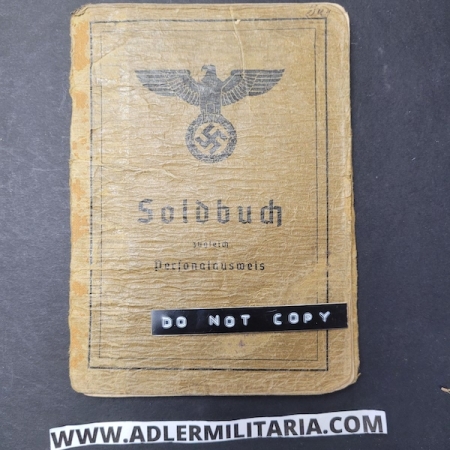
Wehrmacht Soldbuch – Uffz Büttner – Panzer Armee Afrika – DAK – Tobruk & Tunis! (HOLD)
$320.00Heer Soldbuch issued to Johannes Büttner, born in 1919. His Soldbuch was opened in 1940, by a Communications training unit. His frontline unit was: Panzer Nachrichten Regiment 10 (Panzer Armee Afrika) The Panzerarmee Afrika then advanced on El Alamein. There, in July 1942, the first battle for El Alamein took place, which ended in a stalemate. This stopped the German advance and put Panzerarmee Afrika on the defensive. At the end of August 1942, the Battle of Alam Halfa followed, the last German offensive in Egypt. The offensive had to be abandoned on September 6, 1942 without success. On October 23, 1942 the 2nd Battle of El Alamein started. The British troops succeeded in pushing the troops of the Afrika Panzerarmee back into the Fuka area. On October 25, 1942, Panzer-AOK Afrika was renamed German-Italian Panzer Army. On November 8, 1942, British-American units landed in the Vichy-French colonies in North Africa. Due to the new war on two fronts, the troops of the Panzer Army had to give up Tobruk on November 13, 1942 and Libya at the end of January 1943. The army finally withdrew to Tunisia, and the High Command of Army Group Africa was formed there on February 23, 1943. Awards: Africa Cuff-title Italian German Campaign Medal Büttner was captured in Africa, what happened to him after we do not know.
-

Forced Labourer – Frenchman Marcel Labatut – Killed in Berlin 1945 – German Helmet Liner Production (Sold)
Marcel Labatut, was of French nationality born in 1921. He was working for Reinhard Schulz, Tezett Werk in Berlin Tempelhof and also for Biedermann & Czarnikow in Berlin Friedrichshain. Labatut lived in the D.A.F Johannisthal Larger. He was killed on a raid on the 26th of February 1945, in the Eldenaer Strasse 25. It was a place to stay for workers of the firm in Friedrichshain (S-Quartier). The company made items labelled: RB Nr. 0/0256/0038, the new standard for company names making war goods from 1943 on. An attempt to hide where items were manufactured on the home front. The firm, well known for its factory in Litzmannstadt, today Lodz Poland. The company had moved a production plant to the location in order to profit from the cheap labour and used Jewish prisoners en route to the extermination camps such as Auschwitz. Labatut was found among the dead, according to the document dated 8.3.1945 on his person were the work papers and identity card which was later returned to the firm. The raid was one of the largest killing thousands it had left around 80,000 people homeless. This item is featured in a book on Berlin 1945 (Release date Summer 2022). Summary Very rare item, never seen another civilian set like this for Berlin 1945. The fact that he was making helmet parts is also fascinating.
-
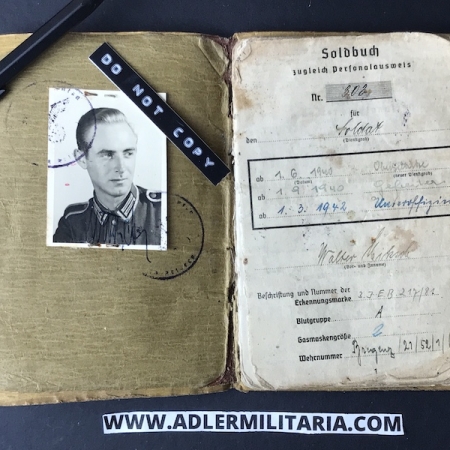
Heer Soldbuch – Uffz Miksch – z.b.v 179 (79 Volks Gren Div) – Wounded in France 1940 – 4 Awards! (Hold)
A very nice Wehrmacht NCO Soldbuch. It would seem that Miksch was resourceful acquiring a spare Soldbuch Cover he attached it on top of his combat worn one (not denazified). Soldbuch was opened in November 1939. Miksch served in the following front line units: Infanterie Regiment 246 ( 88 Inf Div) The 88th Infantry Division was set up on November 11, 1939 to December 1, 1939 as a division at the Grafenwoehr training area. The division was formed from personnel from military districts VII (Munich), XIII (Nuremberg) and XVII (Vienna). The division was equipped with Czech equipment and weapons. The 13th companies of the infantry regiments were initially heavy grenade launcher companies. In mid-January 1940 the division was relocated to the Upper Palatinate. In mid-May 1940, the division moved to the Trier area as OKH reserve and marched from there from May 16, 1940 through Luxembourg and northern France to the Marne. On June 12, 1940, the division experienced its baptism of fire here when crossing the river in the Dormans – Trekop area. The division then pursued the retreating French units as far as the Loire. After the end of the western campaign, the division remained on the Loire in the Bourges area until July 1 and then returned home. It was on the 12th as described in the history, that not only was it the units baptism of fire in France, Miksch was hit by a bomb splinter in his upper right arm. He would rejoin the unit again, but was injured once again this time the other arm, a bullet went through breaking his bone. The actions at the time were the Kursk area of Russia : On July 3, the division forced the passage over the Kschen and then advanced on Alekseewka. On July 5th the division advanced on Mount Olympus. The advance of the division ended here for the time being, and it went into the defence. It would seem that sometime during his hospital stay, or when back with his new unit he had an accident (34 Wound Code), although this accident was with a weapon as it was listed also as a 31a (bullet wound). He would spent till the end of 1944 in hospital. March 1945 z.b.v 179 (79 Volks Gren Div) The last unit he would join just before the war ended again back on the Western front! March 1, 1945, the division settled on the heights on the west bank of the Kyll on both sides of Malbergoft. After fighting on the Ruwer, the division was blown up on March 18 on the march between Idar-Oberstein and Baumholder by a combined attack by air and tank units. The remaining parts of the division settled in the north-western edge of the Palatinate Forest and from there to the Rhine. The division’s new task was to set up a reception position on the western bank of the Rhine to accommodate the remnants of the 1st Army retreating through the Palatinate Forest. On the night of March 24, 1945, the remainder of the division was moved across the Rhine and disbanded there. The remnants of the division were combined to form a corps blocking group.On March 28, the remaining staff of the division received from XIII. SS Army Corps gave the order to transfer to the Jagst. There a surprising attack by the enemy was to be prevented with the help of stray soldiers and the Volkssturm. Awards: Wounds Badge in Black – France 1940 Iron Cross Second Class – Kursk Infantry Assault Badge Eastern Front Medal Summary: A lucky man, he survived both fronts and three woundings. He is not listed as MIA or KIA, and he was probably captured in late March early April.
-

Heer Soldbuch – Feldwebel Worofsky – Gebirgs-Jäger-Regiment 99 (1. Gebirgs-Division) – Shot in Poland 1939 – Iron Cross (Hold)
Very nice Soldbuch with leather cover/pouch. It was Issued just before the war broke out to Richard Worofsky, who was assigned to: Gebirgs-Jäger-Regiment 99 On September 5, 1939, the regiment crossed the German-Polish border from Presov in Slovakia, east of the High Tatras, without enemy interference. On September 6, 1939, there was no contact with the enemy either. There was also no significant resistance on the push forward, so that marching performances of up to 60 kilometers per day were possible. On September 11, 1939, the road junction Sambor was captured. To the west of the Grodek strait, three Polish divisions were encircled, which were broken up by September 18, 1939 It would seem that Worofsky was hit here by a bullet, breaking his bones on his left upper leg. It would take him close to two years to recover from his wounds. After he joined a GJ Training unit, where he worked till the end of the war. There is a red X although it was likely a result of cancelation at the end of the war as he is not listed as Killed in Action. He was awarded the following medals: Iron Cross Second Class Infantry Assault Badge Wounds Badge in Silver In summary, a rare Soldbuch due to the fact he was wounded during the Polish campaign quite badly.
-

Heer Wehrpass – Obergefreiter Bauer – Infanterie Regiment 270 (93 Inf Div) – GESTAPO – KIA – 4 Medals! (On Layaway)
A large grouping of IDs for Obergefreiter Bauer. He worked for the Gestapo in Saarbrücken for around 1 year between 1937/38. He was on active duty in the Wehrmacht with: Infanterie Regiment 270 (93 Inf Div) After the completion, the division moved to the Saar-Palatinate to secure the western border. At the beginning of the western campaign, the division remained in its positions and took part in the breakthrough through the Maginot Line to Epinal in June 1940. After the French campaign, the division was given leave of absence from August 26, 1940 to February 14, 1941, with the exception of the regular troops. After the division was recalled, the division was relocated to France as an occupation force. After the start of the Russian campaign, the division moved to the Eastern Front at the end of June / beginning of July 1941. The division marched through Wesenberg, Narva and through the Luga position as far as Leningrad. From October 1941 to March 1942 the division was at the Oranienbaumer Kessel. In May 1942 the division moved to the Wolchow and Tigoda north of Lake Ilmen, where heavy trench warfare broke out. From August to November 1942, the division was then used on Lowat southwest of Cholm. Bauer was hit in the head by a splinter and was killed as a result. His awards: 1. Infantry Assault Badge 2. Eastern Front Medal 3. War Merit Cross with Swords 4. Iron Cross Second Class Included are many of his other ID papers, including the Kennkarte of his widow.
-

Heer Wehrpass – Gefreiter Dietrich – Jäger Regiment 75 ( 5 Jäger Division) KIA 1944 (Sold)
Heer Wehrpass for Gefreiter Dietrich He was enlisted and sent to mountain troops training. Dietrich was serving on the frontline with: Gebirgsjäger Regiment 144 ( 3 GJ Division) These defensive battles lasted until March 13, 1944. On March 7, 1944, the retreat on Novo Sergeevka began. The 3rd Mountain Division was outflanked by enemy units and was able to break through to the Bug by March 18, 1944. There the division was deployed in the area from Tschitschekleja to Dimitrijewka. On March 29, 1944, the company “Alphabet” began, setting down on the Dniester, which meant a march of 300 km within 12 days. But the regiment suffered heavy losses and basically only existed as a combat group. Wounded in August of 1943 with a grenade splinter. He was awarded the wounds badge as a result. After a long stint in training and recovery he joined the fight again with: Jäger Regiment 75 ( 5 Jäger Division) Heavy defensive battles followed in the area around Kovel and in the Pripjet area as well as retreat battles over the Bug and the Narew to the East Prussian border. He was killed on the 25.10.1944 in Narew, and is listed as buried as an unknown soldier in the German Archives
-
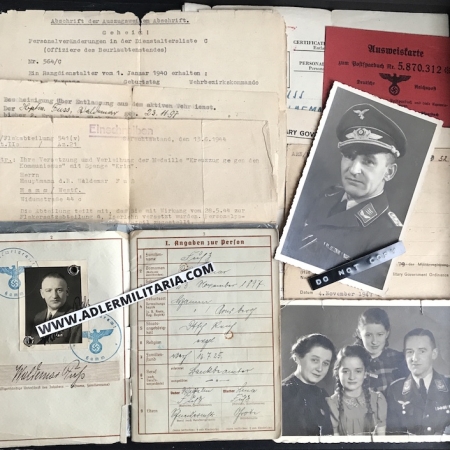
Luftwaffe Wehrpass – Hauptmann Fuss – Flak Abteilung 541 ( 15. Flak-Division ) – Nice Portrait!
Early Wehrpass issued to Waldemar Fuss, a world war 1 veteran he already had a considerable amount of medals from WW1. Some: EK2 – WW1 Wounds Badge – WW1 Annexation Medal War Merit Cross Second Class Medal for the Campaign against Communism with the ‘Krim’ Pin He served the majority of the war with: Flak Abteilung 541 They fought under both the : 17th and 15th Flak Divisions In Russia, Rumania. He also served on the home front, and ended the war with 240 Days in contact with enemy air raids! This group comes with all his capture papers and some wartime documents, also includes two nice photos. One of which is portrait size and wearing his Officers Visor.
-

Heer Wehrpass – Gefreiter Gores – Grenadier Regiment 117 (111 Inf Div) – Sad Last Letter – Letter to family – KIA 1943 (Sold)
Heer Wehrpass to Gefreiter Gores, from Düsseldorf. Grenadier Regiment 117 ( 111 Inf Division) After crossing the bow, the division marched via Dubno, Kiev and the Dnieper to the area east of Poltava. From June 1942, the division took part in the advance into the Caucasus. The advance of the division went via Shakhty, Rostov, Novorossiysk, Krassnodar and Armavir to the Terek near Mozdok. From January 1943 the division then withdrew over the Kuban bridgehead to the Mius position near Taganrog. In the second half of the year, the withdrawal continued via Uspenskaya, Melitopol to the Nikopol bridgehead. In March 1944, the division moved to the Crimea, where it was used at Dschankoi, in the Sivash bridgehead and in Sevastopol. In a last letter to his wife, he wrote how he wished it was all a dream and that he could come home to be with her and the kids, and that she should stay strong. A sad letter to read, in clear German. A letter from the company commander gave the news to her a few months later that he was killed in action.
-
Sale!

Baustab Speer Dienstbuch – Rottenführer Firlus – Berliner – Einsatzgruppe OT Russland Süd – Larger Eichkamp
Original price was: $275.00.$245.00Current price is: $245.00.Hard to find Third Reich ID for a member of the Baustab Speer! In the camps “foreign” or forced laborers from occupied territories, e.g. Poland, also prisoners of war, but also “unworthy of defense” Germans, e.g. homosexuals, politically persecuted, “half-Jews” and towards the end of the war also concentration camp prisoners from all countries had to work According to the protocols of the Wannsee Conference of January 20, 1942, they should also be murdered in principle. In some cases, they were also temporarily housed there for onward transport to other areas of operation, e.g. to France (see above). There were residential barracks in which, in some cases, entire families of “foreign workers” with children who, as evidenced by medical records found, were forced to work, were also housed, as well as work barracks – also for women, e.g. sewing rooms for “Eastern workers”, sick barracks and shielded prison camps. After evaluating a flight image, there were 18 standardized barracks in the center of the Eichkamp camp with around 2,000 people – around 100 per barracks – including guards. He also served with OT Russland Süd behind the frontlines in southern Russia. It would seem he was dismissed in November 1943 in Berlin Grunewald


