Showing 748–756 of 1269 resultsSorted by latest
-

Heer Soldbuch – Uffz Ames – Artillerie Regiment 134 (134 ID) – Close Combat Clasp – Iron Cross Second Class – Assault Badge – Berlin 1945 (Sold)
Wehrmacht Soldbuch – Ernst Ames MISSING Pages 1 – 4 Awards: CCC Bronze, Black Wounds Badge, Assault Badge, Iron Cross Second class, Eastern Front Medal. Issued: Various weapon systems, P.38 Pistol and a winter uniform. Wounded: shot in the chest with a bullet and survived in January of 1944. On healing he seems to what seems to be sent Landeschützen Batl 3 – in Berlin in 1945. Although he was captured in the West by US Troops so he somehow made it out. Ames was NCO in Artillerie Regiment 134 (134 Infanterie Division) Divisional History From 21 On May 1st, the march to the staging area took place, which ended around June 5th. The division then advanced to the Bug about 45 km north-west of Brest-Litovsk. On June 22nd, the day the war against the Soviet Union began, the 134th Infantry Division crossed the Bug near Mielnik. Army Corps. While the 134th Infantry Division faced only evasive opponents in the first days of the war, between June 25 and 29 it was involved in heavy fighting in the Nowy Dvor, Porozow, Podorosk, Lyskow area. After a brief rest, the division started its advance through Belarus on July 4th. The bulk of the division was initially able to advance to Slutsk on the runway. In mid-July, however, the advance stalled because before the XXXXIII. Army Corps Marching LIII. Army Corps at the Berezina met strong enemy resistance. The 45th ID fought and struggled through the Pripet swamps about 110 km south of the 134th ID at this time (15th July Turov). From mid-July to early August 1941, the 134th Infantry Division moved to the area south of Bobruisk, where it had to fend off Soviet counterattacks. The division’s front gradually expanded from Glussk to Parichi to 50 km to the east. The southern neighbor, separated by the huge swampy areas between Pripet and Berezina, was the 45th Infantry Division. Between August 11th and 14th the two divisions interacted for the first time in the Schazilki/Yakimowskaya Ssloboda area on the Beresina. After crossing the Berezina, the 134th Infantry Division continued to the east and crossed the Djnepr at Streschin and Zhikhov. The division then advanced on Retschiza from the north, while the 45th Infantry Division came from the west and crossed the Dnieper at Bronnoje, just south-east of Retschiza. Towards the end of August the paths of the two divisions crossed between Retschiza and Gomel. While the 45th Infantry Division crossed the Ssosh just south of Gomel, the 134th Infantry Division crossed this river at Sharpilovka on August 26 after clearing the Dnieper-Ssosh angle. The subsequent southern swing of the two divisions in the direction of the Dessna was already part of the introductory operations to the Battle of Kiev. On September 8th, the 134th Infantry Division took Tschernigow against tough enemy resistance and then advanced in a southeasterly direction. The 45th Infantry Division crossed the Dessna on 9 September with lively Russian air activity and now also attacked to the south-east. On September 14th the armored spearheads of the Genobst meet. Guderian of the North and of the Comb. Kleist from the south around 150 km east of Kiev and close a huge pincer around 5 Soviet armies. And now the infantry is being hurried, the 44th, 45th, 62nd, 79th, 111th, 134th, 168th and 298th Divisions are tasked with clearing out the great pocket. On September 20th the 45th Infantry Division received orders to accelerate from the Priluki area to reach the Jagotin narrows. The 134th Infantry Division initially advanced to the south-east. Since September 21, both divisions have been subordinate to the LI. Army Corps of the 6th Army and are, so to speak, on loan to Army Group South. The heavy fighting that followed, which lasted until September 29, was characterized by desperate Soviet attempts to break out using four armored trains on the Kiev-Poltava railway that ran through the theater of operations, as well as ruthless infantry attacks. While the 45th ID attacked mainly from the east (Jagotin) to the west (Berezany), the 134th Infantry Division pushed into this area from the south-east and south. After several local crises, the Battle of Kiev ended in a heavy, but not decisive, defeat for the enemy. The 45th ID and 134th ID returned to Army Group Center, the new target was Moscow. Hitler and his OKW believed that all you had to do was march – a serious mistake! Both divisions were now under the Higher Command XXXIV, whose task was flank protection to the south and south-east for the 2nd Panzer Army. From September 30, both divisions marched off in a north-easterly direction. The route led via Priluki, Konotop, Putiwil to the Krupez/Rylsk area, which was reached around October 8th. In this area remained the divisions, torn wide apart, stuck in the mud until mid-November. Because on October 7th the first snow fell and until roads and paths became drivable again, they initially turned into morass. Apart from fighting with a stronger group of enemy forces that broke out of the Bryansk pocket between October 15 and 18. no major combat operations took place during this period. From November 7th we can finally go on again, but without winter equipment for people, weapons and vehicles and this at temperatures of already minus 20°C. The 134th Infantry Division now took a more northerly course, reached Dmitriev around 14 November with IR445 without contact with the enemy and then turned east towards Fatesh. From Fatesh the division advances to the north-east and comes into contact with combat again at Droskowo (36 km west-northwest of Livny). The opponent is thrown and on 25.11. Livny taken. The HK XXXIV now ordered its two divisions to target Yelez as their next target. The boundary between the two divisions – 134th ID on the left, 45th ID on the right – was the Ssossna. The 134th Infantry Division fought its way through Tschernowa, Schatowa, Kasaki to the area west of Jelets. Against increasing enemy resistance, the 45th Infantry Division advanced from Rylsk south past Livny, via Dubrowa, Krugloye, Strelezkoye into the area south of Yelez. The distance to the right neighbor, the 95th Infantry Division, was already more than 30 km. On the 4th/5th 12th, against bitter enemy resistance, 134th Infantry Division took the western and northern parts of…
-

WW1 German Miliärpass – Gefreiter Wilhelm Kühne – Infanterie-Regiment Prinz Friedrich der Niederlande (2. Westfälisches) Nr. 15 – Iron Cross – Wounds Badge – Verdun
Gefreiter Wilhelm Kühne Medals: Iron Cross Second Class 30.4.1918 (Western Front), Wounds Badge . 14.5.1918 Born in Prussia, joined in 1913 a replacement unit, before being posted to: Infanterie-Regiment Prinz Friedrich der Niederlande (2. Westfälisches) Nr. 15 Wounded Once with the above unit in Niewka (Eastern Poland) in 1914. After his recovery in hospitals across Germany, he was posted to: Reserve Infanterie Regiment 218 and a short switch to Niederrheinisches Füsilier-Regiment Nr. 39 Wounded with a bullet to the head in Lapole. The 47th Reserve Division initially fought on the Western Front, entering the line in October between the Meuse and Moselle and remaining there until late November, when it was transported to the Eastern Front. It fought in the Limanowa-Lapanow in December 1914 suffering heavy casualties and Gorlice-Tarnów Offensive in 1915. In May 1917, it returned to the Western Front, and occupied the line near Verdun. In 1918, the division fought in the German spring offensive, breaking through at St.Quentin–La Fère and fighting on to the Montdidier-Noyon region. It later saw action in the Second Battle of the Marne. The division was in Lorraine when it was disbanded on August 2, 1918. In 1917, Allied intelligence rated the division as a mediocre division. In 1918 it was rated second class, and it was noted that its strength had been allowed to diminish without replenishment, leading to its dissolution. He was discharged from the Army in late 1919.
-
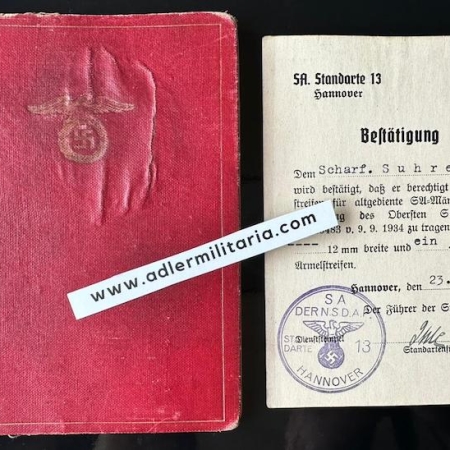
NSDAP Membership Booklet – 1927 Issue – NSDAP Zellenleiter Heinrich Suhre – Hannover – SA Standarte 13 (Sold)
A very nice early (rarely found 1927 issue) Issued to Heinrich Suhre, from Hannover, born in 1.08.1909 and joined the NSDAP in August/October of 1930. The booklet was issued on the 24th of August 1931 in Munich and features a stamped Adolf Hitler Signature. Suhre paid his NSDAP membership from 1931 till 1940 the booklet displays each corresponding payment to the Nazi Party. —- According to page 22 of the booklet the entry states that from January of 1931 till the 1st of May 1932 – Suhre was the rank of Zellenleiter for Hannover – South. The original political rank of Zellenwart was used to supervise local Nazi political leaders during a time when the Nazi Party was attempting to gain power in the Weimar Republic. After the establishment of Nazi Germany in 1933, the political position of Zellenleiter became a type of political strongman and was usually the highest Nazi official that the general population would have direct dealings with on a day-to-day basis. Uniform of a Zellenleiter below: Suhre was also a member of the Sturm Abteilung : SA Standarte 13 Hannover . Interestingly, this Standarte in Hannover is covered online in the article about where they used to meet and was known as a local for clashes with Communists and Workers: KREUZSTRASSE: SA STURMLOKAL – A TAVERN WHERE THE SA MET “Situated at Kreuzkirchhof, the “Zur Kreuzklappe” restaurant, which opened in 1887, enjoys a very dubious reputation in the 1920s and, it being on the fringe of the local red light district, is frequented by criminals and prostitutes. Even before 1933, the tavern was renamed “Restaurant Alt-Hannover” and becomes the notorious meeting place for SA-Sturm 3/13. The owner advertised himself as a PG (a “Parteigenosse”, i.e. a party comrade) and SA man. Within the Hanoverian workers’ movement, they still use the tavern’s old name but with just a slight change: “Haken-Kreuzklappe” [Hakenkreuz = swastika]. According to the social democratic newspaper ” Volkswillen”, it is the “worst dive in Hanover”. At the beginning of 1932, the newspaper repeatedly alleges that Nazis are organising “regular police patrols” against political opponents from his pub. The same happens on Ascension Day in 1932 in neighbouring Calenberg Neustadt: an SA-Sturm stationed at the “Duvestübchen” [a pub] on Duvestrasse engages in a street battle with left-wing workers in front of the pub and surrounding streets. Three of them are wounded, some seriously, by gunfire. When the police arrive, the handguns have vanished.” Included in this booklet is a loose but very rare document issued by Hannover SA Standarte 13 – Hand signed signed by Standartenführer August Ihle (seen below in the middle of the Picture). The document allows Scharführer Suhre to wear the “Ärmelstreifen für altgediente SA-Männer” which is a 4mm armband only worn by long serving SA Men – this document is quite rare. What happened to Suhre? He joined the Wehrmacht in 1941, married and was later captured by US Troops. According to the Genealogy research his grave is located in Hannover, Stöckener Friedhof. He died in February 2008 at 98 years old. Comments: An interesting booklet, usually these are quite boring in terms of history, the average party member did not serve as a Zellenleiter this makes this one quite interesting, along with the SA service in Hannover paints a picture of the political chaos of the time.
-
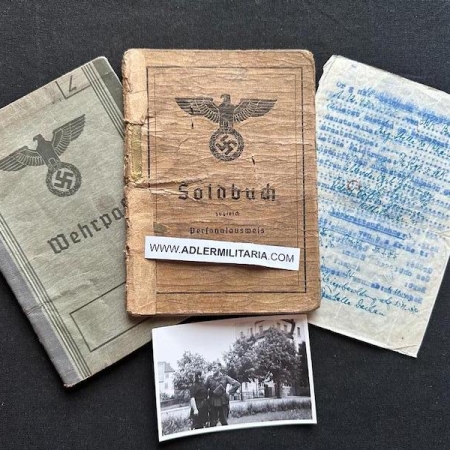
Soldbuch & Wehrpass – SS Unterscharführer Paul Löffler – SS Panzer Regiment 3 – Tank Mechanic (Sold)
Soldbuch issued to Paul Löffler (Second edition), displays him in the front cover in the Waffen SS Panzer Wrap with Totenkopf Skull with the rank of SS Unterscharführer. The Soldbuch was issued in December of 1943 with the Werkstatt Kompanie, of SS Panzer Regiment 3. He had served in the unit since this date and Issued: 11.1944 – Winter shoes and a winter vest 98K Rifle & Luger Pistol P08 as well as a Erma MP in June of 1944. Führergeschenk – type of moral boosting parcel, with often meat, smokes and other goodies. Security Stamps: Three security stamps all signed by SS Officers. Awards: 30.1.1943 – War Merit Cross with Swords Second Class 30.1.1945 – War Merit Cross with Swords First Class Wounded on the 17.2.1945 – arrived at SS Feldlazarett 504 with a code 14 (STD) he just had a 10 day leave prior according to his leave – Sonderurlaub – realised on the 31.3.1945 and back to the unit. The Wehrpass Issued in tübingen in 1940, according to the entries, Löffler joined the SS Panzer Ersatz Abteilung in August of 1942 in Weimar – Buchenwald. He was sent in September to the end of the war with SS Panzer Regiment 3 – Wekstatt Kompanie Löffler was trained on the MG34, K98 and MP. He did a training how to be a tank mechanic in Friedrichshafen. His Battle Calendar displays he was in France from November 1942 till early 1943 on the Atlantic Coast with the Totenkopf Division. Divisional History: In February 1943 the division was moved back to the Eastern Front as part of Erich von Manstein’s Army Group South. The division, as a part of SS-Obergruppenführer Paul Hausser’s II SS Panzer Corps, took part in the Third Battle of Kharkov, blunting the Soviet offensive. During this campaign, Theodor Eicke was killed when his spotter aircraft was shot down. Hermann Priess succeeded Eicke as commander. The SS Panzer Corps, including the division, was then shifted north to take part in Operation Citadel, the offensive aimed at reducing the Kursk salient. It was during February 1943 that the 3rd SS Panzer Regiment received a company of Tiger I heavy tanks. The attack was launched on 5 July 1943 with the II SS Panzer Corps attacking the southern flank of the salient as the spearhead for Generaloberst Hermann Hoth’s 4th Panzer Army. The division covered the advance on the left flank of the II SS Panzer Corps, with the SS Division Leibstandarte forming the spearhead. With the advance slower than had been planned, Hausser ordered his II SS Panzer Corps to split in two, with the Totenkopf crossing the Psel River northwards and then continuing on towards the town of Prokhorovka. In the early morning of 9 July, 6th SS Motorised Regiment Theodor Eicke attacked northwards, crossing the Psel and attempted to seize the strategic Hill 226.6, but failed to do so until the afternoon. This meant that the northern advance slowed and the majority of the division was still south of the Psel, where elements of 5th SS Motorised Regiment 5 Thule continued to advance towards Prokhorovka and cover the flank of the Leibstandarte. By 11 July, elements of the division crossed the Psel and secured Kliuchi. In the afternoon of 12 July, near the village of Andreyevka on the south bank of the Psel, the Soviet forces launched a major counterattack against Regiment Thule and the division’s battalion of assault guns during the Battle of Prokhorovka. Elements of the division engaged lead units of the 5th Guards Tank Army, halting the Soviet advance and inflicting severe damage to the Soviet forces, but at the cost of the majority of the division’s remaining operational tanks. While the II SS Panzer Corps had halted the Soviet counteroffensive, it had exhausted itself. Citadel was called off on 14 July. Along with the SS Division Das Reich, the division was reassigned to General Karl-Adolf Hollidt’s reformed 6th Army in southern Ukraine. The 6th Army was tasked with eliminating the Soviet bridgehead over the Mius River. The division was involved in heavy fighting over the next several weeks. During the July–August battles for Hill 213 and the town of Stepanovka, the division suffered heavy losses, and over the course of the campaign on the Mius-Front, it suffered more casualties than it had during Operation Citadel. By the time the Soviet bridgehead was eliminated, the division had lost 1,500 troops; the Panzer regiment was reduced to 20 tanks. The division was then moved north, back to Kharkov. Along with Das Reich, Totenkopf took part in the battles to halt Operation Rumyantsev and to prevent the Soviet capture of the city. The city was abandoned on 23 August due to the threats on the German flanks. In October 1943, the division was reformed as a Panzer division. The Panzer battalion was officially upgraded to a regiment, and the two motorised regiments were given the titles “Theodor Eicke” and “Totenkopf”. The division, along with other Axis formations, continued its retreat towards the Romanian border. By November, the division was engaged in fighting against Red Army’s attacks over the vital town of Krivoi Rog to the west of the Dniepr. Warsaw In January 1944, Totenkopf was still engaged in heavy defensive fighting east of the Dniepr near Krivoi Rog. In February 1944, Totenkopf took part in the relief attempt of German troops encircled in the Korsun Pocket. In the second week of March, after a fierce battle near Kirovograd, the Totenkopf fell back behind the Bug River. Totenkopf took up new defensive positions. After two weeks of heavy fighting, again alongside the Panzer-Grenadier-Division Grossdeutschland, the Axis forces were retreated to the Dniestr on the Romanian border near Iaşi. In the first week of April, the division received replacements and new equipment, including Panther tanks. In the second week of April, Totenkopf took part in fighting against a heavy Soviet Army attacks towards Second Battle of Târgu Frumos. By 7 May, the front had quietened…
-
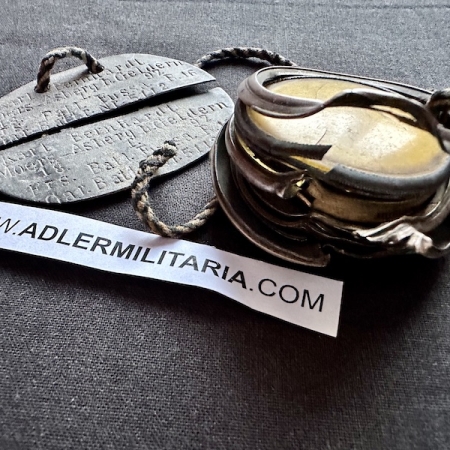
WW1 German Solders ID Tag and “Battle-damaged” Pocket Watch – Karl Bernhardt – Ers.Batl Fuss. Gar. Batt Nr 5112 –
Incredible little group. The battle damage likely deflected shrapnel or a bullet. The German Dog Tag is marked with: Karl Bernhardt Born: 12.1.1897 Unit: Ersatz Batl Fuss Gar Batt Nr 5112 Research shows that Karl Bernhardt survived the war and died in his hometown of Moers in 1966 of ill health. Watch: Incased old watch, was hit and opened, his name and date of birth matching the tag are engraved inside the watch. When we took this apart to show you the internal system of the watch it began to move. We have a video of it and will be given to the next owner…
-

WW1 German Officers Goblet – Winter Battles 1917 in Latvia – I.Pomm.Feld Art Reg No 2
Nice original WW1 800 Silver Goblet Named to Lt Deetjen Of the: I. Pomm Feld Artillerie Regiment Nr 2 They fought in Winter of 1917 with the 3rd Division on the Daugaupils Front. Silver cup was found in a sandy bunker near Riga by a metal detector.
-

WW2 Red Army Soviet Identification Booklet & Medals – Klimov Ivan Grigorievich
Original Red Army Soviet ID Booklet with picture and medals. Medals: Military Merit and Victory over Germany Medal These are extremely hard to find with an original picture inside. Belonged to: Klimov Ivan Grigorievich who was a rifleman guard in various near frontline airbases. He is also mentioned in the Russian Archive website. Nice little set to complete a display.
-
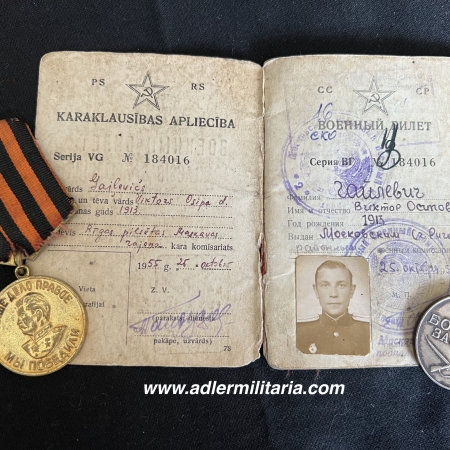
Soviet Red Army Guards Latvian Identifcation Booklet with Medals – Gailevich Viktor Osipovich
Red Army Identification for a Guards Officer (issued in 1955) for a WW2 Veteran of Latvian decent. He fought from 1941 till 1943 as a rifleman in a Sapper Unit, injured in combat in 1942, he was later discharged due to injury. He won the awards: Victory over Germany and the Military Merit Medal. Nice little set for a Latvian fighter in WW2.
-
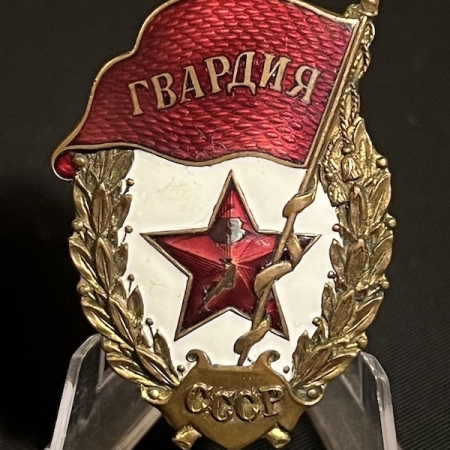
Estonian Made Red Army Guards Badge
An original made Estonian Red Army Guards Badge These are extremely hard to find. The former factory of Roman Tavast, a pupil of the well known Russian jeweler – Faberge. Therefore, all insignia made for RKKA in Estonia are famous for their quality. End of war or early postwar made badge. The screwback is marked: Roman Tavast – Tallinn . The badge is made of copper and covered with gilding. Story behind Roman Tavast Roman Tavast was born in Tallinn in 1895. He was born into a fisherman’s family. Tavast graduated from Niklasen’s 4-year private school and studied engraving as well as goldsmithing in E. Treder’s workshop. He had also worked for the goldsmith Julius Lossman, learned the art of gilding, and later completed courses at an art school. He graduated from evening high school to get a general education. Tavast then started his independent activities after the Estonian War of Independence. In 1920, Roman Tavast had provided himself with a one-seater goldsmith’s workbench, and in 1921, a wire rolling machine. In 1923, at the age of 28, he opened his own independent company for the production of badges, medals and other honors and awards – VMT Roman Tavast. Following the occupation of Estonia and the creation of the Estonian SSR in 1940, the factory and the residential building with the store were nationalized in 1940. Karl Johanson was appointed as the new director of the factory. Roman Tavast worked as a technical manager at the factory until June 1941, when he was deported to the Vorkuta camp system in the Russian North. Roman Tavast was sentenced to death and shot in 1942 in Sosva, Sverdlovsk Oblast, Soviet Union


