Showing 739–747 of 1269 resultsSorted by latest
-
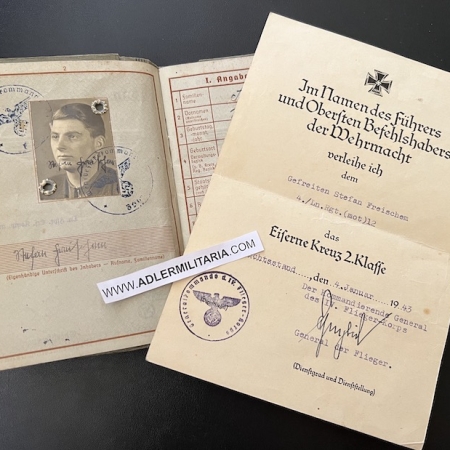
Luftwaffe Wehrpass – Gefreiter Stefan Freischem – Luftnachrichten Regiment 12 – Iron Cross Certificate signed by Gen Kurt Pflugbeil (HOLD)
Luftwaffe Wehrpass opened in Bonn in 1940, to Stefan Frieschem from Cologne Germany. Served with Luftnachrichten Regiment 12 (IV Flieger-Korps) A nice battle calendar, according to research he fought in the following ares: Service: 5.40 operated under IV. Fliegerkorps and VIII. Fliegerkorps (mainly in Belgium) 6.6.40 at Fourmies 4.41 left Luftgau-Kommando Belgien-Nordfrankreich for Poland 22.6.41 in Radom-Warzaw area, under Luftflotte 2 8.11.41 II./12 moved to Wien (rest/refit), and mid-12.41 to Greece (later returned to Russia) 6.42 in Charkow-Kursk area 6.44 in Germany 1.12.44 in Wien (Stab), with I. Abt. in Gratwein/Graz, II. Abt. in Pfaffenhofen/Budweis and III. Abt. in Wien-Hütteldorf 1.2.45 in Königstesten/Tulln (Stab), with I. Abt. in Gratwein/Graz, II. Abt. in Schöbritz/Aussig and III. Abt. in Marksuhl/Eisenach (all under 8. Jagddivision) Iron Cross Certificate signed by Gen Kurt Pflugbeil Please remember: FREE TRACKED SHIPPING
-
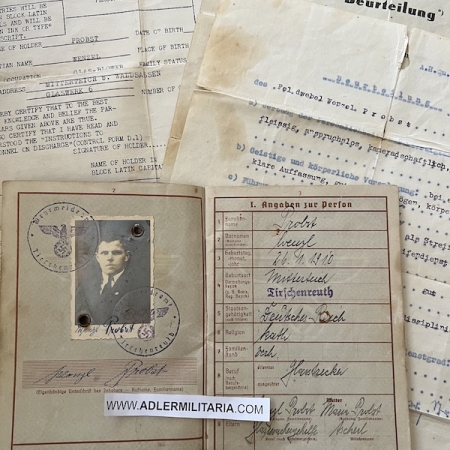
Heer Wehrpass – Feldwebel Wenzel Probst – Streifendienst – Kettenhund – Feldgendarmerie – Large Battle Calendar (Sold)
Probst was active in the German Army since 1934 with Infanterie Regiment 20. Medals: Sudetenland Medal, Infantry Assault Badge, War Merit Cross with Swords Second Class Service with: Infanterie Regiment Amberg 20 Infanterie Regiment 260 Infanterie Regiment 268 Sicherungs Regiment Russworm Sicherungs Regiment Seidel Sicherungs Regiment 30 Gruppe Heeresstreifendienst beim Panzer Armee Korps 4 Wehrmacht Streifen Lehrabt According to his impressive battle calendar, Probst was a very experienced soldier. What was the Heeresstreifendienst? https://www.lexikon-der-wehrmacht.de/Gliederungen/Ordnungstruppen/HWS.htm The Feldgendarmerie, which was primarily intended to monitor military order and discipline, was only able to a limited extent to monitor the soldiers due to its ties to large units and command offices. In addition, large areas of the German sphere of influence were not covered by local command posts (home war zone, parts of the occupied areas under civilian administration), so that initially there was hardly any control. In November 1939, these phenomena gave rise to the establishment of the army, air force and navy patrol services, which were combined on February 1, 1941 under the leadership of the OKW to form the “Wehrmacht patrol service”. The patrol units set up in 1940 as individual patrols or patrol companies by the respective command authorities were combined from 1941 into army patrol groups (later Wehrmacht patrol groups) and train guard departments. The task of monitoring the behavior of the individual soldier in public was later joined by the requirement to look after the soldiers by setting up refreshment stations, warming rooms, overnight accommodation, washrooms, etc. at railway junctions at home and in the occupied territories and at other places where suddenly strong concentrations of individually traveling soldiers appeared. For this purpose, the patrol services were then coupled with the organs of Wehrmacht travel (transport service offices, front control centers) and the mobile or stationary care facilities. Comments: A very interesting role in the German Army, these guys were most feared by their own men, as the war went on they had ever more power to make decisions about deserters etc. Not often found such units. Comes with two reports on his behaviour as well as his western capture papers (discharge).
-
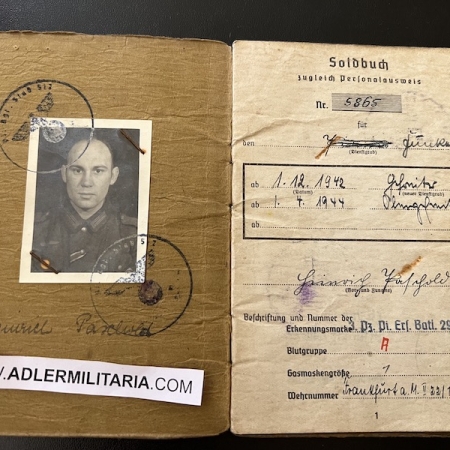
Wehrmacht Soldbuch – Obergefreiter Paschold – Volks Pioneer Brigade 47 – Iron Cross Second Class – Captured by US Army
Soldbuch issued to Heinrich Paschold from Frankfurt Germany, issued in 1942 with a pioneer unit. Awards: Iron Cross Second Class with the 251 Infanterie Division 06.1943 He served with various Pioneer units, Pioneer Batl 750 Pioneer Regiment 512 Heeres Pioneer Brigade 47 (47 Volksgrenadier Division) Unit History The 47th Volksgrenadier Division was raised on September 17, 1944 in Aarhus (Denmark) to replace the destroyed 47th Infantry Division by renaming the 577th Grenadier Division. In addition, the remains of the 47th Infantry Division were incorporated. Half of the division’s personnel came from the Luftwaffe and the Kriegsmarine, with another third from fresh enlistments aged 17 and 18. The rest of the division consisted of older cohorts with Eastern experience. The training of the division suffered from a lack of equipment, some of which could only be made available when the division was transported away. From November 8, 1944, the division was loaded and moved to the Rurfront in the Düren area. During a heavy Allied air raid on Düren on November 16, in which the city was almost completely destroyed, the division suffered its first casualties. Part of the division staff was destroyed. Although the division was actually deployed in the West Wall, it was thrown into the heavy defensive fighting during the 3rd Battle of Aachen in battalions when it arrived at the unloading stations. The division had to replace the bulk of the 12th Volksgrenadier Division and parts of the 275th Infantry Division in the Scherpenseel – Schevenhütte (Stolberg area) section. Heavy defensive fighting ensued around Hamich, Hastenrath and Scherpenseel. The last two towns were lost on November 18, Hamich on November 19, with the division suffering heavy casualties. Wenau was lost on November 20 and Heistern on November 21. The strength of the grenadier regiment dropped to 230 men. All grenadier regiments only had combat group strength. On November 21, the remnants of the division were merged with the remnants of the 12th VGD into one battle group. On November 27, the remaining remnants of the division were transferred to the Wollersheim–Vlatten area (near Zülpich) for refreshment. After the start of the American attacks on the Rur-Inde position between Lucherberg and Merode in the direction of Düren, the 47th Volksgrenadier Division had to replace the 3rd Parachute Division on the night of December 9, 1944. The replacement that arrived on December 8 could only be integrated insufficiently. Deployed in the Düren bridgehead, the division again suffered heavy losses. On December 14, the remnants of the division received orders to cross over to the east bank of the Rur, what she did on December 17th. On December 30, after various refreshments, the division still had a combat strength of 3,051 men. In the fighting on the Maginot Line, the division had to take over the front section of the 21st Panzer Division. In the following weeks she was used in the moder section. On January 16, 1945, the division was relocated with all parts south of the Bienwealdes. From there, the division took part in the last battles of “Operation Nordwind”, the German offensive in Alsace and Lorraine, from January 20, 1945. On January 28, the division received orders to replace the 25th Panzergrenadier Division, which was to be transferred to the east, on the Moder. At the beginning of March the division went back to the West Wall fighting. On March 18th the division was in the Alzey area. On the night of the 25th March 1945 the remnants of the division moved to the east bank of the Rhine. The fighting strength of the division was 830 men. It was refreshed with the remains of other troops. On March 29, 1945, French units crossed the Rhine near Germersheim in the area of the 47th Volksgrenadier Division and formed bridgeheads there. The division was too weak to be able to prevent this. On March 30, the remnants of the division delayed the American advance between Schwetzingen and Hockenheim im Hardt. On April 1, 1945, the division was the last association of the LXXX. Army corps withdrew from the Rhine plain and retreated to the south-east. On April 8, 1945, the division was deployed as the right neighbor of the 16th Volksgrenadier Division along the Enzufer. To withdraw the LXXXX. Army corps in the Swabian Alb, the 47th Volksgrenadier Division had the task of going back to the Ludwigsburg – Leonberg line on April 19th and 20th, in order to bridge the gap between the LXXX. and the LXIV. secure army corps. But already on April 21, the Allied forces succeeded in encircling the LXXX. Closer Army Corps. The combat group of the 47th Volksgrenadier Division managed to break out through the encirclement in the direction of the Swabian Jura. The combat group then built up a base-like front in the Grabenstetten – Neuffen area. On April 24, the battle group was able to cross the Danube to the east, where it was crushed. Remaining units came to the Tyrol area until the end of the war, where they were taken prisoner by the Americans. Volksgrenadier Division had the task of going back to the Ludwigsburg – Leonberg line on April 19 and 20, in order to bridge the gap between the LXXX. and the LXIV. secure army corps. But already on April 21, the Allied forces succeeded in encircling the LXXX. Closer Army Corps. The combat group of the 47th Volksgrenadier Division managed to break out through the encirclement in the direction of the Swabian Jura. The combat group then built up a base-like front in the Grabenstetten – Neuffen area. On April 24, the battle group was able to cross the Danube to the east, where it was crushed. Remaining units came to the Tyrol area until the end of the war, where they were taken prisoner by the Americans. Volksgrenadier Division had the task of going back to the Ludwigsburg – Leonberg line on April 19 and 20, in order to bridge the gap between the LXXX. and the LXIV. secure army corps. But already on April 21, the Allied forces succeeded in encircling the LXXX. Closer Army Corps. The combat group of the 47th Volksgrenadier Division managed to break out through the encirclement in the direction of the Swabian Jura. The combat group then built up a base-like front in the Grabenstetten – Neuffen area. On April 24, the battle…
-
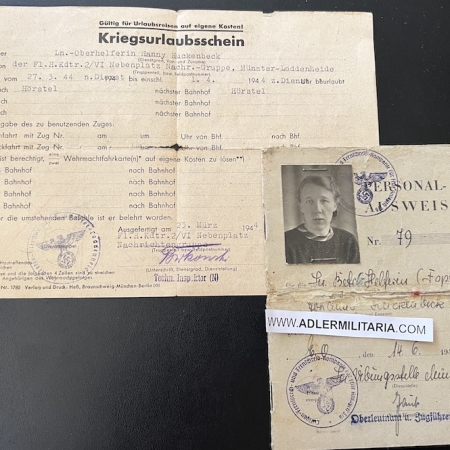
Personalausweis – Ln-Oberhelferin Hanny Huckenbeck – Blitzmädel in Luftnachrichten Regiment 6 – War Merit Cross with Swords 1944
A nice small group to Hanny Huckenbeck She served as a Blitzmädel from 1940 through to the end of the war. Interesting entry that she was awarded the KvK with Swords in 1944
-
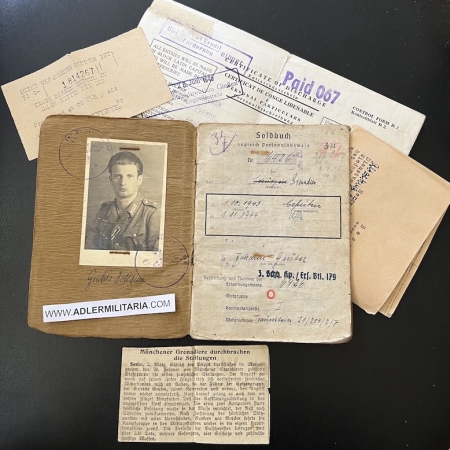
Wehrmacht Soldbuch – Uffz Johann Gruber – Grenadier Regiment 19 “List” – Iron Cross & Wounds Badge – Italian MP. (Sold)
Soldbuch issued to Johann Gruber in 1942. Rarer Unit: Known as “List”, this unit was the unit Hitler had served in during WW1, this is a sought after unit. Medals: Iron Cross Second Class and Wound Badge in Black for Code 31a Issued : Camo Net, Italian Machine Gun!!! Unit History Infantry Regiment 19 and the 7th Infantry Division . The regiment had been in the Gshatsk position since the winter of 1941/42. On March 3, 1943, the regiment began to retreat to the Buffalo position, the so-called “Buffalo movement”. The new positions were reached on March 22nd. Due to the shortening of the front, the 7th Infantry Division was taken out of the front and loaded onto the trains to Orel in Yelnya. After a Russian incursion in the new operational area at the 25th Panzer Division , the regiment was thrown to the front immediately after unloading and to the 12th Panzer Division, which was also under pressure commanded. After the Russian attacks in this area could be repelled, the 7th Infantry Division was taken out of the front and deployed against partisan formations in the area of the Bryansk Forest (“Operation Zigeunerbaron”) in the area north of Lokot. During the heavy fighting against the Partisans were raised by the regiment of several forest camps. At the end of the operation, Desna was reached on June 4th and crossed it on June 5th. The division then moved to the Kromy area in order to prepare for the German summer offensive on Kursk (“Operation Zitadelle”). On July 5, 1943, the attack of the 7th Infantry Division began from the north on Kursk. Heavy hand-to-hand fighting ensued in the well-developed Russian positions. By evening the regiment was able to take Tureika. After a few more successes, the attack was stopped on July 9th, from July 11th the regiment switched to defense. During the night of the 16th-17th, the regiment broke away from the front and slowly retreated to the starting positions it had occupied before Operation Citadel began. These positions were reached on July 18. For the further retreat, the regiment was briefly subordinated to the 72nd Infantry Division . With this division, the regiment made the retreat to the Hagen position. After reaching the Hagen position, the regiment rejoined the 7th Infantry Division. This was taken from the front on August 9th and moved to the Lokot area by August 14th to rest here. On August 22, the regiment was alerted again and marched to the Sevsk area behind the front. When the Russian full-scale attack broke out on August 26, the regiment was placed alongside the 251st Infantry Division pushed to the front. By September 30, 1943, after heavy fighting, the regiment was down to one company strength. By September 25, the regiment retreated to the Dnieper via Novgorod and Kolmy, which was crossed at Lyubech. The regiment moved into new defensive positions. From October 15, Russian attacks began again across the Dnieper. On October 21, the III. Battalion to a Russian breakthrough that almost completely wiped out the battalion. On October 22, the 7th Infantry Division began to withdraw to the west. On October 30, the Pochemka position was reached, where the regiment was allowed some rest. After the Russian attacks had started again on November 10th, the regiment had to retreat west again from November 11th. By the end of the year, under heavy fighting, the Pripet swamps were reached. After a period of rest, the Red Army attacked the neighbouring divisions heavily in the second week of January, so that they had to retreat. Endangered on the flanks, the 7th Infantry Division also closedthis retreat. By March 1944 the regiment had withdrawn to positions near Winwicza. There was some calm again until the Russian large-scale attack broke out on June 22nd. Under heavy pressure, the regiment fell back to defensive positions at Pinsk by June 25. By July 20, the regiment went back to Kobrin via Yanov and Drohiezyn. After fighting north of Brest-Litwosk, the western Bug was crossed at Turzyen via Wegrow and Chniebewo on August 25th. On August 31, 1944 it received the traditional name “Regiment List” from the dissolved GR 199 transfer. (In the List Regiment, A. Hitler had served in World War I.) In the further retreat, the Narew was crossed at Rozan and then, parallel to the Vistula, they retreated to East Prussia. By the end of the year, the area around Gnojo was reached. On January 12, 1945, the last major Russian offensive began. When the 7th Infantry Division was attacked on January 14th, the regiment was dispersed and overrun within a few hours. The remnants gathered at the divisional command post and deployed at Golymin on January 15. The location was lost on January 17th. On January 18, the regiment was replenished with stragglers from the 62nd Grenadier Regiment . The regiment between Bohnsack and Stutthoff came to an end during the further retreat to the Bay of Danzig. By 1945 he was with Infanterie Pioneer Ersatz Kompanie 467 which found in Franken area Germany in 1945. https://www.lexikon-der-wehrmacht.de/Gliederungen/Ausbildungsdivisionen/AusbDivBayern-R.htm Comments: Nice Soldbuch, note the 19 on the shoulder board also which makes it quite a nice edition to a sought after unit. Comes with newpaper printing about how they stormed villages in Russia. It seems he was captured by US Troops and was busy rebuilding the city of Giessen in 1946. A nice little set.
-

Wehrmacht Soldbuch – Stabgefreiter Johann Kriebs – Infanterie Regiment 125 (704 Inf Div) – KRETA – Roman Catholic Insert RARE
Interesting little grouping to Johann Kriebs, First and foremost his Soldbuch has a rare insert, issued by the unit, it states his religion and his last wish to be buried in a Roman Catholic church. He served in the frontline with Infanterie Regiment 125 in the Pak unit (Anti-tank Gun). Unit history: The regiment was put into action on the Western front. In early 1941 it saw combat in the Balkans. By the end of September of that year the regiment fought in Serbian area. In 1942 the regiment became motorized and in October 1942 it was renamed into Panzer-Grenadier-Regiment 125 and was shipped to Afrika. It would see that Kriebs was sent to Kreta as a driver, where it also seems he was heavily wounded as in August of 1946, he is still suffering from grenadier splinter wounds in Dekheila in Egypt. Awards: KVK 2nd Class with Swords, and the medal of the 1st of October 1938. Comments: However he was wounded, his Soldbuch is stained with blood. An interesting set considering he was in Egypt as a POW. Also a nice entry is for the rifle protection bag/cover for the K98, not often seen.
-
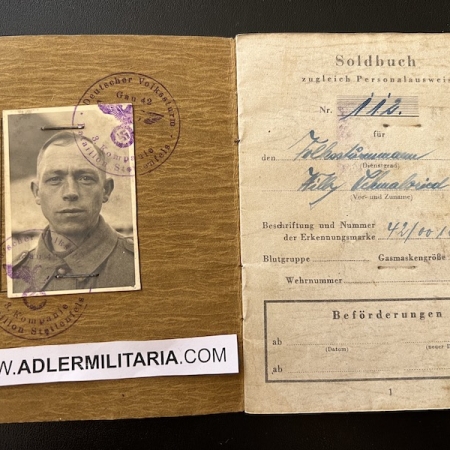
Volkssturm Soldbuch – Volkssturmmann Schmalzried – Gau 42 Stettenfels – XVIII.SS-AK – Westfront – Surrendered to French Army in Bodensee 1945
Rare Volkssturm Soldbuch issued to Willy Schmalzried in January 1945 The XVIII SS Army Corps was formed in December 1944 on the Upper Rhine from the remnants of 3 Wehrmacht infantry divisions.In January 1945, the corps joined the 19th Army until the end of the war. It fought on the upper reaches of the Rhine between Donaueschingen and Schaffhausen. On May 6, 1945, between the Black Forest and the Bodensee, it surrendered to the French First Army. Designation: Volkssturm Battalion Stettenfels Installation site:Reichsgau Württemberg-Hohenzollern Time of installation:before 2/12/1945 Unit Leader: unknown Mission:was subordinated to the XVIII.SS-AK according to the war organization of March 20, 1945, Special features / note: FPN 30979: (11/25/1944-end of war) 2/12/1945 staff and 1.4. Company Volkssturm-Bataillon Stettenfels / Feldpostbrief with adapted date stamp from March 23rd, 1945, exact place of installation probably area Untergruppenbach (Stettenfels is a castle in this place, district Heilbronn)
-
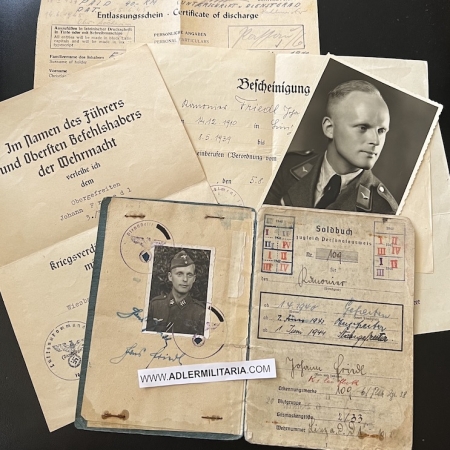
Luftwaffe Soldbuch – Stabsgefrieter Johann Friedl – Schwere Flak Abteilung 387 – Danzig 1945 – Issued Hand Grenades
Soldbuch issued to Johann Friedl, Served as K1 on light Flak Guns! Interestingly he was issued hand-grenades in 1945… A sign of close combat around the corner. Awards: Flak Tade Badge, KVK 2nd Class Schwere Flak Abteilung 387 Formed 4.41 in Luftgau XVII with 5 Batterien (until 7.42 known as Res.Flak-Abt. 387): Stab/Res.387 new 1. – 3./Res.387 new 4./Res.387 from le.Res.Flak-Bttr. 7./XVII 5./Res.387 from le.Res.Flak-Bttr. 8./XVII Reorganised as a schwere Abteilung in late 1943: 3./gem.387 became s.Flak-Bttr.zbV 1515, and was reformed 5./gem.387 became 14./Flak-Regiment 241, and was reformed 6./s.387 new In late 1943 1./s.387 became s.Flak-Bttr.zbV 6395 and 5./s.387 became s.Flak-Bttr.zbV 6396; only 5./s.387 was reformed. Service: 1941 in Luftgau XVII 1942 in Luftgau XI 1.11.43 in Danzig under Luftgau I (Stab/Flak-Regiment 62) 1.1.44 in Danzig under Luftgau I (Stab/Flak-Regiment 62) 1.2.44 in Danzig under Luftgau I (Stab/Flak-Regiment 62) under 18. Flak-Division (Stab/Flak-Regiment 10) [Teile] 1.3.44 in Danzig under Luftgau I (Stab/Flak-Regiment 62) under 18. Flak-Division (Stab/Flak-Regiment 10) [Teile] 1.4.44 in Danzig under Luftgau I (Stab/Flak-Regiment 62) under 18. Flak-Division (Stab/Flak-Regiment 10) [Teile] 1.5.44 in Danzig under Luftgau I (Stab/Flak-Regiment 62) 1.6.44 in Danzig under Luftgau I (Stab/Flak-Regiment 62) 1.7.44 in Danzig under Luftgau I (Stab/Flak-Regiment 62) 1.8.44 under 11. Flak-Brigade (Stab/Flak-Regiment 81) 1.9.44 under 11. Flak-Brigade (Stab/Flak-Regiment 62) [Stab, 2.-4., 6./s.387] 1.10.44 under 27. Flak-Division (Stab/Flak-Regiment 62) [Stab, 2.-6./s.387] 1.11.44 under 27. Flak-Division (Stab/Flak-Regiment 62) [Stab, 2.-6./s.387] 1.12.44 under 27. Flak-Division (Stab/Flak-Regiment 62) [Stab, 2.-6./s.387] 12.44 in Danzig under Luftflotte 6 https://www.ww2.dk/ground/flak/abt/s387.html Comments: A nice Soldbuch with some nice extra documents completing his story.
-

Luftwaffe Wehrpass – Feldwebel Paul Rudolph – Transportgeschwader 1 – Ju52 – Afrika – Stalingrad – Kreta x 7 Medals (Offer Accepted)
Luftwaffe Wehrpass Feldwebel Paul Rudolph Medals: Iron Cross Class Second Class – 6.1941 Frontflugspange in Bronze – 8.1942 Eastern Front Medal – 9.1942 Medal against Communism (Romania) – 5.1943 Fliegerschützenabzeichen without lightning bundle – 19.1944 Frontflugspange for Transport in Silver – 8.1944 Cuff title – Kreta – 11.1942 Served with: Transportgeschwader 1 The Transportgeschwader 1 was a unit of the Air Force during World War II. It was originally formed on August 26, 1939 as Kampfgeschwader z.b.V. 1 set up. As a transport squadron, equipped with transport aircraft, initially of the Junkers Ju 52 type. The formation of the squadron is closely linked to the establishment of the paratrooper school in Stendal, as it was initially intended to serve as a transport squadron for paratrooper and airborne units. At the beginning of the Second World War, all paratrooper and airborne units were combined in the 7th Flieger-Division. So also the KG z.b.V. 1, the I. and II. Groups in Schönfeld-Seifersdorf, the III. Group in Aslau and the IV. Group was in Liegnitz. All groups were equipped with the Junkers Ju 52, a transport aircraft which, with its three BMW 132 engines, achieved a take-off power of 2250 hp and a top speed of 290 km In the airborne battle of Crete that began on May 20, 1941, the I. and II. Groups were the XI. Air Corps assigned to the 4th Air Fleet. From the Greek airfield Megara , they flew paratroopers and airborne troops to Crete. The entire squadron remained in the Mediterranean area and was based on June 22, 1941 at the Greek airfield Eleusis and subordinated to the X. Fliegerkorps. In October 1941, the I. Gruppe moved to the Riga-Spilve air base in the northern section of the Eastern Front during the war against the Soviet Union.[8] From February 19 to May 18, 1942, the II. and IV. Gruppe flew supply missions in the Battle of Demjansk. In June 1942 the III. and IV. Gruppe in Tobruk Libya and Malemes in Crete and were subordinate to the Air Transport Leader Mediterranean, who belonged to Air Fleet 2. Between November 23, 1942 and February 2, 1943, the I. and II. Groups took part in costly operations to supply the Stalingrad pocket. Within two months, 50% of the machines and personnel used were lost. On July 25, 1943, the group commander of Group I, Major Ernst Maess, was killed when his Ju 52 (Geschwadkennung 1Z+AB) was shot down by British Spitfires over the Gulf of Saint Euphemia between Calabria and Sicily. In October 1943 the III. Gruppe sold the Ju 52 transport aircraft they had previously used and received Italian Savoia-Marchetti SM.75 and Savoia-Marchetti SM.82 in return. Both machines performed significantly better. The SM.75, originally a civil airliner, had three Alfa Romeo 126 RC.134 radial engines totaling 2250 hp giving it a top speed of 363 km/h and a payload of 9500 kg. The SM.82 was given 3 nine-cylinder Alfa Romeo 128 RC.21 radial engines, each with 963 hp, a top speed of 347 km/h and a payload of 4000 kg. In November, the III. Group of both types a total of 25 machines in their ranks. In January 1944, the II. Gruppe also received these transport machines. At the start of the Allied landings in Normandy on June 6, 1944, the III. Gruppe with 16 Savoia-Marchetti SM.82 in Celle[10] (♁Lage) and was subordinate to Air Fleet 3, which is responsible for the western area. Comments: A super nice Wehrpass to a well decorated air crew member. Comes with his capture paperwork. Also his prewar work IDs, show he was working as a mechanic in building aircraft with Dornier. Please note the cover of the Wehrpass is in normal condition with Swastica.


