Showing 712–720 of 1269 resultsSorted by latest
-
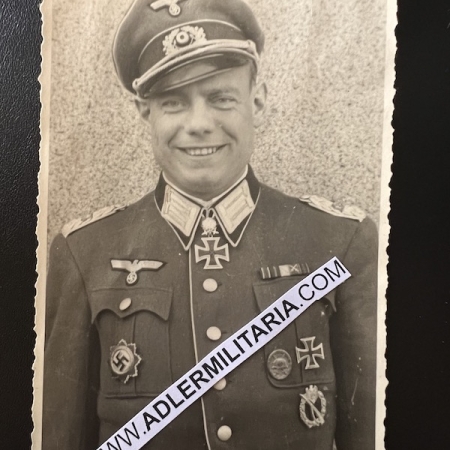
WWII German Portrait Photo – General (Knights Cross) – Erich Bärenfänger – Original Period Photo – Berlin 1945 (Offer Accepted)
Erich Bärenfänger (12 January 1915 – 2 May 1945) was a German general during World War II. He was a recipient of the Knight’s Cross of the Iron Cross with Oak Leaves and Swords of Nazi Germany. In the final days of the war, Bärenfänger was commander of several defense sectors during the Battle of Berlin; he committed suicide on 2 May 1945. Berlin, 1945 Towards the end of World War II, Bärenfänger took part in the Battle for Berlin. On 24 April, due to the direct command of Hitler, Bärenfänger was given command of defence sectors A and one day later also command of sector B.[1] Bärenfänger mounted at least two unsuccessful armored attacks northwards up the Schönhauser Allee. The second was on 1 May.[2] Members of SS-Brigadeführer Wilhelm Mohnke’s “break out group” saw quite a sight thanks to Bärenfänger. On 1 May, the group left the surrounded central government sector, which included the Führerbunker. As they made their escape, there before them they saw a “host” of new Tiger II tanks and “artillery pieces” arrayed around the Flak tower as if “on parade”. Bärenfänger was allegedly seated in the turret cupola of one of the Tigers thus arrayed.[3] On 2 May, Bärenfänger, a devoted Nazi, committed suicide with his young wife and her brother in a side street of Berlin.[2]
-

Luftwaffe Soldbuch – Feldwebel Josef Lotz – Normandy 1944 – 5th Fallschirmjäger Division – War Merit Cross
Luftwaffe Soldbuch issued to Josef Lotz in 1939. From 1939 till July of 1944, Lotz was involved in various transport unit moving items and material to the front… Interestingly a security stamp places him with/under inspection of the 5th Fallschirmjäger Division in September of 1944. Lotz was in France (Paris) according to his pay/holiday entries as early as 1942. Right up until the invasion in the summer of 1944. Another point to note is that his War Merit Cross with Swords was issued by the same officer of the 5FJD in September of 1944. It is worth noting, on the 30th of June he changed units remaining with Kolonnenführer der Luftwaffe zbv 6 until February of 1945 he was sent to the East of Germany to a replacement unit: Flieger Ersatz Bataillon IV – in Leipzig – and later discharged. Comments Its clear Lotz spent considerable time in France mainly Paris, until the invasion in 1944, where he went through a shuffle of units and was lucky to escape further action.
-
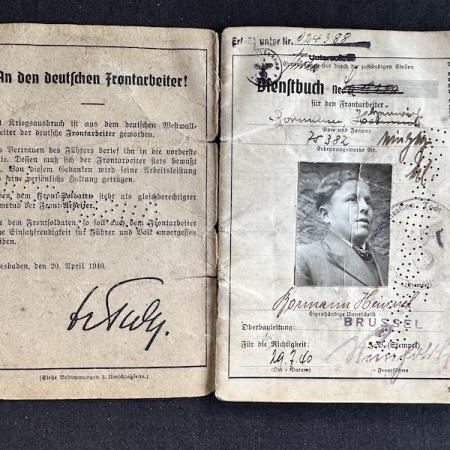
WWII German Organisation Todt Dienstbuch – Bormann – Brussels – OBL Nord Brest France – OT Finnland – Eastern Front Medal
A nice example of a OT Service book, this was issued in Brussels, July 1940. 5.1.1941 – OT Einsatz Westküste OBL Nord – Einsatzgeiet: Brest Frankr – Service in Breast France 11.1940 till 29.4.194 – 43903 (1.10.1940-27.2.1941) Organisation Todt Oberbauleitung Landau (28.2.1941-29.7.1941) Organisation Todt Oberbauleitung (Einsatzstab WestKüste), dann Organisation Todt Oberbauleitung Nord Brest. Interestingly, there is a stamp from Rovaniemi in Finland on page 19, and a stamp from Berlin Eichkamp Eastern Front Medal – 1.12.1942 A Führer package in 9.1.1944 – with 44803 – OT-Einsatzstab Finnland Condition is not the best, but still has desirable entries.
-

WW2 Phillips Produced – Knijpkat – Squeeze Cat – Dynamo Torch – Philips Commando – Camp Vught Netherlands – Wehrmacht 1943 Olive Drab (Sold)
By Philips, Type 7424. 2.5 volt 0.1A. Green painted steel torch/flashlight with integral dynamo generator operated by means of a press lever on the top. Known as ‘Knijpkat’ in the Netherlands which translates to ‘squeeze cat’ in English, the name being derived from the sound produced by the dynamo. The olive drab painted steel version was only produced in 1943 and Philips was ordered by the occupying Germans to produce these for the Wehrmacht, although there is also evidence of USAAF crews using them and the Imperial War Museum suggests use by the SOE. In good working order with the original bulb. The case is in good original condition with only minor paint chipping. Stamped with manufacturer’s details on the base. Wikipedia Article: The Philips-Kommando was a labor command in Camp Vught during World War II . They produced radio tubes , razors and squeeze cats , among other things . https://nl.wikipedia.org/wiki/Philips-Kommando Please remember: Our prices include recorded shipping.
-
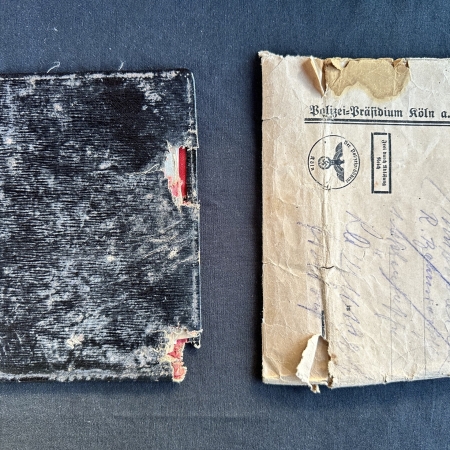
WWII German Personal Documents – Bomb Damaged – Reichsbahn Train Driver Friedrich Lämmerhirt – Killed during Raid on Köln December 1941 – SS Death Card (On Hold)
This grouping comes in the original envelope sent from the Police in Köln 1941. The police found Friedrich Llämmerhirt inside the Fire Department at the Railway Station repair facility in Cologne South (Köln-Süd) He was killed during a British Bombing raid in November 1941 Contents of Wallet: Leather Wallet Registration documents dates November 1941. Control Card and Marks for the buying of Tobacco. Membership of the Reichsbahn Card – stating he is a train driver in the Reichsbahn. Reichsbahn ID Papers – stating he is a train driver, including a period applied photograph. Motor Vehicle Licence – Issued by the Reichsbahn in 1936, he is in his Reichsbahn uniform. Negative and photograph of workers in the Reichsbahn Train Station repair yard Cologne. A Photograph of Friedrich. SS-Unterscharführer Friedrich Lämmerhirt – he must have been also a member of the SS. Comments: A very odd item from an unfortunate member of the Reichsbahn. It comes with a print out about his grave in Germany.
-
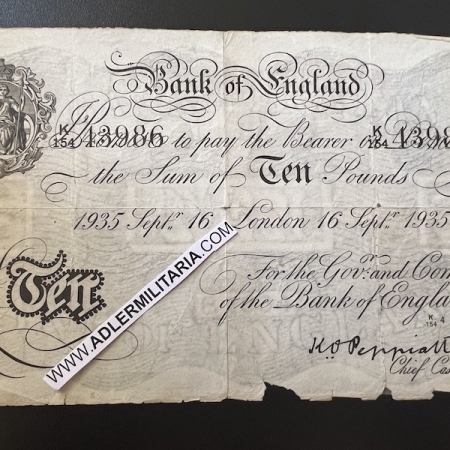
WWII German Fake British 10 Pound Note – Operation Bernhard – Sicherheitsdienst (SD) – Heydrich
Operation Bernhard was an exercise by Nazi Germany to forge British bank notes. The initial plan was to drop the notes over Britain to bring about a collapse of the British economy during the Second World War. The first phase was run from early 1940 by the Sicherheitsdienst (SD) under the title Unternehmen Andreas (Operation Andreas). The unit successfully duplicated the rag paper used by the British, produced near-identical engraving blocks and deduced the algorithm used to create the alpha-numeric serial code on each note. The unit closed in early 1942 after its head, Alfred Naujocks, fell out of favour with his superior officer, Reinhard Heydrich. There is a lot of information on Wiki: https://en.wikipedia.org/wiki/Operation_Bernhard
-

Reichswehr Truppen Ausweiss – Oberwachtmeister Otto Wehring – Issued 1923 – Artillerie Regiment Nr 5 – 100,000 Man Army – Weimar Republic – Rare
A very rare photo identity paper known as the Troop Identity. Issued to Oberwachtmeister Otto Wehring in the Reichswehr in 1923 with Artillerie Regiment Nr 5 – He was one of the 100,000 standing army… Interestingly the II Batt, that Wehring was in was in Bayern, and the Reichswehr took part in the downing of Hitlers Putsch in 9 November 1923. If Wehring was present, we will not know, but he certainly was in active service at the time in a very small army. —– Reichswehr (lit. ’Reich Defense’) was the official name of the German armed forces during the Weimar Republic and the first years of the Third Reich. After Germany was defeated in World War I, the Imperial German Army (Deutsches Heer) was dissolved in order to be reshaped into a peacetime army. From it a provisional Reichswehr was formed in March 1919. Under the terms of the Treaty of Versailles, the rebuilt German army was subject to severe limitations in size, structure and armament. The official formation of the Reichswehr took place on 1 January 1921 after the limitations had been met. The German armed forces kept the name ‘Reichswehr’ until Adolf Hitler’s 1935 proclamation of the “restoration of military sovereignty”, at which point it became part of the new Wehrmacht. Although ostensibly apolitical, the Reichswehr acted as a state within a state, and its leadership was an important political power factor in the Weimar Republic. The Reichswehr sometimes supported the democratic government, as it did in the Ebert-Groener Pact when it pledged its loyalty to the Republic, and sometimes backed anti-democratic forces through such means as the Black Reichswehr, the illegal paramilitary groups it sponsored in contravention of the Versailles Treaty. The Reichswehr saw itself as a cadre army that would preserve the expertise of the old imperial military and form the basis for German rearmament. Structure of the Reichswehr Arms limitations under the Treaty of Versailles In Part V of the 1919 Versailles Peace Treaty, Germany had obligated itself to limit the size and armaments of its military forces so that they could be used only as border protection and for the maintenance of order within Germany. In accordance with the treaty’s provisions, personnel strength was limited to a professional army of 100,000 men plus a 15,000-man navy. The establishment of a general staff was prohibited. Heavy weapons above defined calibers, armored vehicles, submarines and large warships were prohibited, as was any type of air force. The regulations were overseen by the Military Inter-Allied Commission of Control until 1927. Conscription into the German army had traditionally been for a period of 1 to 3 years. After they had completed their terms of service, the discharged soldiers created a large pool of trained reserves. The Versailles Treaty fixed the term of service for Reichswehr officers at 25 years and for all others at 12 in order to prevent such a buildup of reservists. Artillerie Regiment Nr 5 The regiment was formed on January 1, 1921 in Ulm from the Reichswehr Artillery Regiments 11, 13 and 14 of the Transitional Army. At the beginning of the 1920s, the departments in Ulm and Fulda exchanged their numbering. In the course of the expansion of the Reichswehr in 1934, the new regiments Artillery Regiment Ulm, Artillery Regiment Fulda and Artillery Regiment Ludwigsburg , each with five departments, were set up from the three departments of the regiment. On October 15, the Artillery Regiment Ulm was renamed Artillery Regiment 5 and placed under the 5th Infantry Division.
-
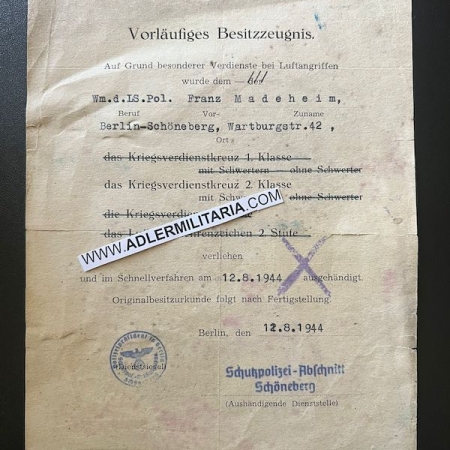
WWII German – Certifcate for War Merit Cross – Bombing of Berlin 1944 – Luftschutz Polizei
A very nice and unusual pre award certificate for a member of the Air Protection Police, awarded during the Bombing of Berlin in 1944 by the Police section in Schöneberg.
-

Post War Signed Knighscross Holder – General der Panzertruppe Walther Wenck – Berlin 1945 (Sold)
Nice hand signed photography printed post war on Agfa paper. Walther Wenck (German: [ˈvaltɐ ˈvɛŋk]) (18 September 1900 – 1 May 1982) was a German officer and industrialist. He was the youngest General of the branch[1] (General der Truppengattung) in the German Army and a staff officer during World War II. At the end of the war, he commanded the German Twelfth Army that took part in the Battle of Berlin.[2] Wenck left the military after surrendering to the Allies. He was asked to become Inspector General of the Bundeswehr as West Germany was re-arming in 1957, but declined to take the post when conditions he set were not met, such as the Inspector General being the commander-in-chief of the armed forces, not just an administrative leader. Historians consider Wenck a capable commander and a brilliant improviser, although incapable of the impossible task he was given of saving Berlin in 1945.


