Showing 721–729 of 1179 resultsSorted by latest
-

Heer Soldbuch – Panzerschützen Lipp – Panzerjäger E.u.A Abt 5 – (9 Pz Div) – Ardennes/Remagen 1944/45 (sold)
Soldbuch to Otto Lipp Born in Stuttgart, Germany in 1927. He enlisted in Böblingen in November 1944 with a Panzer Ersatz Abteilung 7 Panzerjäger-Ersatz- und Ausbildungs-Abteilung 5 The unit was disbanded in late 1944, and the soldiers used for the 9th Panzer Division. What we can make out from the Soldbuch is the following: He was issued combat equipment on the 23.12.1944, including a camouflage cover and winter kit! In February of 1945, he was issued a Rifle (no more vehicles?) In early 1945, the division engaged the Allied in fighting around the Eifel mountain range. It also participated in fighting around the Erft River in February, where its armored force was reduced to 29 tanks and 16 assault guns. Late in the month, it launched an attack on the Allied Remagen Bridgehead over the Rhine River, which failed to reach the Remagen Bridge. It is unknown what happened to Ott, but he was likely captured in the last stage of the war. The Soldbuch is a clean example.
-

Heer Soldbuch – Oberfeldwebel Kaufer – 28 Infanterie Division – Krimschild! – Great Photo!
Soldbuch to Oberfeldwebel Hermann Kaufer. Born in Gottesberg, 1907, his Soldbuch was issued in 1939. Kaufer was mainly in the rear of the lines, in various supply units. Weapons & equipment He was issued various weapons including pistols. He served mostly with the 29th Infanterie Division / 28. leichte Infanterie-Division / 28. Jägerdivision On September 1, 1939, the division crossed the Polish border and, after the first battles, occupied Kattowitz. The division then pushed north of Kraków past the Vistula and from here to over the Wisloka. Then the San was crossed near Sokolov and after fighting near Osuchy the railway line Brest – Lemberg near Krasnobrod was reached. This is where the division stood at the end of the campaign. The division was moved west to the Aachen area and used for border security. At the beginning of the western campaign, the division crossed the border at Münstereifel and onto the Meuse south of Namour. The further advance led the division via Maubeuge to Lille. The division stayed here until the end of the campaign. In May 1941 she was transferred from northern France to northern Poland. At the beginning of the Russian campaign, the division advanced from Suwalki via Lida and the Njemen to the area north of Smolensk. Here the division had to endure heavy defensive fighting in August and September 1941. At the beginning of the advance on Moscow, the division pushed through Yartsevo and the Vyazma area to the Tyma estuary on the Volga. Since the division had suffered heavy losses up to this point, it was pulled out of the front and transferred to France. Fighting later in the Crimea, then later in Eastern Prussia. Kaufer won the following awards: War Merit Cross with Swords 2nd Class Eastern Front Medal Krim Shield Drivers Badge in Bronze War Merit Cross with Swords First Class Romanian Medal for the Fight against Communism
-

Heer Soldbuch Oberwachtmeister Salge – Turkestan Legion (Extremely Rare!) – Ostvölker Medal – Partisans Italy 1944!
Heer Soldbuch to Wachtmeister Salge Werner Salge was born in Wittenberg, Germany in 1908. He enlisted in the Wehrmacht early in the war, loosing his first issue Soldbuch. His Second Issue was opened on the 24th of July 1941, by then he already made it to Wachtmeister! Fighting with various units: Artillerie-Regiment 194 (94 Inf Div) then later with Artillerie-Regiment 209 (209 Inf Div), then with Front Stalag 137, and Dulag 137 in Ukraine. The last series of unit was the guarding and processing of Prisoners of War. Interestingly, his next unit was: 1st Turkestan Legion / Turkestan Battalion The Turkestan Legion was the name for the military units composed of the Turkic peoples who fought in the Wehrmacht during World War II. Most of these troops were Red Army POWs who formed a common cause with the Germans (cf. Turkic, Caucasian, Cossack, and Crimean collaborationism with the Axis powers). Its establishment was spearheaded by Nuri Killigil, a Turkish theorist of Pan-Turkism, which sought to separate territories inhabited by Turkic peoples from their countries and eventually unite them under Turkish rule. Although Turkic peoples had been perceived initially as “racially inferior” by the Nazis, this attitude officially already changed in autumn 1941, when, in view of the difficulties faced in their invasion of the Soviet Union, the Nazis attempted to harness the nationalist sentiment of Turkic peoples in the Soviet Union for political gain. The first Turkestan Legion was mobilized in May 1942, originally consisting of only one battalion but expanded to 16 battalions and 16,000 soldiers by 1943. Under the Wehrmacht’s command, these units were deployed exclusively on the Western Front in France and Italy, isolating them from the Red Army. The battalions of the Turkestan Legion formed part of the 162nd Infantry Division and saw much action in Axis-occupied Yugoslavia (especially modern-day Croatia) and Italy. Much of the Turkestan Legion was ultimately imprisoned by British forces and repatriated into the Soviet Union after the war’s end, where they would face execution or incarceration by the Soviet government for having collaborated with the Nazis. Notable members of the legion include Baymirza Hayit, a Turkologist who after the war settled in West Germany and became an advocate for Pan-Turkist political causes. Infanterie Regiment 303 Reorganized on June 1, 1943 in the General Government from the 2nd Turkestan Legion and the Turk. Field battalions I./44 and I./384. The regiment was deployed in Slovenia at the end of 1943 and then in northern Italy to fight partisans near Spezia and Val di Taro. In March 1944 he was transferred to Liguria. On June 9, 1944, the regiment was assigned to the XIV Panzer Corps, which was under pressure in central Italy. The III. Battalion was disbanded on June 14, 1944. Between August and November 1944, the regiment was part of the 10th Army’s coastal security section in the Rimini area and was transferred back to Liguria in December 1944. Grenadier Ersatz und Ausbildungs Batl 179 It seems some time in 1945 he was sent to the above unit Awards: War Merit Cross with Swords Eastern Front Medal Ostvölker 2nd Class – (20.4.1944) Rumanian Medal for the fight again Communism Wounds Badge in Black War Merit Cross with Swords 1st Class Summary Super rare unit, I have not seen one to this unit before. The awarding of the Ostvölker Medal is also a nice entry, there are many stamps from the Turkestan Unit also, could be worthy of further research!
-
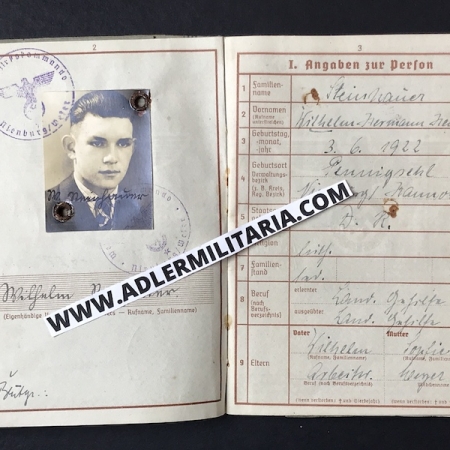
Waffen-SS Wehrpass – SS-Sturmmann Steinhauer – SS Flak Abt 5 ‘Wiking’ – KIA – Heeres Flak Badge !
Waffen SS Wehrpass to SS-Sturmmann Wilhelm Steinhauer Steinhauer born in 1922 in Pennigsehl, Hannover volunteered for the Waffen SS in January 1941 (SS-VT). He was assigned in February 1941 to SS-Verfügungstruppe in Graz-Wetzelsdorf – SS ‘Der Führer’ He was trained on K.98, MG34, Handgrenade, P08 Luger, 3,7cm Flak 36 After his training he was assigned to: SS Flak Abteilung 5 – ”Wiking” The 5. SS-Panzer-Division Wiking was formed in December 1940 around the Germania regiment from the SS-Division Verfügungstruppe (later renamed Das Reich). It took part in the invasion of the USSR attached to Heeresgruppe Süd and during the advance took part in several encirclements of Soviet troops before reaching Rostov November 1941. During the winter it was pressed back by the Soviet advances. In the spring it once again went on the offensive, this time towards the Caucasus. It was however soon forced to retreat to avoid being cut off. In January of 1943, Steinhauer was hit in the upper right leg with shrapnel and died as a result in the Don Swinowod area. Awards General Assault Badge Eastern Front Medal Iron Cross Second Class Heeres Flak Badge Signature: Page 12/22/23/ – Emil Kurz, German Cross in Gold Holder
-

Wehrmacht Wehrpass – Obergefreiter Illgen – Inf Reg 534 / Inf Reg 174 – Technische Brigade Mineralöl (Sold)
Wehrmacht Wehrpass to Obergefreiter Max Illgen Born in 1913, in the Leipzig area. Illgen joined the German Army in 1938, and was assigned to the Infanterie Regiment 101, he served later in various other units including Infanterie Regiment 534 and Infanterie Regiment 174. Interestingly he was badly wounded and assigned to the : Technische Brigade Mineralöl. He was later released from service in October 1944, included is his certificate of discharge, this was due to being unfit for service.
-
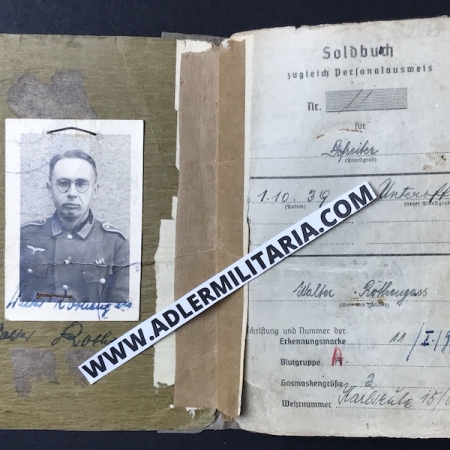
Wehrmacht Soldbuch – Uffz Rothengass – Grenadier Regiment 104 (15 Pz Div) DAK & France – EK2 (Sold)
Soldbuch to Unteroffizier Walther Rothengass Rothengass was born in 1915 in the area of Pforzheim, Germany. The Soldbuch was issued in 1939 with Grenz Infanterie Regiment 125 The Grenz-Infanterie-Regiment 125 was formed on 10 November 1938 in Saarbrücken and was redesignated Infanterie-Regiment 125 when it was mobilized. He was sent to Africa in October 1942, with the 15th Panzer Division, leaving one month later arriving in Munich with dysentery. It seems he was assigned in August 1944 to, he was assigned to Panzer Grenadier Regiment 104, (15th Panzergrenadier Division). Division Info: In mid-August 1944, the division was assembled in the area south of Paris-Troyes. Defensive battles for Lusigny followed. As part of the defensive battle for Lorraine, the division fought in the area south-east of Verdun – north-east of St. Dizier – around Bar le Duc. This was followed by defensive fighting west of the Moselle around Lunéville until September 1944. After that, the division at Chateau-Salins was refreshed at short notice. Fighting ensued southwest of Chateau-Salins to east of Lunéville. In October and November 1944, the division fought a defensive battle west of the West Wall for the Saar. He was awarded the Iron Cross Second Class in November 1944 for fighting in these defensive battles. Summary It would seem he was not in Italy in 1944, Considering the EK2 was the last entry he must have been captured shortly after. He is not listed as killed in action. A nice Lorraine related Soldbuch.
-
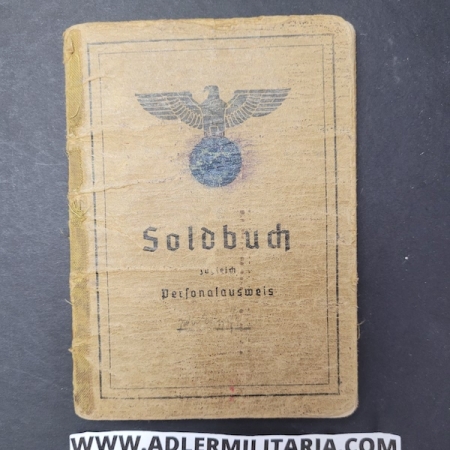
Wehrmacht Soldbuch – Feldwebel Krause – Fla Batl 612 (DAK) – Battle of Tunis! – Confirmed Kills! (Sold)
Soldbuch to Feldwebel, Willy Krause from Bremen The Soldbuch was issued in October of 1941 with: Fla Batl (Mot) 612 Raised 12 April 1941 with four companies. The battalion was in Africa. While crossing from Italy to Africa, some of the battalion’s transport ships were sunk. On September 6, 1942, the battalion shot down a Curtiss. On October 9, 1942, the battalion shot down a Douglas Boston and a Spitfire. On October 30, 1942, the battalion shot down a Hurricane. The battalion was destroyed in Tunis in May 1943. Krause, like many pulled some pages from his Soldbuch before going over the lines to surrender. Interestingly, he left the awards page, which shows he was not only wounded in Tunis (Wounds Badge in Black) but he was also awarded in the Iron Cross Second Class in May of 1942, as well as the German Italian Africa Medal. Summary A nice DAK Soldbuch with Discharge Papers, DAK is becoming increasingly sought after and are not easy to find anymore. Interesting is the Tropical weather instructions in the back pouch.
-
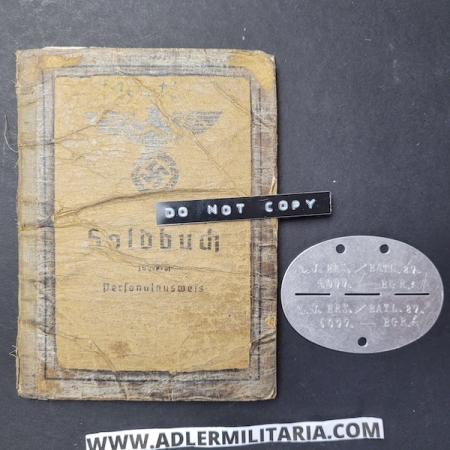
Wehrmacht Soldbuch – Feldunterarzt Martin – Schützen Regiment 104 (15 Pz Div) & (21st Pz Div) DAK (Sold)
Feldunterarzt Karl Martin Born in Mainz, Germany 1920. Martin was a medical student, passing his first state exam he reached the rank of Feldunterarzt. His Soldbuch was issued in March 1941, and by August of 1941 he arrived in Africa with: Schützen Regiment 104 (15 Panzer Division) After the start of the British Operation “Crusader” on November 18, 1941, the division, coming from Sidi Azeiz, intervened in the German defensive battles from November 20, 1941. After German troops had managed to stop the British advance by November 23, 1941, Erwin Rommel on November 23 that it was time for a counterattack. He had the 21st Panzer Division advance in a south-easterly direction, while the 15th Panzer Division was to advance against the suspected enemy troops in front of Bardia. In between, the Italian division “Ariete” should march towards Fort Capuzzo. The 15th Panzer Division finally arrived in front of Bardia to find there that there were no enemy troops worth mentioning in front of the city. The 5th New Zealand Brigade was able to hold its position at Fort Capuzzo against the “Ariete” Division and finally the incoming 21st Panzer Division. The German counterattack was largely in vain. Allied XXX. Corps had managed to avoid their pursuers to the west unnoticed, and the New Zealand 4th and 6th Brigades had each marched unnoticed along the oncoming 15th Panzer Division towards Tobruk. On November 29, Erwin Rommel decided to mobilize the XXX Panzer Divisions. corps and instead intervene directly in the fighting at the siege ring around Tobruk. There the trapped crew had repeatedly tried to break out to the east and to unite with their own forces. Rommel’s goal was to encircle and destroy the New Zealand forces coming from outside. By the evening Sidi Rezegh could be taken again and in the following two days the Axis powers were finally able to fight their way to the New Zealand units. At Ed Duda, however, the 15th Panzer Division suffered heavy losses at the hands of the British 70th Division stationed there, and Rommel eventually withdrew them to Bir Bu Creimisa. On December 1st, the Axis powers tightened the cauldron – still open at Ed Duda – to destroy the two New Zealand brigades. However, the New Zealanders managed to retreat to Tobruk. However, the forces of the 15th Panzer Division and the German Afrika Korps were exhausted, and most of the tanks were destroyed or damaged. Faced with near exhaustion and the failure of an attack on Ed Duda on December 4, Rommel finally decided to withdraw all forces east of Tobruk and concentrate his forces west of the city, concentrating entirely on XXX to the south. Allied Corps to concentrate. Fierce fighting continued until December 6th. The allied Indian division suffered the heaviest casualties in attacks on a strategically important hill and had to retreat almost completely smashed. However, the Axis powers were unable to take advantage of the situation due to exhaustion of their own strength. On the evening of December 6th, Walter Hugo Reinhard Neumann-Silkow, commander of the 15th Panzer Division, was seriously wounded and died of his injuries in the hospital on December 9th. On December 7th and 8th, German troops retreated to the Gazala Line at Gazala, Sanitätsdienste 200 (21st Panzer Division) It is unknown when he crossed into this unit, but on the 12th of December 1941, after spending 115 days in North Africa he was sent back to Germany. He was awarded the Africa Cuftitle, and the Italian German Campaign Medal for Africa. Martin was captured by US Troops who put his medical skills back into use, at the 300th Provisional German Hospital Center in 1945/46. His Discharge papers, some POW notes and his matching Tag he wore the whole war comes with the set.
-
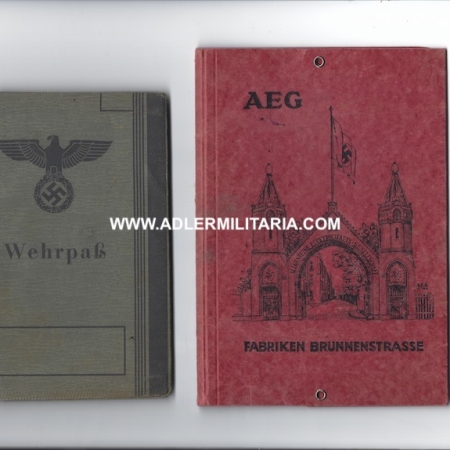
Wehrpass – Max Kühne – Berlin AEG Factory Master (Sold)
A nice Berlin related ID trio to Max Kühne. He worked at the AEG Factory on the Brunnenstrasse in Berlin. According to his Wehrpass, he was found fit for garrison duties. During the First World War he was in the Torpedo School! Kühne was a master in his trade at AEG and worked there from 1929 till 1945. AEG was one of the targets of many raids on Berlin due to the war industry, although the AEG Plant was beside the Flak Tower at Gesundbrunnen it was well protected. The Cover for his IDs, is elaborately decorated and is very rare, his ID for the AEG factory is also not common. His story is featured in a book: Under civilians in Berlin (released date Summer 2022). A nice unique set, published and accredited to a landmark place in Berlin, the cover for the Wehrpass displays the entrance to the AEG works and is a protected landmark in Berlin still standing.


