Showing 991–999 of 1403 resultsSorted by latest
-
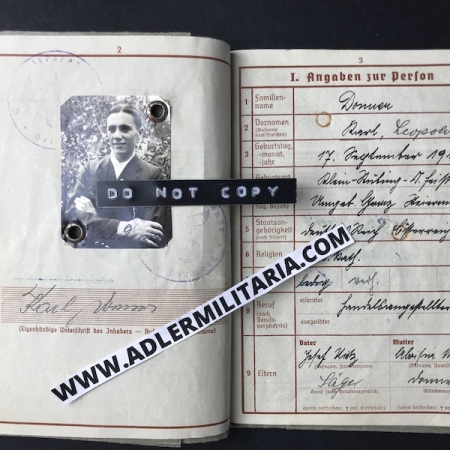
Heer Wehrpass – Hauptmann Donner – Grenadier Regiment 380 (215 ID) – Company Commander – KIA Latvia 1944 (Offer Accepted)
Wehrpass to Hauptmann Karl Donner, born in 1918 in Austria.
He spent a short time in Graz, in the RAD.
His frontline units are as follows:
Infanterie Regiment 738 (718. Infanterie-Division)
From 5.1941 till 12..1941
For more info: https://www.lexikon-der-wehrmacht.de/Gliederungen/Infanteriedivisionen/718ID.htm
Infanterie Regiment 380 – (215 Inf Div)
Following the refresher, the division was deployed in front of Leningrad and fought at Staro Panowo and Urizk. In 1943 the division stood at Schliisselburg, on the Ssinjawino Heights and at Krassny Bor, later at Mga, on the Neva knee and between Pushkin and Alexandrowka. From January 1944 the division had to withdraw to Pleskau via the Ishora and the Luga. The division was then placed in the “Panther” position, where trench warfare took place until May 1944. After a brief refresher, there were defensive battles north of Ostrow, which were followed by a retreat via Dünaburg and Birsen to Bauske and, from October 1944, to Courland. The division fought here until February 1945.
Awards:
- Iron Cross Second Class
- Infantry Assault Badge
- Iron Cross First Class
- Wounds Badge in Black
He was killed due to grenade splinters south of Dunaburg, likely on the border with Belarus.
Summary, the Wehrpass comes with a photo of Donners grave, stating his old rank. This Wehrpass for a Company commander is rather rare, as it is very hard to find company commanders!
-

Heer Soldbuch – Uffz Burger – Grenadier Regiment 728 (728 VGD) Normandy 1944 – MP40 (Sold)
Heer Soldbuch to Till Burger from Munich.
The Soldbuch was opened in 1939, and used to the end of the war.
His frontline units of interest are:
Artillerie Abteilung 758
Artillerie Regiment 262
Artillerie Abteilung 1708 (1944)
Grenadier Regiment 728 (1944) (708 Volksgrenadier Division)
At the end of July, the division was moved towards the invasion front in northern France. By August 2, the motorized parts of the division had reached the area south of Angers and the other parts of Niort. By August 5, 1944, the division had reached parts of the Domfront, Laval and west of Le Mans areas. Here the division met allied units. On August 6th, after heavy fighting, the western part of Laval was lost and the bridges over the Mayenne were blown up. The division set up fuses in the line Bernay – Sable-sur-Sathe, the Fusilier battalion secured in Laval. On August 8, 1944, after heavy fighting, Le Mans was lost and the Domfront area could be held. On August 10, 1944, the remnants of the division were in the line 3 km west of Domfont – creek section to north of Ambrieres – 4 km of Ambrieres – 3 km to the east of Mayenne. On August 13th, the division of the 7th Army was directly subordinated and secured the line Domfront – hard south of Starße Domfront – Alencon to the area west of Pre en Pail. On August 14, American units broke the division’s security and advanced north. The remnants of the division were pushed back to the heights south of Lonlai by the following day. The remnants of the division had been destroyed by the end of August. The division commander, Major General Arndt, fell to Les Loges Margueron on August 24, 1944.
Awards:
- Wounds Badge in Black – 5.12.1942
- Infantry Assault Badge – Issued by Arbeitsstab Stalingrad! 10.7.1943
Equipment:
MP40
Mixed Iron Rations
In summary, this is a very nice Normandy Soldbuch, of which there are hardly any available on the market. Burger was captured by US Troops as his Soldbuch displays the usual 31G POW Number.
-

Heer Soldbuch and Wehrpass – Uffz Reuter – Killed by US Fighter Plane – Berchtesgaden April 1945
Soldbuch and Wehrpass, including the death letters and correspondence.
Reuter was from Düsseldorf, and served pre war in:
Schützen Regiment 1 (Gera)
Although he spent most of the war with:
Grenz Abschnitt Nachrichten Kompanie 9 (526 Inf Div)
It would seem that he spent most of the war in Occupied France.
During the closing stages of the war he was assigned to s communications unit and was driving a truck in a convoy.
He was according to the letters, hit by a fighter plane bullet, which hit him in the lung. The commanding officer recorded his body and brought the body in the night to a morgue in order to bury him properly.
His grave is in Berchtesgaden today.
See below, footage of air raids by US Aircraft on ground targets, most of these were filmed by onboard gun cameras.
In the rear of the Soldbuch was a racist poem, and a declaration that he is not of Jewish decent.
This is a detailed set, directly connected to the US Airforce targeting troops on the ground.
-
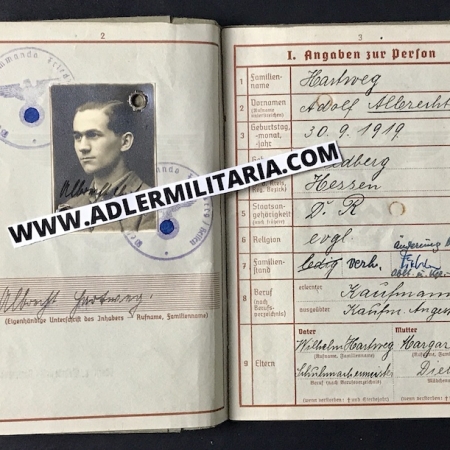
Heer Wehrpass – Uffz Hartweg – Feste Nach Aufkl Stelle 12 – Communications Intelligence – ‘Coder’ (Sold)
Heer Wehrpass for Funker Hartweg.
He served mainly in Intelligence Communications.
There is very little information online about these units, given the nature of their activities.
Although the following information is from a book called: Codeword Overlord: Axis Espionage and the D-Day Landings: By Nigel West
That one of his units were based in France in Saint Germain en Laye, then later in Euskirchen. They consisted of around 120 personell and were listing to all radio communications.
Interestingly, Hartweg was listed as Schüssler also known as a Coder, used to code messages this could incorporate the Enigma also!
He was also trained as a radio man in a recon unit.
He has a quite impressive battle list.
The units would require further research.
Awards
- Eastern Front Medal
- Wounds Badge in Black (31B – Splinter)
-

Heer Wehrpass – Gefreiter Geipel – Panzer-Aufklärungs-Abteilung 231 (11 Panzer Division) – KIA Ultra Rare Grave Map – Killed by Partisans (Sold)
Wehrpass Grouping to Gefreiter Geipel
After a short stint in the RAD he volunteered to join Panzer Regiment 2.
Although it would seem he would not actually be assigned to the Panzer Regiment, and served in a home front unit until September 1940:
His frontline unit was:
Panzer-Aufklärungs-Abteilung 231 (11 Panzer Division)
After being set up, the division moved to Romania as a teaching force in mid-January 1941 and from there took part in the invasion of Bulgaria in March 1941. In April 1941 the division was used to advance on Belgrade during the Balkan campaign. After conquering it, the division advanced on Sarajevo. After the end of the Yugoslavia campaign, they remained as an occupying force in Yugoslavia and then marched back to their garrison location at the end of April. From the beginning of June 1941 the division in Poland was made ready for the Russian campaign. From June 22nd the division fought in Russia. After the Bug crossing and the breakthrough through the Russian border fortifications, the tank battle at Radziechow and fighting over the Styr crossings at Szcznrowice and Berestezko took place on June 23. By June 25, the division reached the Stalin Line via Horyn. Fights for Ostrow and the Wilja and Horyn crossings followed. In heavy fighting, the division broke through the Stalin line from July 2nd to 5th and then the Russian positions at Miropol. Then there were fighting at Starokonstantynow and Lubar and until mid-July 1941 at Cudnow – Berditschew. Then the division advanced by July 20 on Uman, which was fought for until August 8. This was followed by cleansing battles in the Dnieper bend and in the Boguslav – Cherkassy area until mid-August. The deployment in the operational area of the 6th Army for the battle of Kiev followed by August 22nd. This began for the division on August 23 with fighting around the Gornostaipol-Osztjer bridgehead and ended at the end of August 1941. Subsequently, the division was in the operational area of Army Group South and Center. At the end of September 1941, the division took part in the defensive battle of Yelnya and Smolensk. The double battle at Vyazma and Bryansk followed by mid-October, followed by the advance on Moscow. The Moscow protective position could be breached by the end of October. and overcome the Istra by the beginning of December. From December 5, the division was put on the defensive, there were defensive battles in front of Moscow, in the Rusa-Wolokolamsk position, east of Gshatsk and in the winter position Juchnow – Gshatsk – Subzoff.
According to his Officer in command in a letter to Geipels father:
”1.2.1942 – on an attack to the village Boldyrewo. There is a train station near Mitino, the line is Smolensk-Wjasma. The place was occupied by partisans and enemy paratroopers. During the attck we noticed that the enemy was stronger than we imagined. To prevent further losses we pulled back, and your son was hit by a machine gun blast, he died on the spot. We were unable to take him with us. His personal items were robbed by the Russians, as we went back there the next day and found him with six others. We buried them near the train station.”
On further investigation with this map, a search team was dispatched in 2012 to the location to try and locate the missing graves, but to no avail.
Finding a map in such detail is extremely rare.
-

Heer Wehrpass – Gefreiter Thoma – Infanterie Regiment 380 (215 Inf Div) – Killed by Partisan Patrol – Death letters (On Hold)
Wehrpass issued to Gefreiter Wilhelm Thoma
He served with:
Infanterie Regiment 380 (215 Inf Division)
On June 19, the attack of the 215th Infantry Division began on the Maginot Line near Lembach-Wörth. The regiment was deployed on the right side of the division section. The 1st / Infantry Regiment 435 and the 1st / Pioneer Battalion 204 were assigned to him. The aim of the regiment was the breakthrough at Nehweiler. By the evening of June 19, the breakthrough had been achieved and 18 plants had been taken from the regiment. The III. Battalion of fallen 3 NCOs and 3 men, 1st Battalion 1 dead officer. A total of 31 men were wounded. By evening the regiment reached Hagenau and captured two bridges prepared for demolition. On the night of June 20th the regiment began to advance through Alsace. Across the Rhine-Marne Canal to Fort Mutzig, which was evacuated by the French. The Romannsweiler – Westhofen – Molsheim line was reached on June 21. On June 22nd, the regiment encountered the enemy again during its advance, with some major fighting. On that day the advance of the regiment and the entire division ended, shortly afterwards France surrendered.

Subsequently, the 215th Infantry Division was used to secure prisoners of war in the Belfort – Geradmer – Strasbourg area. At the beginning of December 1940 it was relocated to the Moulins area on the Loire. Here the regiment operated intensive training and securing the demarcation line. In the summer of 1940 the regiment provided a guard company for the capital Paris. On February 28, 1941, the 13th Company was transferred to the IR 282 and replaced on November 13, 1941 by the 13th / IR 338. On October 1, 1941, the regiment was the only one in the division to be transferred to the le Valdahon military training area for intensive training. In November 1941 the regiment was relocated to the northern section of the Eastern Front. It was unloaded in Chadovo on the Volkhov on the road to Tikhvin. Immediately after unloading, the regiment was deployed. The III. The battalion took up positions on the east bank of the Wochow near Grusino. The 2nd Battalion arrived here on November 27th and released the III. Battalion, which was then able to relieve the trapped Meschnik. In the following three days there were heavy defensive battles around the place, whereby after the arrival of the 1st battalion of the regiment, it was used as a closed unit at Meschnik. It was supported by the 1st / Artillery Regiment 215. The regiment suffered first frostbite. Around 60 men per battalion suffered from frostbite. There was increased patrol activity on both sides.
On December 18, the front was withdrawn behind the Volkhov, where the regiment moved or had to set up new positions. The transfer to these positions took place gradually until December 23rd. There were violent attacks by Russian troops, some of them fierce.
It was here that Thoma was according to his NCO at the time in a letter to Thomas father. The 2 and half page report, goes into depth about the unit situation at the time, the NCO was also wounded the day before and states that Thoma was killed like this:
” The road was meant to be free from enemy. We did not have to pay special attention to that. Around 2 KM outside Glady on the main road, our commander spotted a small forest, we went there for something to eat. And as the luck would have it a strong enemy patrol attacked us. Because of the thick forest, they were only 50 meters away. Wilhelm was with four other soldiers, as there was a massive machine gun blast towards them and the vehicle, a burst hit him and he fell before there was time to think about cover. We took up arms, and pushed the Patrol back towards Glady. Some lost their lives on this action. Also we left many vehicles, and many horses were shot up. There was no time left, we had to leave the dead… I lost 5 of my best friends in one action. ”

-
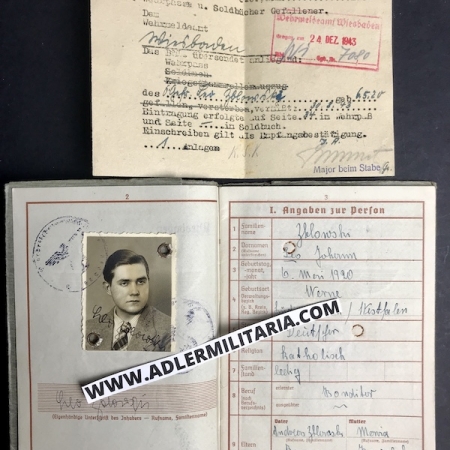
Heer Wehrpass – Funker Zblowski – Infanterie Regiment 689 (246 ID) – Missing in Action (Sold)
Heer Wehrpass issued to Leo Zblowski, in 1939.
He was from Werne in Westfalen, Germany, a Catholic who was not married.
He was enlisted on the 30.8.1939 with Nachrichten Ersatz Kompanie 36
After a while training he was assigned to:
Infanterie Regiment 118 (36 Infanterie Division)
From May 10, 1940, the division took part in the western campaign and advanced to the Meuse. Heavy fighting broke out when crossing the river at Stonne south of Sedan. The division was then used to secure the flanks of the German units advancing towards the canal. In the second phase of the campaign, the “Battle of France”, the division advanced on Verdun on the left bank of the Meuse and captured the city on June 15, 1940. The further advance to the armistice led the division into the Toul area. The division stayed here until the end of September 1940 and then returned to the home garrisons. From November 1, 1940, the division was converted into an Inf.Div. (mot). This resulted in the surrender of the 70th Infantry Regiment to the 111th Infantry Division. The drawn hawsers of the division, however, went to the 126th Infantry Division. Thereafter, the division was referred to as the 36th Infantry Division (motorized).
Infanterie Regiment 689 (246 Infanterie Division)
In exchange, the division received the 689 Infantry Regiment. In February 1942, the division was then transported by rail to the east in the Rshew – Bjeloje area. The division fought here throughout 1942. In March 1943 she stood in the western part of the front arc near Rzhev and withdrew to the Vitebsk area via Duchovshchina and Jelnya and Smolensk as part of the “Buffalo Movement” operation. The division suffered heavy losses and had only the strength of a combat group after the withdrawal movement had ended. In September 1943, further withdrawal movements began via Rudnja, Mikulino and southwest of Vitebsk.
It was here that Leo went missing, the card returning his Wehrpass states that he was reported missing, he is not listed anywhere on the official records and is likely still missing to this day somewhere in Belarus.
Awards: Eastern Front Medal
Trained: Radio Man (Funker), also trained on the light Mortar and K98 Rifle.
Interestingly, inside his Wehrpass is the form required to be filled out that the owner of the Wehrpass is not of Jewish decent.
-

SS-VT ID – SS-Staffelmann Knodel – SS Regiment ‘Deutschland’ – KIA in 1942 (On Hold)
A very rare early SS-Verfügungstruppe ID Card.
These were discontinued when the SS Soldbuch was introduced, hence this was not stamped on the back with a duty stamp, and looks to be left in a folder.
SS-Staffelmann Paul Knodel was a member of the famous SS Regiment Deutschland!
They were responsible for various guard duties also at famous NS locations.
Interestingly, this ID has in pencil at the top left ‘ Junk.Tölz‘ likely meaning SS Junker Schule Tölz in Bad Tölz, the infamous SS Officer School.
It would seem thought that Knodels’ career was cut short, killed in action at the frontline on the 7th of June 1942 according to the German Graves Commission. He is listed as a SS-Rottenführer at the time of his death. He was likely fighting in the SS Division ‘Reich’ .
A very desirable ID and a greta picture of Knodel with the Regiment D shoulder badge and collar tab with ‘1’
-
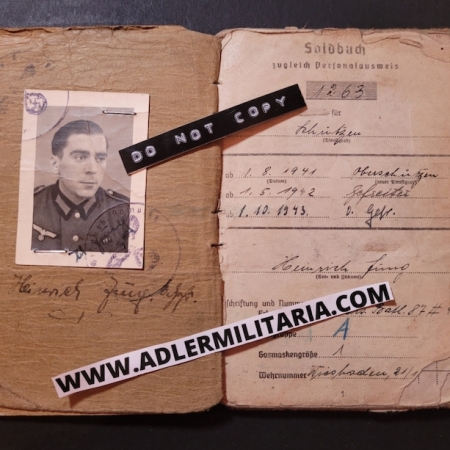
Heer Soldbuch – Obergefreiter Jung – Grenadier Regiment 652 (Inf Div Berlin) – Battle of Seelow Heights 1945 (Hold)
Heer Soldbuch opened in February 1941.
Issued to Heinrich Jung from Wiesbaden, Germany.
After training he was sent to a rather rare frontline unit, also known as a ‘Hunter Unit’:
Jagd Kommando 12 (Heeres Gruppe Nord)
After the battalion was deployed in northern Russia, it was used to fight partisans. The command was deployed under Army Group North near Novgorod.
After a long stint in various driving units, he was sent to :
Reserve Grenadier Regiment 86 (86 Infanterie Division)
The division was torn apart several times and its regiments were deployed separately from the division headquarters. In 1942 the division fought in the Rshew area, as well as in the first months of 1943. In March 1943, the division was relocated to the Orel area. Here she defended the Orel – Kursk railway line and led defensive battles in the Punyri area. At the end of August 1943 the division withdrew via Ssewsk and at Norwgorod-Ssewersk via the Dessna and at Lojew via the Dnieper. At the end of September / beginning of October 1943 defensive battles followed north of the mouth of the Pripet into the Dnieper and finally the retreat into the Mosyr area. On November 3, 1943, the division was dissolved, the division staff, the intelligence department and the supply troops came to Denmark.
Reserve Grenadier Regiment 167
The reserve battalion was in Söndervig in Denmark in December 1944. The reserve battalion formed with parts on February 1, 1945 the 1st battalion of Grenadier Regiment 652 of the Berlin Infantry Division.
Grenadier Regiment 652 (Infanterie Division Berlin – Former 309 Inf Div)
This unit is extremely rare!
They fought during the battle of Seelow Heights according to the book Downfall 1945 (Zaloga,p.50) Grenadier Regiment 652 took the main brunt of the attack in the Haupt Grabben Canal near Letschin just north of Seelow. Fiercely fighting for bridge area just west of the town of Letschin. They fought the 32nd Guards Rifle Corps and the 26th Guards Rifle Corps, on the first day of the attack on April 16th 1945.
If Jung made it out after Seelow, the next was the trap of the Halbe Pocket.
There is no record of Jung, if he survived then he did against all the odds as one battle after another was a disaster for the Germans.
This Soldbuch is featured in an upcoming book on the Battle of Berlin, presented with around 180 other personal documents and items as well as over 400 unpublished photos.
Awards:
Clearly, he was awarded the Iron Cross Second Class, as it is visible on his ribbon band, although this is not entered.
Eastern Front Medal
German Riders Medal
German Drivers Medal
Equipment and issued items:
Wool Blanket
Winter Kit
Mixed Iron Rations
K98 Rifle and Bayonet, as well as his own pistol 7.65mm
In summary, this Soldbuch was issued to a very rare unit, and the link to Seelow 1945 makes it highly desirable as well as the fact that it will soon be published.


