Showing 964–972 of 1445 resultsSorted by latest
-
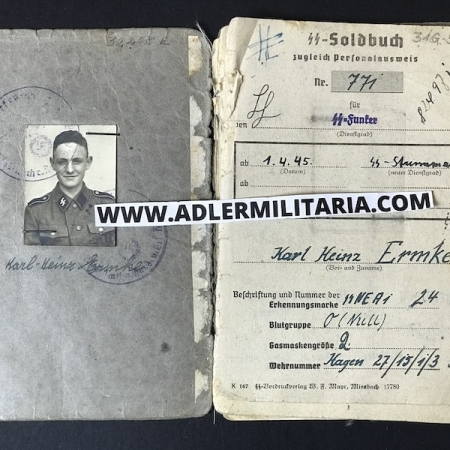
SS Soldbuch – SS Sturmmann Ermke – SS-Panzergrenadier-Regiment 3 “Deutschland” – Das Reich – Captured by US Troops 1945 ! (Reserved)
SS Soldbuch to SS Sturmmann Karl Heinz Ermke Ermke joined the Waffen SS at 17 years old, he was born into a Catholic family in Köln in 1927. His SS Soldbuch was issued to him in March of 1944, in Nuremberg Germany at the SS training unit for Radio communications. His rank designation was SS Funker (SS Radio Man). Promotion: SS Sturmmann – SS Regiment Deutschland 1.4.1945 Ermke was assigned to the following frontline units: SS Panzergrenadier Division Götz von Berlichingen : Bataillon Nieschlag in mid 1944. It would seem that the FPNR on the Soldbuch cover matches: 32208 E (8.9.1943-22.4.1944) – SS-Panzergrenadier-Regiment 37 (17. SS-Division). It seems Nieschald to whom Ermke was assigned, was a war criminal. If Ermke was also involved we will likely never know. ”In Graignes 25 wounded paratroopers from the 3rd Battalion, 507th Parachute Infantry Regiment, 82nd Airborne Division and 30 civilians were killed after the village was captured by 2. Bataillon of the SS-Panzergrenadier Regiment 38 under the command of SS-Sturmbannführer Nieschlag after two days of heavy fighting.” The 17. SS-Panzergrenadier-Division Götz von Berlichingen was raised October 1943 from replacement units and conscripts. It saw action against the US forces in Normandy from 10 June 1944 and suffered heavy losses. The surviving parts of the division refitted in the Saar during Sep and took of manpower from Heer and Waffen-SS stragglers. It fought around Metz in October and November before once again retreating to the Saar, seeing action there in December. SS-Panzergrenadier-Regiment 3 “Deutschland” – Das Reich On January 12, the enemy managed to break into the northern part of Les Tailles. On January 13th, after detachment, the regiment moved to the wooded areas east of Wilwerdingen. On January 14, the regiment moved to the woods north of Holler. On January 15 the regiment had to be withdrawn across the Ourthe. It marched via Burg – Reuland – Winterspelt – Bleialf to Brandscheid, where it passed between the West Wall bunkers. From February 8th to 13th the regiment was then transferred to the Hungary area. The regiment moved into accommodation at Bö – Sarkany. Subsequent replacements came to the regiment, the weapons and the regiment were repaired. On March 2, 1945, the regiment was alerted again. The II. Battalion remained in the accommodation room because it was not ready for action. The regiment was to take part in Operation Spring Awakening, the final offensive in the Southeast. The attack against the Russian troops began on March 6, but after a few initial successes, it got stuck after just a few kilometers. Heavy fighting broke out at Sarkeresztur. The fighting lasted until March 18, then the regiment was pulled out of the front. and transferred to the area north of Varpalota, where it was used against a Russian offensive towards the Vertes Mountains. On March 22, 1945, the area south-east of Raab was reached. The regiment had to fend off heavy Russian attacks in this area. On March 26, the regiment’s retreat began. On March 31, 1945, the regiment left the area south of Esterhazy with the last backups. The regimental staff moved to Wallern. The regiment was then used in early April in the defensive battles around Vienna. The regiment then marched further north-west. On April 19, 1945, the regiment replaced the “Der Führer” regiment in the Gansbach and Kirschlag security line. On April 20, the regiment prepared to attack St. Pölten from the west. But the attack was called off. The regiment was transferred to the Passau area, where it was used again against the Americans. On April 29th the regiment was relieved and Passau was lost. The regiment was up in the air. On May 5, it was still in combat contact with the Americans at Ernshofen and then secured the Danube – Enns – Ernsthofen line. On May 8, the regiment was taken prisoner by the Americans near Enns. Issued a K98 Rifle and Bayonet: in March 1944 and again in May of 1944 Ermke was captured by US Troops, as per page 1 his POW number indicates. Summary This is a great SS Soldbuch to two famous SS Divisions. The line of when he was with who is grey, although with further research this could unveil more. He was certainly with SS-Sturmbannführer Nieschlag who was a known war criminal. This is over all a great example of a SS Soldbuch with clear uniform photo. According to the security stamps it seems like he was twice assigned to a training unit and twice sent to a different SS Division. What is certain was he spent the last months of the war with Das Reich. A little more research could be done with this one by the new owner.
-

Heer Soldbuch – Grenadier Dörrich – Grenadier Regiment 958 (363 Inf Div) St Lo – KIA Normandy (Sold)
Josef Dörrich was born in Sarajevo in 1924. He was enlisted in the the Wehrmacht in summer 1943. He served with: Reserve Grenadier Panzer Jäger Kompanie 251 (159. Reserve-Division) In Belfort France. Grenadier Regiment 958 (363 Infanterie Division) Although the reports state the unit was destroyed int he Falaise Pocket it would seem he was killed a little earlier. Near the famous town of St Lo, Normandy. Josef Dörrich rests in the Marigny War Cemetery. Final grave location: block 3 row 14 grave 543 Summary A KIA Soldbuch for Normandy coming up on the market today is very rare. The Floppy Version of the Soldbuch is not common.
-

Heer Soldbuch – Obergefreiter Malter – Nachrichten Abteilung ‘Ulrich von Hütten” – Berlin 1945! (Hold)
Heer Soldbuch to Ludwig Malter Issued in 1941 Malter served in many Communications units: Korps Nachrichten Abteilung 459 – LIX. Armeekorps (59.) The most interesting of all these units is: Nachrichten Abteilung – Ulrich von Hütten Already on April 12, 1945 the formation of the division was finished. The division had a strength of around 5,000 men. During the night of April 15, 1945, the division moved to the Mulde and was deployed in the Mulde section between Dessau and Bitterfeld. The division’s main battle line ran from south of the blown-up Autobahn bridge of Reichsautobahn 9 (Leipzig-Dessau) across the Mulde between Kleutsch and Möst. The division’s supply units and reserves took up positions east of the Mulde in the area of Kleckewitz, Alt-Jeßnitz, Roßdorf and Mulkdenstein. The first skirmishes with American troops took place near Sandersdorf and Thurland. The division managed to stop the American spearheads who wanted to advance on Bitterfeld. Heavy fighting developed around Thurland during the night of April 16, with most of the village being destroyed. There was further fighting around the towns of Raguhn and Siebenhausen. The heavy fighting lasted until April 20, 1945, on April 21, 1945 the Americans took Bitterfeld. The Infantry Division Ulrich von Hutten was transferred to the Eastern Front with the 12th Army and marched to Wittenberg. There it formed a bridgehead to the north-east and north, which was intended to secure the Elbe line between Wittenberg and Coswig. The division’s task was to secure the town of Wittenberg and the villages north of the town. On the morning of April 25, the division’s regiments that had arrived east and south-east of Wittenberg were engaged in combat with Russian units. The division managed to block the Russian attack on Wittenberg. The division then took part in the 12th Army’s relief attack on Berlin. On the left flank of the XX. Army Corps pushed the division through the villages south of Brück into the Lehnin forest, where heavy forest fighting broke out. The division then marched towards the Autobahn triangle south of Ferch. By April 28, 1945, the heads of the division advanced as far as Ferch, by the evening of April 29 the Bliesendorf – Ferch line had been reached and the town of Hutten had been taken. Here the German advance came to a halt and the division turned to defense. After absorbing the remnants of the 9th Army from the Halbe pocket, the division and the remnants of the 12th Army began to withdraw to the Elbe. By May 8, 1945, the last remnants of the division had been taken prisoner across the Elbe near Tangermünde. Awards Eastern Front Medal Westwall Medal War Merit Cross with Swords This Soldbuch is featured in a new book on the Battle of Berlin 1945, release due Summer 2022. Ask for more information. Summary A very rare unit to find anything to, given there were only 5000 members!
-
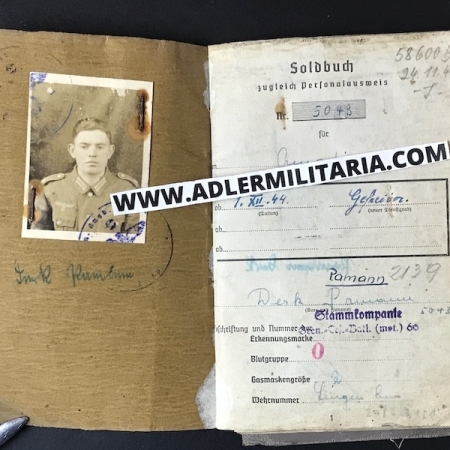
Heer Soldbuch – Gefreiter Pamann – Feld Ersatz Abt 190 (90 Pz Gren Div) Italy 1944 – Died in POW Camp
Soldbuch to Derk Pamann Pamann was born in 1926. He was enlisted into the German Army in 1944. He served with: Grenadier Ausbildungs Batl (mot) 60 Then: Feld Ersatz Battalion 190 (90 Panzer Grenadier Division) The 90. Panzergrenadier-Division was formed on 6 July 1943 in Sardinia from Division Sardinien as a replacement for the destroyed 90. Leichte Afrika-Division. It was moved to Corsica before being transferred to northern Italy. It fought at Anzio, Rome, the Caesar and Gothic Lines and the Po River. It was destroyed near Bologna, Italy, April 1945. Pamann died in Merano, Italy in 1945. Included is his fathers drivers licence with photo. Summary A sad story, to a sought after unit.
-

Heer Soldbuch – Uffz König – Artillerie Regiment 182 (82 Inf Div) – France / Holland (Ralph Fiennes Double!)
Soldbuch to Herbert König Born in Altona in 1914, König entered the German Army in 1939. He served exclusively with: Artillerie Regiment 182 (82 Inf Div) The division was on furlough from August 1940 to February 1941 and then occupation force in the Netherlands. The division commander was also commander of the army troops in the Netherlands. On February 7, 1942, the expansion to a full assault division was ordered. On March 1, 1942, the three infantry regiments each received a 13th IGC. After breaking out of the Kastornoje pocket, the division near the front was refreshed and received new Fp numbers in the summer of 1943. After breaking out of the “Hube” pocket near Kamenetz-Podolsk, the division was disbanded except for a division group of 82, which met in regimental strength with the 254th Infantry Division. The remaining staff was formed on November 22, 1944 as Divisional Staff z.b.V. 608 budgeted for Army Group A. Wounded in September 1943
-
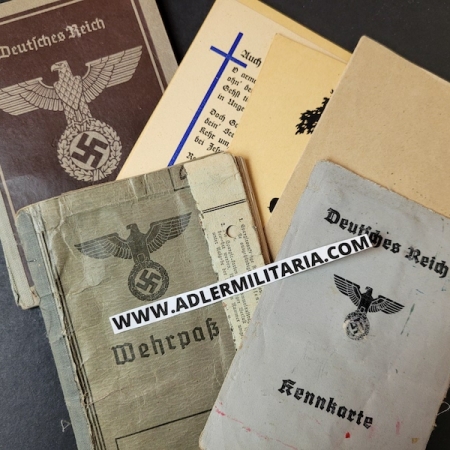
Wehrpass Set – Fähnrich Görg – Schützen Regiment 67 – Berliner – EK2 (Sold)
Set to Werner Görg Görg was born in Berlin in 1920, at 20 years old he enlisted in the German Army with Schützen Regiment 67 Spandau. It seems he removed some pages and entered in another promotion. The Award entries are real: Iron Cross Second Class Wounds Badge in Black Eastern Front Medal Included in the set: Wehrpass Workbook 3 Religious Cards Document from 1947 – Border Police West Germany Kennkarte – Wartime with Photo A small starter set for those wishing to enter the hobby.
-

Soldbuch & Wehrpass Set – Stabsgefreiter Förg – Flak Regiment 42 (9 Flak Div) – Krimschild
Complete set to Stabsgefreiter Ludwig Förg from Fürth. Born in 1906, he was married with no children. He served in the Luftwaffe from before the war till the very last day of the war in 1945! Serving in many different types of Flak moving units, he was lastly assigned to: Flak Regiment 42 – 9th Flak Division in the Saarpfalz. Awarded the Crimea Shield and War Merit Cross Second Class. Förg has a two page Battle calendar, and seen both the Eastern and Western Fronts. Included: Soldbuch Wehrpass Military Drivers Licence with Photo! Post War ID – issued in 1948 along with some extra papers Summary Förg survived the war, seen both fronts served in both the Army and the Airforce and even was awarded a few medals. This is a perfect set for those looking to begin collecting, or needing a full set example.
-

Luftwaffe Wehrpass Set – Dr Schilling-Voss – German Air Sports Association (Nr.64 – DVL)- Rare Badges!
Interesting set to Dr Schilling Voss. Soldbuch from WW1 shows an interesting service starting in Husaren Regiment 9 he fought at Arras in 1914 as well as other trench battles, after he was sent for flight training and ending in a Pilot School as an Officer with: Offizier Flieger Funker Abteilung Warschau . Where as a Pilot he won the Iron Cross First Class! This would not be the end of his flying! An ID for the German Air Sports Association was issued to him in March 1934 in Berlin. Included in this lot: WW1 Soldbuch WW2 Wehrpass Passport with visas for France and Belgium SA Sports Badge Document – SA in Berlin 1935, with photo German Air Sports Association ID with Photo Hunting Licence for 1923 Copy of his Berlin ID 1946 Work related Documents 5 DLRG Membership IDs one with photo Personal ID for the Siemens & Halske AG Berlin in 1946 as a leader of the department German Air Sports Association Box German Air Sports Association Cap Badge – Meybauer Berlin, plus two minatures. Pilots Wings DVL – (Flugzeugführerabzeichen des Deutscher Luftsportverband). Constructed of dark blue wool twill, bearing a machine-embroidered silver aluminum wire insignia in the form of dual wings with a wreath and central black-threaded mobile swastika, unmarked, measuring 125 mm (w) x 25 mm (h), in unissued and near mint condition. Three Pilot Pins Five Diverse other Summary Very nice set, the insignia is quite rare also never mind knowing the story of the owner who was in the first batch in the DVL! Number 64!!
-
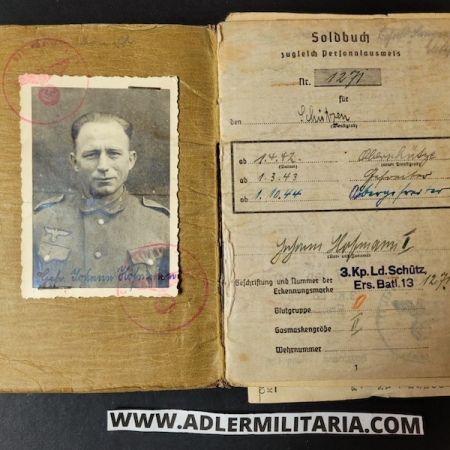
Heer Soldbuch – Obergefreiter Hofmann – Inf.Sich Batl 908 Holland & Grenadier Regiment 984 & 980 (Normandy)! (HOLD)
Obergefreiter Hofmann, was born in 1902. He joined the German Army in January of 1941. It is unknown when he was exactly with certain units, although his last entry for the GR908 is in July 1944, for the GR984 in October, then shortly after he is captured. He was assigned to: Landesschützen Batl 908 / Infanterie Sicherungs Regiment 908 (15th Armee) Grenadier Regiment 984 Two entries are in the Soldbuch from GR984, a promotion in October of 1944 being one. Unit Synopsis: After the start of the Allied invasion in June 1944, two battalions of the division were transferred to Normandy. In July 1944 the rest of the division followed. This was used on the Cotentin peninsula. The division suffered heavy losses in the course of the fighting in the American Operation Cobra and in the retreat in the Falaise Pocket. From August 21, 1944, the remnants of the division were gathered in the Cambrai – Péronne area (northern France) and the division was reorganized again by August 27, 1944. It was deployed again along the Somme (northern France) and was destroyed a second time in early September 1944 in the Mons pocket (Belgium). Only 2,400 men of the division, 400 of them combat troops, were able to escape from the Mons pocket and retreat to the Maastricht area. On September 5, 1944 the remnants of the division were in the Sint Truiden area (Belgium). When the division crossed the German border at Aachen, it still had a strength of around 800 men. Grenadier Regiment 980 It seems that Hoffmann was fighting with GR980 in September of 1944 for a few days. Unit Synopsis: They fought alongside units such as the 1.SS, 2.SS, and to a great-degree 12.SS-HJ. GR980 was often praised for their action in battle although they were not seen as an elite unit. After having participated in heavy action around Caen GR980 was eventually caught in the Falaise Pocket. Those who survived escaped to the north under continual harassment from the French resistance. GR980 later fought in the Hürtgen forest. Summary


