
Showing 946–954 of 1445 resultsSorted by latest
-
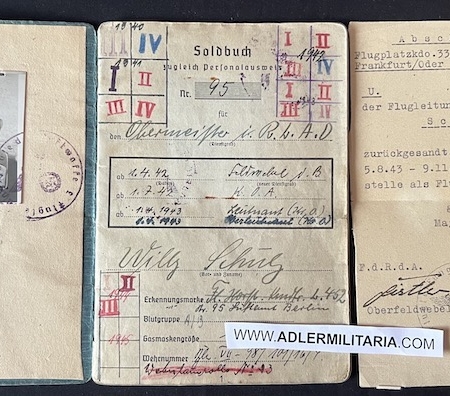
Luftwaffe Soldbuch – Oberleutnant Schulz – Kampfgruppe Schulz – Wounded at Schönefeld Airport Berlin 1945 – Super Rare (On Hold)
Soldbuch Issued to Willy Schulz in September 1939. This is an exceptional Soldbuch, simply because he served in all the famous airports in Berlin as Flugleiter, meaning he was in some sort of Air Traffic control role. A list of the airports/Berlin locations he worked in: Fürstenwalde, Rangsdorf, Döberitz, Schönefeld, Johanisthal, Tempelhof By 1945, according to the entries in the Soldbuch, he was leading his own battle group (Kampfgruppe) “22.4.1945 – Kampfgruppe Schulz – Combat in defence of Berlin” Then, “Wounded and taken Prisoner and send to hospital” It would seem he was according to his Soldbuch delivered to the War Hospital in Potsdam, where he was treated till August of 1945, finally staying in Berlin Kreuzberg St Josef Hospital. This is an exceptionally rare Soldbuch, and is also being published alongside many others for the Battle of Berlin in an upcoming book on artefacts of the battle.
-

Deathcard – Staudinger – Killed in action in Berlin Spandau 1945 – Battle of Berlin (on Hold)
Killed in action in Berlin Spandau in the final days of the battle of Berlin 1945.
Comes with the German Graves registry printout.
-
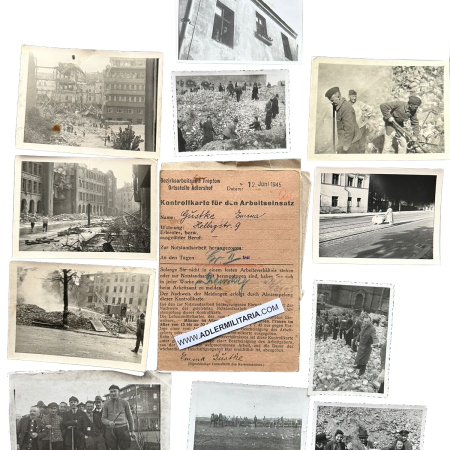
Tümmerfrau- Emma Gustke – Berlin 1945 – Rubble cleaner – Rare grouping
$235.00Tümmerfrau – Berlin in Ruins The Work Control Card and photos of a Trümmerfrau For more information see: https://en.wikipedia.org/wiki/Tr%C3%BCmmerfrau Emma Gustke, from Treptow was employed from the 18th of June 1945 to clean the streets of Berlin. Men from 15 to the age of 65 and woman from the ages of 15 to 50 years old were required to work. Her photos show the extent of the damage, brick by brick the areas were cleared. In Berlin alone around 60,000 woman were employed to clean the streets from the debris the war inflicted on the city. The pictures tucked inside the work card, a few memories she tucked away…
-
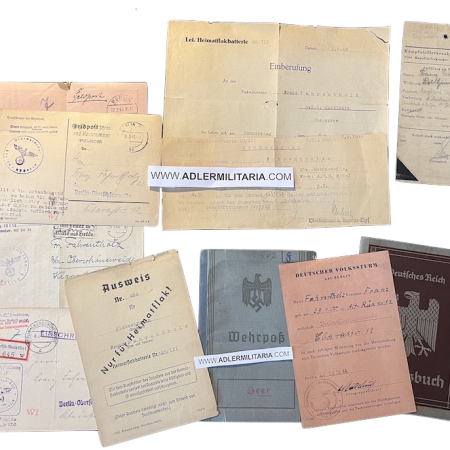
Volkssturm/Heimat Flak – Flakwehrmann Fahrentholz – Wounded in Battle of Berlin Tempelhof Airport 1945 – Super Rare (On Hold)
Franz Fahrentholz was born in 1900 in the small town of Altrüdnitz (Today: Stara Rudnica) on the banks of the Oder River. He served in the First World War during the end phases of 1918 and was lucky to have missed the horrible bloodshed seen by the men only a few years older than him. From early 1932 Franz was an employee at the AEG Cable Works in Berlin Schöneweide. Franz continued to work there throughout the war, leading teams that produced items directly linked to the war industry and used slave labour. Franz was not immune to the war effort in another form, defence. These large structures of the AEG were prime targets for Allied bombing raids. The large buildings on the banks of the river Spree would have been an easy target from above. By July 1941, Franz was sent an order to report to a large gym hall in Berlin-Neukölln to be considered for military duty, he was found fit for duty in the Landwehr, also known as a home army. Although he was not sent to a home army unit he could have been called up anytime. By early 1943, Franz was ordered to take his Wehrpass and report for a further inspection, by June he was enlisted into a home guard Anti-Aircraft unit known, Heimatflakbatterie 28/III. Franz was trained on a captured French light machine gun, the FM 24/29 and received instruction on an anti-aircraft searchlight (Flak-Sw 36 – 60cm). The 60cm searchlight was operated by one person and was built on a small turntable equipped with a seat and trailer, it allowed for a 360-degree reach and was deployed very fast. If an allied aircraft was spotted and followed with such a search light it would mean the spotters firing had a clear target to aim at. Franz was given the rank of Flakwehrmann, which was a civilian rank given to those that completed a standard course designed in 1943. The objective of which was to train civilians on anti-aircraft related equipment for the purpose of defending the home front. On successful completion of the course the rank of Flakwehrmann was reached and the soldier was awarded a civilian badge. The badge was worn on the left side of the lapel, the eagle of the Luftwaffe holding the swastika inside the cog symbol the symbol for German workers. He fought with: 1st Flak Division, Leichte Flak Abteilung 979 (o) Stationed at the Berlin Tempelhof Airport. By April 1945 during the advance of the Soviet army, Franz was found on the banks of the Landwehr Canal on the Maybachufer in Berlin Neukölln. The Maybachufer a 1.47 kilometre long street with one side running parallel to Canal. Comments: an extremely rare set for central Berlin, the wounding tag completing the picture on what happened to him.
-

Luftwaffe Soldbuch – Flieger-Hauptingenieur Breitkopf – RLM Berlin – Rare (On Hold)
98Very rare Berlin Soldbuch, for the infamous RLM Building which still stands in Berlin. Flieger-Hauptingenieur Walter Breitkopf was born in 1908 in Breslau (Today: Wroclaw in Poland). Breitkopf, an engineer that joined the Luftwaffe in 1938 worked in the RLM from the early days till the end of the war. Breitkopf was a member of the Fliegeringenieur-Korps (Flight Engineer Corps) admission to the Corps meant having had done a prior two year military service, be commissioned as an officer whilst holding a degree in engineering and whilst having the state exam for aircraft design. Breitkopf was assigned to the department GL4 (later TLR/B) responsible for testing new aircraft. Work was done inside the RLM building and in 1942 Breitkopf was moving back and forth from an airbase in near Paris. When on duty for the RLM in Paris in late 1943 he was sent home to Berlin due to his apartment being damaged due to an allied bombing raid. On the first of March, Breitkopf was promoted to Flieger-Hauptingenieur, a head engineer with the rank equivalent of a Capitan. In the final days of the war he was captured in Rostock, (2nd Belo Fr) likely at the Heinkel aircraft plant. The first page of his Soldbuch is stamped by the Soviet Command in Rostock. His prewar Dienstausweis (entry pass) into the RLM made of waterproof paper displays usage right the way till February 1945. His matching Erkennungsmarke (Dog Tag) and Luftwaffe issue Soldbuch. Interestingly, Breitkopf lived with his wife next to Germany’s oldest airport in Berlin-Johannisthal the many streets around there were home to all the top names in the German aircraft industry. It was from there that the first planes and Zeppelins took to the sky over Germany. The scene of one of the world’s first air disasters. A test flight of a Zeppelin exploded and crashed killing all 28 crew members. Today the former Johannisthal airport is an abandoned place slowly falling apart, the runways are now a nature park, the paths around it a popular spot for runners. Please note: This Soldbuch will feature alongside many other Berlin Soldbücher in a Book currently in he end phases.
-
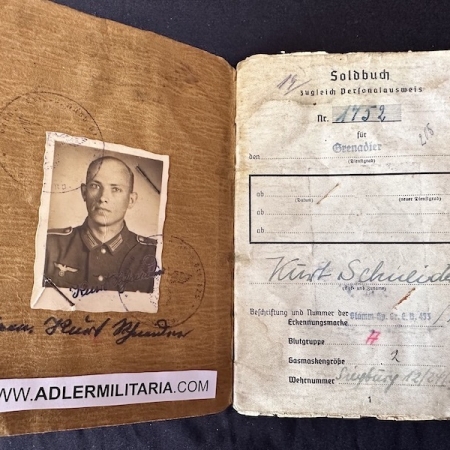
Wehrmacht Soldbuch – Grenadier Schneider – 36 Volksgrenadier Division – Operation Nordwind – Wounded fighting the US Army (sold)
Soldbuch issued in March 1943, to Grenadier Kurt Schneider from Siegland, Germany. He was born in November of 1912. He was not married and had a civilian job before he was called up. After a period training he was deployed into: Arriving in Russia in late 1943, with Ausbildungs Batl 453. He was wounded with them in March of 1944, after that he was sent in June to a replacement unit and made his way back to the front sometime in later 1944 with: Grenadier Regiment 894 ( 265 Infanterie Division) & Grenadier Regiment 165 (36th Volks Grenadier Division) – This time Schneider would fight in the Westfront exclusively. Wounded again in January of 1945 with a bullet wound, 31a in the Soldbuch. He was moved to another hospital in April of 1945 as the front drew closer and likely made it through the war. By the end of November the division had lost 50% of its personnel in the fighting in Lorraine. On December 5, the so-called “Forbach position” was occupied. Although completely exhausted, the division received the order on December 25, 1944 to move from the Saarbrücken area to positions in the St. Ingbert – Blieskastel area east of the Saar in order to break through the Maginot Line from there in a southerly direction. It was thus part of an attack in the lower Vosges to relieve the deadlocked Ardennes offensive in the north. The attack began on December 31, 1944 at 11 p.m. The division was unable to reach its attack objectives in the following days. As early as January 3, 1945, the attack was ordered to cease and the division went over to defense in the old main. In the weeks that followed, things remained relatively quiet at the main front line. The division was replaced, so that on February 3, 1945 it had a fighting strength of 3,165 men again. Interestingly the battles of Grenadier Regiment 165 are documented in the book: In Pursuit of Hitler Battles Through the Nazi Heartland March to May 1945 By Andrew Rawson · 2008 Comments: Interestingly, the NCO of the same Regiment and the first batl is for sale online, – Unteroffizier Hans Greiter (26.08.1920 † 01.10.2002) earned the Ritterkreuz on January 13, 1945 as Unteroffizier und Meldestaffelführer of the I. Bataillon/ Grenadier-Regiment 165 of the 36. Volksgrenadier-Division- Operation Nordwind
-
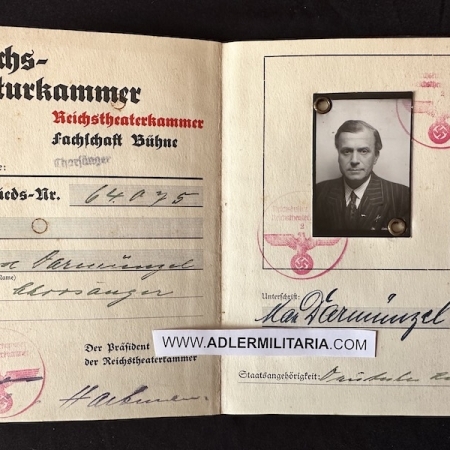
Reichskulturkammer – Choir Singer Darmünzel
Interesting Civilian ID for a professional choir singer for work on stage. Interestingly, he worked in Berlin and in the Deutsche Nationaltheater Weimar in 1943 and 1944. With the support of the conservative state government, the National Socialists had been holding regular party meetings in Weimar since 1924. In 1926, the first Reich Party Congress of the NSDAP was held in the theater after the ban was lifted. The General Manager Ernst Hardt left the theater in 1924 after there had been violent and defamatory protests against his performances from ethnic-nationalists. His successor Franz Ulbrich initially tried to continue playing contemporary authors such as Ernst Toller, Carl Sternheim and others, despite threats of censorship and calls for »cleansing« of the Weimar theater schedule. However, he increasingly made compromises with the National Socialists, who were involved in the state government from 1930 and demanded a “Jew-free theatre”. From 1933, Ernst Nobbe, a member of the NSDAP, took over the directorship, followed in 1936 by Hans Severus Ziegler, who, among other things, had co-initiated the decree »Against Negro culture for German nationality«. During the Nazi regime, a classical repertoire was mainly played, with Schiller’s drama in particular being placed in a National Socialist perspective. Hitler wanted to develop the Weimar Theater into one of the leading theaters in the German Reich and supported the DNT annually with private funds. History – National Theater Weimar The conversion of the auditorium and the renovation of the stage technology in 1939/40 devoured a sum of over 800,000 Reichsmarks, which Hitler personally campaigned for. The fact that such a sum came together during the war years illustrates the special importance of the DNT at that time. The theater also played for the entertainment of the SS members in the casino of the Buchenwald concentration camp. While Franz Lehár’s “The Land of Smiles” was being performed at the DNT, Fritz Löhner-Beda, the Jewish librettist of this operetta, was imprisoned just a few kilometers away in Buchenwald. His name was concealed in the program booklet. In autumn 1944 all theaters in Germany were closed. The DNT was leased to Siemens & Halske as a production facility. An American bombing raid on February 9, 1945 reduced the theater to rubble and ash except for the façade and the foyer.
-

Truppenausweis – Oberst Max Röhrs – Judge in Berlin Reichskriegsgericht – Sent “WinzenGruppe German Resistance -” leader to death
Truppenausweiss for Oberst Max Röhrs, born on the 26.01.1893 in Brake, Germany. Röhrs served as a Judge in the Reichskriegsgericht (German War Court). Super rare to find anything for the Reichskriegsgericht in Berlin-Charlottenburg. Röhrs was a Judge that sent Paul Winzer to death, the leader of the Winzengruppe. As well as that, Röhrs was a judge in other high profile cases such as the case against Werner Engel another German Resistance member. This Identification paper was used right up to 1944. He is wearing the WW1 Marine Wounds Badge as well as the Iron Cross First Class with WW2 Clasp. Paul Winzen * November 24, 1911 in Dortmund Paul was born as the youngest child of the Winzen family. It is no longer possible to determine when he left his parents’ house. In the Dortmund address book from 1941 he is still listed under this address, his profession is given as a stationer. Paul Winzen was a member and leading figure of a resistance group that had emerged from free-thinking/free-religious organizations. People met to go to the theater, visited exhibitions and discussed a wide variety of topics. Politically, they rejected both Soviet communism and social democracy. They advocated a humanistic social order. After 1933, the Dortmund group, which was also called the Winzen Group after its founder Paul Winzen, met in various places and organized the resistance: leaflets against the Nazi regime were printed and foreign radio stations were listened to. When an informer finally crept into the group in 1940 and betrayed the members, they were arrested as members of the Winzen group. The trial of Paul Winzen took place in February 1942 in Berlin before the People’s Court. He and another head of the group, Josef Kasel (see Stolperstein Gneisenaustr. 89) were sentenced to death for “undermining the military force” and “preparing for high treason”. Winzen was also convicted of “broadcasting crimes”. The judgment was carried out on June 12, 1942 in Berlin-Plötzensee.
-
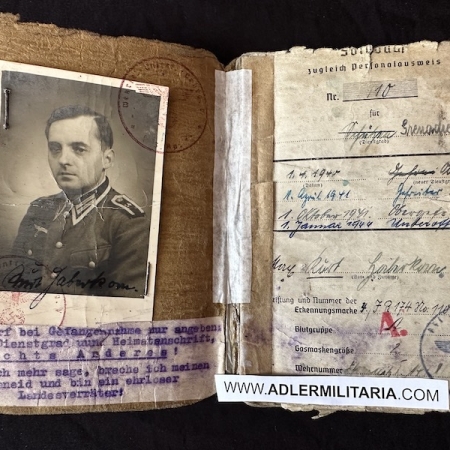
Wehrmacht Soldbuch – Unteroffizier Haberkorn – Grenadier Regiment 1120 – 553 Volksgrenadier Division Ardennes 1944 – Wounded fighting US Troops 1945 (Reserved)
$345.00Wehrmacht Soldbuch for NCO Kurt Haberkorn. Soldbuch opened in December of 1939 with Infanterie Regiment 174. In 1941 – Etra Südost / Wehrmachttransportleitung Südost On 01.11.1940 – set up in Vienna, the use of which is to be considered in connection with the dispatch of the German army mission to Romania, which began in October, and the increasing involvement of the Balkans in German military plans. It was initially responsible for the transport command in Ostmark, Bohemia and Moravia, the transport officer in Pressburg and the German border command in Regensburg. Location always Vienna Late 1944 / 1945 – Grenadier Regiment 1120 (553 Volksgrenadier Division) – Fought against: US ARMY – 79 US Infantry Division & 10 US Armoured Division near Oehringen/Schwaebish Hall 1945 553. Volksgrenadier division was created on 9 October 1944 by the renaming of the 553. Grenadier division in Lorraine. The 553. Grenadier division was originally formed as a Sperr division (blocking division) in Münsingen. The unit was composed of men from Württemberg. In September 1944, the 553rd was rushed to the Lorraine region of the western front and thrown into battle against the Allied troops advancing on the city of Nancy. During September 1120. Grenadier regiment of the division defended Forêt de Champenoux to cover the withdrawal of the rest of the division. The regiment had entrenched thoroughly, building a line of log-covered dugouts and foxholes ten or fifteen yards inside the forest. Within the shelter of the woods a few assault guns backed up the infantry and covered still more entrenchments. When the Americans attacked with tanks and infantry on 20 September, they were repulsed. Repeated attempts were made to push the 1120th Regiment out of their positions during the day, and the following day, but all were driven back. The Americans tried a prolonged artillery barrage to demolished the entrenchments, but even this was unable to dislodge the defenders. On 22 September, the Americans tried a combined attack with the 80th and 35th Infantry Divisions, supported by one combat command of the 6th Armoured Division and the Volksgrenadiers were finally pushed out of the forest. With the Americans now threatening both his flanks, the 553. GD’s commander, Oberst Erich Loehr pulled his division back. The division was pulled out of the line in October. The whole 553. Grenadier division had been worn down after a month’s hard fighting and had to be reinforced. The reinforcements it integrated were number of fortress and independent battalions in the area of Army Group D. Even with the addition of these groups, one regiment (the 1121st) was dissolved along with the 2nd Battalion of 1120. Grenadier regiment. While the US Third Army was advancing from Metz, the US Seventh Army was preparing to clear the Saverne Gap. In mid-November, the American 44th Infantry and the French 2nd Armoured Divisions started an advance aimed at taking Saarbourg. Among the defending units was the newly renamed 553. Volksgrenadier division. Another hard defensive battle began for the Volksgrenadiers. The Allied assaults ground down the German units until they were only shadows of their normal organisations. After Saarbourg fell to the US 44th Infantry Division on 21 November, the remnants of 553. VGD were pulled out and transferred to southern Alsace. During Operation Nordwind the division the division attacked alongside 10. SS-Panzerdivision from Gambsheim towards Haguenau. At the end of January, the High Command decided to pull the 553. VGD out of the line entirely and rebuild it once again. The division was re-established on 31 January 1945 in Pforzheim. The division was deployed in the 19. Armee sector on 20 March. The division surrendered to the Americans shortly thereafter in Württemberg. Awards: Wounds badge in Black , he was wounded twice and received no Silver badge due to the war ending. Soldbuch comments. Very nice piece of paper added to the front page, detailing that he is if the captured only allowed to say his name, rank and home address, anything else is dishonourable and guilty of treason against Germany. A rare late war unit, fighting in desirable and sought after battles. 10th Armoured – US Army Documentary about the fighting in Germany, also where Haberkorn was wounded. An interesting documentary covering the creating on the Volks Grenadier Divisions


