Showing 82–90 of 1445 resultsSorted by latest
-
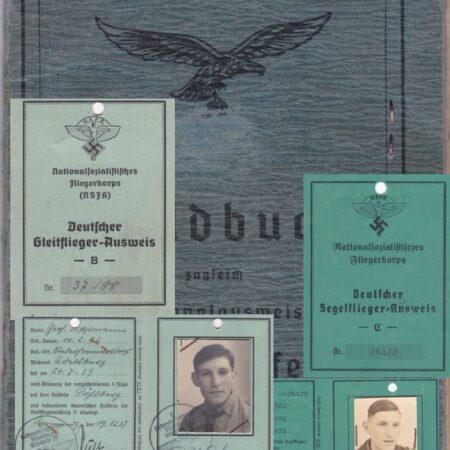
WWII German Luftwaffe Soldbuch ID Grouping – Pilot NCO Gerhard Lippmann – Nachtjageschwarder 101 – FL Sonderkommando ObL – Pilot Badge
Lippmann clearly wanted to bump his rank up by forging the promotions to Hauptmann, this included him removing his photo. It is clear he did not get promoted to Officer Rank, I have checked the Officer Career Summaries and he is not listed as having been promoted to Officer. Served with: In 1943 till early 1944 I – Nachtjagdgeschwader 101 10 / Nachtjagdgeschwader 5 Then in April 1944 with: I /Jagdgeschwader 302 FL Sonderkommando Oberbefehlshaber der Luftwaffe (LP) – Based at Dedelsdorf airfield was likely a flight testing facility. By 1945 Lippmann was sent to Flak Abteilung 1003, and later Flak Regiment 255 Captured and interned in POW Camp in Bellaria June 1945. Awards It seems on page two he added more awards beside his fake promotions. His real awards were, Hj-Leistungsabzeichen, Deutsch Segelflieger Abzeichen, Reichssportabzeichen, Pilots Badge (1943) Died in March 2018
-
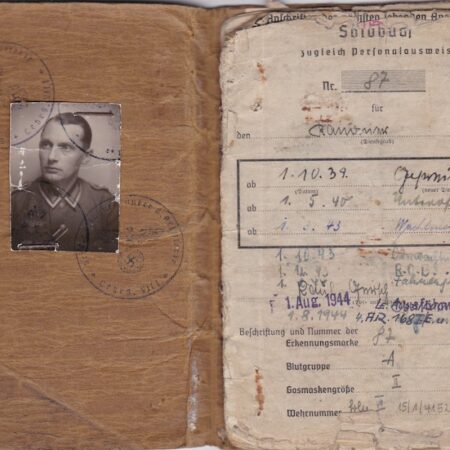
WWII German Army Soldbuch – Wehrmacht Leutnant Gersch – Berliner – Artillerie Regiment 168 – 38 Infanterie Division – Sturmtage – Iron Cross First Class
$275.00Soldbuch opened in August 1939 with Artillery Regiment 168. Issued to Paul Gersch from Berlin Rudow He served with Art Reg 168 till late 1943. The division was already operational at the beginning of the Polish campaign, so that on September 1, 1939 the division became an army reserve of the 4th Army. From the area north of Kraków, the division advanced through Sandomierz to Janow. After the end of the Polish campaign, the division was used as an occupation force in Poland until November 1939 and then transferred to the 16th Army on the Moselle north of Trier. At the beginning of the western campaign, the division was the army reserve of AOK 16 and only took part in the second phase of the campaign, the “Battle of France”. They marched from south of Sedan to Epinal. Already in July 1940 the division was transferred to eastern Poland for border security. On October 15, 1940, the division sold a third of its inventory (Stab IR 196, I./169, I./118 I./196) to the 340th Infantry Division. The levies have been replaced. From June 22, 1941, the division took part in the Russian campaign. The division advanced across the San from the Yaroslav area. The division advanced past Lemberg via Vinnitsa to the Cherkassy area. Here the division formed the flank protection of the 6th and 17th armies. In October 1941 the division continued its advance through Poltava to Kharkov. Heavy winter fighting then broke out in the Izyum am Donets area. These were to last until May 1942. After that, the division took part in offensive battles on Izyum and Znamenka. In the summer of 1942 the division marched to Voronezh-on-Don. Here the division remained in trench warfare until February 1943, when the division had to join the German retreat after the defeat of Stalingrad. Defensive battles and positional battles followed on the Oskol, near Gorshetsnoye and in the Ssumy area west of Kursk. In July 1943, defensive and retreat battles followed on the Dnieper. The division then stood until November 1943. On November 1, 1943, the division was converted into an infantry division of a new type 44 and the third battalions of the three regiments were dissolved. In November 1943 the division moved to the Radomyshl area and was in December 1943 near Zhitomir. It was in this room that it was smashed in January 1944. The remnants of the division were pulled from the front and collected and refreshed at the Demba military training area He then was a trainer at the: Schule für Fahnenjunker der Artillerie Lehrgang VIII School for Officer Cadets of the Artillerie In March of 1945, Gersch was wounded with an infantry bullet (I.G) and in May of 1945 he is back again in hospital in Hamburg due to a code 34: accident of self mutilation. So one thing is clear he certainly seen action after his training. Issued a FN Pistol and later a Mod 27 Pistol. Medals Eastern Front Medal Iron Cross Second Class Iron Cross First Class Assault Days 28.01.1943 – Alarm Regiment 1 (Einheit Embacher) 29.01.1943 – Alarm Regiment 1 Included in the back of the Soldbuch are the 10 Rules for German Soldiers. Final Comments: A nice Soldbuch to a real combat Officer. Awarded both classes of the Iron Cross. Interestingly, after his deployment with his Officer rank it seems he once again seen combat, although I am unsure with who. Maybe the School or maybe back to his old unit? Missing one page 13/14
-
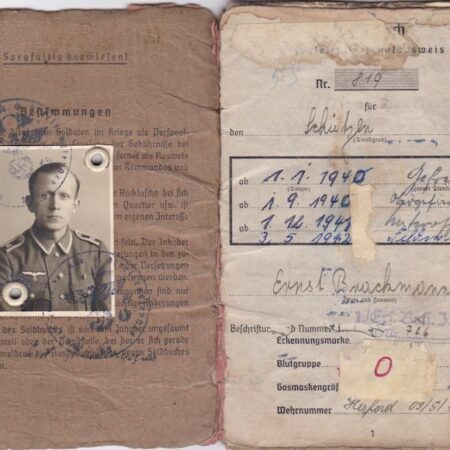
WWII German Wehrmacht Soldbuch ID – Unteroffizier Ernst Brackmann – Festungs Pak Verband 5/XXVI – 8,8 cm Pak 43 – Wounded Frankfurt-Oder April 1945 (HOLD)
$165.00Unteroffizier Ernst Brackmann Served with many units, although the most interesting is: Festungs Pak Verband 5/XXVI The staff of Fortress Anti-Tank Unit XXVI was established in January 1945 in Military District V as an army unit. In March 1945, the Fortress Anti-Tank Companies 1./XXVI to 10./XXVI were formed in Military District III (Berlin). The unit was deployed in the Frankfurt an der Oder area. They were armed with the 8,8 cm Pak 43 Wounded with grenade splinters – 18.4.1945 – arrived at Beelitz in a Reserve Hospital. Awards – War Merit Cross with Swords – Wounds Badge in Silver Final Notes He himself entered in a Promotion and EK1 & EK2 – I believe these to be self promotions and likely postwar as its with a ball point pen. Also the entry on page 17, “Schwere Jagdpanzer” is phoney. But still is an interesting Soldbuch given the small issues.
-
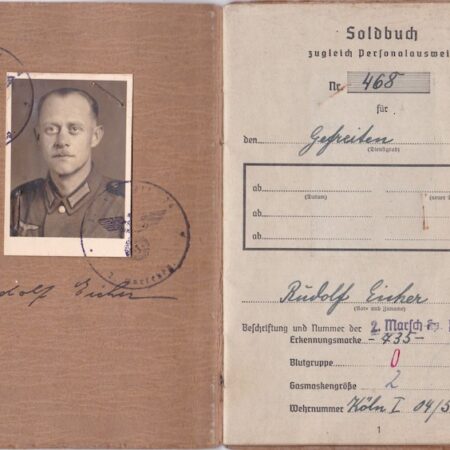
WWII German Wehrmacht Soldbuch ID – Gefreiter Rudolf Eicher – Einweisungs Abteilung 1008 – West Wall Medal – Minty Soldbuch!
Soldbuch opened in December 1943 Eicher was from Munich Germany. Served with: Stellungsbau-Rahmen-Bataillon 1008 Einweisungs-Abteilung 1008 The unit was deployed as an army troop in the Oppeln area, in military district VIII. Interestingly there is a Security Check on 1.09.1944 – it seems it was by Hoherer Pionier-Fuhrer z.b.V. 104 – 9th Army Awards: 26.2.1945 – West Wall Medal – Hoherer Pionier-Fuhrer z.b.V XI Captured by the Red Army – Page 8c – August 1946 entry from Red Army Military Command.
-
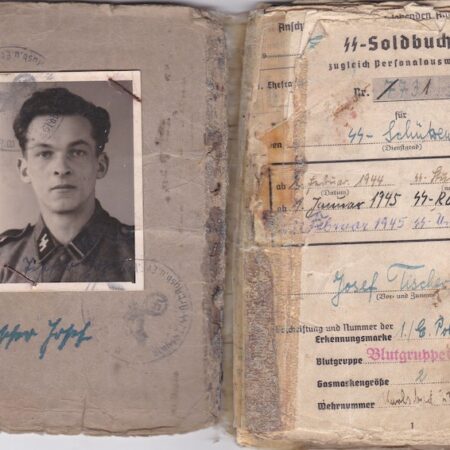
WWII German Waffen-SS Soldbuch ID – SS Rottenführer Josef Tischer – SS Panzer Artillerie Regiment ” Das Reich ” – SS Artillerie Regiment 54 – Nederland – Kurland 1944 – SS Artillerie Regiment 23 – Oder / Halbe 1945 – POW – Rare unit!
Frontline Units: SS Korps Nachrichten Abteilung 1943 – Injections SS Panzer Artillerie Regiment ” Das Reich “ It seems he was with them in the Summer of 1943 At the end of June 1943, the division took up its starting position west of Belgorod for the impending German offensive at Kursk. From June 5, 1943, the division participated in Operation Citadel and advanced on the town of Berezov. On June 6, the division was in the Luchki area, and on July 11, it was 3.5 km from Prokhorovka. On July 18, 1943, the division’s offensive was called off. It was withdrawn from the front and prepared for transfer to Italy after the Allied landings in Sicily. SS Artillerie Regiment 54 – Nederland – Stabsbattr – 4. SS-Freiwilligen-Panzergrenadier-Brigade Nederland (Payment Group Change – Page 22 – 1.2.1944, Equipment Issued – 12.4.1944, Last Entry was a promotion in January 1945) On January 15, 1944, the brigade endured its first heavy defensive battles. Elements of the brigade succeeded in liberating the encircled 9th and 10th Luftwaffen Field Divisions . As early as January 26, 1944, the brigade received orders to move to the so-called “Panther” position along the Narva River . After heavy defensive fighting, a new position was established in early February 1944. After several smaller battles in February, a new Soviet offensive followed from March 11, 1944. By June 30, 1944, the brigade had 6,714 men. During the major Soviet summer offensive, the first elements of the brigade were ordered to withdraw from the front line on July 24, 1944. The SS Volunteer Panzergrenadier Regiment 48 served as the rearguard, was encircled, and subsequently destroyed by Soviet troops. The remainder of the brigade was deployed in the “Tannenberg” position. On September 21, 1944, the III SS Panzer Corps ordered the re-establishment of the SS Volunteer Panzergrenadier Regiment 48. For this purpose, the remnants of the regiment were shipped to Germany and re-established at the Hammerstein military training area, primarily with members of the Kriegsmarine . The brigade saw action in Courland south of Dobele until September 28 and was immediately involved in heavy defensive fighting. On October 12, 1944, the brigade was given command of the area south of Liepāja and a few days later south of Priekule . In the heavy fighting that followed, the brigade’s front was repeatedly breached. On January 16, 1945, the brigade still had a strength of 5,751 men. After relatively quiet days, the Red Army launched a major attack on the entire front in front of Liepāja on January 21, 1945. After heavy fighting, the brigade was withdrawn from the front line. On January 28, 1945, the brigade was loaded onto ships in Liepāja and transported to Stettin. SS Artillerie Regiment 23 – Stab – The 23. SS-Freiwilligen-Panzergrenadier-Division Nederland (niederlandische Nr. 1) It fought on the Eastern front seeing action on the Oder and south of Berlin where it was caught in the Halbe pocket, before surrendering to US forces at the end of the war. Issued Items Pair of Drivers Gloves, and Protection Glasses – June 1944 Feb 1945 – Rifle Awards Black Wounds Badge – 2.9.1943 Payments 4.1942 – FPNr 04962 – Putzgeld 8.1943 – FPNr 24262 – Wehrsold & Frontzulage 9.1944 – Fontzulage Post War payments – POW Camp Final Notes Comes with his POW Release Document Bad entries – he bumped himself up a rank and awarded himself an EK1 & EK2 – these are 100% post war entries in an otherwise really desirable and interesting Soldbuch. Especially because it seems he made it out of Kurland and was part of the unit in the Halbe that made it to the US lines!
-
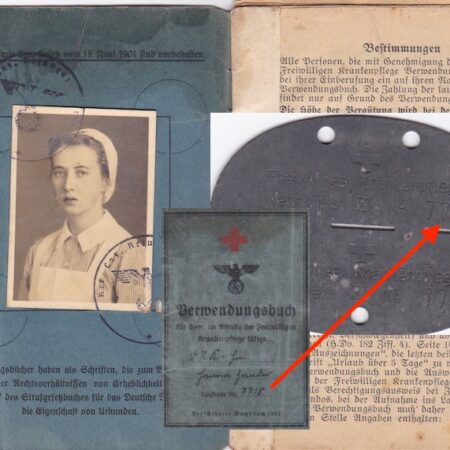
WWII German DRK Verwendungsbuch & Erkennungsmarke – DRK Nurse Hanna Zander – Tag – Freiwillige Krankenpflege Wehrkreis XI
Interesting set, issued to Volunteer Nurse Hanna Zander, with matching EKM. Wehrkreis XI – Hannover Some pages are missing but none the less, an original matching combo that you do not see all too often.
-
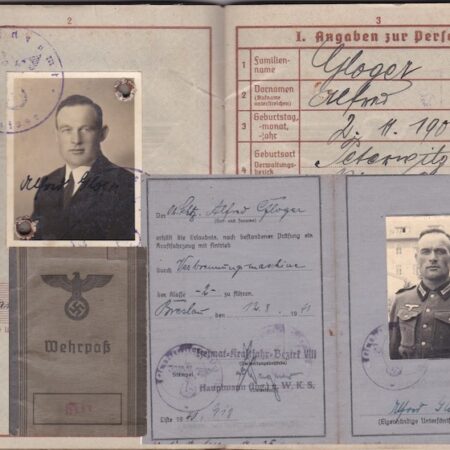
WWII German Wehrmacht Wehrpass ID & Wehrmacht Führerschein – Stabsgefreiter Alfred Gloger – Wehrmacht Driver with Drivers Licence
Interesting little set to a driver.
-
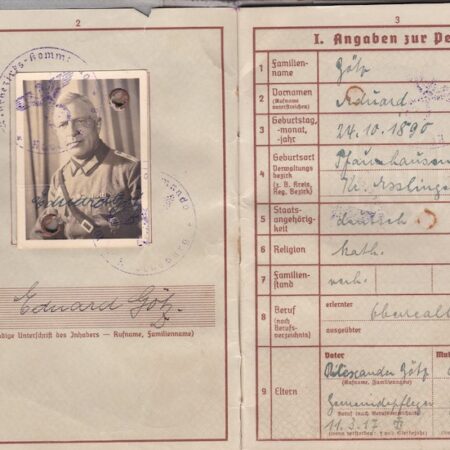
WWII German Wehrmacht Wehrpass ID – Hauptmann Götz – Landesschützen Batl 423
$165.00Hauptmann Götz Wehrpass Nice early Wehrpass with the Officer in uniform on the photo. He served in the First World War – fighting on both West and Eastern Front (1915 Argonnen, 1917 Russian Front, 1917 Aisne, Champagne, 1918 Verdun, France. He was wounded also twice – first time in September 1915 in the head area. Then again in 1918 – due to an aircraft dropping a bomb, he sustained multiple wounds on his arm. Awards: Hindenburg Cross, Silver Service Medal, Iron Cross 1914, War Merit Cross II Class with Swords 1942. Served with the below unit, guarding POWS. The 423rd Landesschützen Battalion was formed on June 6, 1940, in Military District V. At the time of its formation, the battalion was subordinate to the 405th Special Purpose Division. The battalion was organized into six companies for the guarding of prisoners of war. Initially, the battalion was deployed in Ulm, also in Military District V. In 1943, the battalion was stationed in Göppingen, also in Military District V. There, the battalion was under the command of the Commander of Prisoners of War V.
-
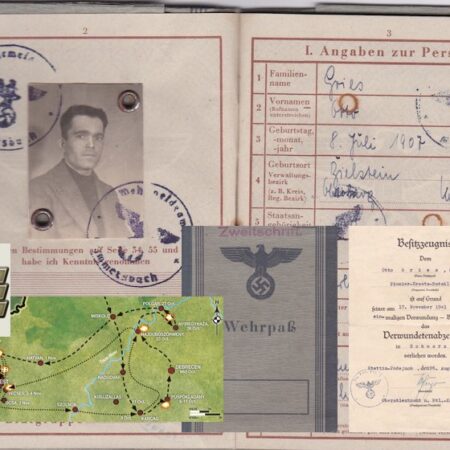
WWII German Wehrmacht Wehrpass ID – Unteroffizier Otto Gries – Panzer Brigade 110 “Feldhernhalle” – Wounds Badge Certificate – KIA Budapest Oct 1944
Interesting Wehrpass issued to Otto Gries. He served in various Pioneer units, Pioneer Batl 160 (renamed Feldhernhalle) Part of 1943 and early 1944 fighting with them, at the time they were in Narva Estonia, under the 18th Armee. There he was wounded and was awarded the Assault Badge. July 1944 – Panzer Pioneer Kompanie / Panzer Brigade 110 – Feldhernhalle On the 12th of October 1944 he was wounded in his arm, he would die five days later and is buried in the Budapest area. I have attached two bits of research in the images from an online source, it would seem he was likely wounded in the Battle of Debrecen near Budapest Hungary. Awards: Black Wounds Badge (1942), War Merit Cross 2nd Class, Wounds Badge in Silver, Assault Badge (early 1944). His Wounds Badge Award Certificate was tucked into the back of the Wehrpass!


