Showing 91–99 of 1445 resultsSorted by latest
-
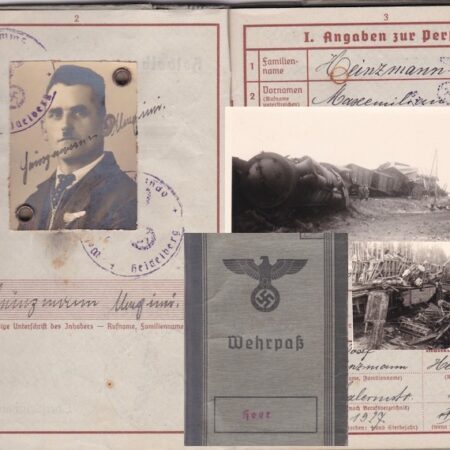
WWII German Wehrmacht Wehrpass ID – Sonderführer (G) Maximilian Heinzmann – Feldeisenbahn – Krimschild – KIA Aircraft Bombed Train Krim 1942 !
Interesting Wehrpass to Heinzmann, he was killed on the Krim when his train was attacked near the Train Station on the Krim. Three photos can with the Wehrpass, where you can clearly see a train has been hit with a bombing raid. Not such a common unit: Feldeisenbahn-Betriebsabt 2 He was awarded the Krimschild (Crimea Shield) I have added in three bits of research to print if you wish to buy this confirming his death in the German Archive.
-
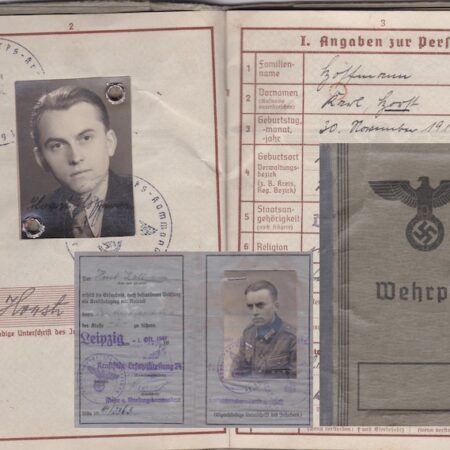
WWII German Wehrmacht Wehrpass ID & Wehrmacht Führerschein – Obergefreiter Horst Hoffmann – Signal Intelligence – Nachrichten-Fernaufklärungskompanie 610 – Rare Unit!
Really interesting unit not often met, according to records this unit was only built up of 250 men! What they did: The Signal Intelligence Regiment (German: Kommandeur der Nachrichtenaufklärung, lit. ’Commander of intelligence’) (KONA) was the basic element of the field organisation of the German Army (Heer) signals intelligence organization (first called Inspectorate 7/VI, then LNA, and finally OKH/GdNA) during World War II. The KONA regiments were mobile communication reconnaissance units which were assigned to an army group and operated close to the front lines within the theatre of operations to intercept and build intelligence, via evaluation services (cryptanalysis) and disseminate the intelligence to senior staff locally and in the OKH/GdNA headquarters in the rear. To quote World War II cryptographic historian, Christos T “The KONA units did not have the ability to solve complicated Allied cryptosystems. Instead they focused on exploiting low/mid level ciphers and even in this capacity they were assisted by material sent to them by the central cryptanalytic department. This was the German Army High Command’s Inspectorate 7/VI”. He has an impressive battle calendar, clearly he was with Heeresgruppe Nor, he was awarded the Eastern Front Medal, and managed to get out from the Kurland Pocket early enough to make it back to Germany. Comes with his Wehrmacht Drivers Licence.
-
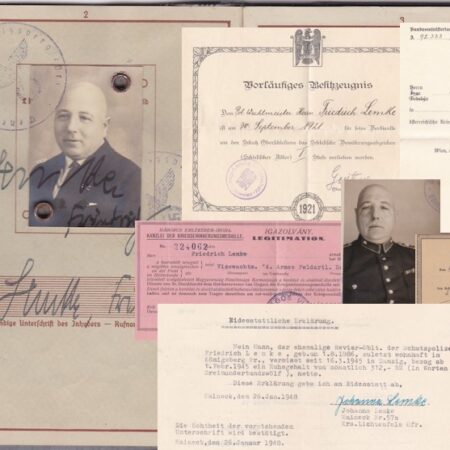
WWII German Wehrmacht Wehrpass ID – Revier-Oberleutnant Lemke – Freikorps Medals 1921 Schlesisches Bewährungsabzeichen (Silesian Eagle) 1st Class With Certificates – Missing in Danzig 1945
Lemke served with the Freikorps then during the war was in the local Police. In 1945 he was reported missing in Danzig. World War One – Iron Cross 1914 – Ehrenkreuz (Hindenburg Cross 1934) War Memory Medal (1935) and Freikorps Medals – 1921 – Schlesisches Bewährungsabzeichen (Silesian Eagle) 1st and 2nd Class. Award Certs for the Silesian Eagle and other medals are with the lot!
-
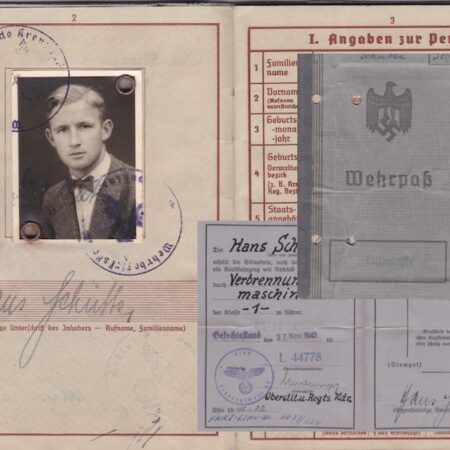
WWII German Luftwaffe Wehrpass ID & Wehrmacht-Führerschein – Oberleutnant Hans Schütte – Stab Flak Regiment 47 – 8.8cm FlaK 18 – Iron Cross Second Class
Schütte was from Göttingen, Germany. Worked his way up from the bottom to Oberleutnant. Served with various different Flak Units, August 1941 – April 1942 – Reserve Flakabteilung 512 April 1942 – June 1944 – Stab Flak Regiment 47 – Serving in Germany in Anti-Aircraft Roles Awards: West Wall Medal & Iron Cross Second Class
-
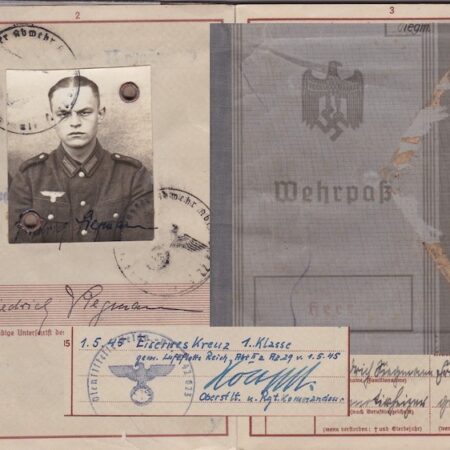
WWII German Wehrmacht/Luftwaffe Wehrpass ID – Oberleutnant Siegmann – Flakscheinwerfer-Abteilung 268 (o) (Flakgruppe Bremen) – Korps Ems – EK1 1st of May 1945!
Seems to have switched in the Luftwaffe from the Wehrmacht pre-war. Promoted to Oberleutnant in late 1943, in 1944 he was named the Batterieführer (Battery Leader). Awards: Iron Cross First Class, Iron Cross Second Class, Flak Badge, October 1938 Medal, Served with: 1935 – 1939 – Panzer Abwehr Abtl 22 8.1939 – 3.1944 – Fl Schwere Abtl 268 – Bremen Area 3.1944 – End – Flakregiment 160 It seems he seen the war out in Germany, with many days fighting Allied Bombers. Interesting is the entry for the EK1 on 1.5.1945!
-
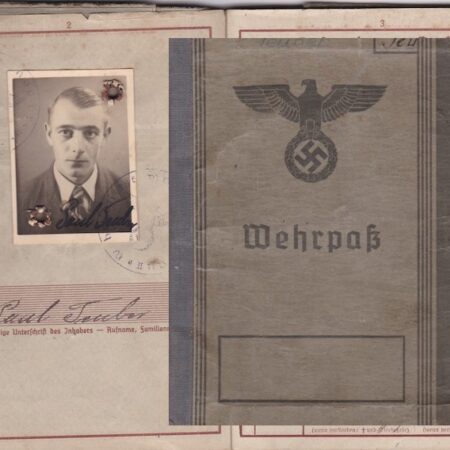
WWII German Wehrmacht Wehrpass ID – Gefreiter Paul Teuber – Artillerie Regiment “Grossdeutschland” – Nachrichten Abteilung 162 – Eastern Front Medal
Paul Teuber served with many units during the war. In 1942 he did a short stint of one month with Artillerie Regiment “Grossdeutschland” , ending the war with Nachrichten Abteilung 162. It seems that they were destroyed in late 1944 in Jassy, although I did not find any mention of Teuber in the KIA lists.
-
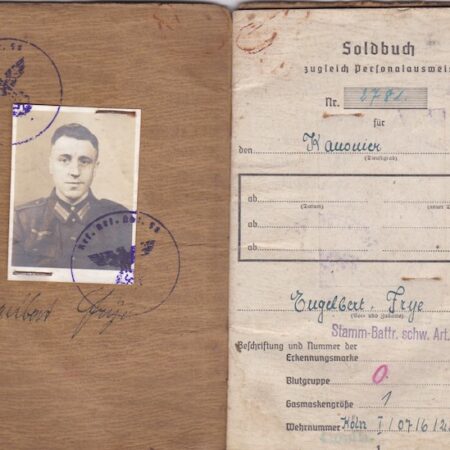
WWII German Wehrmacht Soldbuch ID – Kanonier Engelbert Frye – Artillerie Regiment 309 – Infanterie-Division “Berlin” – Küstrin & Halbe Kessel 1945
Soldbuch opened in October of 1944 Served with: Reserve Artillerie Abt (mot) 58 https://www.lexikon-der-wehrmacht.de/Gliederungen/ArtErsAbt/ArtErsAbt58-R.htm Artillerie Regiment 309 309. Infanterie-Division – “Infanterie-Division Berlin” The division was deployed near Küstrin and destroyed in the Halbe pocket. He was for sure in the unit in January of 1945, and he seems to have made it out alive as on Page 2 is a POW entry.
-
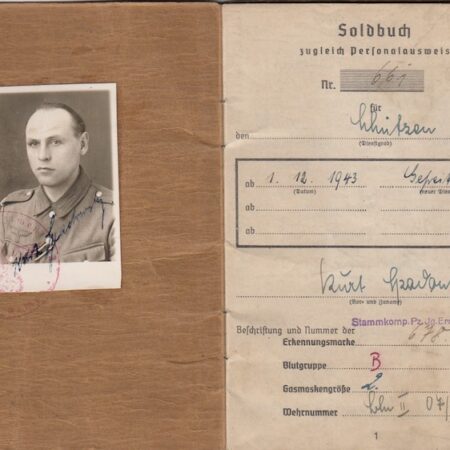
WWII German Wehrmacht Soldbuch ID – Gefreiter Kurt Szadowsky – Panzer Grenadier Regiment 12 – 4 Panzer Division – Reservelazarett 109 Berlin-Charlottenburg 1945
Soldbuch opened in Feb 1943 in Spremberg He served in various units till his last, Panzer Grenadier Regiment 12 – 4 Panzer Division According to the Promotion he was with them since December 1943. In July of 1944, he was hit with a bullet (Russia) and would be sent to a hospital in the rear. Awards: Iron Cross Second Class, Wounds Badge in Black He was sent to: Reservelazarett 109 Berlin, Berlin-Charlottenburg, Westendallee 45 Interestingly he seen the Battle of Berlin as a wounded soldier still recovering, he was given tobacco at the hospital on the 1st of May 1945! I have added a picture of the Hospital today which serves today as a School.
-
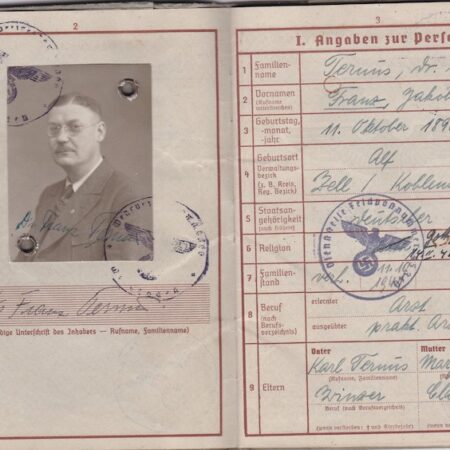
WWII German Wehrmacht Wehrpass ID – Stabsarzt Ternus – Stalag 350 – Salaspils Riga – Kriegslazarette Abt 532 – Lithuania 1944 (Zakret-Wilna)
Ternus was a Doctor, reaching the rank of Stabsarzt! He had service in WW1, and was awarded the Iron Cross. He served in the following units: Heeresbetreuungsabt 5 Stab Heeres Betreuungsabt 11 4 Months with – Stalag 350 – Riga The Camp Kurtenhof or Stalag 350 as the Nazis called it was built in 1941 to officially function as a police and labor re-education camp. Jews from the Riga Ghetto were responsible for the construction. It would temporarily house about 15,000 Jews and political prisoners. Two years later, in 1943, the head of SS Heinrich Himmler tried to turn it into a real concentration camp, but that never happened. The camp would become known for its terrible medical experiments, especially on (Jewish) children from Russia. They were used to pump blood from their bodies for hospitals to help German soldiers. There are different stories about the numbers of victims; about 50,000 people are said to have been murdered here and between 2,000 and 3,000 survived. 1944 – Kriegslazarette Abt 532 – Lithuania 1944 (Zakret-Wilna) According to his Battle Calendar he was in France in 1940, in 1941/1944 in the Baltics namely in Lithuania. He was dismissed on medical grounds in December of 1944.


