Showing 1063–1071 of 1403 resultsSorted by latest
-
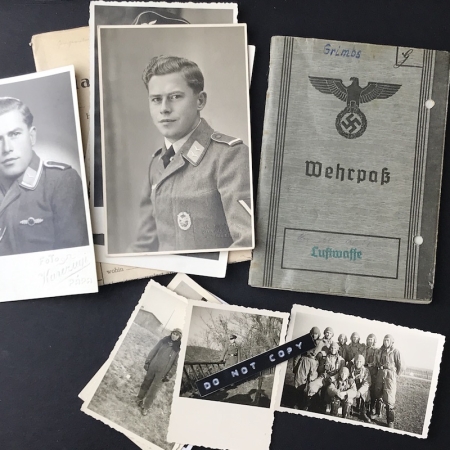
Wehrpass – Unteroffizier Alois Grimbs – Kampfgeschwader 4 General Wever – HE 177 Bomber – Survived a Plane Crash – EK1/FFSG (On Hold)
Unteroffizier Alois Grimbs Alois Grimbs a mechanic born 1921 in Riedelsbach living in Peisselberg. He volunteered the military in 1939 and served: Oct.39 with Flak-Ersatz-Abteilung 351 in Friedrichshafen(?); Oct.-Dec.39 with Luftwaffe-Bau-Kompanie 21/VII; discharged Dec.39; called-up again 1941; Aug.-Oct.41 with Luftnachrichten-Kompanie Flieger-Bereitschaft Ansbach; Oct.41-Apr.42 with Luftnachrichten-Stelle Regensburg; Apr.-Jun.42 with Luftnachrichten-Stelle Ansbach; Jun.-Jul.42 with Luftnachrichten-Stelle Crailsheim; Jul.42-Apr.43 board radio operator schooling at Luftflotten-Nachrichten-Schule 2 in Königgrätz; Apr.-Jul.43 with flight school Blindflug-Schule 5 home based at the airfield in Belgrade-Semlin Serbia. Jul.43 till Apr.45 he served as a He 177 heavy bomber plane board radio operator with: Kampfgeschwader 4 „General Wever“. The wing was named after General Walther Wever, the prime pre-war proponent for a strategic bombing capability for the Luftwaffe, who was killed in an aircraft accident in 1936. In the period 1943-45 the Kampfgeschwader covered the continuous retreat of the Wehrmacht at the Eastern Front until the end of the war, in the tactical and supply role. Bases where he flew his missions from during this period: 1943 Avord (France); 1943-44 Sarabus (Crimea) , Nikolayev (Ukraine); 1944 Odessa (Ukraine), Sarabus (Crimea), Krosno (Poland), Milec (Albania), Focsani (Romania), Zilistea (Romania), Buzau (Romania), Grosswarden (Rumania), Debrecen (Hungary), Budapest (Hungary), Papa (Hungary), Novy Dvor; 1945 Novy Dvor (Belarus), Dresden. He got severely wounded Apr.45 when his plane crashed on 11.4.45. He burned both his hands and his face (1st and 2nd degree burns) and was hospitalised in Heiligenstad-Königsgrätz and Miesbach. Discharged Jun.45 with burning scars on hands and face, as mentioned on the POW release document. Awards: Front Flying Clasp in Bronze (13.1.44), Iron Cross 2nd Class (26.2.44), Iron Cross 1st Class, Front Flying clasp in Silver, Front Flying Clasp in Gold (30.1.45). 1) Wehrpass, 2.5.39. One staple of the cover loose. 2) Krankenblatt, 1945. Medical document. 3) POW certificate of discharge, 27.6.45. 4) 10 very nice uniform photos. Three postcard sized. Wearing flying gear, with bomber clasps etc. Comment Nice grouping to a desirable unit and a combat experienced airman, who was lucky to survive his plane crashing.
-
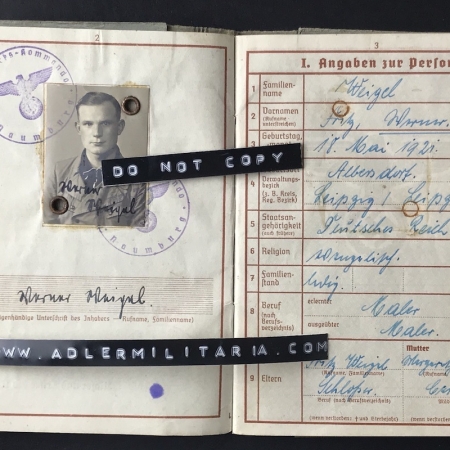
Wehrpass – Unteroffizier Werner Weigel – Kampfgeschwader 55 – Survived a Crash landing – FFS/EK2/VWA (on Hold)
Unteroffizier Werner Weigel Werner Weigel was born on the 18th of May 1921 in Albersdorf Leipzig, in his civilian career he was a painter. Weigel was enlisted in the RAD on the 3rd of October 1940, he spent only 3 months in the RAD before he was called up to the Wehrmacht. He arrived for training on the 10th of February 1941, by July he was sent for training as an Observer. Interestingly he was found fit for all roles in the aircraft and was sent for training. After successful training, Weigel was assigned on the 16th of August 1942 to the: 12th Staffel, Kampfgeschwader 55 Weigel would spend until March 1943 with the IV Gruppe in Dijon France, the unit was mainly used for training runs from France to Germany, they were dropping concrete bombs. They flew the Heinkel 111, and reported only a few losses. For more information of their stay in France, including pictures: https://www.histavia21.net/LIEUX-HISTOIRE/BA-102/LONG-0007a1.htm On the 14th of April 1943, Weigel joined the II Gruppe, 6th Staffel, Kampfgeschwader 55 In 1943, from June 5th to 22nd, it took part in the air raids on Gorky and Yaroslavl. In night raids, together with other combat squadrons, the “Molotov” armored car plant and the Yaroslavl synthetic rubber plant were to be attacked. 282 people were killed in Gorki, 527 injured and 52 buildings of the plant were destroyed. In Yaroslavl, over 120 people were killed, around 150 others injured and over 200 buildings (including some of the rubber works) completely destroyed. Then the staff, the II. And III./KG 55 took part in the Operation Citadel. It seems that in such a short time Weigel had earned himself the Front Flying Clasp in Bronze as well as the Iron Cross Second Class in the space of one month. On the 16th of June 1943 until Weigel was wounded in an emergency landing in a Heinkel 111 due to an engine fire due to enemy fire, the crash was so bad that two crew members were killed in the crash Weigel. Below the details of the Crash as well as the name of the young Pilot Officer who was killed in the landing. Weigel acting as Observer survived a crash landing due to a fire on board on their return from a combat mission, in which the pilot and another crew member was killed. WUNDERLICH, Otto. (DOB: 01.05.21 in Postelberg, Krs. Saaz/Bohemia). 17.05.43 Lt., 6./KG 55 KIA – emergency landing due to engine fire – vic Bakhekolkhos farm near Krichevo. Buried at Donezk. Comments An interesting Wehrpass from a highly sought after KG, Weigel flew 32 combat missions in a very short time. Weigel was extremely lucky to survive the crash, but he would never fly again. A Heinkel 111 from KG 55
-

Document Grouping – Oberwachtmeister Erich Thrun – Cherkassy Breakout 1944- Met GFM von Manstein & Goebbels! (HOLD)
Grouping to Oberwachtmeister Erich Thurn Cherkassy Breakout Erich Thurn was born in Hagen/Haspe on January 1915, and worked in his civilian life as a Saddler. Thrun was a volunteer and started his career in Wehrmacht in 1937. During the war, Thrun was serving with the Artillerie Regiment 389 with the 389 Infanterie Division. Thurn survived the downfall at Stalingrad and somehow made it out, and was later encircled in 1944 in the famous Cherkassy Pocket. Interestingly, Thurn had displayed extreme courage earning the Iron Cross First Class. He featured in various wartime Newspapers some of the highlights are listed below. Thrun explained to the newspapers that the Soviets had tried their hardest to get the Germans to surrender using leaflets, loudspeakers and propaganda. As well as constant air attacks on their positions on the ground. Thurn found himself knee deep in a cold swamp trying to push out of the encirclement, Thrun explains that the villages around him left and right were all on fire. Their group made it through the swamp and seen a tank and could hear German, they had reached the German lines! After three weeks trapped in the Pocket. Thurn was presented to Feldmarschall von Manstein after the breakout! Original photo included! After which he was sent on leave to Berlin where he would be presented to Propaganda Minister Goebbels. Included in the Grouping is the following Three Newspaper articles displaying Thrun and his story Photo with GFM von Manstein – Original Photo printed on Agfa Brovira Iron Cross Second Class Medal Iron Cross Second Class Document – July 1942 Signed by Generaloberst Erwin Jaenecke (Knights Cross winner, wounded at the Battle of Stalingrad was flown out!) Wounds Badge in Black Wounds Badge Document Marriage Certificate from 1943 A Certificate confirming his awards in August 1945 from the field police. Certificate of Discharge 1945 Three letters from the Bundesarchive A Certificate thanking Thrun for helping to rebuild his hometown of Hagen in 1947 An unusual grouping, but very interesting to find anything related specifically to the battles at Cherkassy!
-
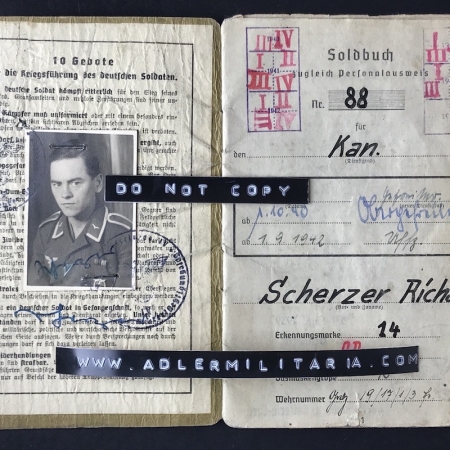
Soldbuch – Unteroffizier Richard Scherzer – Flak Abt 13400 – KIA Paris 1944 – FFI & US Army Battles (Hold)
Unteroffizier Richard Scherzer Richard Scherzer was born on the 16th of August 1919 in Germany. He was enlisted in the Luftwaffe with: 1./Flak Regiment 38. They supported the 5th Panzer Division during the Polish campaign. Then the department was in Regensburg and took part in the French campaign in May 1940 under the staff of Flak Regiment 102 under the I. Flak Corps. The department was then located in Le Havre and, from January 1941, in Sicily. From June 1941 she took part in the Russian campaign with the I. Flak Corps. In 1943 the department was on the Don. From November 1943, the division was under the 10th Flak Division in southern Russia. On the 12th of June 1944, Scherzer was with: Schwere Flak Abteilung 13400 (mot) in North France. Interestingly, by August/September 1944, Scherzers unit had clashed with the FFI also known as the Maquis on the outskirts of Paris. According to the FFI Museum: ‘’American forces bypass Paris to the east. In the lead, the recognition of the 4th Cavalry Group followed by the 3rd Armored . The 1st German Army strives to put up roadblocks behind the capital. In La Queue en Brie and in Plessis Trevisse a battalion of the Flak arrives in the early morning. The FFI surprised, can only slip away in the face of the irruption of nearly 600 men with many guns. At La Queue, one or two batteries with 150 men take up positions on the plateau around the village. This is probably Major Krebs’ Battalion 13400, Schwer Flak Abteilung 13400. This heavy, motorized battalion was made available to the 48th German division on a barrage mission. Shortly afterwards, the positions of the camouflaged guns were overflown by a few American planes which suffered a few gusts. The first clashes took place around 6 a.m. with the FFI. The position was abandoned after half an hour of fighting. The Germans fall back towards Chennevières. At 7 p.m., the American armored vehicles ( 3rd Armored and 1st Infantry ) arrived through the woods and took up position at the Pavé de Pontault. Exchanges of fire take place. The tanks of the 634 Tank Destroyer accompanying the 26th Infantry Regiment pounded the battery. At Plessis-Trevisse, a column of American armored vehicles also opened fire on a German formation. The Flak artillerymen left the sector during the night of August 27 to 28. The next day, we find on the ground, at La Queue, two abandoned 88 and three 20 mm guns, a mortar, three trucks and a car loaded with ammunition. In Plessis-Trevisse, the FFI found a tractor and its 88 gun, machine guns. ’’ Scherzer was reported missing or killed on the 24th of August 1944, either by members of the FFI or the US Army and is buried today in Champigny-St.André near Paris. Pictures of the abandoned Flak of Scherzers Abteilung can be seen here: http://museedelaresistanceenligne.org/media4437-ArrivA Below French Resistance Fighters take on Germans on the Streets of Paris. Although for some reason Scherzers award page is missing, it is very odd as the page can be clearly seen to be ripped out. Was it done by Scherzer to conceal something, we will never know the answer. Although it can be clearly seen on his photo that he is wearing the following awards: Iron Cross Second Class Luftwaffe Ground Assault Badge Black Wounds Badge Small Clasp with Annexation Medal Bars Comments Scherzer saw both fronts and was decorated for his combat experiences, he raised the ranks from a simple Kanonier to a Unteroffizer. Killed in Northern France in 1944, this Soldbuch is still very sought after even though the awards page have been taken out.
-
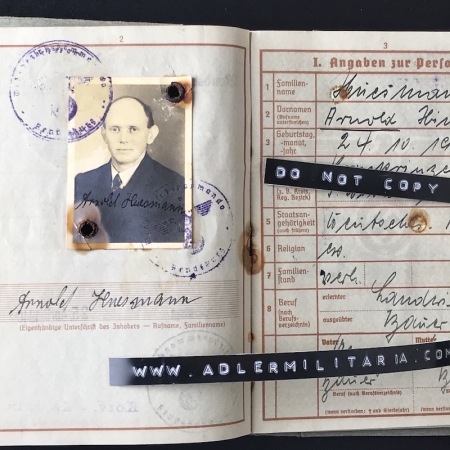
Wehrpass – Gefreiter Arnold Huesmann – Landesschützen Batl 660 – KIA Italy Cassino February 1944
Gefreiter Arnold Huesmann Huesmann was born on the 24th of October 1905 in Germany into a Protestant family. He was married and worked in his civilian life as a farmer. His Wehrpass was issued in April 1940, and by October 1940, he had sworn an allegiance to Adolf Hitler with a Infantry replacement unit in Heide. He served as a guard with Landesschützen Batl 660 in the Munsterlarger for nearly two years before being sent to the Front. Huesmann arrived in Italy with Landesschützen Batl 686, and was killed in Anagni, Italy on the day before the official Battle for Cassino began. According to online sources the town was badly smashed on the Allied advance lines by heavy aerial bombardment. Huesmann was killed and buried in Anagni, but it seems he was later reburied in the main German Cemetery at Cassino, Italy.
-

Wehrpass – Stabsfeldwebel Waldemar Ullmann – Battle of Moscow / Ardennes Offensive – POW Remagen – 17 Years of Service! (on Hold)
Stabsfeldwebel Waldemar Ullmann Ullmann was born on the 17th of March 1910 in the area of Reuthen, Germany into a catholic family. Ullmann married during his service in 1941, although oddly it seems his wife was removed as next of kin. Ullmann volunteered for service in October 1929, with Infanterie Regiment 7 , as part of the 100,000 Man Reichswehr! His Kompanie was the 13th Kompanie which was named in honour: Schlesisches Füsilier-Regiment “General-Feldmarschall Graf Moltke” Nr. 38 Infanterie Regiment 470 / 260 Infanterie Division – From Belarus to Moscow! According to Ullmanns Wehrpass he served in the following actions, here an extract from the history books. The move to the eastern front began on June 30, 1941. The train went to Siedlce, which was reached on July 4th. Unloading took place here and the march into the Wysokie Litowskie area was carried out until July 6th. As a corps reserve, the division then marched via Pruzana and Baranowicze to Lubany. There IR 470 had its first skirmishes with Russian units. On July 19, the march continued in the direction of Berezovka and on July 20, parts of the regiment attacked Romanishche together with the IR 460. At 8:20 p.m. the location could be taken. The attack continued on July 21st. The regiment crossed the Rudyanka River, passed through Pess’tschanya, and took Chernin in the evening. On July 23, the battle of Romanishche broke out and was to be retaken by the Russians. This was prevented by the 260th Infantry Division. On July 27th the regiment marched further north. After Rudjaanka was reached, the division and the regiment set up to secure the front. From August 5th, an attack to the south was launched to close the gap between Army Groups Central and South. On August 10, the division was replaced by the 45th Infantry Division and marched north again. On the night of August 12th the Berezina was crossed at Shazilki and the Dnieper at Streschin on August 13th. They then met their army corps and attempted to prevent the enemy forces from breaking out between Rogachev and Shlobin. The regiment had to fend off difficult enemy breakthrough attempts. On August 19th the encirclement was over and the regiment marched south again towards Gomel. On August 23, the movement began with an attack in the direction of Chernigov in order to enclose the enemy armies near Kiev. Parts of the division had reached Desna by August 30th. On September 1, the regiment began its attack on Kisseleska from the heights around Tschernisch. When the 5th Company reached the bank of the Desna, a platoon succeeded in crossing the river with river boats and forming a bridgehead. The regiment extended the bridgehead to the villages of Poski, Wibli and Uborki. The next day it had to fend off severe counterattacks. Via Chernigov, Kiev was advanced further and the return route of the Russian troops was cut off. The division established itself on the Chernigov-Kiev road and repelled all Russian attacks. The badly battered division and thus the regiment no longer took part in the further fighting during the Battle of Kiev. It stayed in the positions it had reached and rested. It was not until September 14 that the regiment marched again, this time to the northeast in the direction of Bryansk and then further north to Dubrovka. The first frost occurred on September 27th. At the end of September the 52nd Infantry Division was relieved at Dubrowka. On the night of October 2, the regiment began to attack Moscow. The regiment crossed the Dessna and formed a bridgehead. By the evening 120 bunkers had been knocked down and 200 prisoners taken. The first snow fell on October 6th. On October 7th, the Kaluga-Brjansk railway line was taken, and it continued in the direction of Kaluga. But on October 21st, the advance in the baseless mud was stopped. The regiment took up position in the Okatal. At the beginning of November the regiment and the division moved into the Kremenki bridgehead. When the German attack on Moscow resumed on November 13th, the regiment moved into its staging area on either side of Browna and made a deep break in the enemy frontline on the first day of the attack. In spite of this, the division and regiment’s attack remained concentrated in the increasingly fierce enemy resistance. On November 14th, the initiative passed to the Red Army and breached the frontline on the wings of the regiment. The attacks of the regiment did not abate on November 15 either, and only the 260 Artillery Regiment, which fired 2050 shells that day, was able to prevent a breakthrough. But the attacks began again on December 8th. On December 15, Russian units succeeded in breaking through the 52nd Infantry Division, so that the Kremenki bridgehead had to be evacuated. On December 17, the regiment repelled a Soviet attack into the seams of the 260th and 52nd divisions. At noon, the regiment was overrun by Russian tanks and 40 soldiers were killed. The regiment went back to Radenki. The division was trapped by Russian forces and had to free itself from the encirclement at Christmas. The division withdrew to the Detschino area and moved to the new line on December 31st. Ullmann was wounded in these breakout fights and was lucky to have made it out. It was not until January 1943 until he was back on the frontline again, now healed from his wounds and now a Stabsfeldwebel. Serving with the Machine Gun Company of Infanterie Regiment 684 / 335 Infanterie Division The division was then transferred to France as an occupying force and used to secure the coast in Brittany and near Marseille. In October 1942 the division was reclassified into an attack division and in February 1943 it was transferred to the 1st Panzer Army on the Don. Heavy defensive battles followed on the Donets and in the Voroshilovgrad area by August 1943. In September and…
-
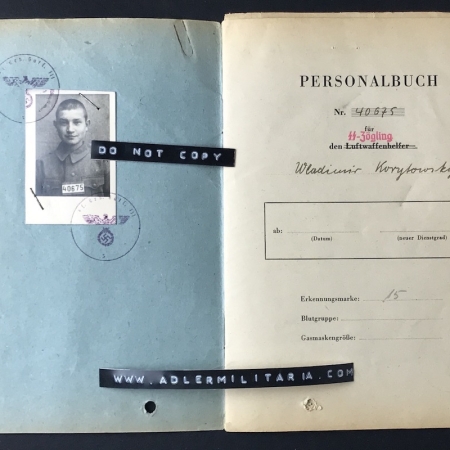
Personalbuch – SS-Zögling Wladimir Korytowskj – Flak Abteilung 755 – Oder Front / Berlin 1945 – Ukrainian 16 Years Old! (Hold)
SS- Zögling Wladimir Korytowskyj Korytowskyj was born on the 6th of September 1928 in Sahiericzko, Ukraine. (Galizien) He was found fit for service (With : Flieger-Ersatz-Btl.III Einstellungs-Kommando I Eger) in September 1944, at only 16 years old. SS-Zögling refers to a juvenile SS pupil who was not yet eligible to join the formal SS. In Eastern Europe and the Baltic states (in this case Hungary), these members were tasked to defend and guard airfields, buildings, warehouses, workshops, factories, etc. against enemy aircraft attacks. He would join Flakabteilung 755, it seems they served for a short time in Flensburg, then at the military airport Jagel. According to a survivor of the unit, they were armed with 3.7cm Flak and were later deployed on the Oder Front. Many of the young men reported missing seem to be in the area just east of Berlin in Fürstenwalde in April 1945, just as the Red Army advanced on Berlin. Although the author of the article below ended up a little further south in the Halbe Pocket. It is unknown what the fate of this young boy was, he is not reported as missing or as killed in action. Survivors Account: http://www.hphansen.de/assets/applets/Allzeit_meine_Pflicht.pdf An interesting and rare book for a young SS recruit, interestingly others from this unit are seen on the market. There is not many, but they seem to be from a hoard find.
-
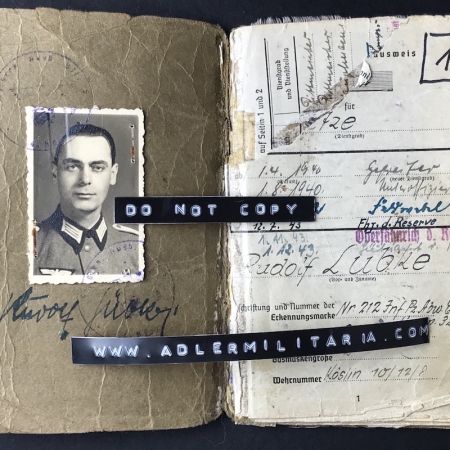
Soldbuch – Leutnant Rudolf Lübke – 32 Infanterie Division – Matching Tag – Iron Cross 2nd Class – Wounded in Riga, Latvia 1944 (sold)
Leutnant Lübke Rudolf Lübke was born on the 11th of February 1910 in Stettin, Pommern ( today Poland). Lübkes Soldbuch was issued in November 1939, with: Infanterie Panzer Abwehr Ersatz Abteilung 32 / 32 Infanterie Division Note: Matching Tag and Soldbuch! Lübke served in a supply function, although he was armed and travelling to and from the frontline. 32 Infanterie Division At the outbreak of World War II, the division crossed the Polish border on 1 September 1939 and reached the Vistula at Kulm on the third day of operations. On 6 September the division crossed the Drewenz at Gollup and continued its advance to the Modlin Fortress via Sierpc. The division encircled the fortress from the southeast and then marched to Warsaw–Praga. In December 1939 the division was moved to the Eifel. Here the Feldersatz-Bataillon 32 (32nd Field Replacement Battalion) was transferred to the 162nd Infantry Division in January 1940. At the beginning of the Battle of France (Fall Gelb—Case Yellow), the German invasion of France and the Low Countries, the division stationed southwest of Prüm in the Eifel and penetrated the Belgian border defenses and crossed the river Meuse at Givet. The division then marched through Ohain to Cambrai, and from here south of Douai to La Bassée and Lille. During the second phase campaign, Fall Rot (Case Red), the division crossed the river Somme at Bray-sur-Somme and the river Seine near Rouen. Afterwards the division pursued the defeated French opponents to the river Loire near Nantes. Here the division remained until August 1940. It then relocated to the Cotentin peninsula, in preparation for Operation Sea Lion (Unternehmen Seelöwe), the planned invasion of the United Kingdom which was never carried out. In October 1940 the division was transferred to East Prussia. At the same time, the staff of Infanterie-Regiment 4 (4th Infantry Regiment) and every 3rd battalion of every infantry regiment were handed off to the 122nd Infantry Division. The hand-offs were replaced. In the winter of 1941 the Division was trapped in the Demyansk Pocket along with the 12th, 30th, 123rd and 290th infantry divisions, and the SS-Division Totenkopf, as well as RAD, Police, Todt organization and other auxiliary units, for a total of about 90,000 German troops and around 10,000 auxiliaries. Their commander was General der Infanterie Walter Graf von Brockdorff-Ahlefeldt, commander of the II. Armeekorps (2nd Army Corps). Following the successful relief of the Demyansk Pocket three of its infantry battalions were disbanded due to heavy casualties. Lübke stayed with the Division until he was wounded near Riga. After which is unit would be trapped in the famous Kurland Pocket, so this wounding allowed him an early escape from Kurland. In April 1945, Lübke recovered from his wounds was posted to: Panzergrenadier Ersatz und Ausbildungs Bataillon 90 They were made mobile and sent to the Oder Front with: Panzerausbildungsverband Ostsee The tank training association Baltic Sea was set up on March 28, 1945 from members of various training units of the tank troops and remnants of other associations in the Prenzlau area. Even before training and deployment were complete and before the planned brigade strength had been reached, the unit was relocated to the Oder front near Stettin in April 1945. During battles with the Red Army, the unit was severely decimated. The rest ended up in Soviet captivity. Equipment and Weapons K98 as well as a Spanish Victoria Pistol. Later Lübke bought a Mauser 7.65mm Pistol from Heeres stock. Wounds On the 11th of November 1944, Lübke was wounded with a piece of shrapnel and moved away from the front with a Hospital train. Awards War Merit Cross 2nd Class with Swords – 26.3.1942 Eastern Front Medal – 29.7.1942 Iron Cross 2nd Class – 1.4.1943 – Pleskau Northern Russia. Wounds Badge in Black – 22.8. 1944 – Riga Lübkes military career did not end in 1945, after his return to Germany he moved to Hamburg and joined the Bundeswehr (Modern German Army) enlisted in 1960. Interestingly, his old rank was reinstated, and joined once again logistic troops. Lübkes military career ended in July 1969 as a Major. Interestingly, he was allowed to wear his WW2 earned Medals of which they are entered, also note the entry for the Demjansk Shield.
-

Soldbuch – Leutnant Heinrich Lodes – Artillerie Regiment 246 (246 Volksgren Div) – Battle of Aachen 1944 (On hold)
Leutnant Heinrich Lodes Lodes was born on the 23.1.1914 in Drosendorf, Germany. In his civilian profession he was a teacher. The Soldbuch was issued on the 6th of September 1939 by Artillerie Regiment 231. Frontline Units Artillerie Regiment 231 Taking part in the attack on Poland and occupation. This unit was redesignated to the next unit name in Winter 1939. Artillerie Regiment 239 / 239 Infanterie Division Taking part in the advance into Southern Russia, the then Wachtmeister Lodes was wounded by a bullet which stuck in his upper left arm. Promotion to Leutnant on the 1st of October 1941. Artillerie Regiment 241 / 161 Infanterie Division When in the area of Rshew in September 1942 – A grenade splinter hit his right foot, he would spend time in various hospitals till June 1943. It seems Lodes was awarded the Wounds Badge in Silver Artillerie Regiment 246 / 246 Volks Grenadier Division After his recovery Lodes joined the above unit, and would serve with them in September 1944 (See Leave Stamps for date). At the end of September 1944 the division was relocated to the western front and reached the Jülich, Bedburg and Linnich at the unloading area on September 25th. From September 28, 1944, the division replaced the 116th Panzer Division in the main frontline near Aachen. The division suffered heavy losses in the fighting for Aachen. Aachen was surrounded by Allied troops until October 16. The division in Aachen was destroyed by October 21, 1944. It’s unknown what happened to Leutnant Lodes, he is not listed as killed in action or as missing. Although it would seem there is staining to his Soldbuch also there is no capture numbers entered into the first pages of the Soldbuch. What happened to Lodes will remain a mystery. Equipment Own Pistol – Walther Model 7.65mm Medals Iron Cross Second Class – July 1941 – with AR 239 in Southern Russia Wounds Badge in Black – July 1941 – with AR 239 Wounds Badge in Silver – Hard to make out due to water stain. 1942 War Merit Cross with Swords – 20.4.1944 Comments An interesting Soldbuch to a combat experienced soldier who made his way into the officer ranks. Wounded twice, and fought on both fronts. His Soldbuch picture is a desirable one, as he is not following regulations namely the wearing of eye glasses and headgear. A desirable Soldbuch to the Battle of Aachen 1944.


