Showing 1027–1035 of 1403 resultsSorted by latest
-

Soldbuch – Pioneer Brandt – 1945 – Oder Front – Rare Late War Soldbuch Version
Soldbuch to Bau-Pioneer Hermann Brandt Born in 1903 into a protestant family, he was a normal worker and was married. His Soldbuch was issued on the 6th of April 1945! This last ditch Soldbuch is a hard cover version, with no pouches and is of not great quality reflective of the situation at the time. His frontline unit was: Bau-Pionier-Ersatz- und Ausbildungs-Bataillon 3 According to the Lexicon der Wehrmacht, his unit was thrown into action on the Oder Front in April 1945. He seems to have been in a hospital in July of 1945, a lucky man to have survived the onslaught unleashed on the Oder… A clip below of the Oder Front in 1945. https://www.youtube.com/watch?v=H42JoWP2SRA
-
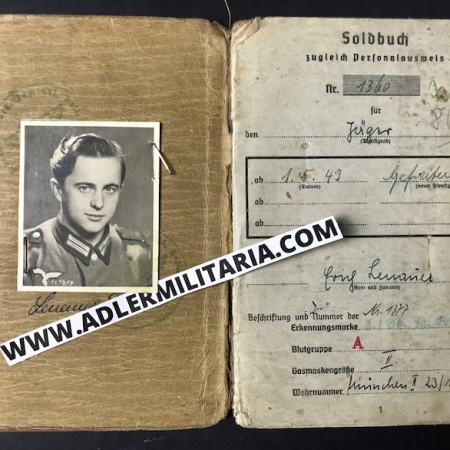
Soldbuch – Gefreiter Lenauer – GJR 99 & Hoch Gebirgsjäger Batl 201 – ‘Operation Habicht & Battle Bloody Hill’ (Sold)
Soldbuch to Gefreiter Erich Lenauer He was born in Munich in 1923 into a Catholic family, and worked as a tailor in his civilian life. Lenauer was enlisted in May 1942, with a mountain troop replacement unit. After a period of training in various GJ (Mountain troop) units he was sent in early 1943 to his frontline unit: Gebirgsjäger Regiment 99 (1 Gebirgsjäger Division) According to his Soldbuch he was with this unit from around August 1942 till mid 1943. The Don was crossed on August 5, 1942, and between August 12 and 21, 1942, the high passes of the Caucasus between the Elbrus, Maruch, Bgala and Adsapsch passes were taken. Then the regiment marched over the Matruckkojpass, the Klochorpaß (August 17, 1942) and the Elbrus towards Ssuchum. But on the Elbrus the advance came to a standstill. By September 1942, the Russian pressure on the German positions increased more and more. After the other parts of the 1st Mountain Division had been withdrawn to attack Tuapse, the regiment remained as the only part of the 1st Mountain Division on this section of the front. Due to the threatening overall situation, the withdrawal began for this regiment in December 1942. On January 27, 1943, the regiment reunited with the division. The regiment withdrew into the looming Kuban bridgehead. In January the Kuban was crossed at Usti-Labinskaya. On January 31, 1943, the Goths position was taken. Subsequently, the Hubertus position was taken up to February 5, 1943 and the Poseidon position from February 22, 1943. On March 22, 1943, the regiment was withdrawn from the front and transferred to the Crimea. From here we went to the Balkans by train. From Bulgaria the regiment moved to the black mountains of Montenegro, where it arrived in April 1943. In the Balkans there was heavy and fierce fighting with Tito partisans during “Operation Schwarz” in May 1943. On June 16, 1943 the regiment was then transferred to Greece. After a period with various illnesses and time in healing and with a replacement unit he was sent to his next frontline unit: Hoch Gebirgsjäger Battalion 201 (1 Gebirgsjäger Division) After having been hastily trained and equipped in Garmisch, Mittenwald and Sonthofen, the Heerestruppe battalion was transfered to the West and was put under direct command of AOK 19. The command was given to Major Franz Seebacher, an Austrian from Graz. This former officer of the 4. Gebirgs-Division had very much combat experience. In one of his prior posts he served as the commanding officer of the III./Gebirgsjäger-Regiment 91 from August 1943 – May 1944 on the Eastern Front (awarded with the German Cross in Gold). Soon after arriving on the spot still in October 1944 the unit was thrown into combat. The battlefield situation and tactical circumstances on the German side towards the end of October can be characterised with confusion and desperate attempts of taking defensive measures to stop the Americans. Trying to hold the positions in the Vosges mountains and to avoid the advance of the US forces towards Colmar and Strassbourg and to finally reach the Reich’s border through the Alsatian Plain, the fightings of the much under-strength forces of 19. Armee were fierce. 16. Volksgrenadier-Division (Gen. Haeckel) had virtually ceased to exist as an infantry unit, whereas Panzer-Brigade 106 “Feldherrnhalle” on his right had failed to stop the US 3rd Division. Also General Egdar Feuchtinger’s 21. Panzer-Division was preparing to pull back from Baccarat. With a twenty-mile gap in the german main defense line, the only card left to play was that of Geb.Jg.Btl. 201.To complicate the situation, the sister unit of the btl. – Heeres-Gebirgsjäger-Bataillon 202 – had been cut off behind the frontline in the Foret Domaniale de Champ eastward from Belmont [greater Saint-Dié region] and the Army and Korps headquarters were near to count it as lost. So, Geb.Jg.Btl. 201, what had arrived only a few days earlier, started a desperate rescue mission around 26 October 1944. That ended successfully, although the own and the casualties of the sister unit were very high. The memory and the description about these days by the battalions Adjutant Vitus Kolbinger : ”It was a senseless fight. In the days to follow [= after 26 October], our battalion was left completely in the dark about ist hopeless situation, and resupply was almost nonexistent, while the enemy bombarded us ceaselessly with artillery, mortars, tanks, and aircraft.” During the next weeks the 19. Armee was pushed backed towards the Alsatian Plain and with the Upper Rhine in the back the struggle for Geb.Jg.Btl. 201 went on. One of the hardest fightings took place in the Kientzheim / Sigolsheim area in mid December 1944. As part of the german counter-attack to re-occupy the last Vosges mountain positions in front of the Plain, the battalion as part of 19. Armee was involved in Unternehmen “Habicht”, which was ordered mainly on initiative by Himmler. This was meant to be a diversion in the Upper Alsace, a few days prior to the last German main strike, the “Ardennenoffensive”. Operation “Habicht” did bring a series of the most violent and desperate fightings in autumn/winter 1944 at this theatre of war. After the US 36th Division had attacked Riquewihr on 12 December, the counter-attack was started to stop and throw out the US troops from the area KAYSERBERG – KIENTZHEIM – SIGOLSHEIM. Le Mont de Sigolsheim [Sigolsheimer Berg] changed hands numerous times and was called “Blutberg” – Bloody Hill, by the participants. The term of the Alsacian inhabitants for the hill was “Blutbuckel”. Directly nearby, at Kientzheim, the Führer of the 2./201, Leutnant Krebs, was KIA on 14 December. According to Lenauers Soldbuch, we can see he was issued a Rifle just before the outbreak of the battle as well as various items of combat gear, and he was for sure at the final battles in December as he was still with his unit in January of 1945, as part of the Stab. He was issued a Red…
-

Soldbuch & Tank Licence – Feldwebel Arlt – PzReg27 (19PD) – Panzer Driver! (Sold)
Soldbuch to Erhardt Arth Born into a Catholic family, he was married and was a student before the war. His Soldbuch was issued on in February 1940 with Panzer Ersatz Abteilung 1 in Erfurt. After tank driver training he joined his frontline unit: Licence is for a full tracked Tank to 30 Tons. (6.1941) 6.Kompanie – Panzer Regiment 27 (19 Panzer Division) End of June 1941 for the first heavy defensive battles in the context of the ‘Kesselschlacht’ near Bialystok and Minsk. The division then marched through Minsk to Dzisna on the Daugava, which was taken on July 4th. On July 5, the division crossed the Daugava and then broke through the Stalin Line. Then the division marched towards Polotsk and broke through the Dryssa position. Before Polotsk, the division turned north on July 17 and reached Velikiye-Luki. The division stayed here until July 20th. That day the division evacuated the city and marched on Welish. Then it turned to the north, then later to the east over the Daugava to Ilino. This was followed by the advance on both sides of the Smolensk – Bjeloy road as far as the Pochenki area. After heavy fighting in this area, the division was withdrawn from the front in early August 1941 and refreshed near Shishkovo. On August 18, the division received the order to advance again on Velikiye Luki and to enclose suspected enemy forces there. The second battle for Velikiye-Luki took place. Before the final end of the fighting, the division marched on towards Toropyets, then towards Kholm and then towards Demyansk. After marching through Demyansk, the division closed the rear edge of the pocket formed around Staraya Russa. It would seem that he was wounded as he arrived in a hospital in Cholm, and sent back from the front. He would then attend the following Tank training units: Panzer Lehr Regiment (Panzer Fahr Lehr Komp) Panzer Ersatz Abteilung 11 Equipment: Issued a Pistol Awards: It would seem removed the second part of his award page, but it was highly likely he had other medals. At the very end of the war he was sent to Grenadier Regiment 32 – But suspect this was a reformation of the original unit. Eastern Front Medal The Soldbuch seems to be missing several pages sadly, although the unit and division is desirable. The Licence has a perfect picture, and we can clearly see he was a Tank driver for heavy tanks!
-
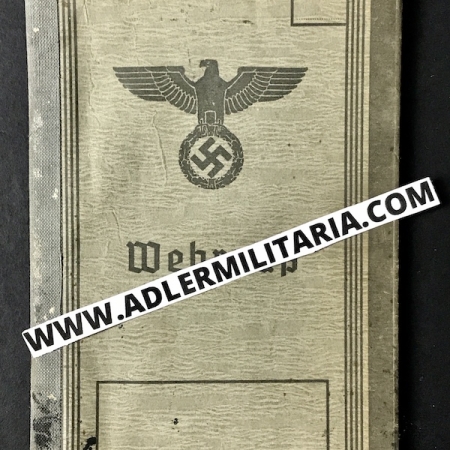
Wehrmacht Wehrpass – Unissued (Sold)
As the title says this is an empty Wehrpass. Not been issued and for those that like items that are untouched this is for you!
-

Wehrmacht Soldbuch – One Stamp inside!
A Wehrmacht Soldbuch that was not given out. Looks to be prepared but never used or issued, for those collectors who enjoy the items that never seen daylight in WW2!
-
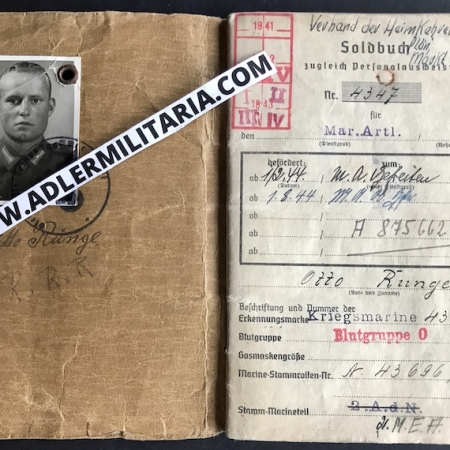
Soldbuch – Marine Artillerie Obergefreiter Runge – MAA203 – Battle of the Scheldt/Breskens Pocket – EK2 – Festung Schelde-Süd (On Hold)
Soldbuch to Marine Artillerie Obergefreiter Otto Runge Runge was born into a protestant family in 1924, in the area of Köslin. His Soldbuch was issued in August 1942 by: Marine-Artillerie-Ersatz-Ausbildungs-Kompanie Haarlem (Holland) After a while in training and various other duties Runge was sent to a new unit. Marine-Artillerie-Abteilung 203 Considered to be the most important battery on the South of the Scheldt. Marineküstenbatterien are usually large strongpoints and this one was no exception. A German map of March 1944 shows the exact location of the strongpoint, as well as the presence of minefields. Actually, the strongpoint was only protected by a small minefield to its left and by a Grossminenfeld behind it, 113 Virginie. Despite the importance of the strongpoint, the exact function of some of the smaller remaining bunkers is still unclear. As often, we extend an invitation for comments and corrections. The MKB Cadzand also played an important role during the liberation fighting in West-Zeeuws-Vlaanderen in the autumn of 1944. More information on this is available on this page. This battery was undoubtedly the most important one within the Festung Schelde-Süd, considering its modern guns and excellent fire-direction equipment. The attentive reader may have noted the presence of an M195 bunker above, was aw a bunker with an open emplacement on top. Indeed, one of the guns was able to fire 360° as a result of this. Seeing the importance of this construction of another open emplacement was started in mid-September and completed on 1 October. With the Kriegsmarine wanting to keep 2 guns trained on the Schelde estuary, the other 2 were mainly used against the Canadians at the Leopold canal. On 27 October the battery had the doubtful honour of being the only one not yet captured by the Canadians. Interestingly, on this day Runge was awarded an Iron Cross Second Class Also on this day, the two guns still inside the bunkers were destroyed by the Germans. With the benefit of hindsight, this may have been too early, especially since the battery only surrendered on 2 November. The FuMO 214 Würzburg Riese (Seetakt) radar was the subject of quite a saga, perfectly illustrating the chaos in those days. On 6 September the Admiral Niederlanden was informed that the radar had been blown up the day before on the orders of Korvettenkapitän Immo Hopman because important parts were missing. On enquiry the admiral learnt that the device had not been blown up, but had been prepared for destruction. The operators of the radars, however, had been ordered to withdraw by the 41. Funkmesskompanie and had taken essential parts with them. The Seekommandant Süd-Holland threatened to have the radar blown up in the parts were not returned. In the absence of such a return the radar was eventually blown up on 13 October, with the approval of the Admiral Niederlanden. When Cadzand-Dorp was liberated by the Canadians on 28 October 1944, the commander of the 64 Infanteriedivision, general Eberding wanted to evacuate the battery. It took some persuasion by the commander of the MAA 203, Korvettenkapitän Ernst Schleeweis to convince Eberding that the battery could be defended well against attacking infantry. On 30 October the battery was attacked for the first time by Canadian infantry. As expected, the battery resisted well, using the 2 15cm guns in the open to good effect. In the following Allied artillery response 4 Flak guns were destroyed. On 31 October the Canadians attacked again. In the process of this attack the Canadians were able to enter the battery from 2 sides, only to be repulsed and pushed back by german counterattacks, supported by the naval batteries Zoutelande and Dishoek on Walcheren. By evening many Germans were wounded. Those still unhurt were exhausted, most weapons were out of order and ammunition was extremely low. Not surprisingly the decision was taken to surrender at the next attack. On 1 November, however, the Canadians did not attack the battery. Making use of the lull in the fighting the Germans requested the Canadians to take over 20 heavily-wounded soldiers for treatment in hospital, which the Canadians refused. In a further attempt to have their wounded comrades evacuated the Germans requested the Seekomandant to send assault boats to extract the wounded, but this was deemed impossible by the latter. Just past noon on 2 November, the MKB Cadzand surrendered. Another source for info: https://www.canadiansoldiers.com/history/battlehonours/northwesteurope/breskenspocket.htm Notes: Finding a Soldbuch related to this battle is quite hard, a really sought after area in our collecting circles. A nice entry confirms Runge fighting against the Canadian Forces at the Scheldt on the 27th of October 1944, the day his unit did not surrender and was the only one still active in the area. A movie made recently about this battle:
-
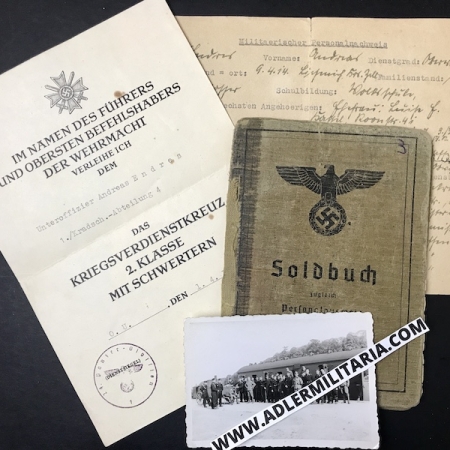
Soldbuch – Oberwaffenmeister Endres – Escaped Stalingrad – Pz.A.A.24 (24PD) – KVK1 – Von Edelsheim Signature! (Sold)
Soldbuch to Oberwaffenmeister Andreas Endres Born into a catholic family in 1914, Enders was enlisted into the Wehrmacht already in 1939. The Soldbuch was opened in August 1939 by: Infanterie Regiment 451 (251 Inf Div) After the formation, the division was relocated as Army Reserve of the 5th Army in the Eifel in the area north of Monschau. At the beginning of the western campaign, the division marched from the area south of Aachen to Liège, then fought its way through Lille to Bethune. The division then returned to Lille, where it was used as an occupation force. From July 1940 to April 1941 it was an occupying force in Brittany. By the end of 1941 Endres was assigned to a new unit for learning to be a weapons specialist. Heereswaffenmesiterschule in Berlin After training he was assigned to: Kradschützen Abteilung 4 (24PD) Kampfgruppe Edelsheim in Stalingrad The unit was under the 24th Panzer Division and was destroyed in Stalingrad in January 1943. Although it would seem that Endres was indeed with the unit from the 1.4.1942 – till the 3.3.1943, although it would seem that he was sent on leave on the 4th of November 1942 it is highly likely he did not return to his unit as it was recorded as being encircled in Stalingrad on the 19th of November. Endres was a very lucky man, he likely never seen any of his original unit ever again. As for the battles of Kradschützen Abteilung 4 in Stalingrad they were heavily involved for fighting in the centre of the city, even parts of the unit were part of the infamous Kampfgruppe von Edelsheim. See here for an in depth synopsis: https://www.lexikon-der-wehrmacht.de/Gliederungen/Panzerdivisionen/24PD-R.htm by April 1943: Enders was awarded the War Merit Cross with Swords, his Document is hand signed by General von Edelsheim (Knightscross with Oakleaves and Swords) Panzer-Aufklärungs-Abteilung 24 On April 7, 1943,in France was renamed Panzer-Aufklärungs-Abteilung 24. In August 1943, they were sent to ward off the expected Allied landing and relocated to Northern Italy. From October 16, 1943, the company was relocated to southern Russia. The further deployment in the last years of the war took place in partly large-scale areas in the Ukraine, Romania, Poland and Slovakia and ended in the enclosed East Prussia. Enders was awarded the War Merit Cross First Class with Swords in January 1945. On March 27, 1945, the unit was set for a break out and the reaching of the Pillau area. For this purpose, a bridgehead had to be built at Balga. The division entered without tanks and without artillery support. The attack succeeded, and by noon the line had been reached. The division was now a line of defense with no depth whatsoever. The Russian enemy never attacked as planned. A very desirable unit, very desirable battles to a special NCO who seen both the West and Eastern Front, the Stalingrad link and the von Edelsheim signature really make this a nice lot.
-

Arbeitskarte – Lenina Doschetschko – Taken from Russia to Germany to CZ (Sold)
Arbeitskarte to Lenina Doschetschko She was born in 1928 from Brudi, Osada Baronowitsch. Given out on the 22. August 1944, she was a Forest Worker. It is unknown what the fate of this young lady was. A rare work card, in complete condition.
-

Wehrpass – Feldwebel Noack – PzReg24 (24PD) – PzIII Commander in Stalingrad! – PzJagd Kdo Potsdam 1945 (Sold)
Wehrpass to Feldwebel Georg Noack Noack was born in 1917 in Naumburg / Saale, into a protestant family. He was married and was a salesman in his civilian life. By 1938 he was a volunteer in Kavallarie Regiment 8, by the time the war started he was in: Reiter Regiment 21 Deployed on October 25, 1939 from the 1st Cavalry Brigade. There were now two brigades, each with two cavalry regiments. The division began the western campaign on May 10, 1940 in North Holland. After achieving their goals it was ordered back to their quarters in the Emsland and from there deployed again in France. The advance led the division west of Amiens past towards Paris and then via Saumur to the La Rochelle – Royan area on the Atlantic. In August 1940, the division was moved from the Bordeaux area in a five-day rail transport to the area west of the Bug, where it spent the time leading up to the start of the Russian campaign with training. On June 22, 1941 the war with Russia began for the division as well. The division’s mission was to cover the southern flank of Panzer Group Guderian. During the first months in Russia it soon became apparent that the division could no longer fully fulfil the tasks assigned to it in the present structure. It was therefore renamed and reclassified to the 24th Panzer Division on November 28, 1941 using all units. His next unit: 9./ Panzer Regiment 24 The regiment fought its way through Voronezh and Bykowo to Stalingrad as part of the 24th Panzer Division. It was here the regiment went down in the encirclement. Noack was wounded in Stalingrad earning him a ticket out in November/December 1942. According to his Wehrpass he was trained as a Tank Gunner and Tank Commander of a Panzer III. See below for an exact model of his regiment at Stalingrad… After his wounding he would go on to train on the Panther Tank at Erlangen, but as the war continued was sent to the following units… Sicherungs Battalion der Heeresgruppe Nord April 1945 – Pz Jagdverband ‘P’ – Potsdam, it could be that this unit took part in the some battles around Berlin in 1945. After a short stint with the above unit he was sent to another unit in Schwerin where he was likely captured. —- His medals: Medal for the Annexation 1938 Wounds Badge in Black Iron Cross Second Class Assault Badge —- This is a nice Wehrpass to a highly desirable unit during the battle of Stalingrad. His wounding was a ticket out of the downfall of his unit.


