Showing 982–990 of 1403 resultsSorted by latest
-
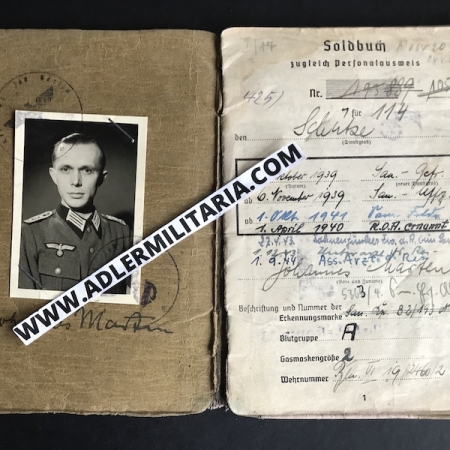
Heer Soldbuch – Ass.Arzt Marten – Grenadier Regiment 947 (359 Inf Div) – Wounded in action 1944 – (hold)
Heer Soldbuch opened in 1939.
For the Johannes Marten, who started his career as a normal Soldier, he worked his way up to be the Assistant Doctor!
He was a medical student, who finished and became a doctor during the war.
He served with many units, the Soldbuch is full of entries!
Interesting points:
He was a doctor in Berlin in a military hospital for some time.
He spent two short stints deployed:
Panzerjäger Abteilung 193
Grenadier Regiment 947 (359 Inf Div)
From the end of April until the start of the major Russian offensive against Army Group Northern Ukraine on July 14, 1944, positional and defensive battles followed in this section of the front. During the Russian major attack, the division was not in the main direction of the enemy attack, but had to deliver parts to neighboring units or to relieve them. These deployed units (Grenadier Regiment 949 new, Divisions Fusilier Battalion, parts of Grenadier Regiment 948 and Field Replacement Battalion 359) fought at Chorobrow and Chorosciec as well as at Josefowka and Augustowka. On July 20, 1944, the divisional front at Cecowa was breached and a detachment was achieved by crossing several rivers into the Molotow – Zalesce area. Parts of the division were encircled and could only escape by leaving their heavy weapons behind. On July 22nd, the division reported a trench strength of 600 men. After the formation and defense of a bridgehead at Zalesce and successful defensive battles at Ruda and Mlyniska, a night crossing over the Dniester was successful without losses. After gathering the division north-east of the city of Stryj on the Stanislaus – Lemberg railway line, the division placed itself under subordination to the “Group Balck” (= XXIV. And XXXXVIII. Panzer Corps) via Zyrawa – Oblaznica – Daszaza – Stryj – Lubience – Synowodzko in the area of Skole off. Here the division was able to spend a few quiet days refreshing themselves within the Hunyadi position on both sides of the pass road to secure the Carparthen without any significant contact with the enemy.
From August 19, the division was relocated from the Lawoczne station (approx. 45 km south of Skole) via Hungary and Slovakia to the area on both sides of the Tarnow-Debica road west of the Wisloka and east of the Dunajew to the LIX. Army Corps.A nice Soldbuch full of entries, could be further researched!
Awards:
- Wounds Badge in Black
-

Heer Soldbuch – Gefreiter Georg Hiebl – Heeres Festungs Artillerie Abteilung 1310 (7. Armee) – Austria 1945 – Captured (Sold)
Heer Soldbuch
Complete with picture, this Soldbuch was issued in 1943.
Hiebl served with:
Heeres Festungs Artillerie Abteilung 1310 (7. Armee)
A heavy fortress artillery unit, they fought with the 7th Army and were in Austria in 1945.
Issued a K98 Rifle
He was captured and survived the war.
-

Heer Wehrpass – Schütze Lamy – Infanterie Regiment 673 (376 Inf Div) – Death Letter – Signature Generalleutnant Stümpfl
Heer Wehrpass issued to Johann Lamy.
He served with the RAD with Army Group North behind the front lines.
A few pages are missing inside this Wehrpass, although luckily its not he important ones!
On the May 1945, he joined:
Infanterie Regiment 673 (376 Inf Div)
It was reformed in the Netherlands in April 1943. Returning to the Eastern Front in November 1943, the division fought in the Ukraine before withdrawing to Romania.
Lamy was killed in June 1942, not long after he arrived on the front.
A postcard to his mother was wrote short before he was killed, he describes 5 hard days of marching up to 55 KM per day. He mentions the front, and that people are falling away. They are pushing further and further… A sad story and could be further translated.
A letter to his mother from his officer stated:
… during an attack on an enemy nest of resistance. A bullet hit his left side, a few mins later he died… He was true to his Oath…
A letter to his mother from the Commander of Vienna, Generalleutnant Heinrich Stümpfl wrote to her giving his condolences, the document is hand signed.
Interestingly Generalleutnant Heinrich Stümpfl was hailed as a ‘resistance fighter’ evidence that he had in fact worked against the persecution of individuals lead to him getting an award after he passed away. Seen below:

-

SS Soldbuch – Erwin Keller – SS Panzer Artillerie Regiment 5 (SS Panzer Division Wiking) – 6 Combat Awards! (Sold)
SS Soldbuch to Erwin Keller
Keller spent from 1941 till March 1945 (!) with the:
SS Panzer Artillerie Regiment 5 (SS Panzer Division Wiking)
The division took part in Operation Barbarossa, the invasion of the Soviet Union, advancing through Galicia, today’s Ukraine. In August the division fought for the bridgehead across the Dnieper River. Later, the division took part in the heavy fighting for Rostov-on-Don before retreating to the Mius River line in November. In the summer of 1942, the unit took part in Army Group South’s offensive Case Blue, aimed at capturing Stalingrad and the Baku oilfields. In late September 1942, Wiking participated in the operation aimed to capture the city of Grozny, alongside the 13th Panzer Division. The division captured Malgobek on 6 October, but the objective of seizing Grozny and opening a road to the Caspian Sea was not achieved. The division took part in the attempt to seize Ordzhonikidze. The Soviet Operation Uranus, the encirclement of the 6th Army at Stalingrad, brought any further advances to a halt and later necessitated a retreat from the Caucasus.
After Operation Winter Storm, the failed attempt to relieve the 6th Army, Erich von Manstein, the commander of Army Group South, proposed another attempt towards Stalingrad. To that end, Wiking entrained on 24 December; however, by the time it arrived on 31 December, it was forced to cover the withdrawal of Army Group A from the Caucasus towards Rostov-on-Don. The division escaped through the Rostov gap on 4 February.
1943–1945
In early 1943, the division fell back to Ukraine south of Kharkov, recently abandoned by the II SS Panzer Corps commanded by Paul Hausser. In the remaining weeks of February, the Corps, including Wiking, engaged Mobile Group Popov, the major Soviet armoured force named after Markian Popov during the Third Battle of Kharkov. As the post-Stalingrad Soviet offensive exhausted itself, Manstein was able to stabilize the front.
In 1943, Herbert Gille was appointed to command the division. The SS Regiment Nordland, along with its commander Fritz von Scholz, were removed from the division and used as the nucleus for the new SS Division Nordland. The Finnish Volunteer Battalion was also withdrawn and they were replaced by the Estonian Battalion Narwa.
In the summer of 1943, the division, along with the 23rd Panzer Division, formed the reserve for Manstein’s Army Group in Operation Citadel. Immediately following the German failure in the Battle of Kursk, the Red Army launched two counter-offensives, Operation Kutuzov and Operation Rumyantsev. Wiking, together with the SS Divisions Totenkopf and Das Reich, was sent to the Mius-Bogodukhov sector. The Soviets took Kharkov on 23 August and began advancing towards the Dnieper.
In October the division was pulled out to a quiet sector of the line just as the Dnieper–Carpathian Offensive overtook Army Group South. In the aftermath of the fall of Kiev in late December 1943, the 1st and 2nd Ukrainian Fronts of the Red Army encircled several German divisions during the Battle of the Korsun–Cherkassy Pocket in January 1944. Over 60,000 soldiers, including the Wiking division, were trapped along the Dnieper River. Roughly half of German forces broke out of the encirclement. Similar to other formations in the pocket, Wiking suffered heavy casualties and lost nearly all of its heavy equipment.
On 13 February 1945, the division was ordered west to Lake Balaton, where Oberstgruppenführer Sepp Dietrich’s 6th SS Panzer Army was preparing Operation Spring Awakening, an offensive at Lake Balaton. Gille’s remained as a support to the 6th SS Panzer Army during the beginning of the operation. Dietrich’s army made “good progress” at first, but as they drew near the Danube, the combination of the muddy terrain and strong Soviet resistance ground them to a halt. The division performed a holding operation on the left flank of the offensive, in the area between Lake Velence-Székesfehérvár. As the operation progressed, the division was engaged in preventing Soviet efforts at outflanking the advancing German forces. On 16 March, the Soviets forces counterattacked in overwhelming strength causing the Germans to be driven back to their starting positions. On 24 March, another Soviet attack threw the IV SS Panzer Corps back towards Vienna; all contact was lost with the neighbouring I SS Panzer Corps, and any resemblance of an organised line of defence was gone. Wiking withdrew into Czechoslovakia. The division surrendered to the American forces near Fürstenfeld, Austria on 9 May.
Equipment:
Many items issued, Pistol P38
He had Malaria in 1943, note his blood could not be used also as a result.
Security Stamps:
There are six control stamps in this Soldbuch, each one is worthy of research I will leave this to the next owner!
One is for March 1945, so he was with the Division in 1945.
Awards:
- Eastern Front Medal
- Wounds Badge in Black
- Drivers Badge in Bronze
- War Merit Cross 2nd Class with Swords
- Assault Badge
- Iron Cross Second Class
He was likely the driver of a Wespe, as they had these see below:

Summary, this sadly is missing page 1/2 and I am not certain that the picture is actually of him. That said, his name is there and with further research more details could be worked out. There is an abundance of nice Signatures in this SS Soldbuch, and likely many are for high award winners. Lastly, SS Soldbücher are becoming so rare that any of them with combat experience is getting so sought after they demand high prices.
-

Heer Soldbuch – Leutnant Kowalkowski – Gren.Ersatz Batl 67 – Spandau – Berlin 1945 – Killed in Action! Featured in Book! Rare! (SOLD)
Leutnant Josef Kowalkowski
Kowalkowski was born on the 6th of August 1897 into a Catholic family, he had served in the First World War.
Kowalkowski was called up on the 11th of April 1945 in Berlin-Spandau at 48 years old, and given the rank of Leutnant. This was likely due to his service and rank during the First World War, where he had once seen combat he was allowed to wear his Iron Cross Second Class awarded in 1915.
Kowalkowski was enlisted to the replacement unit Grenadier-Ersatz- und Ausbildungs-Bataillon 67 based in Berlin Spandau. He was issued food stamps for his unit, and given payment according to his new rank. In the back pouch of the Soldbuch was his card, which further details his role as a recruitment officer for the home front. On the 16th of April Kowalkowski was given an injection for typhus, and according to the other entries issued a steel helmet, bread bag, water bottle, mess kit and rucksack. It is unknown what happened to Kowalkowski, his half Erkennungsmarke could be the sign he was killed and never listed as killed in action or found again.
The German Red Cross has listed 115 soldiers of the same unit as missing in action in the final days of the Battle of Berlin. Among those missing are 17 year old boys right up to men as old as 50 with diverse backgrounds such as Lawyers, a Doctor, a bank worker and a gardener.
Kowalkowski is not listed on the German War graves lists, but the blue penciled 66 on the front page is consistent with other body removed identification documents. The lower part of his Erkennungsmarke; protocol stated that the tag be broken in two, the lower part be kept for records and the top part to remain on the soldier.
This item is featured in a book on the Battle of Berlin, due out next year. This item is featured alongside 180 other items relating to the battle!
Summary, Berlin 1945 related items are hard to come by, especially KIA or MIA Soldbücher with tags.
-

Luftwaffe Soldbuch – Obergefreiter Kiedel – Fallschirm-Pionier-Regiment 20 (20 FJD) – Oder Front – Schwedt – Oath to Dönitz! (Hold)
Luftwaffe Soldbuch to Obergefreiter Kiedel.
Interestingly, Kiedel joined and went through some training at flight school, but for some reasons he did not proceed further likely due to a medical problem, this is noted also in his Soldbuch.
After a short stint with Fallschirmjäger Regiment 9 in Northern France, he was sent to a weapons technical school in Dresden.
But as the war was coming to a close, he was sent to
Fallschirmjäger Ersatz Batl Stendal
Fallschirm-Pionier-Ersatz- und Ausbildungs-Bataillon 1
Lastly, Fallschirm-Pionier-Batl 20
The division was to be assembled in the Liebenwalde area, about 35 km north of Berlin. Young Luftwaffe soldiers, mainly from the Kladow and Gatow Air War Schools, were sent to the regiments. The crews had reported to the air force and had no infantry experience.
In March 1945 the division, or the parts that had already been set up, were thrown onto the Oder front – mostly in the Schwedt area. The left wing of the division was about 2 km south of the city, the right wing about 10-12 km further south. On April 14, 1945, the division, was pulled from the front line and marched westwards, as its combat value was considered insufficient.
On the 5.5.1945 – there is an entry on page 14. This entry as he was till with his unit on active duty, is an odd one! That he swore an Oath to Grossadmiral Dönitz!
It would seem he had some sort of accident and was lucky to escape right at the end, pulling back with the division to the west he was hospitalised.
A nice Soldbuch from a rather rare FJ Division.
-

KM/Heer Soldbuch – Obergefreiter Mack – Panzer Kompanie C (ND) 224 (346 Inf Div) – Flamethrowing Panzer – Holland (Sold)
Soldbuch for Walter Mack
Issued in April 1945 because he lost his other Soldbuch!
His unit was Panzer Kompanie C (ND) 224
The Panzer-Kompanie 224 was formed on 1 July 1943 and was equipped with captured French tanks. It was converted flame thrower tanks in April 1944 and was one of the armored units sent against the Allied landings at Arnhem in September under Panzerjäger-Abteilung 657.
346 Inf Div
The 346. Infanterie-Division was formed in September 1942 and served as an occupation, security and coastal defense unit in France. It fought in Normandy and was largely destroyed there in August 1944. It withdrew to the Netherlands where it was reformed and fought until surrendering to the British north of Arnhem in May 1945.
Awards
- Iron Cross Second Class
- Panzer Badge in Silver
Sadly this is a second edition and so late, but finding anything about this unit is very difficult!
There is a book on this very Panzer Kompanie in Holland.


-

Luftwaffe Soldbuch – Oberwachtmeister ‘Der Spieß’ Schilling – Flak Abteilung 456 – 8 Awards – France 1944 & Holland 1945!n (Sold)
Great little group to an important NCO!
Oberwachtmeister Schilling was already a member of the Armed forces as early as 1933!
He served in various Flak and Artillery units most importantly with the following:
Flak Regiment 11
Flak Abteilung 852
He served most of the war with this unit, most interestingly they were stationed in St Nazaire and spent then most of their time in Rennes in Brittany France, and pushed back to Colmar later that year.
It would seem that by 1945 he was sent to a few units in a short period, although this proves to be an interesting path in Holland into Germany:
In February 1945 Achterluk (Holland) to the Geldern area. On March 1, 1945, the brigade was deployed on a mobile basis in the area to the left of the Rhine, where it also took over the units of the 4th Flak Division deployed there. On March 9, 1945, the command area then moved to the right bank of the Rhine.
On March 18, 1945, the brigade command post was in Oestrich west of Dorsten, and on March 31, 1945 in Münster i.W. In mid-April 1945 the brigade staff moved to Oldenburg and at the end of April to the Elbe in the Cuxhaven area.
Flak Abteilung 456
It would seem right at the end of the war, Shilling won the Luftwaffe Ground Combat Badge fighting near Cuxhaven against the allies.
Awards:
- Service Medal 4th Class
- Medal for Memory of the Annexation 1938
- Iron Cross Second Class
- Flak Specialist (?)
- Unknown
- Black Wounds Badge (Wounded fighting on the Westfront) with Award Cert
- Flak Badge
- Luftwaffe Ground Assault Badge (April 1945!) With Award Cert – Signed by Oberst Nabakowski (German Cross in Gold Holder)
Issued a MP40
Summary; a nice Soldbuch grouping to a West Front Flak unit, could be further researched as I am sure there are some nice facts to find out!
-
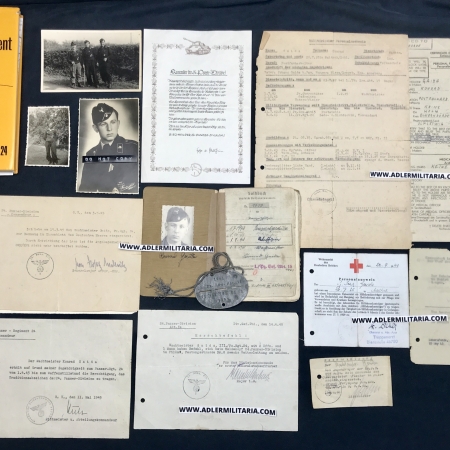
Heer Soldbuch – Wachmeister Gaida – Panzer 4 Commander – Panzer Regiment 24 (24 Panzer Division) – Pz Badge 25 – Honor Roll Clasp – 11 Tank KILLS! 49 Panzer Days! (SOLD)
Incredible Grouping to a well recorded tank commander in on of the most famous units!
I have yet to be offered anywhere such a jaw dropping Panzer Soldbuch, never mind see one for sale.
Conrad Gaida was born in July 1925, by 1942 he was in a Panzer replacement unit and working the post room (humble start).
On the 9th of April 1943 he was fully trained and sent to Panzer Regiment 24, trained as a Gunner and Tank Commander.
24th Panzer Division
In April 1943 the 24th Panzer Division was reorganized in the Lisieux area in France. At the end of July 1943, the division was relocated to northern Italy in the Modena-Florence-Pisa-Livorno area, where it was used for coastal protection.
In September 1943, the division took part in the disarmament of the Italian armed forces. From mid-October 1943 she fought in the southern section of the Eastern Front and took part in the defensive battles on the Dnieper near Novo Staro Dub. Further defensive battles followed in the Dnepropetrovsk – Krivoy Rog area.
From December 1943 to February 1944 the division defended the Nikopol bridgehead.
At the beginning of March 1944 it fought north of Nikolajew and then withdrew to the Romanian Carpathian foothills via the Bug and the Vltava by March 22, 1944. From March 28, 1944, the division had to face defensive battles in northern Besserabia.
From mid-May defensive battles followed on the upper Vltava as well as the counterattack north of Jassy until the beginning of June 1944. Subsequently, the division was taken from the front and refreshed until July 1944. After, the division was transferred to Galicia.
From August to early September 1944, the division carried out counter-attacks between the San and the Vistula.
On September 15, the division moved to the Beskids, where it was used to defend the Dukla Pass. From October 11th, the division was moved by rail to the Szolnok bridgehead in Hungary on the Tisza. The division fought defensive battles between Theiss and Ipel until January 12, 1945.
Sent then via train transport, leaving behind the heavy weapons and armoured vehicles to Marienburg / Elbing (East Prussia). In the Elbing area, makeshift refitting with weapons and vehicles was carried out. The division was then used for defense and counter-attacks in South-East Prussia.
From February 21 to March 27, 1945 defensive battles followed in Warmia and the retreat to the bridgehead at Heiligenbeil. At the end of March 1945 the division was still transported across the Baltic Sea to the Fresh Spit near Pillau.
In mid-April the remnants of the division (approx. 4 – 5000 soldiers) were evacuated to Schleswig-Holstein. There the surrender took place.
Awards:
- 7.11.1943 – Panzer Badge in Silver
- 3.12.1943 – Wounds Bade in Black
- 26.1.1944 – Iron Cross Second Class
- 28.3.1944 – Iron Cross First Class
- 19.4.1944 – Panzer Badge – 25
- 15.3.1945 – Honor Roll Clasp of the German Army
Wounded:
- 5.11.1943 – Splinter in the left hand
- 23.3.1944 – Grenadier Splinter chest
Other documents and photos included:
- A Certificate allowing him to wear the Traditional Badge of the 24th Panzer Division! ”Leaping Horse” Signed by Knights Cross Holder Major Kuls (Kuls, Wolfgang 24.02.1945 Rittmeister Kdr III./Pz.Rgt 24)
- Marching Order – 14.4.1945 – They were reported to go to Pillau to report. Likely without their tank at this stage! Signed by: Knights Cross Holder Major von Knebel-Doeberitz (11.05.1945 Major i.G. Ia 24. Pz.Div)
- A certificate stating that Gaida, was mentioned in the Honor Roll of the German Army. Signed by Knights Cross Holder: Generalmajor Gustav-Adolf von Nostitz-Wallwitz (very rare signature as he died in 1945).
- 24 Panzer Division Flyer – These are also rarely seen a personal speech from von Edelsheim to the men of the 24th Panzer Division!
- 25 May 1945 – Eckernforde – Gaida is allowed to carry a rifle with 10 rounds, he is now employed by the Military Police
- Discharge Papers – Gaida was discharged and send home in 1946
- Military Personal Evidence Sheet – listing all his awards, his battles and injuries and training. A great document detailing many of his battles!
- Photos. 1 Portrait of Gaida wearing the Iron Cross First Class and Panzer Badge and EK2 Ribbon. One of Gaida standing facing the camera in 1944. One of Gaida, Hunger and Maar. Note the Traditional badges on their side caps and Numbered Tank Badges. The photo was taken in Ludwigsburg in May 1945.
- Certificate that Gaida was allowed to be considered to be a Helping Medic, likely a useful tool if captured!
- Certificate that Gaida is now a member of Rittmeister Fischers Command in Palmnicken – 9.4.1945 signed by Fischer (Likely German Cross in Gold Holder:
Soldbuch & Tag
Gaida raised the ranks till Wachmeister in 1945!
The Soldbuch is his first issue Soldbuch and would have been on his person from the date of issue. His matching Tag was also first issue, and still retains the neck cord.
He was issued a P39 Pistol, pocket lamp.
Interesting on page 8 of the Soldbuch is that he is allowed to wear yellow waffenfarbe on his cap to signify Cavalry! An amazing entry that I have never seen before and was unique to the 24 Panzer Division!
The most interesting and detailed battle calendar for any Tank Commander, 49 days are listed! One day away from earning the prestigious Panzer Badge 50!
When researching these final days, It would seem that Gaida proved his resilience and battle knowledge.
The following quotes are taken from the book: Unser Regiment, Panzer Regiment 24, Weidman, 1984
Page 283: Already the next day our tanks had to defend against an enemy tank attack on Deutschendorf, around 15 KM north east of Krawitten. The most forward tank was under the leadership of Oberlt Rehäuser, arriving in the night they immediately spotted a large number of heavy enemy tanks right opposite us! Commander of the first tank is Wachmesiter Gaida. In a report to the division, a special attention was given to the unusual circumstances of the attack. In near darkness, Gaida drove forward at a range of 200 meters in front of a row of enemy tanks, that were preparing to advance on Deutschendorf. Wachmeister Gaida shot immediately on the first tank into flames. Now in the lite up battlefield, and taking enemy fire in a lightning speed shot six more tanks! As a result, the enemy tanks broke up, the others retreated. Because of his actions, the dangerous attack was unsuccessful in this sector of the front (…) the next day Wachmeister Gaida fought in the forest and bushes destroying another 5 from 7 tanks that broke through the lines. This report highlights, how by the fighting in Eastern Prussia the individual actions of single tank commanders and their crews could master the situation.”
Last 20 Tanks for the division, ‘Kampfgruppe von Einem‘
Page 286: Last 10 tanks for the division, Gaia, Kobbe, Bachor, Hippler – Fighting for days at Mertensdorf and Anticken.
Summary, this Soldbuch grouping is astounding, and as far as I have collected IDs, I have yet to see 49 Panzer days entered in a Soldbuch! His awards, and his brave actions are well recorded and this grouping will be hard to top if your interested in owning a Panzer Commander!
Another Interesting fact: Pictured are tanks of the Regiment in late 1944 and 1945.


