
Showing 226–229 of 229 resultsSorted by latest
-
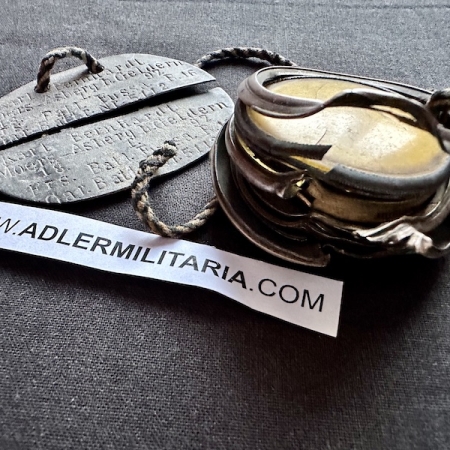
WW1 German Solders ID Tag and “Battle-damaged” Pocket Watch – Karl Bernhardt – Ers.Batl Fuss. Gar. Batt Nr 5112 –
$695.00Incredible little group. The battle damage likely deflected shrapnel or a bullet. The German Dog Tag is marked with: Karl Bernhardt Born: 12.1.1897 Unit: Ersatz Batl Fuss Gar Batt Nr 5112 Research shows that Karl Bernhardt survived the war and died in his hometown of Moers in 1966 of ill health. Watch: Incased old watch, was hit and opened, his name and date of birth matching the tag are engraved inside the watch. When we took this apart to show you the internal system of the watch it began to move. We have a video of it and will be given to the next owner…
-

WW1 German Soldbuch and Militärpass – Uffz Illies – Landwehr Infanterie Regiment 37 – Eastern and Western Front – 1914 – 1918
$95.00Uffz Rudolf Illies Born in Blankenburg in 1885. Entered Active Service on the 30th of November 1914 Awarded: Iron Cross Second Class and Brunswick War Merit Cross 2nd Class An impressive battle calendar spanning across both fronts. Served with The 3rd Landwehr Division (3. Landwehr-Division) was an infantry division of the Imperial German Army during World War I. It was formed on the mobilization of the German Army in August 1914 under the “Higher Landwehr Commander 3” (Höherer Landwehr-Kommandeur 3). The Landwehr was the third category of the German Army, after the regular Army and the reserves. Thus Landwehr divisions were made up of older soldiers who had passed from the reserves, and were intended primarily for occupation and security duties rather than heavy combat. While the division was a Landwehr formation, at the beginning of the war it also had an attached Ersatz infantry brigade, made up of cadres from various regimental replacement battalions (this brigade was dissolved in September 1914). The division was primarily raised in the Prussian provinces of Posen, Lower Silesia, and West Prussia. The division was disbanded in 1919 during the demobilization of the German Army after World War I. Combat chronicle The 3rd Landwehr Division fought on the Eastern Front in World War I. It was on the front in Poland from the early days, and participated in the Gorlice-Tarnów Offensive, crossing the Vistula in July and advancing toward the Bug, and eventually reaching the line between the Servech and Shchara rivers, where the front stabilized. It remained in the line there until the armistice on the Eastern Front in December 1917. Thereafter, the division served in the Ukraine and in the German occupation forces in Russia until late September 1918, when it went to the Western Front, serving in the Flanders area until the end of the war. Allied intelligence rated the division as fourth class and of mediocre combat value. Comments: A nice set to a combat soldier,
-
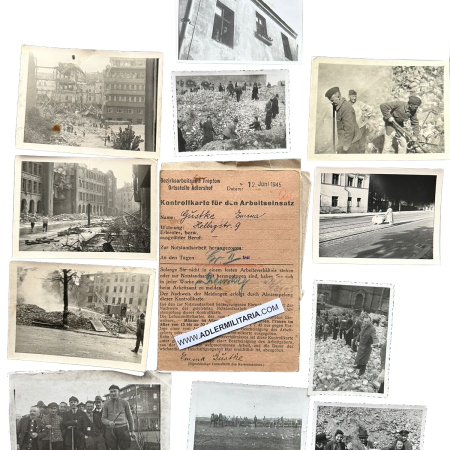
Tümmerfrau- Emma Gustke – Berlin 1945 – Rubble cleaner – Rare grouping
$235.00Tümmerfrau – Berlin in Ruins The Work Control Card and photos of a Trümmerfrau For more information see: https://en.wikipedia.org/wiki/Tr%C3%BCmmerfrau Emma Gustke, from Treptow was employed from the 18th of June 1945 to clean the streets of Berlin. Men from 15 to the age of 65 and woman from the ages of 15 to 50 years old were required to work. Her photos show the extent of the damage, brick by brick the areas were cleared. In Berlin alone around 60,000 woman were employed to clean the streets from the debris the war inflicted on the city. The pictures tucked inside the work card, a few memories she tucked away…
-
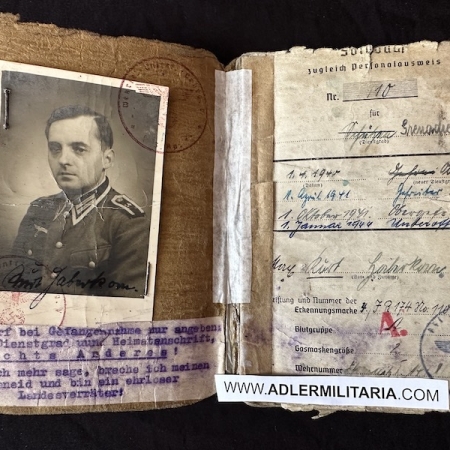
Wehrmacht Soldbuch – Unteroffizier Haberkorn – Grenadier Regiment 1120 – 553 Volksgrenadier Division Ardennes 1944 – Wounded fighting US Troops 1945 (Reserved)
$345.00Wehrmacht Soldbuch for NCO Kurt Haberkorn. Soldbuch opened in December of 1939 with Infanterie Regiment 174. In 1941 – Etra Südost / Wehrmachttransportleitung Südost On 01.11.1940 – set up in Vienna, the use of which is to be considered in connection with the dispatch of the German army mission to Romania, which began in October, and the increasing involvement of the Balkans in German military plans. It was initially responsible for the transport command in Ostmark, Bohemia and Moravia, the transport officer in Pressburg and the German border command in Regensburg. Location always Vienna Late 1944 / 1945 – Grenadier Regiment 1120 (553 Volksgrenadier Division) – Fought against: US ARMY – 79 US Infantry Division & 10 US Armoured Division near Oehringen/Schwaebish Hall 1945 553. Volksgrenadier division was created on 9 October 1944 by the renaming of the 553. Grenadier division in Lorraine. The 553. Grenadier division was originally formed as a Sperr division (blocking division) in Münsingen. The unit was composed of men from Württemberg. In September 1944, the 553rd was rushed to the Lorraine region of the western front and thrown into battle against the Allied troops advancing on the city of Nancy. During September 1120. Grenadier regiment of the division defended Forêt de Champenoux to cover the withdrawal of the rest of the division. The regiment had entrenched thoroughly, building a line of log-covered dugouts and foxholes ten or fifteen yards inside the forest. Within the shelter of the woods a few assault guns backed up the infantry and covered still more entrenchments. When the Americans attacked with tanks and infantry on 20 September, they were repulsed. Repeated attempts were made to push the 1120th Regiment out of their positions during the day, and the following day, but all were driven back. The Americans tried a prolonged artillery barrage to demolished the entrenchments, but even this was unable to dislodge the defenders. On 22 September, the Americans tried a combined attack with the 80th and 35th Infantry Divisions, supported by one combat command of the 6th Armoured Division and the Volksgrenadiers were finally pushed out of the forest. With the Americans now threatening both his flanks, the 553. GD’s commander, Oberst Erich Loehr pulled his division back. The division was pulled out of the line in October. The whole 553. Grenadier division had been worn down after a month’s hard fighting and had to be reinforced. The reinforcements it integrated were number of fortress and independent battalions in the area of Army Group D. Even with the addition of these groups, one regiment (the 1121st) was dissolved along with the 2nd Battalion of 1120. Grenadier regiment. While the US Third Army was advancing from Metz, the US Seventh Army was preparing to clear the Saverne Gap. In mid-November, the American 44th Infantry and the French 2nd Armoured Divisions started an advance aimed at taking Saarbourg. Among the defending units was the newly renamed 553. Volksgrenadier division. Another hard defensive battle began for the Volksgrenadiers. The Allied assaults ground down the German units until they were only shadows of their normal organisations. After Saarbourg fell to the US 44th Infantry Division on 21 November, the remnants of 553. VGD were pulled out and transferred to southern Alsace. During Operation Nordwind the division the division attacked alongside 10. SS-Panzerdivision from Gambsheim towards Haguenau. At the end of January, the High Command decided to pull the 553. VGD out of the line entirely and rebuild it once again. The division was re-established on 31 January 1945 in Pforzheim. The division was deployed in the 19. Armee sector on 20 March. The division surrendered to the Americans shortly thereafter in Württemberg. Awards: Wounds badge in Black , he was wounded twice and received no Silver badge due to the war ending. Soldbuch comments. Very nice piece of paper added to the front page, detailing that he is if the captured only allowed to say his name, rank and home address, anything else is dishonourable and guilty of treason against Germany. A rare late war unit, fighting in desirable and sought after battles. 10th Armoured – US Army Documentary about the fighting in Germany, also where Haberkorn was wounded. An interesting documentary covering the creating on the Volks Grenadier Divisions


