
Showing 514–522 of 1179 resultsSorted by latest
-

WWII Soviet Army Identification Booklet – Sergeant Anna Roschina – Radio Operator Sevastopol 1941/1942 – Original Photo – Rare ID (Sold)
1. Surname: Roshchina. 2. First and middle name: Anna Kupriyan. 3.Date of birth: 1921 4.Place of birth: Moscow 5.Nationality: Russian 6. Education: 7 grades of school 3. Rank and position: junior sergeant in charge of production. 4. Name of the unit: headquarters of the 88th Air Defense Division. 5.Conscripted on: 1942 6. Specialty before conscription: typist Passage of service: •Battalion 50 06 VNOS, 2nd regiment (radio operator) – 1942. This battalion participated in defending Sevastopol in 1941-1942. •Headquarters of 88th Air Defense Division (in charge of production) – 1944. •On the basis of the order of the Deputy NPO of the USSR, number 0200 dated 18.07.44, she was transferred to the position of a civilian, leaving her in the Red Army. Fired: Demobilized on the basis of the decree of the President of the Supreme Council of 06/23/45. Awards: •Order of the Patriotic War 2nd class •Medal “40 Years of Victory in the Great Patriotic War” •War veteran’s certificate awarded on 04.09.79 Final Comments: This ID is just marvellous, with the originally applied photo wearing the Urshanka, finding these with photos is nearly impossible for Wartime Issue.
-
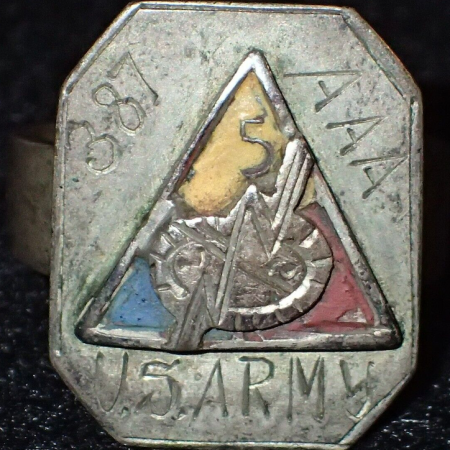
WWII US Army – 5th Armored Division – 387th AAA Automatic Weapons Battalion – Silver Ring – Ardennes 1944
Wonderful Original Theater Made WW2 U.S. Army 5th Armored “Victory” Division 387th Anti-Aircraft Artillery Automatic Weapons Battalion (Mechanized) German Silver (.800 Marked) Signet Ring, Size 9. The 387th Automatic Weapons Battalion was Assigned to The 5th Armored Division from 1 August 1944 to 25 March 1945 and Saw Extensive Combat Including The Battle of The Bulge
-

WWI US Army 6th Infantry Division – German Occupation 1919 – Silver Signet Ring
WWI US Army 6th Infantry Division German Occupation 1919 Silver Signet Ring Size 11.5 Wonderful Original WWI Army 6th Infantry Division German Occupation 1919 German .800 Silver (tested not marked) Signet Ring Size 11.5 & Weight 7.9 Grams – Good Worn Condition as Photographed with moderate personal wear as seen – Recent Estate Acquisition & Presented as Acquired, Very Rare ORDER OF BATTLE Activated: November 1917 Subordinate Units: Headquarters, 6th Division 11th Infantry Brigade 51st Infantry Regiment 52nd Infantry Regiment 17th Machine Gun Battalion 12th Infantry Brigade 53rd Infantry Regiment 54th Infantry Regiment 18th Machine Gun Battalion 6th Field Artillery Brigade 3rd Field Artillery Regiment (75 mm) 11th Field Artillery Regiment (155 mm) 78th Field Artillery Regiment (75 mm) 6th Trench Mortar Battery 16th Machine Gun Battalion 318th Engineer Regiment 6th Field Signal Battalion Headquarters Troop, 6th Division 6th Train Headquarters and Military Police 6th Ammunition Train 6th Supply Train 6th Engineer Train 6th Sanitary Train 20th, 37th, 38th, and 40th Ambulance Companies and Field Hospitals The division went overseas in June 1918, and saw 43 days of combat. Casualties totaled 386 (KIA: 38; WIA: 348). The 6th Division saw combat in the Geradmer sector, Vosges, France, 3 September – 18 October 1918, and during the Meuse-Argonne offensive 1–11 November 1918. Separately the 11th Field Artillery Battalion became engaged earlier in the Meuse-Argonne offensive and fought from 19 October to the Armistice.
-

WWI Imperial German Visor – Dunkelblau Officers Dress Parade Service Visor – “Schwarzburg Rudolstadt”
Wonderful Original WWI Imperial German Dunkelblau Officers Dress Parade Service Visor Hat Cap – Cockade Arrangement Denotes ‘Schwarzburg Rudolstadt’ Valley of Schwarza, Overall Fine Issued Condition as Photographed with light exterior wear and damage to the interior lining as seen, edge of the visor has some loose stitching that causes it to move slightly, Hat is Solid – This Imperial German Dress Cap displays very nicely and would make a great addition to any collection of the period.
-

WWII Imperial Japanese – Occupation Taiwan ‘Chokunin’ Governor General Epaulettes – Rare
Wonderful Original & Exceptionally Rare WWII Imperial Japanese Occupation of Taiwan (Formosa) Governor General ‘Chokunin’ Epaulettes & Tin Carrying Case; Appointment of the Emperor, Fine Early War-Time 1930’s Issued Condition as Photographed with some light discoloration as seen
-

Vietnam War USAF – Senior Air Force Officers Service – Named Visor Hat – Lt. Col. YEUTTER – Full Bio
Wonderful and Rare Original Vietnam War USAF Senior Air Force Officers Service Visor Hat by ‘Berkshire DeLuxe’ Size 7 1/4 of Lt. Col. Clayton Yeutter 831 Hazlewood Dr. Lincoln, Nebraska on the Identification Tag who was Lieutenant Colonel Clayton K. Yeutter (b. 10 Dec 1930 – d. 4 Mar 2017) was a Air Force Veteran and Long Serving Government Official ultimately becoming Secretary of Agriculture under President George H.W. Bush from Feb 1989 – Mar 1991 (see full obituary followed by full history below), Fine Issued Condition as Photographed with wear as seen – Recent Estate Acquisition & Presented as Acquired, Very Rare (Photos 18 – 22 Reference Only) OBITUARY: Clayton Keith Yeutter US Presidential Cabinet Secretary. He served as the Secretary of Agriculture under President George H.W. Bush from February 16, 1989 to March 1, 1991. He earned his B.S., J.D., and Ph.D. in Agricultural Economics from the University of Nebraska-Lincoln. During this time, he also enlisted in the United States Air Force and the credits he earned under the G.I. Bill in his military tenure helped him to attend graduate school. He continued to serve in the Air Force Reserve until 1977. From 1957 to 1975 he operated a 2,500-acre farming enterprise in central Nebraska. After his degree work, he started his government service as chief of staff to the Governor of Nebraska in 1967. In September of 1968 he left government service to work as the director of the University of Nebraska Mission in Colombia. He stayed in this position until October of 1970 when he went to work at the United States Department of Agriculture. In January 1972 he joined the Nixon re-election campaign and after the election, he rejoined the Agriculture Department. In 1975 he moved over to the position of Deputy Special Trade Representative. After Gerald Ford left the presidency in January 1977, he went into private law practice until early 1978 when he became Presdent and CEO of the Chicago Mercantile Exchange. He served in this capacity until June of 1985 when he was named U.S. Trade Representative by President Ronald Reagan. He remained at this post until January of 1989 when he was named the Secretary of Agriculture by the newly elected President Bush. In January of 1991 he left the Agriculture Department to become the chairman of the Republican National Committee. He served as chairman for one year before being named counselor to the President for domestic policy by President Bush. After leaving the government in 1993, he worked in various positions such as private law, holding numerous corporate directorships, and lobbying for an agricultural group. He passed away after a four year battle with colon cancer. HISTORY: Clayton Keith Yeutter, ONZM (/ˈjaɪtər/; December 10, 1930 – March 4, 2017) was an American politician who served as United States Secretary of Agriculture under President George H. W. Bush from 1989 to 1991 before serving as Counselor to the President in 1992. He served as United States Trade Representative from 1985 to 1989 and as Chairman for the Republican National Committee from 1991 until 1992. Yeutter was employed as a Senior Advisor at the international law firm Hogan Lovells in Washington, D.C. He additionally founded the Clayton Yeutter Institute of International Trade and Finance at his alma mater, the University of Nebraska-Lincoln. The University subsequently published his biography, Rhymes with Fighter. Yeutter was born in Eustis, Nebraska. Yeutter was a graduate of the University of Nebraska–Lincoln from which he received a B.S., a J.D., and a Ph.D. in Agricultural Economics. Yeutter later served as Assistant Secretary of Agriculture for Marketing and Consumer Services from 1973 to 1974, Assistant Secretary of Agriculture for International Affairs and Commodity Programs from 1974 to 1975, and Deputy Special Representative for Trade Negotiations from 1975 to 1977. Early life and education Yeutter was born in Eustis, Nebraska, on December 10, 1930, during the Nebraska Dust Bowl and the Great Depression. Despite a successful career in government and politics, Yeutter expressed a continued desire to remain close to his upbringing. As Deputy Trade Representative Yeutter stated, “I once wanted to stay in Nebraska and be a successful farmer. There are days when I get a yearning to return.” Yeutter graduated from Eustis High School in 1948. He then attended the University of Nebraska–Lincoln and was a member of FarmHouse Fraternity. In 1952 Yeutter graduated with a B.S. “With High Distinction”, the highest scholastic honor given by the University of Nebraska. He also ranked first in the College of Agriculture graduating class and was named the “Outstanding Animal Husbandry Graduate” in the United States. Upon graduation from the University of Nebraska-Lincoln, which coincided with the Korean War, Yeutter enlisted as a Basic Airman in the United States Air Force. While enlisted he earned credits under the G.I. Bill to attend graduate school. From the completion of his enlistment in 1957 until 1975 Yeutter worked as the operator of a 2,500-acre farming enterprise in central Nebraska. He also continued to serve in the active reserve until 1977. During an overlapping six-year period beginning in January 1960, Yeutter worked as a faculty member within the Department of Agricultural Economics at his alma mater, the University of Nebraska. While working within the Department of Agricultural Economics Yeutter completed extensive graduate work. He completed one semester of graduate studies in agricultural economics at the University of Wisconsin–Madison in 1960. After entering the College of Law at the University of Nebraska-Lincoln Yeutter served as an editor of the Nebraska Law Review. In 1963 Yeutter graduated cum laude with a J.D. and ranked first in his graduating class. While Yeutter continued to work as a faculty member he also completed a Ph.D. in agricultural economics by 1966. While completing his J.D. and Ph.D., Yeutter taught agricultural economics and agricultural law part-time. After completing his J.D. Yeutter taught full-time from 1965 to 1966. Professional career Yeutter began his professional political career as the chief of staff to the governor of Nebraska in January 1967. During the…
-

WWI U.S. Army – Siberia Expedition Campaign – Siberian A.E.F. – Allied Expeditionary Force – Super Rare Photos
Wonderful Original WWI U.S. Army Siberia Expedition Campaign Siberian A.E.F. Allied Expeditionary Force (88) Photographs of Russia, Japan, & Korea during participation in the Siberia Campaign 27th Infantry Regiment: Sixty (60) Photos of Siberia with numerous views of the Harbor, Coastal Artillery, Russian Troops, Government Buildings, Armored Train, Railyards, Bicycle, Ships, AEF Troops, Construction, Religious Procession, Indigenous Man with Pet Bear, Equipment, and Numerous other Scenes; Twenty-Eight (28) Photos of Japan & Korea while enroute to Siberia 1921 Dated with Villagers, Architecture, Machine Gun Training, and More – Good Condition as Photographed with some torn corners and typical bending from age will easily album mount
-

WWI US Army- 108th Ambulance – Private Joseph F. Desmond – 27th Infantry “O’Ryan’s Roughnecks”- Battle of the Somme – Dog Tags – Armband – Rare
Wonderful Original WWI U.S. Army 108th Ambulance Company 102d Sanitary Train 27th Infantry Division Private Joseph F. Desmond ASN ‘1.222.992’ Personnel Identification Discs “Dog Tags” AEF Service June 1918 – March 1919. Seeing Action with the 27th Infantry “O’Ryan’s Roughnecks” Division in the Somme Offensive, Ypres-Lys, and Meuse-Argonne Campaigns; Medical Corps Red Cross Armband Brassard Stamped ‘Army Medical Service’ Embroidered Button Type, Medical Corps Private First Class Specialty Sleeve Patch Embroidered, Overseas Service Chevron French Tailor Embroidered in Bullion, Three Authorizations for Leave, St Malo and Surrounding Area Guide by The YMCA, Catholic Pocket Crucifix and Card with Joseph Desmond of Binghamton NY Address, and a Veterans of Foreign Wars VFW Service Ribbon Early Production Pin Back, Exceptional Condition as Photographed – Recent Estate Acquisition & Presented as Acquired, Very Rare (Photos 16 – 19 Reference) The 102nd Sanitary Train was mustered into Federal service in July of 1917 following the entry of the United States into World War I and served in the 27th Infantry Division on the Western Front. On August 20th, Ambulance Companies 106 and 107 of the 102nd Sanitary Train supported the 2/1 East Lancashire Field Ambulance in a forward position near Busseboom, Belgium, where they established a dressing station for the wounded. Field Ambulance Company 106 then manned a sick post for reserve battalions at Trappiste Farm between August 24th and September 3rd. Men from the 106th and 107th Ambulance Companies also provided aid to front line troops at an advanced dressing station at Long Barn. There, they received wounded troops by wheel cart and stretcher before loading them into motor ambulances for transportation to the main dressing station at Remy Siding, which was seven kilometers away. On August 27, British command ordered the 2/1 and 2/2 Field Ambulances to turn their equipment over the 102nd Sanitary Train, which acquired “four Fords, nine Daimlers and six horse-drawn ambulances.” However, “The condition of this motor transport at the time it was received from the British was of such a character that under constant use it was unable to stand the strain, and about September 2d the cars had to be frequently sent to the shop for repairs and at times only seven or eight of the motor cars were fit to take the road. During this period only two cars were damaged by shell fire.” (550). On September 27th, Ambulance Companies of the 102nd Sanitary Train established a new main dressing station at Villers Faucon: “The forward area was covered by Ambulance Companies Nos. 106 and 107, less a detail to run the advanced dressing station, augmented by the litter bearer section of the 133d Field Ambulance and 100 men from the 108th Infantry. Motor transport consisted of three Fords and eleven Daimlers.” (550) The dressing stations became quickly overwhelmed with the wounded and the 102nd Sanitary Train faced congestion when evacuating wounded to other medical facilities. However, with the aid of the American Red Cross they were able to provide waiting men with blankets for cover and hot drinks. The 102nd Sanitary Division was relieved on October 2nd and marched to a rest area at Courcelles. On October 11, the 102nd Sanitary Train was ordered to take over a main dressing station at Premont for the offensive through St. Souplet. Field Hospital Company 105 set up rooms for the main dressing station at Premont while Field Hospital Company 106 established a forward station at Busigny. The rapid advance of the Allied frontline during the offensive strained the men and equipment of the 102nd Sanitary Train; its men needed to follow the advancing infantry closely enough to render effective aid, but had little help from hospital and railhead accommodations. When the battle at St. Souplet began, the main dressing station at Premont was abandoned in favor of the closer Busigny. The movement was undertaken at nighttime over poor roads, and the round trip took up to nine hours by car. Worse still, on October 15th, the 102nd Sanitary Train was ordered to transfer twenty of its forty motorcars to the 30th Infantry Division. The Ambulance Companies faced a backlog of 160 stretcher cases awaiting evacuation and the 102nd Sanitary Train demanded and received 22 cars from elsewhere in the army.
-
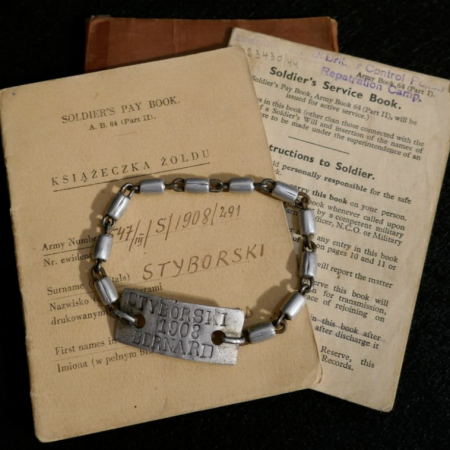
WWII Free Polish Army – Service & Pay Book – Armed Forces West – Styborski – Soldier’s ID Bracelet – Super Rare
Rare Original WW2 Free Polish Army Armed Forces West Soldier’s ID Bracelet ‘STYBORSKI 1908 BERNARD’ From Aircraft Aluminum and a Section of K98 Cleaning Chain. Soldier’s Service Record Army Book 64 in Polish & Pay Book, all pieces to Bernard Styborski 1908 (Year of Birth), Called into Service 1944. The formations, loyal to the Polish government-in-exile, were first formed in France and its Middle East territories following the defeat and occupation of Poland by Germany and the Soviet Union in September 1939. After the fall of France in June 1940, the formations were recreated in the United Kingdom. Making a large contribution to the war effort, the Polish Armed Forces in the West was composed of army, air and naval forces. The Poles soon became shock troops in Allied service, most notably in the Battle of Monte Cassino during the Italian Campaign, where the Polish flag was raised on the ruined abbey on 18 May 1944, as well as in the Battle of Bologna and the Battle of Ancona (both also in Italy), and Hill 262 in France in 1944. The Polish Armed Forces in the West were disbanded after the war, in 1947, with many former servicemen forced to remain in exile. https://www.youtube.com/watch?v=MMlrL2x173w


