Showing 541–549 of 1269 resultsSorted by latest
-

WWII Hitler Youth Leaders Sports Badge – HJ Führer Sportabzeichen – Low Number – With COA from Militaria Berlin
HJ Führer Sportabzeichen, with bearer photo and COA from Militaria Berlin. Low issue number, great condition.
-
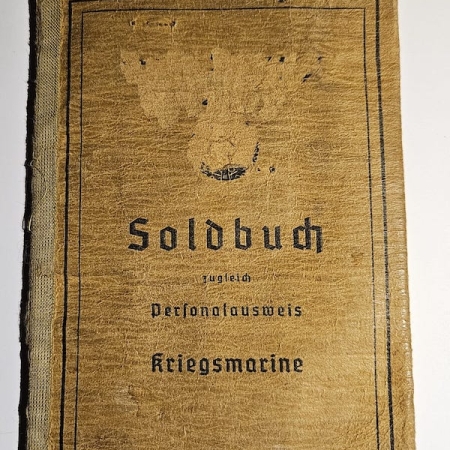
WWII German Navy Soldbuch – Post War Deminer – EOD – Netherland or Denmark
$149.00Denazified, but a very interesting one: he was in a Kriegsmarine demining unit until November 1945 and got paid until this time. Unit was probably in Denmark or the Netherlands.
-

WWII Portuguese Army – Officers Uniform ‘Camacho Lisboa’ – Ribbons / Medals Loops – Hard to find!
WWII Portuguese Army Officers Uniform ‘F. Camacho, Lisboa’ Tailors – Ribbon or Medal Bar Loops, Illegible Pocket Tag; Overall Nice Issued Condition as Photographed with some wear, cuff rank removed and the top button replaced as seen, An Exceptional Addition to Any Period Collection, Portugal remained effectively neutral until 1944 when they allowed the United States to establish a base in the Azores at which point they were deemed ‘Non-Belligerent Favors Allied Nations’
-

WWI Imperial German Baden-Württemberg Honor Badge Voluntary Fire Brigade 25 Year
WWI Era Imperial German Baden-Württemberg Honor Badge for Voluntary Fire Brigade Service 25 Years in the Jewelry Box ‘Ludwig Bertsch Hof-Juwelier Karlsruhe 1/B.
-
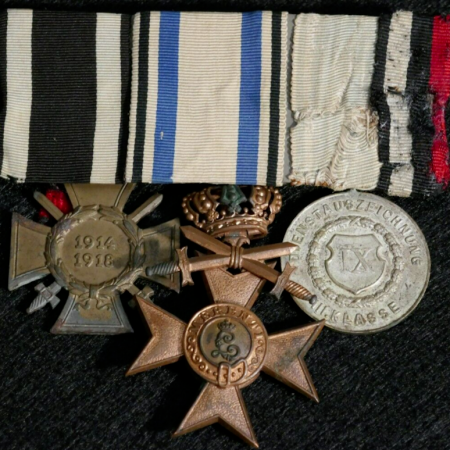
WWI German Medal Bar – Bavarian Medal Bar EKII Military Merit Cross & Long Service III Class
Original WWI German Bavarian Medal Bar Iron Cross 2nd Class (EKII) Needs added!, Bavarian Military Merit Cross & Long Service III Class War-Time
-
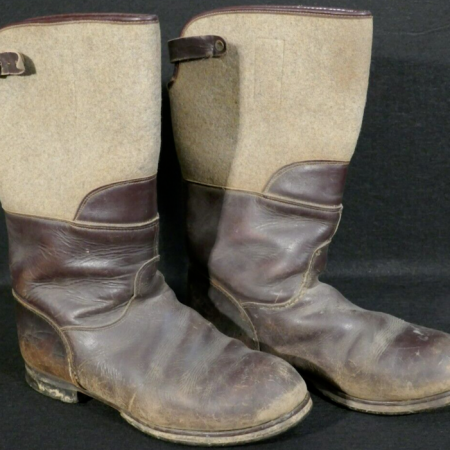
WWII German Wehrmacht – Winter Combat Boots – Eastern Front Felt & Leather – Issued
Original WWII German Wehrmacht Winter Combat Boots Eastern Front Felt & Leather, Overall Good Issued Condition as Photographed with wear as seen – serviceable; this set displays very nicely
-
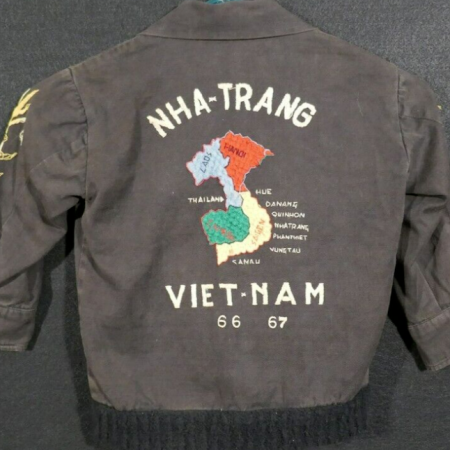
Vietnam War Souvenir – NHA-TRANG 1966 – 67 Tiger Dragon Jacket Coat Children’s Size
Wonderful and Unusual Child’s Original Vietnam War Souvenir NHA-TRANG 1966 1967 Tiger and Dragon Embroidered Jacket Coat Small Children’s Size – Overall Good Condition as Photographed with wear to the waistband as seen
-
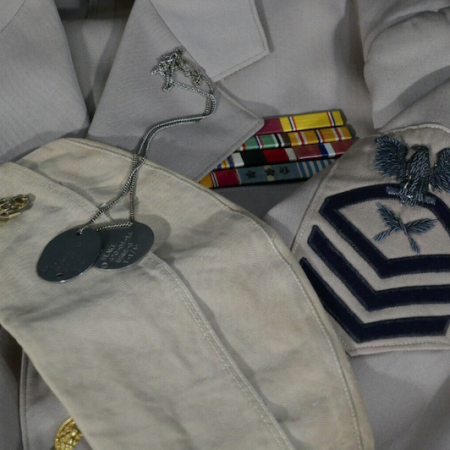
WWII US Navy – Chief Yeoman Dog Tags – Khaki Uniform – Garrison Cap – USS Bogue CVE-9 – Sank U-217 U-118 U-527 U-1229 Escort Carrier Sqdr. VC-9 – Rare
Wonderful Original WWII USN CY Chief Yeoman “Dog Tags” Khaki Uniform & Garrison Cap USS Bogue CVE-9 Sank U-217, U-118, U-527 & U-1229 Escort Carrier Composite Squadron VC-9 Flying Grumman Wildcat and Avengers: Chief Yeoman CPO Chief Petty Officer C E Blake ‘620-08-16’ USNR Khaki Summer Uniform with Chief Yeoman Bullion Rate Patch, Two Service Stripes, and 12 Ribbon Bar: US Navy Presidential Unit Citation with Star, Navy Good Conduct Medal, American Defense, American Campaign, Europe North Africa Middle East Campaign, Asiatic Pacific Campaign, World War Two Victory, Occupation Service, Philippine Liberation, National Defense Service, Korean War Service with Three Campaign Stars (Served Aboard Destroyers), and UN United Nations Korea Service. Uniform Tailored by Ashland Clothes New York, Khaki Trousers, and Overseas Garrison Cap with CPO Chief Petty Officer Device. All Pieces Named to C E Blake and Accompanied by his Personnel Identification Discs “Dog Tag” on Chain – One Early War with Thumb Print Reverse. Overall Good Condition as Photographed with wear as seen – Recent Estate Acquisition & Presented as Acquired, Rare (Photos 17 – 24 Reference Only) – Warrants Further Research USS Bogue (AVG/ACV/CVE/CVHE-9) was the lead ship in the Bogue class of escort carriers in the United States Navy during World War II. The ship was named for Bogue Sound in North Carolina. Originally classified AVG-9, this was changed to ACV-9 on 20 August 1942; CVE-9 on 15 July 1943 and CVHE-9, on 12 June 1955. She was part of an effective force, where aircraft operating from Bogue or ships escorting the carrier claimed ten German and two Japanese submarines between May 1943 and July 1945. Construction Bogue was laid down on 1 October 1941, as Steel Advocate under Maritime Commission contract, MC hull #170, by Seattle-Tacoma Shipbuilding, in Tacoma, Washington. She was launched on 15 January 1942 sponsored by Mrs W. Miller, the wife of Lieutenant Commander Miller, transferred to the United States Navy on the 1 May 1942 and commissioned on the 26 September 1942. Aircraft carried Bogue had capacity for up to 24 fighter and anti-submarine aircraft normally a mixture of Grumman; Wildcat and Avengers with composition dependent upon mission. The squadron had the callsign VC-9 (Composite Squadron Nine). When she was utilised in a ferry role, she could carry up to 90 aircraft depending on aircraft type. Service history After a shakedown cruise and repair period, Bogue joined the Atlantic Fleet in February 1943. Although she escorted convoys early in her career, she served principally as the nucleus of independent, highly successful anti-submarine hunter-killer groups for Atlantic theater carrier operations. 1943 During March and April, she made three North Atlantic crossings, departing on her fourth crossing on 22 April. On 21 May, her Avengers damaged German submarine U-231 and the resulting chlorine gas leak knocked out both of the boats radio transmitters forcing the boat to return to La Pallice in occupied France. Bogue claimed her first kill on 22 May, when depth charges dropped by one of her Avengers damaged U-569 at 50°40′N 35°21′W. The Captain ordered his crew to scuttle the boat and 24 of the crew were later captured by the Canadian destroyer St. Laurent. On 5 June, U-217 was sunk at 30°18′N 42°50′W with all hands by depth charges dropped by Bogues Avengers near the Mid-Atlantic Ridge. On 12 June, the already damaged U-118 was sunk by aircraft from Bogue with bombs and gunfire, at 30°49′N 33°49′W 16 of the boat’s crew were picked up by the escort vessel USS Osmond Ingram. On 23 July, during her seventh patrol, her aircraft sank U-527 at 35°25′N 27°56′W. Twelve survivors were picked up by USS Clemson and later transferred to Bogue. The destroyer George E. Badger, part of Bogue’s escort screen, sank U-613 at 35°32′N 28°36′W, while she was en route to lay mines off the coast of Jacksonville, Florida. Bogue’s eighth patrol. On 30 November, aircraft from Bogue damaged U-238 east of the Azores with rockets that killed two crew members and wounded five more, prompting the submarine to return to Brest with damage that put the boat out of service for a month. On 12 December, U-172 was sunk on 13 December, in mid-Atlantic west of the Canary Islands by Avenger and Wildcat aircraft and attacks from the destroyers George E. Badger, Clemson, Osmond Ingram and Du Pont (DD-152). The battle between U-172 and the ships and aircraft lasted for 27 hours. U-172 sank at 26°19′N 29°58′W.,[7] thirteen of U-172’s crew were killed and 46 survived. 1944 Bogue had a break from her anti-submarine operations during January and February, when she ferried a cargo of United States Army fighter aircraft to Glasgow. She then returned to her anti-submarine role. On 13 March, her Avengers, from VC-95, along with British Fortress Mk IIs from 220 Squadron, the destroyers Haverfield and Hobson, and the RCN River-class frigate Prince Rupert collectively sank U-575 at 46°18′N 27°34′W. On 5 May, Bogue and her escorts departed Hampton Roads, Virginia, for a cruise that netted two more submarines and lasted until 2 July. Francis M. Robinson, of the screen, sank the Japanese submarine RO-501 (ex-German U-1224) on 13 May, and Bogue’s Avengers sank the Japanese submarine I-52 at 15°16′N 39°55′W, on 24 June, in a torpedo attack, dropping a Mark 24 “mine”. The Mark 24, code-name “Fido” and designated a “mine” for secrecy reasons. During the next deployment from 24 July to 24 September, Bogue’s aircraft sank German submarine, U-1229, on 20 August at 42°20′N 51°39′W. Following her return in September, Bogue operated on training missions out of Bermuda and Quonset Point, Rhode Island. 1945 In February she completed a ferry trip to Liverpool with US Army Aircraft. In April, Bogue put to sea again as an anti-submarine vessel, forming part of Captain George J. Dufek’s Second Barrier Force during Operation Teardrop. On 24 April, her escort Frederick C. Davis was torpedoed and sunk by U-546. Bogue’s accompanying escorts, Flaherty, Neunzer, Chatelain, Varian, Hubbard, Janssen, Pillsbury and Keith sank U-546 at 43°53′N 40°07′W….
-
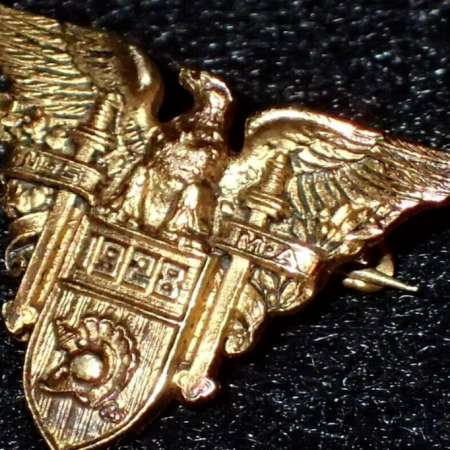
1928 USMA West Point – 14K Gold – Class Graduation Lapel Pin – R.C.R. ‘Tiffany & Co.’
1928 USMA West Point 14K Gold Class Graduation Lapel Pin R.C.R. ‘Tiffany & Co.’ Wonderful and Rare Original 1928 USMA United States Military Academy at West Point 14K Gold Class Graduation Lapel Pin R.C.R. Initials Engraved Made by ‘Tiffany & Co.’ New York, Fine Condition as Photographed


