Showing 514–522 of 1269 resultsSorted by latest
-
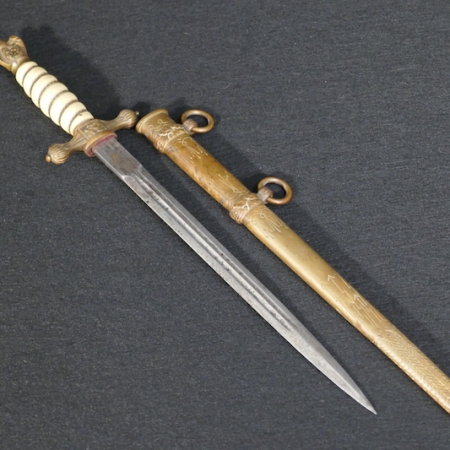
WWII German Navy – Officers Kriegsmarine Dagger – Uncleaned
An untouched KM Officers Dagger, this was a bring back to the USA after WW2. Seen some wear and small damage on the handle, the blade could be cleaned nicely. These are not so easy to get when they are not parts daggers. Probably worth to clean the blade, but we will leave this to a new owner. Price is shipped tracked worldwide.
-
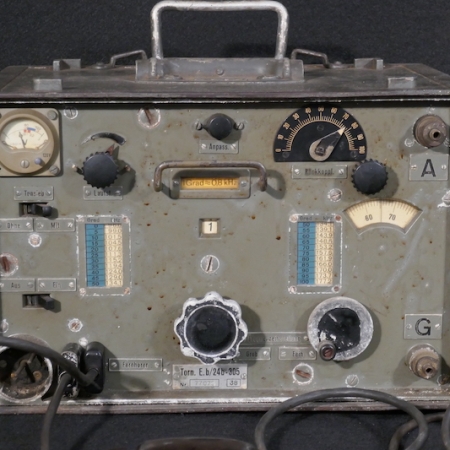
WWII German Wehrmacht Radio – Torn.E.b /24b-305 – With Morse Code Handset – Original Untouched – Rare
The Telefunken Torn.E.b /24b-305 (Spez 976 Bs) receiver was the end product of a series of Telefunken ‘portable’ receivers developed mainly for field use from the late 1920s onwards. They were intended for use both as a general purpose field receiver and as an accompanying receiver for a number of transmitters of the type normally found installed in signals trucks. The receiver frequency coverage is from 100kHz to 6670kHz. The earliest version was designed by Telefunken in the late 1920s as Spez 276 Bs and this was revamped in the early 1930s as Tornister Empfanger (portable receiver) Spez 445 Bs. By later standards it could be described as clumsy. Not unlike the National HRO, it employed plug-in coil units (three of them marked Kurz, Mittel and Lang) to cover the frequency range (see cover photo). The circuit employed four triode valves type RE 074 powered from a 90 volt battery and a 4.8 volt alkaline accumulator (type NC10). Radio, batteries and accessories were all in one case – quite a load for the signalman! With the development of the military general purpose two volt filament pentode valve (RV2 P800) the set was redesigned and split into two cases, one for the radio and one for the batteries and accessories. If necessary, the two cases could be clipped together. The plug-in coil system was dispensed with and replaced by an integral rotating coil turret. Trials with this equipment pointed to a need for some ergonomic improvements and some simplification of controls and other slight changes resulted in a more ‘user friendly’ front panel. The rectangular power supply plug and socket were replaced by a circular five pin connector which became standard for much field equipment. Thus, in 1936/37 the Telefunken Torn.E.b Spez 976 Bs was accepted for Wehrmacht use as the Torn.E.b/24b305 ( also known outside Germany as the AE95). Comments: This is an early model, with the original morse code handset, with Waffenamt stamps. Price includes shipping in the USA – if you are in Europe let us know via email which shipping method you would like due to weight.
-
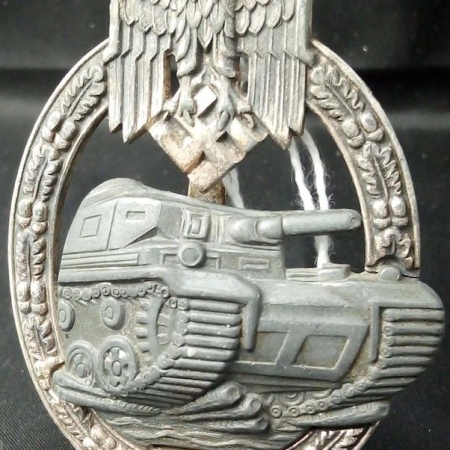
WWII German Panzer Assault Badge Silver – “25” – Original made by JFS Josef Felix, Gablonz – Rare
Panzer Assault Badge in Silver 25 assaults by Josef Felix, Gablonz Construction: Copper coated zinc constructed – with riveted zink tank and crimped in set up. Condition: a small crack but does not affect the display of the award. Price is posted inclusive tracked worldwide.
-
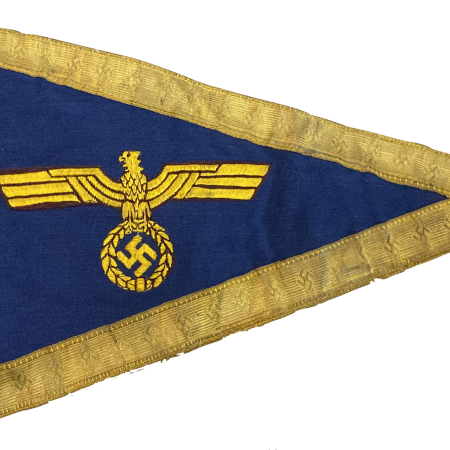
WWII German Kriegsmarine Admirals Pendant – Ultra Rare Original Item
Pennant for Admirals, a navy-blue triangular pennant with national eagles embroidered on both sides in golden yellow and continuous edge trim of golden swastika braiding. No interior reinforcement. Dimensions approx. 34 x 22 cm. Condition: This example shows signs of wear/use. Price is shipped tracked worldwide.
-
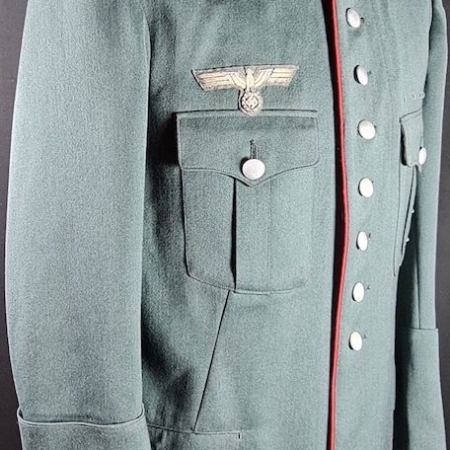
WWII German Wehrmacht Majors Tunic – Veterinarian – Made in Passau – Rare Waffenfarbe
Original Majors tunic, early style. Shoulder board has the cyphers for a Veterinarian Major. Not the easiest type of tunic to find.
-

WWII Spanish Wehrmacht Volunteers – Division Azul Barcelona Banner – Original – Extremely Rare Banner
A really rare banner with a size of circa 35x25cm. This particular banner was for the Azul Division Volunteers from Barcelona.
-
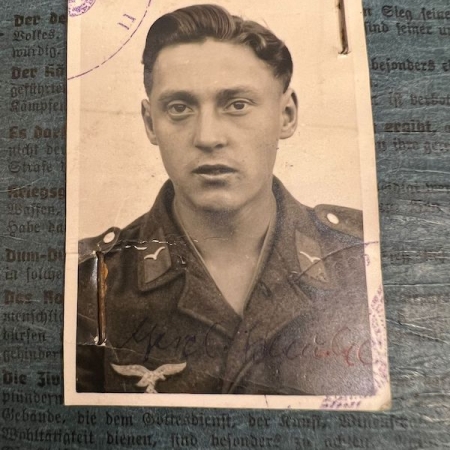
WWII German Luftwaffe Soldbuch – Flieger Schulze – Fallschrimjäger Pioneer – Oder Front 1945 – Wounded
An Original Luftwaffe Soldbuch for Flieger Schulze, who served with: I Fallschrimjäger Pioneer Replacement in December 1944. (Fallschirm-Pionier-Ersatz- und Ausbildungs-Bataillon 1) First he went through training to be onboard a Luftwaffe Aircraft, but as the war progressed he was transfered into a later war FJ unit thrown into the battle towards the end of the war on the Oder Front 1945. He was wounded by a 31(b) in March of 1945 on the Oder Front.
-

WWII German Luftwaffe Soldbuch – Feldwebel Dohm – LW Pionier Batl 10 – Polar Circle Document – POW in France 1945 (sold)
Luftwaffe Soldbuch opened in 1940 to Leonhard Dohm, Dohm was no stranger to war, wounded in 1918 and earning the Iron Cross. He also was awarded the KVKII in 1945 – Original signature of Knights Cross Holder Generaloberst Stumpff. https://en.wikipedia.org/wiki/Hans-J%C3%BCrgen_Stumpff He served the whole war in various building units within the Luftwaffe. But, it seems that in November 1944 Fw Dohm, went over the 66 Degree North, onboard the SS Lochstedt. An elaborate certificate was created for those on board. Capture Papers – Seems he was held by the US Army in France 1945. Rare Edible Fruit and plants in Cold Climates – Insert for the Soldbuch – Merkblatt 103 – I have not seen many of these.
-

WWII German Luftwaffe Soldbuch – Gefr Schmidt – Bordschützen Junkers Ju 88 – N.J.G 101 – Ardennes 1944 – Wounded fighting US Troops at the West Wall March 1945 (Sold)
Soldbuch issued in 1943, to Albert Schmidt born in 1925 from Konstanz, Germany. (Radolfzell). He enlisted to be aircrew, completing a Bordschützen (Aircraft Crew) Training in August 1944. This training was to apply to the Junker Ju 88. Nachtjagdgeschwader 101 Arriving in September 1944 to his unit in Germany. He would by December 1944 moved into a ground fighting unit. Ending up with Panzer Grenadier Regiment 11 (9 Panzer Divsion) Just in time for engagements in the Ardennes 1944/45 – The division then took part in the Ardennes Offensive, where it was deployed west of the Meuse. The battles for Rochefort, and later for Donchamps and Longchamps, were purely defensive in nature. On February 7, 1945, our own HKL was back on the West Wall. From February 24th to March 4th, 1945, the division fought for the Erft section, Erkelenz and the artillery defense positions. In the battle for Cologne there was heavy house-to-house fighting. After the loss of the city, the division set up a final defensive position on the Cologne – Frankfurt / Main highway. From March 25, 1945, it moved via the Sieg into the Betzdorf – Siegen area on the southern front of the Ruhr basin that was forming. Here the division went into American captivity at the end of April 1945. By March of 1945, Schmidt was awarded the wounds badge in black for fighting in early March against US Troops. He arrived in Heilbronn Hospital and was likely taken a POW. Interesting Soldbuch, from the skies to the ground he seen it all. Also desirable unit for the Battle of the Bulge.


