Showing 361–369 of 1445 resultsSorted by latest
-

WWII Red Army Soldier – Guards Soldiers Grouping – Battle of Berlin – Red Army Book with Photo – Rare (Sold)
$355.00Here we have a large grouping from a Soviet Guards Soldier who fought in the Battle of Berlin with the 31st Guards Artillery. Incredible is the amount of Certificate for capturing the different locations. This is a rare set, and comes with his Red Army ID Papers. This comes with some research .
-

WWII Red Army Propaganda – Rare Poster – Hitlers Come and Go, German People Remain – Stalin 1945 – Berlin 1945 – Rare
This incredibly rare Soviet Poster comes from a Berlin Collection. History has shown us, the Hitlers come and go, but the German People and state remains Stalin This too is featured in Berlin 1945 Book of Stories. We have not been able to find another example of this poster available, it is quite large bigger than two a4 pagers. Extremely Rare
-

WWII Red Army Certificate for the Capture of Berlin – Major Zhukov – IS2 & SU76 Tanks – Reichstag Battle – Rare Researched
Nice original certificate for Major Zhukow, Unit: 1st Belorussian Front, 9th Tank Corps. 3rd Shock Army Zhukow lead a unit of IS2 & SU76s – destroying hundreds of enemy soldiers. Battle of the Seelow Heights 1945 Battle of Berlin 1945 Detailed descriptions online of the Majors actions in Germany in 1945. He also had many awards, including the Order of Suvorov and the Order of the Red Banner. Interestingly, his unit fought side by side the 79th Rifle Corps during the attack on the Reichstag. Comes with his print out from the Russian Archives.
-

WWII Red Army Postcard – Sent from Berlin Cellar During Battle 1945 – Mentioned in a Book – Translated – Rare
A very interesting postcard, written in the basement of a Berlin House during the battle. This is featured in a book on the Battle of Berlin 1945, should be published this year. Translation Dear friend! I have received all your letters and am very glad and thank you many times, the only letters that I recieved, are yours. I congratulate you, and your relatives, with May 1st – day. I am writing this postcard sitting in a cellar in Berlin, so we have taken it, you may congratulate us. Besides, I was awarded the “Red Star Order”. Enough now, I’ll write more later.I embrace everybody and shake hands and wish you all the best with your exams. – Nikolay. (Sgt BESPALOV – 52330) * The Russians entered Berlin on April 22nd * The red stamp 27.4.45 is the date the unit “postal service” accepted the Postcard
-

WWII Red Army Soviet Postcard – Sent From Potsdam Berlin 1945 to Russia – Translated – Rare
(stamp) Field mail of the USSR 25.4.45 (stamp) Arkhangelsk Center USSR 554512 (stamp) VIEWED by Military censorship 19522 City of Arkhangelsk Petrogradskiy prospect house № 246 apartment № 3 Karpova Claudia Afanasievna Field mail 03757 Potsdam – 23rd Guards Rifle Division Hello from Berlin. Again there is no time (?) to write a letter, so (?) I am writing a postcard, otherwise you are probably worried. I live well and everything is great and already clav (?) in Berlin. But even in the very center I was not, you know, the city is very big. I don’t know about the center, but the suburbs are not very destroyed: yes, a large, culturally clean city. Although the weather is still cool again, all sorts of fruit trees are blooming. On this note I’m finishing, I will write in detail in the letter. Goodbye for now, my dear and beloved Claudia (?). Kiss, your Shura.
-

1946 KPD ID – Communist Party Germany – Original Post War ID – Rare
Here we have an original KPD ID for a German in Post War East Germany. I have not found another one of these dated 1946. Seems to be quite rare.
-
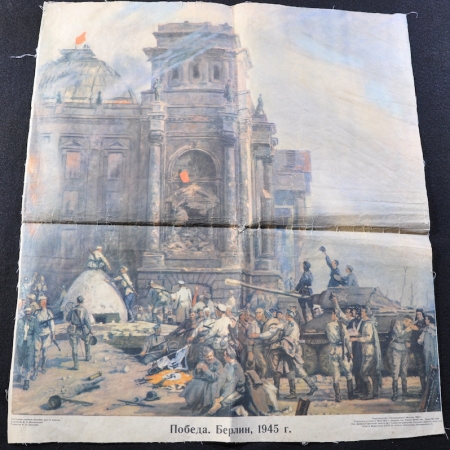
WWII Soviet Army at the Reichstag Berlin 1945 – Poster
Very nice Poster made in 1964 Moscow. Its about four times bigger than A4, printed on material. Depicting the Soviet Army at the Reichstag in Berlin 1945, nit seen another!
-

WWII German Wehrmacht / Waffen SS – M42 Helmet – Ex-Camo – Stahlhelm – Original
A nice Ex-Camo M42 with a 58 Liner inside. The decal was removed likely during the war as this is a bring back and was not offered for sale on the market before. It seems to be a toned Winter Camo under or a light Grey. Looks to be a late issue M42, with ersatz style leather on the chinstrap, and shell quality is not the best due to the production/war going on.
-
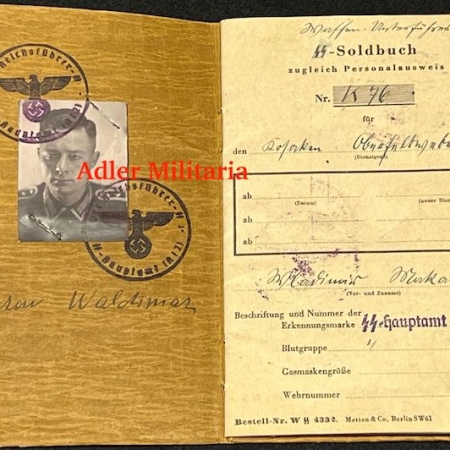
WWII German Waffen SS-Soldbuch – Cossack Waffen-Unterführer Waldimar Makarow – XIV SS Cossack Cavalry Corps – Russian Born Volunteer – SS Hauptamt Berlin 1944 – Ultra Rare
$2,650.00Waffen SS Soldbuch issued to Russian born (11.1918 – Orthodox Religon) Waldimar Makarow. The Soldbuch was issued with the SS Hauptamt (SS Main Office) in Berlin Germany, the specific department corresponding with the stamps: A I 2 – Personnel Department. Issued in Berlin on the 1st of September 1944. Makarow was assigned to the XIV SS Kossak Kavallerie Korps Unit History The XV SS Cossack Cavalry Corps (German: XV. SS-Kosaken-Kavallerie-Korps) was a World War II cavalry corps of the Waffen-SS, the armed wing of the German Nazi Party, primarily recruited from Cossacks. It was originally known as the XIV SS Cossack Cavalry Corps from September 1944 to February 1945. During the Russian Civil War (1917–1923), Cossack leaders and their governments generally sided with the White movement. After the Soviets emerged victorious in the civil war, a policy of decossackization was instituted between 1919 and 1933, aimed at the elimination of the Cossacks as a separate cultural and political group. Cossacks in exile joined other Russian émigré groups in Central and Western Europe, while those in Russia endured continual repression. In October 1942, the Germans established a semi-autonomous Cossack District in the Kuban. This put them in a position to recruit Cossacks from these areas and mobilize them against the Red Army. This was in contrast to soldiers of the ROA, who had been recruited from POW camps and Red Army defections, most soldiers of the German Cossack units had never been citizens of the Soviet Union.[ In the summer of 1944 Heinrich Himmler and the SS became interested in gaining control of the 1st Cossack Division under Helmuth von Pannwitz. In July 1944 Himmler discussed the organization of a Cossack fighting unit in the Bialystok region and requested from Hitler, that the Cossack Division would be placed in the organizational structure of the SS. On 26 August 1944 he met with Pannwitz and his Chief of Staff. Himmler planned to gather all Cossack units to form a second Cossack division and proposed the transfer of the 1st Cossack division to the SS. All units were to be placed under von Pannwitz’s command. Though initially reluctant, Pannwitz eventually agreed to place his division under SS administration. Both German cadre and Cossack troops would retain their traditional uniforms and their Wehrmacht or Cossack rank. Pannwitz hoped to raise his unit’s low morale and to receive more supplies and better equipment. The Cossacks did not wear the SS runes or receive any ideological indoctrination. In September 1944, the XIV SS Cossack Cavalry Corps was established on the basis of the 1st Cossack Division. The Cossacks fought an engagement against the Red Army on 25 December 1944 near Pitomača to prevent them from crossing the Drava River. The commander of the 5th Don Cossack Cavalry Regiment was awarded the Iron Cross, 1st class after the battle. In November 1944 the 1st Cossack Division was taken over by the Waffen-SS. The SS Führungshauptamt reorganized the division and used further Cossack combat units from the army and the Ordnungspolizei to form a 2nd Cossack Cavalry Division. Both divisions were placed under the command of the XV SS Cossack Cavalry Corps on 1 February 1945. With the transfer of the Volunteer Cossack-Stamm-Regiment 5 from the Freiwilligen-Stamm-Division on the same day the takeover of the Cossack units by the Waffen-SS was complete. According to Samuel J. Newland, the Corps, composed of the 1st and 2nd Cavalry Brigades and the 1st and 2nd Division, was actually formed on 25 February 1945, when it was officially created by the High Command. The Corps was initially subordinated to the Army Group F in Croatia, and since March 1945 to the Army Group E in Croatia. During their time there, they were known by the locals as “Čerkezi” (“Circassians”), despite the Corps’ Cossack ethnic makeup. The Corps supported the German offensive Operation Spring Awakening in Hungary by launching an offensive against a Soviet bridgehead at Valpovo on the Drava. During April the Corps was engaged in minor actions and then began to withdraw from Yugoslavia on 3 May 1945. The superior officers had concluded that the Corps should fight their way back to Austria in order to be captured by the British. According to one source Pannwitz felt that the West would have great use for the Corps as a military anti-Bolshevik eastern formation. The 2nd Division covered the withdrawal of the 1st Division against partisan forces. Unaffected by the German surrender on 8 May and partisan demands to surrender, the Cossack units continued fighting on their way to the British zone. On 10 May Pannwitz surrendered to the British, while the last Division elements reached the British zone on 13 May 1945. Interesting entries in the Soldbuch: Walther PP Pistol Interesting entry, from SS Hauptamt that the owner of the Soldbuch is allowed to wear a Uniform of the Wehrmacht with the rank Oberfeldwebel. Comes with a photo of Marakow wearing Cossack insignia. Very rare photograph. Final Comments Incredibly rare document, this is one of small minority of IDs issued to members of the Cossack Volunteers. The Units page – under the paper it seems the same thing is written underneath. I do not think we will ever have another one of these in stock. If you are anyway a serious Cossack / Volunteer Collector/researcher then this is likely one of your only chances to get anything like this, many patches and insignia were produced, but hardly any of these IDs have surfaced or survived.


