Showing 307–315 of 1445 resultsSorted by latest
-

WWI US Army M1917 Battery & Store Wagon – Made by American Car & Foundry Company 1918 – For US M1902 3 Inch Field Gun & French 75mm mle/97 Cannon – Last 1 Known – Price on Request
We are delighted to be able to offer this original WWI US Army M1917 Battery & Store Wagon Built in 1918 by AM Car & FDY CO, this has likely sat in storage since. The Original Brass plate still is perfectly readable No 1378 The American Car and Foundry Company During World War I, the American Car and Foundry Company (ACF) produced a variety of equipment to support the Allies, including: Freight cars ACF was the largest builder of freight cars for the USRA during the war. ACF also leased freight cars to railroads and private car companies through a subsidiary called the Shippers Car Line. Artillery ACF produced artillery gun mounts, three-inch shells, and artillery shells. Boats ACF produced submarine chasers and other boats. Railway cars ACF continued to produce railroad equipment while also filling military contracts. According to a snapshot from their website in 2003, ACF commented on their long History including their WWI production capabilities. ACF Industries traces its history to 1873, the year the St. Charles Car Manufacturing Company was founded. This was one of the thirteen railroad carbuilding companies that merged in 1899 to form the American Car and Foundry Company. The country’s first railroad tank car, a “tub car” was built by one of these companies in 1889. Five years after the 1899 merger, the first all-steel passenger car ever ordered from a car builder left our former Berwick, PA shop. It was the first of a shipment of 300 similar cars built for New York City’s pioneer subway, the Interborough Rapid Transit Company. By 1906, AC&F had steel shops at St. Louis, Detroit, Berwick, Huntington, and Madison, IL. American Car and Foundry Company’s reputation rapidly spread abroad and in 1905 more than 100 motor and trailer subway cars were shipped to England for use in London’s underground system. In 1917, a tank car leasing operation began which, in 1923, became Shippers Car Line, and later was acquired by AC&F in 1927. During World War I, AC&F produced artillery gun mounts and ammunition, field kitchens, pack saddles, submarine chasers, cloth shrinking machines and rollers, and even wooden tent pegs, as well as railway cars, for the Allies. AC&F’s Wilmington plant also produced boats for the navy, and after the war switched production to yachts. In 1922, AC&F expanded into the automotive field by acquiring Carter Carburetor Corporation of St. Louis. This was our first step in product diversification – planned and executed long before the diversification concept became the by-word of American industry. In 1925, AC&F acquired Fageol Motors Co, a bus builder, and the Hall-Scott Motor Car Company, which produced bus engines. In 1926, AC&F acquired the J. G. Brill Co, a streetcar builder. During World War II, several AC&F plants produced army tanks, aircraft subassemblies, artillery shells, armor plate, and hospital cars, as well as ordinary railroad cars. By 1954, the corporation’s interests had become so diversified that the name was changed from American Car and Foundry to ACF Industries Inc. ACF produced its last passenger car in 1959. It displays all its original paint and is in overall good condition given the age, and stands a near 87 Inches High by 77 Inches Wide with a length of 10 Feet. The purpose of this Wagon was to service the Gun and Crew of either or both pictured below 75mm Cannons. US M1902 3 Inch Field Gun French 75mm mle/97 Cannon This is currently in our hanger in the USA, if you have any questions please do not hesitate to contact us directly. This appears to be the last original known, there are currently none on display in any museum next two either of the Artillery above.
-
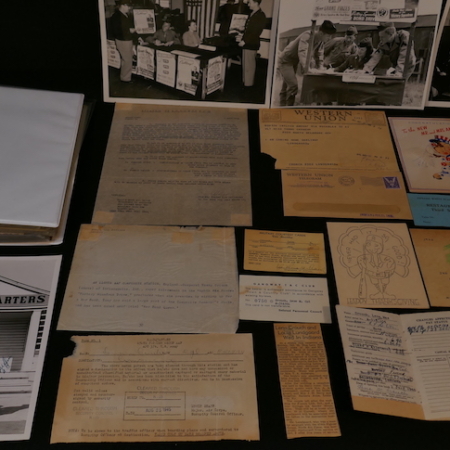
WWII US WAAC Grouping – Cpl Lena Mae “Tommie” Crouch – 8th Airforce England 1944 – Stars & Stripes “War Bond Queen” –
Interesting Grouping to Cpl Lena Crouch and her husband, Louis Lungaard 4th and 9th Airforce. Lena served in the WAAC, was a driver and even was deployed to England in 1944 to an 8th Airforce Base. Interestingly, she sold War Bonds. Featured in Stars and Stripes, “Tommy Crouch, super saleswoman in the 8th Airforce. She is known as the ” War Bond Queen” Included in this lot are all their photos, it is clear from the Telegrams and the photos that they both were deeply in love throughout the war. I have done some extra research on the web, please find below the results for reference only. Its a large grouping with some really great photos and a lot of interesting period WAAC Pocket Litter. Everything is neatly placed inside a white ring binder.
-

WWII US WAAC Grouping – Pvt Clythro V Staples – 1378th AAF Base Unit North Atlantic Wing-Air Transportation Command – Fort Totten Long Island New York
Pvt Clythro V Staples US Army WAC Grouping It seems she served stateside from 1944 till the wars end. She served in 1378th AAF Base Unit North Atlantic Wing-Air Transportation Command – Fort Totten Long Island New York Was awarded the Good Conduct Medal. Below some extra research from the web
-
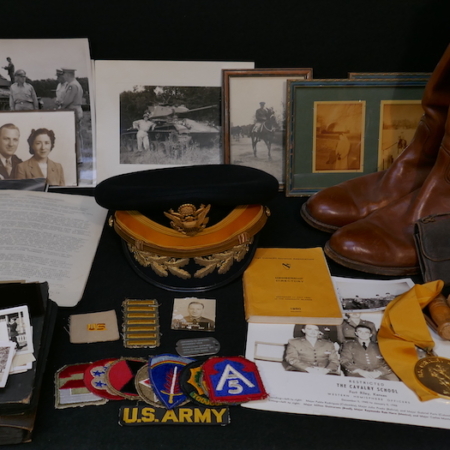
WWII & Korea US Cavalry Grouping – Lt. Colonel George E Sapora – Battle of Inchon Korea 1950 – Visor Photo Albums Medal Patches Dog Tag – Great Historical Grouping
WWII – Korea War US Army Cavalry Officer Grouping to Lt. Colonel George E. Sapora, O-302203. Grouping includes several newspaper clippings, women’s handbags, spurs, patches, many photos and much more. Contents US Army Officer service dress cap. Pair of brown leather cavalry riding boots. 1st Cavalry Divison membership directory book. September 25th, 1939 edition of Life Magazine. 75th Anniversary Army /Navy Journal magazine. US Cavalry Medal. Engraved “Trooper G. Sapora.” Framed photo of Sapora. Size: 8″ x 6″. Framed set of 3 photos. Size: 7″ x 15″. Single dog tag named to Sapora. Photo albums containing around 300 photos of family and military life. Lt. Colonel Sapora’s Military resume. Lt. Colonel Sapora’s Military Service 1934 – Active Training 1935 – CCC Civilian Conservation Corps 1936 – 1937 – One Year Active Service, Thomasson Act. 1939 – CCC Civilian Conservation Corps – Woodbine, NJ Camp Responsible for 250 People. 1941 – 1942 May – Processed 1500 Selectees for the War Effort. June 1942 – June 1945 – South West Pacific. Organised and maintained a MP Camp 44 Officers, in Melbourne and Sydney Australia. Admin for up to 1400 Men. 1945 – Cavalry School 1946 – 1950 – Assistant Professor for Military Science and Tactics, Michigan State College. August 1950 – June 1951 – Inchon Landings as Ex Officer, 3rd Bn, 32nf Inf Regiment, 7th Division. Civil Affairs Officer, set up new governments as we approached the Yalu River. Please see his comments on this Service Sheet. Over all a wonderful complete collection and career of a US Cavalry Officer. Grave Photo taken from Findagrave.com Inchon Landings
-
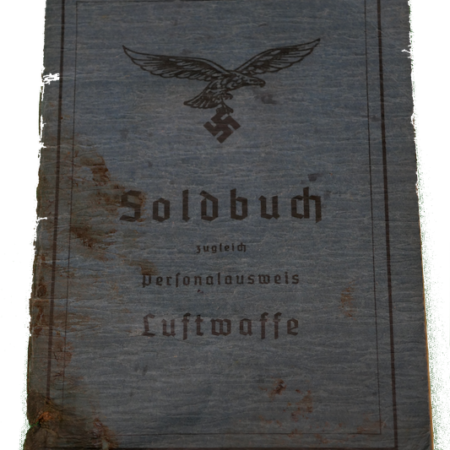
WWII German Fallschirmjäger K.I.A Battle Damaged Soldbuch – Jäger Helmut Wiess – 17 Years Old – Operation Grenade 1945 – Killed Fighting US XIX Corps – Very Rare
Helmut Weiss was born on the 5th of December 1927, in a town formerly called Leipe-Petersdorf near Breslau, today Lipa Piotrowska in the District of Wroclaw Poland. Helmut lived with his parents Adolf (Farmer) and Martha. Helmut at 16 years old worked on the Railways in Breslau, his ID for the German Railway system in Breslau Bahnmeisterei, the Main Railway Works can be seen in the photo section. Six months later, he would be in Gardelegen, Germany as a new recruit in the Fallschrimjäger (German Paratroopers). Helmut was issued his Official Military photo Identification, known in German as the Soldbuch on the 28.9.1944 on base. The photo added to the Soldbuch shows Helmut in a standard Tunic although there are no shoulder boards or collar tabs to compliment his uniform. This could be for the fact that either they did not have them at the time when issuing his uniform, or the fact that recruits earned their insignia after training. He is still only 16 years old. In Gardelegen, the Germans had raised a force of 30,000 of fighting age into the 1st Fallschrimjäger Armee (First Parachute Army). On the 1st of November 1944 – Helmut had finished his two months basic training and was sent to another replacement unit (Fallschirmjäger Ersatz und Ausbildungs Regiment 1). By late December Helmut was assigned to a frontline unit, Feldersatz-Regiment der Fallschirm-Armee, 1. Fallschirm-Armee. Stationed in Dinxperlo, a town in the Netherlands on the German border. Helmut was not assigned directly to the fighting regiment but a replacement regiment. By December Helmut received his last transfer to Fallschim Lehrgruppe Ausbildungs Kommando, Fallschirmjäger AOK near Muenchen-Gladbach, Germany. Weiss is still only 16 years old; he turned 17 in December of 1944. Germans Taken By Surprise – Operation Grenade 1945 Weiss was Killed in Action at 17 years and 2 months old on the 27th of February 1945, by US Troops during Operation Grenade. Weiss was likely killed by the shrapnel seen that passed through the Soldbuch, the Soldbuch was usually held in the front Tunic Pocket. Clearly the blood staining from when it was also removed from the Tunic Pocket. Wiess has a marked grave in Germany today. See the link below from the German War Graves Commission. US XIX Corps’ attack from their rapidly-acquired bridgehead soon swung east, throwing the German defense plan off balance, and catching their reserves in mid-maneuver. The 29th they took Juelich and pushed on to take Muenchen-Gladbach on March 1st, while the 30th overran the Hambach Forest, and guarded the right flank of the Corps until VII Corps finally came up alongside. The 2nd Armored, committed on the fifth day of the attack, drove between Muenchen-Gladbach and Neuss, to reduce Uerdingen, while the 83rd, which had attacked along with them, pealed off to the right to reduce Neuss and be the first American troops to reach the lower Rhine. The 95th Division was thrown in eventually and cleaned up the left bank of the Rhine from Uerdingen to Rheinhausen. This battle drove the attack deep into the heart of Germany for the first time, and the Corps Artillery was able to fire across the Rhine into the steel plants of the Ruhr. Here, too, for the first time, the men of the Corps began to see the hordes of slave-workers used by the Germans in factories and on farms, and effects of the bombing with which our Air Force had crippled German industry. The attack was over in ten days, and XIX Corps had 11,000 prisoners, 353 towns, and over 300 square miles of territory to its credit. The enemy had rushed more of his best troops into battle: 9th Panzer, 11th Panzer, 130th Panzer Lehr, elements of the 2nd Parachute and 15th Panzer Grenadier Divisions. They had been cut up, driven back, and in some cases, completely destroyed. Operation Grenade on Youtube Note the young soldiers expected to fight the US Army. https://www.youtube.com/watch?v=R89fzTqn0KA Graveyard Details and Links on the German War Graves Commission for the information they have on Wiess. https://mags.de/Medien/2._Downloads/6._Gr%C3%BCn/1._Friedh%C3%B6fe/1._Ehrenfriedh%C3%B6fe/Namens-_und_Grablageverzeichnis_Soldatenfriedhof_M%C3%B6nchengladbach-Hardt.pdf https://kriegsgraeberstaetten.volksbund.de/friedhof/moenchengladbach-hardt-kriegsgraeberstaette https://www.volksbund.de/erinnern-gedenken/graebersuche-online/detail/b4d66e5e99a3ee7bd9e8ed3455ccef2a Links used to write the listing https://www.ww2.dk/ground/fallschirm/fsarmy.htm https://en.wikipedia.org/wiki/1st_Parachute_Army_(Wehrmacht) https://www.militaria-fundforum.de/forum/index.php?thread/412910-hauptuntersuchungsstelle-der-fallschirm-armee/&postID=2959344 Final Comments Soldbücher with such a story do not come up very often. Wiess was 17 years old, and the factors surrounding the keeping of the Soldbuch are unknown. It was highly likely a trophy item taken after his death, or taken when buried. We will never know, although what is clear is that he was identified and buried in Germany after the battle. This is a museum grade item for the top FJ Collection. This was the last breaths of the German Paratroopers on the final stages of the War in Germany 1945.
-

WWI Canadian Army Officer Grouping – Captain Lyman C Lauchland MD – British Officers Sword J.R Gaunt London Birmingham – Royal Canadian Army Medical Corps – Photos – Rare
A really nice and very rare Canadian Officers Grouping from Ontario, Canada to: Captain Lyman C Lauchland MD Canadian Army Medical Corps, he served in various units in France in World War One. The Sword a British Pattern 1897 Officer’s Sword which and scabbard is in fairly good condition for its age, nicely maker marked for JR Gaunt & Son, London Birmingham. The proper unit badge for the Canadian Medical Corps can be seen on the etching along with the correct period British Monarchs Coat of Arms. I was unable to find another one online in the same configuration. There is great information in a book format here on the unit and it seems they were in the area of Ypres, Belgium. Note the Menin Gate at Ypres everyday a small ceremony is held at the gate. See below. https://digital.library.upenn.edu/women/adami/camc/camc.html Lauchland passed away in 1935. Please see the extensive archive material that compliments this exceptional Grouping.
-
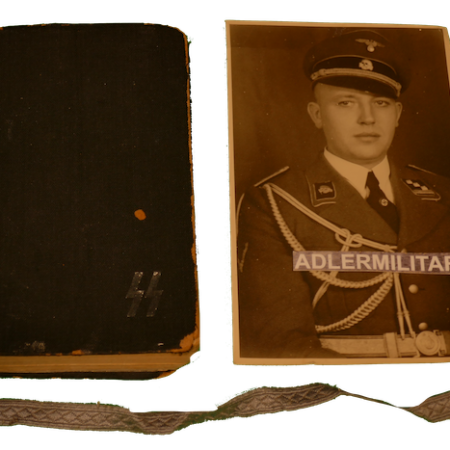
WWII Waffen-SS Grouping – SS-Obersturmfuhrer Georg Kinzler (DKiG) – Totenkopf Division 1942 SS Pocket Diary – One of Kind – Very Rare (Offer / Reserved)
SS Obersturmfuhrer Georg Kinzler (DKiG) This incredible SS Diary details the Demyansk Pocket 1942, transcribed into 53 Pages into English with Annotations. It is completed with a USB Drive with the 53 Pages. All Inside a Ring Binder. Extra Research Demyansk Pocket The Demyansk Pocket was the name given to the pocket of German troops encircled by the Red Army around Demyansk, south of Leningrad, during World War II’s Eastern Front. The pocket existed mainly from 8 February to 21 April 1942. A much smaller force was surrounded in the Kholm Pocket at the town of Kholm, about 100 km (62 mi) to the southwest. Both resulted from the German retreat after its defeat during the Battle of Moscow. The successful defence of Demyansk was achieved by using an airbridge and was a significant development in modern warfare. Its success was a major contributor to the decision by the Army High Command to try the same tactic during the Battle of Stalingrad, but it then failed to save the Sixth Army, commanded by Friedrich Paulus. In April 1941, the Totenkopf Division was ordered East to join Field Marshal Wilhelm von Leeb’s Army Group North. Leeb’s force was tasked with advancing on Leningrad and formed the northern wing of Operation Barbarossa. Totenkopf took part in the advance through Lithuania and Latvia, and by July had breached the Stalin Line. The division then advanced past Demyansk to Leningrad where it was involved in heavy fighting in August. During Soviet winter counter-offensive, the division was encircled for several months near Demyansk in what became known as the Demyansk Pocket. During the fighting in the pocket, it was re-designated “Kampfgruppe Eicke” due to its reduced size. In April 1942, the division broke out of the pocket. At Demyansk, about 80% of its men were killed, wounded or missing in action. The division was sent to France to be refitted in late October 1942. Comments This diary is a historical insight into the war year of 1942 with the Totenkopf Division, including in the Demjansk Pocket in 1942. Kinzler seemed to be very calculated, many original notes of orders numbers etc Battle of Kursk Kinzler is mentioned in the Battle of Kursk literature, LAST VICTORY IN RUSSIA , The SS-Panzerkorps and Manstein’s Kharkov Counteroffensive February-March 1943, George M. Nipe, Jr, Schiffer Military History Atglen, PA, Page 172 There were a number of forward defensive positions controlling the approaches to the village from the west and they held up the battalion until nightfall. After eliminating these defenders and driving the main body of Russians out of the town, Schubach rested and reorganized his battalion, planning to resume his attack at 0100 hours. 26 Meanwhile, SS-Hauptsturmführer Wilhelm Schulze’s II./Regiment “Totenkopf’ had begun its advance toward Pavlograd after the departure of Schubach’s battalion from Pereshschepino, taking a different road out of the town. Schulze’s objective was to assemble in the area to the north of Pavlograd, in preparation for attacking the town from the northwest. The battalion was reinforced by motorcycle troops, an artillery battery and the division’s Panzer-Pioniere Kompanie, led by SS-Obersturmführer Georg Kinzler. The long column, moving over narrow, icy roads, advanced slowly to the southeast of Pereshschepino, although its passage through the darkness was unimpeded, until just after midnight. At that point it ran into a detachment of Soviet cavalry troops, at the village of Popassnoje, fifteen km northwest of Pavlograd. The column deployed for battle and assaulted the village, supported by fire from a battery of 10cm howitzers. By daylight Popassnoje was in German hands and the Soviet cavalrymen had been put to flight, but the battalion was delayed and could not support “Das Reich’s” attack on Pavlograd. When the advance resumed Russian cavalry, numbering about 150-200 men, appeared on the flank of the march route, forcing Schulze to deal with them. A Kampfgruppe of the SS Panzer Pioniere-Kompanie, two assault guns, an SPW and the howitzer battery, set off in pursuit. The commander of the battery, SS Hauptsturmführer Friedrich Messerle, remembered the chase as a ‘crazy hunt out of the wild west.” Following the tracks of the Russian horses, the Germans made their way to a Soviet town, which was typically spread out along the road which ran through its center. By this time, nightfall was approaching and the Germans did not want to risk entering the village and stumbling into an ambush in the dark. The small Kampfgruppe circled its vehicles like wagon train threatened by Indians and positioned its howitzers along the perimeter, ready to go into action at a seconds notice. Just before the dawn, the SS Pioniere cautiously entered the village, feeling their way down both sides of the main street. This flushed out the Soviet cavalry, which suddenly took off across the snow, galloping hard for a hill behind the village. Messerle’s howitzers fired into their midst, but within seconds the Russians reached the edge of the hill, after suffering only a few casualties. By 1945, Kinzler was on the staff of the SS Pioneer School. SS-Pionierschule command structure was the following one. March 1945, the school staff was formed with the following officers : Kdr. : SS-Obf. Klein Adjutant : SS-Ostuf. Nägele Ia : SS-Ostubaf. Deschner (then SS-Hstuf. Kinzler in April) Ib : SS-Staf. Hermann IVa : SS-Hstuf. Förster IVd : SS-Ostuf. Hohl V Pi. : SS-Hstuf. Otto-Karl Witt TFK : SS-Hstuf. Paduch 01 : SS-Ostuf. Stelzenmüller Stamm-Kp. : SS-Hstuf. Schwarz SS-Pionier-Sperr-Bataillon “Brosow” April 1945 – defended bridges while the school was being evacuated and its remaining personnel withdrawn. Kinzler was awarded the German Cross in Gold as per, Mark C Yergers book in 1945. We have chosen not to share the complete content of Georg Kinzler. Due to the fact that many details of the battle have not yet been published. This is a prime, first hand item for any serious Military Archive or Museum or an advanced Private Archive.
-

WWII German Army Wehrmacht -Horse Saddle Bag – fys – WaA Stamp VGC – Original
Original Saddle Bag, nicely stamped.
-