
Showing 901–909 of 1403 resultsSorted by latest
-
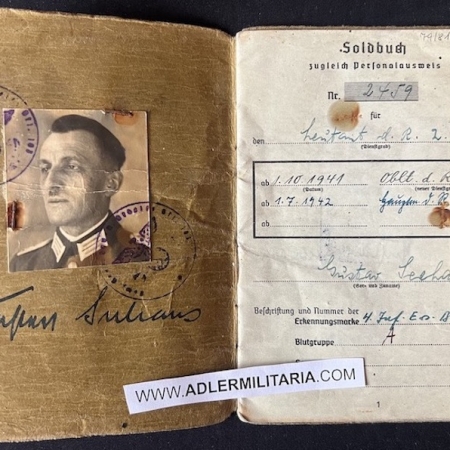
Wehrmacht Soldbuch – Hauptmann Seehaus – Soviet POW Camp Berlin – Rare Soldbuch
Soldbuch issued to Gustav Seehaus in Berlin Spandau with a replacement unit in 1941. Seehaus was promoted from Lt through to Captain by 1942. The unit he served with is an interesting and not well known unit: Sowjetische Kriegsgefangenen-Bau- und Arbeits-Bataillon 103 The Soviet prisoner of war construction and labor battalion 103 was set up on October 28, 1941 in Fürstenberg an der Oder by the Landesschützen Battalion 343 and placed under military district III (BERLIN). The battalion was deployed in the Berlin-Spandau and Berlin-Staaken area. The battalion consisted of Soviet prisoners of war and had a maximum strength of 1,900 men. According to the book: Kriegsgefangen in Brandenburg: Stalag III A in Luckenwalde 1939 -1945 His unit was stationed in : Kloster Zinna The tasks performed by the units were mainly construction tasks and manual labour. Batl 103 mainly operated in the Berlin Staaken and Spandau areas as well as near Kloster Zinna. It is highly likely Seehaus got caught up during the Battle for Berlin.
-
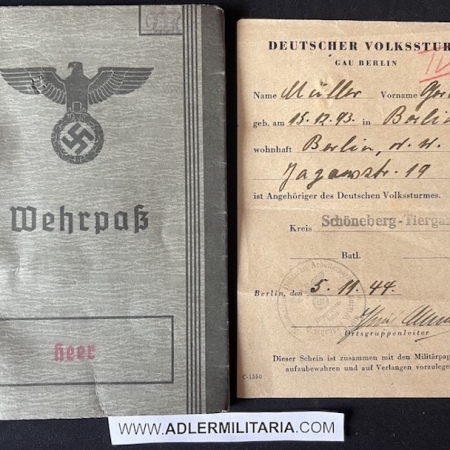
Wehrpass – Volksstrum Berlin – Müller – Berlin VS Batl 487 – Battle of Berlin 1945 (Offer Accepted)
A nice Wehrpass for a WW1 Veteran who was called up to the Berliner Volkssturm. Gerhard Müller, born in Berlin on the 15th of December 1893, worked in his civilan career as a Light Operator on Film Industry in Berlin. He lived with his wife in Schöneberg. He served in the First World War and earned the Iron Cross First Class for bravery. He was enlisted in the Berlin Volkssturm in November 1944. The Volkssturm – the German Homeguard – was established in October 1944 as a militia utilizing males between the ages of 16 and 60 who were not otherwise serving in the Wehrmacht or other military units. They were under the control of the Nazi party and its officials (Gauleiters) with Heinrich Himmler as commander. This a pretty rare find today ,especially for Berlin. This will also be featured in the Berlin 1945 Artefacts book.
-
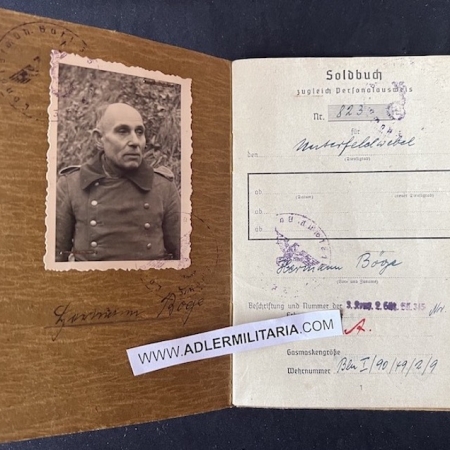
Wehrmacht Soldbuch – Uffz Böge – Landesschützen Batl 345 – Battle of Berlin 1945 (Hold)
Soldbuch to Unterfeldwebel Hermann Böge. This World War I veteran, 157 cm short and already 55 years old, was called up for the Endkampf in March 1945, retaining his WWI rank. He was a Berlin resident and remained in his city to serve with Landesschützen-Bataillon 345, at that time located in Berlin-Lichterfelde. Though originally not intended for front line fighting, this Landesschützen unit was trapped in the city and did see fierce action during the last weeks of the war, fighting off the 1st Ukrainian Front. As he is not listed on the Volksbund database, we can assume Böge survived the Battle of Berlin and entered Russian captivity – or perhaps he was able to avoid POW time by throwing off his uniform and returning to his wife in the Stettiner Strasse. Before the battle began he was issued a K98 rifle and 100 rounds of ammo The Soldbuch has a fantastic photo showing the veteran wearing a greatcoat Fought against the 1st UkFr, 7 Panzer G Korps in Berlin 1945 Also featured in the Berlin 1945 book in progress.
-
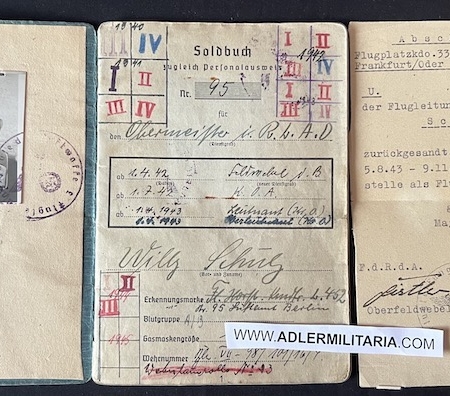
Luftwaffe Soldbuch – Oberleutnant Schulz – Kampfgruppe Schulz – Wounded at Schönefeld Airport Berlin 1945 – Super Rare (On Hold)
Soldbuch Issued to Willy Schulz in September 1939. This is an exceptional Soldbuch, simply because he served in all the famous airports in Berlin as Flugleiter, meaning he was in some sort of Air Traffic control role. A list of the airports/Berlin locations he worked in: Fürstenwalde, Rangsdorf, Döberitz, Schönefeld, Johanisthal, Tempelhof By 1945, according to the entries in the Soldbuch, he was leading his own battle group (Kampfgruppe) “22.4.1945 – Kampfgruppe Schulz – Combat in defence of Berlin” Then, “Wounded and taken Prisoner and send to hospital” It would seem he was according to his Soldbuch delivered to the War Hospital in Potsdam, where he was treated till August of 1945, finally staying in Berlin Kreuzberg St Josef Hospital. This is an exceptionally rare Soldbuch, and is also being published alongside many others for the Battle of Berlin in an upcoming book on artefacts of the battle.
-

Deathcard – Staudinger – Killed in action in Berlin Spandau 1945 – Battle of Berlin (on Hold)
Killed in action in Berlin Spandau in the final days of the battle of Berlin 1945.
Comes with the German Graves registry printout.
-
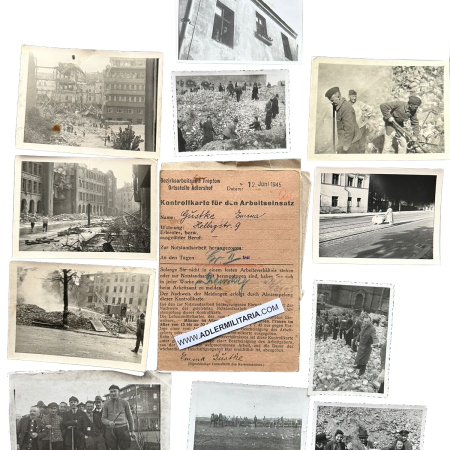
Tümmerfrau- Emma Gustke – Berlin 1945 – Rubble cleaner – Rare grouping
$235.00Tümmerfrau – Berlin in Ruins The Work Control Card and photos of a Trümmerfrau For more information see: https://en.wikipedia.org/wiki/Tr%C3%BCmmerfrau Emma Gustke, from Treptow was employed from the 18th of June 1945 to clean the streets of Berlin. Men from 15 to the age of 65 and woman from the ages of 15 to 50 years old were required to work. Her photos show the extent of the damage, brick by brick the areas were cleared. In Berlin alone around 60,000 woman were employed to clean the streets from the debris the war inflicted on the city. The pictures tucked inside the work card, a few memories she tucked away…
-
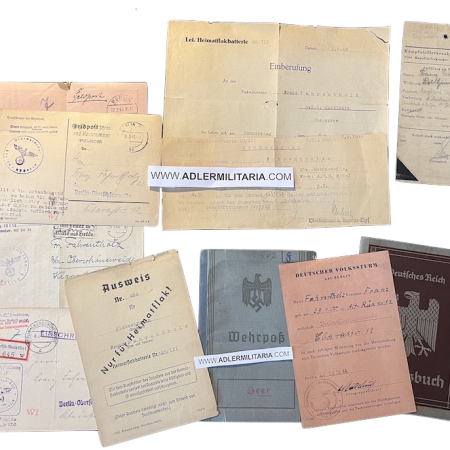
Volkssturm/Heimat Flak – Flakwehrmann Fahrentholz – Wounded in Battle of Berlin Tempelhof Airport 1945 – Super Rare (On Hold)
Franz Fahrentholz was born in 1900 in the small town of Altrüdnitz (Today: Stara Rudnica) on the banks of the Oder River. He served in the First World War during the end phases of 1918 and was lucky to have missed the horrible bloodshed seen by the men only a few years older than him. From early 1932 Franz was an employee at the AEG Cable Works in Berlin Schöneweide. Franz continued to work there throughout the war, leading teams that produced items directly linked to the war industry and used slave labour. Franz was not immune to the war effort in another form, defence. These large structures of the AEG were prime targets for Allied bombing raids. The large buildings on the banks of the river Spree would have been an easy target from above. By July 1941, Franz was sent an order to report to a large gym hall in Berlin-Neukölln to be considered for military duty, he was found fit for duty in the Landwehr, also known as a home army. Although he was not sent to a home army unit he could have been called up anytime. By early 1943, Franz was ordered to take his Wehrpass and report for a further inspection, by June he was enlisted into a home guard Anti-Aircraft unit known, Heimatflakbatterie 28/III. Franz was trained on a captured French light machine gun, the FM 24/29 and received instruction on an anti-aircraft searchlight (Flak-Sw 36 – 60cm). The 60cm searchlight was operated by one person and was built on a small turntable equipped with a seat and trailer, it allowed for a 360-degree reach and was deployed very fast. If an allied aircraft was spotted and followed with such a search light it would mean the spotters firing had a clear target to aim at. Franz was given the rank of Flakwehrmann, which was a civilian rank given to those that completed a standard course designed in 1943. The objective of which was to train civilians on anti-aircraft related equipment for the purpose of defending the home front. On successful completion of the course the rank of Flakwehrmann was reached and the soldier was awarded a civilian badge. The badge was worn on the left side of the lapel, the eagle of the Luftwaffe holding the swastika inside the cog symbol the symbol for German workers. He fought with: 1st Flak Division, Leichte Flak Abteilung 979 (o) Stationed at the Berlin Tempelhof Airport. By April 1945 during the advance of the Soviet army, Franz was found on the banks of the Landwehr Canal on the Maybachufer in Berlin Neukölln. The Maybachufer a 1.47 kilometre long street with one side running parallel to Canal. Comments: an extremely rare set for central Berlin, the wounding tag completing the picture on what happened to him.
-

Luftwaffe Soldbuch – Flieger-Hauptingenieur Breitkopf – RLM Berlin – Rare (On Hold)
98Very rare Berlin Soldbuch, for the infamous RLM Building which still stands in Berlin. Flieger-Hauptingenieur Walter Breitkopf was born in 1908 in Breslau (Today: Wroclaw in Poland). Breitkopf, an engineer that joined the Luftwaffe in 1938 worked in the RLM from the early days till the end of the war. Breitkopf was a member of the Fliegeringenieur-Korps (Flight Engineer Corps) admission to the Corps meant having had done a prior two year military service, be commissioned as an officer whilst holding a degree in engineering and whilst having the state exam for aircraft design. Breitkopf was assigned to the department GL4 (later TLR/B) responsible for testing new aircraft. Work was done inside the RLM building and in 1942 Breitkopf was moving back and forth from an airbase in near Paris. When on duty for the RLM in Paris in late 1943 he was sent home to Berlin due to his apartment being damaged due to an allied bombing raid. On the first of March, Breitkopf was promoted to Flieger-Hauptingenieur, a head engineer with the rank equivalent of a Capitan. In the final days of the war he was captured in Rostock, (2nd Belo Fr) likely at the Heinkel aircraft plant. The first page of his Soldbuch is stamped by the Soviet Command in Rostock. His prewar Dienstausweis (entry pass) into the RLM made of waterproof paper displays usage right the way till February 1945. His matching Erkennungsmarke (Dog Tag) and Luftwaffe issue Soldbuch. Interestingly, Breitkopf lived with his wife next to Germany’s oldest airport in Berlin-Johannisthal the many streets around there were home to all the top names in the German aircraft industry. It was from there that the first planes and Zeppelins took to the sky over Germany. The scene of one of the world’s first air disasters. A test flight of a Zeppelin exploded and crashed killing all 28 crew members. Today the former Johannisthal airport is an abandoned place slowly falling apart, the runways are now a nature park, the paths around it a popular spot for runners. Please note: This Soldbuch will feature alongside many other Berlin Soldbücher in a Book currently in he end phases.
-
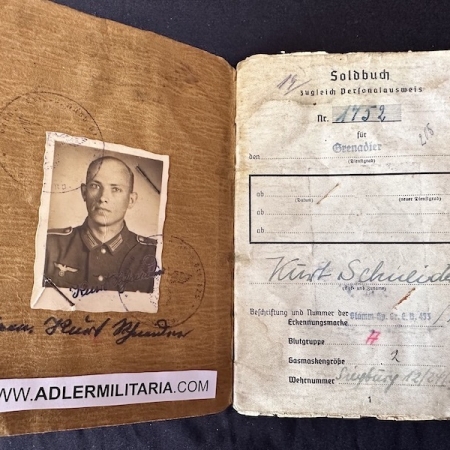
Wehrmacht Soldbuch – Grenadier Schneider – 36 Volksgrenadier Division – Operation Nordwind – Wounded fighting the US Army (sold)
Soldbuch issued in March 1943, to Grenadier Kurt Schneider from Siegland, Germany. He was born in November of 1912. He was not married and had a civilian job before he was called up. After a period training he was deployed into: Arriving in Russia in late 1943, with Ausbildungs Batl 453. He was wounded with them in March of 1944, after that he was sent in June to a replacement unit and made his way back to the front sometime in later 1944 with: Grenadier Regiment 894 ( 265 Infanterie Division) & Grenadier Regiment 165 (36th Volks Grenadier Division) – This time Schneider would fight in the Westfront exclusively. Wounded again in January of 1945 with a bullet wound, 31a in the Soldbuch. He was moved to another hospital in April of 1945 as the front drew closer and likely made it through the war. By the end of November the division had lost 50% of its personnel in the fighting in Lorraine. On December 5, the so-called “Forbach position” was occupied. Although completely exhausted, the division received the order on December 25, 1944 to move from the Saarbrücken area to positions in the St. Ingbert – Blieskastel area east of the Saar in order to break through the Maginot Line from there in a southerly direction. It was thus part of an attack in the lower Vosges to relieve the deadlocked Ardennes offensive in the north. The attack began on December 31, 1944 at 11 p.m. The division was unable to reach its attack objectives in the following days. As early as January 3, 1945, the attack was ordered to cease and the division went over to defense in the old main. In the weeks that followed, things remained relatively quiet at the main front line. The division was replaced, so that on February 3, 1945 it had a fighting strength of 3,165 men again. Interestingly the battles of Grenadier Regiment 165 are documented in the book: In Pursuit of Hitler Battles Through the Nazi Heartland March to May 1945 By Andrew Rawson · 2008 Comments: Interestingly, the NCO of the same Regiment and the first batl is for sale online, – Unteroffizier Hans Greiter (26.08.1920 † 01.10.2002) earned the Ritterkreuz on January 13, 1945 as Unteroffizier und Meldestaffelführer of the I. Bataillon/ Grenadier-Regiment 165 of the 36. Volksgrenadier-Division- Operation Nordwind


