Showing 199–207 of 212 resultsSorted by latest
-

WWII US Navy Estate – Flag Officer to Admiral Raymond Spruance – Fifth Fleet 1944/1945 – USS Indianapolis – Kamikaze Piston – With Diary – Original ‘Raising the Flag on Iwo Jima’ by Joe Rosenthal – Ultra Rare Museum/Archive Grade (Request further details)
One of a kind and personal U.S. Navy Archive of Lt. Cyrus Huie, USNR who served as the Flag Officer to Admiral Raymond Spruance, Fifth Fleet Commander in 1944 and 1945 during many of the critical campaigns of later World War Two in the Pacific. Admiral Spruance, often considered to the be one of the best US Admirals of WWII, Commanded US Naval Forces during many of the most crucial Battles of the Asiatic Pacific Campaigns including The Battle of the Philippine Sea, Task Force 16 at The Battle of Midway with Carriers Enterprise , Hornet, subsequently becoming Commander of Fifth Fleet in April 1944 Spruance preferred to use the heavy cruiser USS Indianapolis, named for his hometown, as his flagship. Spruance moved his flag to the old battleship USS New Mexico after USS Indianapolis was struck by a Kamikaze off Okinawa “March 31, 1945: Well we got it today. A Jap plane crashed aft our main deck and banged us up a bit. Can still move along but fresh water is no more and looks like we will have to move. Am getting things lined up for it. Pretty scary feeling when the plane hit, retired to Kerawa Retto, 1 man buried this aft. Adm 2 guests for dinner.”- Diary of Lt. Huie (Kerama Retto). When New Mexico was struck by two kamikazes on the night of 12 May 1945 an immediate search by Spruance staff found the Admiral manning a fire hose midship. Determining that New Mexico was not too badly damaged Spruance kept her as his flagship for the rest of the campaign. Admiral Spruance was calculating and cautious in contrast to Admiral Halsey who commanded the Third Fleet. Spruance was nicknamed “Electric Brain” for his acute ability to remain calm even in moments of supreme crisis a reputation only further bolstered by his successful tactics. “April 12, 1945: We caught a mean one today shot down three planes, one plane hit the (illegible) about 1000 yards from us, one hit the Fellars and two were coming right for us it seemed. This is pretty jittery business, and everybody is fairly nervous except the Admiral who keeps very calm throughout. At GQ again tonight with flares dropped and torpedo attacks, several exploded fairly close to the ship.” – Diary of Lt. Huie. After World War II Spruance went on to serve as President of the Naval War College and Ambassador to The Philippines. On his way to take his position as President of the Naval War College Spruance and his wife stopped in Little Rock, Arkansas to dine with and visit his old Flag Officer Lt. Cyrus Huie as described in a newpaper article within the archive. This extraordinary personal archive chronicles the later portion of the Asiatic-Pacific Campaign and heralds the well known accomplishments of Spruance aboard the USS Indianapolis and USS New Mexico during some of the fiercest fighting of World War Two. It tells a unique story from the perspective of a Navy Lieutenant who loved to sketch cartoons and play the accordion or ukulele but was apprehensive about his experience with daily air raids and the grim loss of life. Join us as we take a close and personal look through the lens of Flag Officer Lt. Huie and his archive of exceptional objects and history related to this discovery. This Museum Quality Archive tells the story of some of the most significant moments of US Naval History with priceless highlights including an aluminum piston head from a Japanese Kamikaze Aircraft, an original theater printed copy of the ‘Raising the Flag on Iwo Jima’ by Joe Rosenthal with a Passed by Censor stamp to the reverse, Lt. Huie’s personal desk top calendar diary with extensive entries Feb 1944 – July 1944, Photographs, Autographs, Intelligence Items, documents, maps, newspapers, souvenirs and more. The diary alone contains a near daily appearances of the who’s who of leadership in the Pacific including Admiral Nimitz, Halsey, Sharp, Kirkpatrick, Gillies, Hill, Hover, Reifsnider, General Erskine, Riley, Rocky, Worton, Col. Hogaboom, Secretary of the Navy Forrestall, Ernie Pyle, and Numerous Others. A full dossier including diary transcription with reference footnotes and inventory is available to qualified buyers upon request. Contact us today to discuss this Estate
-
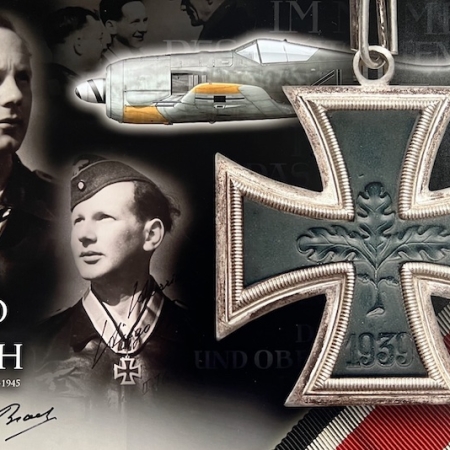
Post War Signature of Knights Cross Winner Hugo Broch – JG54 – 1
$65.00Original signed A4 size very good quality paper. Price includes shipping
-

Antique Swedish M-1815 Cutlass Sword Bayonet M/1770 Cavalry Pallasch Blade – Exceptionally Rare
$895.00Wonderful Original Antique Swedish Model 1815-20 Cutlass Sword Bayonet with a Model 1770 Cavalry Pallasch Double Edged Straight Blade that Measures 25 3/4 Inches and 29 Overall; Made for the M1815-20 or M1815-38 (see more reference information below) – Forge Mark to the Ricasso, Brass Hilt Lettered at the Guard, and Wrapped Wooden Grip, Good Issued Condition as Photographed with the mechanism missing at the ring, damage to the grip, and use wear as seen; a Fantastic Addition to Any Advanced Collection of Edged Weapons of Sweden – m/1815-20 Production more than 800 production (“fältjägarstudsare”) Sword bayonet In 31/3 1820 800 and bayonets was ordered to Jämtlands fältjägare. It was decided in 1821 that Värmlands fältjägarekår should be issued “new with mounted cutlasses as bayonets”. The bayonets were received in 1822 and after being tested, they were stored in Karlstad armoury. The blade is from m/1770 cavalry palasch.
-
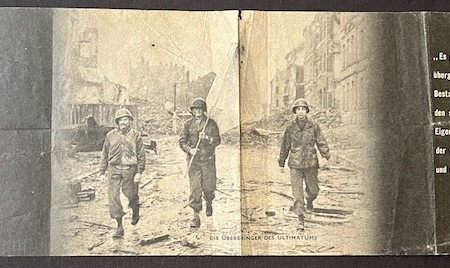
WWII American Propaganda – For German Soldiers – The Lessons of Aachen Battle 1945 – Rare Flugblatt – Flyer
$75.00Dropped on German positions, this particularly rare document was prepared very late war by advancing US Army into Germany. Basically, the lesson of Aachen was that they decided to fight so the city was destroyed. Stating you have the choice to surrender now, there is no middle way” This particular Allied flyer is quite rare and in good displayable condition.
-

WWII American Propaganda – For German Soldiers – Hürtgenwald 1944 – 12 Volksgrenadier Div / 47 Volksgrenadier Div – Rare
$65.00An interesting flyer, basically stating all is lost, describing both fronts and there is a chance to survive if you surrender.
-

WWII Red Army Soviet Propaganda – For German Soldier – Pass to POW – Bank Note – 23.04.1945 – Rare – Berlin 1945
$39.50A very late pass to surrender to the Red Army, made in the form of a bank note to capture attention. Very late war (23.04.1945) perhaps used during the battle for Berlin 1945.
-

WWII German Photograph – General Leo Geyr von Schweppenburg – Normandy 1944 – Wearing British Dust Glasses – Super Rare Photo
$265.00An amazing photograph, displaying him with dust glasses taken from the British Army. Geyr von Schweppenburg (2 March 1886 – 27 January 1974) was a German general during World War II who is noted for his pioneering stance and expertise in the field of armoured warfare.[2][3] He commanded the 5th Panzer Army (formalised as Panzer Group West) during the Invasion of Normandy, and later served as Inspector General of Armoured Troops. After the war, he was involved in the development of the newly-built German Army (Bundeswehr). Freiherr von Geyr was born in 1886 in Potsdam into the Prussian military aristocracy and descended from a family that had produced two Prussian field marshalls.[4] He joined the German Army in 1904. In World War I, he fought on several fronts and rose to the rank of captain. After the war, he remained in the army, becoming an Oberst in 1932 and a Generalmajor in 1935. From 1933 to 1937, he was a military attaché to the United Kingdom, Belgium and the Netherlands and resided in London. Promoted to Generalleutnant upon his return from London, he took command of the 3rd Panzer (armoured) Division in 1937.[5] World War II From 1 September to 7 October 1939, Geyr commanded the 3rd Panzer Division during the invasion of Poland, where it was the most numerically powerful Panzer Division, with 391 tanks.[6] For a victory at Kulm, he was praised on the battlefield by Hitler, who had visited the division in recognition for its achievements in Poland.[7] He was promoted to General der Kavallerie of the XXIV Panzer Corps on 15 February 1940. In 1940, he commanded the XXIV Panzer Corps in the Invasion of France. In 1941, in the invasion of the Soviet Union, Geyr’s XXIV Panzer Corps was part of General Heinz Guderian’s Second Panzer Army, and consisted of all of Guderian’s major tank units.[8] On 9 July 1941, he was awarded the Knight’s Cross of the Iron Cross as General der Panzertruppe.[9] By early November 1941, Geyr’s Panzer Corps commanded the 3rd, 4th, and 17th Panzer Divisions, the panzer regiment from the 18th Panzer Division, as well as the Infantry Regiment Großdeutschland, and spearheaded the advance of Army Group Centre during the Battle of Moscow.[8] From 21 July 1942, taking over from the court-martialed Georg Stumme,[10] to 30 September 1942, he was commanding General of the XXXX Panzer Corps, taking part in the fighting in the Caucasus. Geyr was relieved in a command cadre shakeup at the end of September 1942.[10] In the spring of 1943, Field Marshal Gerd von Rundstedt ordered Geyr to prepare a force of 10 Panzer and motorised infantry divisions. On 19 November 1943, Geyr’s command was formalised as Panzer Group West, which had responsibility for the training and formation of all armoured units in the west. The group of armoured divisions near Paris constituted the Germans’ main force of tanks in France. In the event of an Allied landing on the northern French coast, Panzer Group West was expected to counterattack northward and to halt the invasion force.[11] The Allied invasion of Normandy took place on 6 June 1944. By 8 June, Geyr had moved three panzer divisions northward against British and Canadian forces advancing on the town of Caen. On, Royal Air Force aircraft attacked his newly-established headquarters at La Caine in Normandy. Geyr was wounded and many of his staff officers were killed, which forced the cancellation of the counterattack.[12] Geyr’s reinforced tank units managed to prevent the British advance for another month, but he was nevertheless relieved of his command on 2 July after seconding Rundstedt’s request for Hitler to authorize a strategic withdrawal from Caen.[13][14][15] He was succeeded by Heinrich Eberbach on 4 July and served as Inspector General of Armoured Troops until the closing phase of the war
-
Sale!

WWII German Knights Cross Holder – Karl-Conrad Mecke – Raid on St Nazaire – 22 Marine Flak Regiment
Original price was: $225.00.$165.00Current price is: $165.00.An extremely desirable and rare postcard size photograph of Mecke with his Knights Cross, which he won during the British raid on St Nazaire, also known as the Greatest Raid of All. Knights Cross action: Awarded for his role in combating the British raid on St. Nazaire, Operation Chariot, on 28.03.1942. Due to the unusual behaviour of the British bombers it was Mecke who recognized the potential of a landing and put his troops on alert. His guns later opened fire on the British convoy despite their disguise as German vessels and also participated in the fight against the British landing forces.
-
Sale!
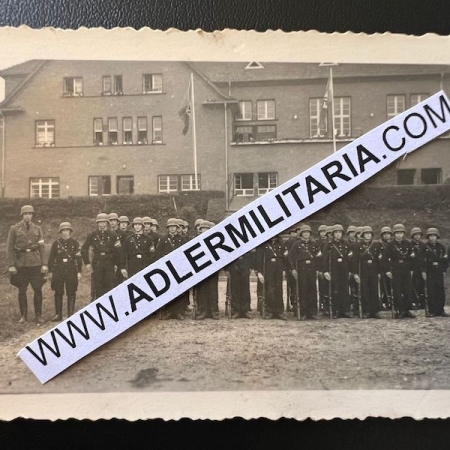
WWII German Photograph – Hitler Youth Bahn 277 – 1945 Danzig – “larger ready for transport to the front” – Issued Rifles
Original price was: $165.00.$135.00Current price is: $135.00.An extremely rare annotated photograph, depicting Hitler Youth 277 Bahn Ost Ostland. On the rear of the photograph, “Larger fertig zur Abfahrt an der Front” Meaning they are ready for transport to the front. It is unknown what became of these HJ Boys, they were likely thrown in at the end of the war which was not uncommon. Note, they have been issued helmets and Rifles, to the far left a HJ Leader can be seen in Helmet and the far right a HJ wearing a Wehrmacht Visor.


