
Showing 10–18 of 168 resultsSorted by latest
-
-

Original WWII German Army Wehrmacht Soldiers Match Box Holder Helmet Westfront 1940
$155.00Vintage metal matchbox cover or holder featuring a raised military-style steel helmet, oak leaves, sword and the word “WESTFRONT” across the front. The rectangular silver-coloured case is designed to hold a standard sliding matchbox, with part of the original cardboard inner box still present. The front has a detailed embossed design with an aged, darkened finish. Shows substantial age-related wear, including surface scratches, tarnishing, oxidation, discolouration and areas of plating loss. The cardboard insert is worn, stained and frayed. It has not been cleaned or restored. The exact age, origin, metal composition and historical authenticity have not been independently verified, so it is offered as a vintage collectible based on appearance only. Please examine the photograph carefully, as it forms an important part of the condition description. Condition:Used vintage condition with noticeable wear, scratches, tarnish, staining and finish loss. Cardboard matchbox insert is heavily aged. Sold as pictured.
-

Original WWII German RAD 25 Year Medal Faithful Service Medal (Treuedienst-Ehrenzeichen) – 2nd Class
$145.00Description Original Third Reich Faithful Service Medal (Treuedienst-Ehrenzeichen), 2nd Class – 25 Years. This original German Faithful Service Medal was awarded to civilian public servants in recognition of 25 years of loyal and faithful service to the German state. Instituted in 1938, the medal was presented to employees of government departments, municipalities, and other public institutions who had completed the required period of service. The obverse features a stylized swastika above a sword flanked by oak leaves, while the reverse bears the inscription “Für treue Dienste im Reichsdienst” (“For Faithful Service in the Service of the Reich”). The medal is suspended from its original cornflower blue ribbon, complete with the silver national eagle ribbon device, and displays an attractive aged patina with light wear consistent with its age. It remains a well-preserved example of a recognized German civil service award from the Second World War era. English Translation Reverse inscription: “Für treue Dienste im Reichsdienst”“For Faithful Service in the Service of the Reich.” Condition The medal retains its original blue ribbon and silver eagle ribbon device, with clear details on both obverse and reverse. It shows light age-related wear and patina consistent with an original period example
-
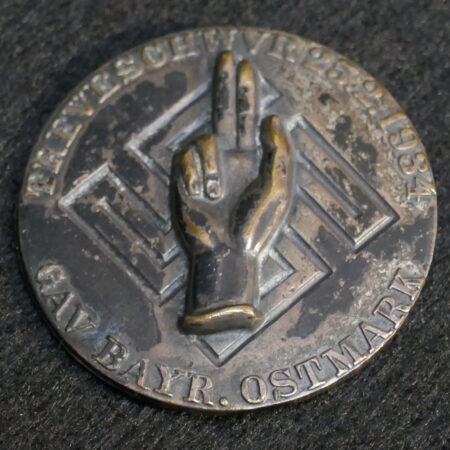
Original WWII 1934 NSDAP “Hilfswerk” Donation Badge – Gau Bayreuth Ostmark – Rarer Version
$135.00Description Original 1934 NSDAP “Hilfswerk” Donation Badge – Gau Bayreuth Ostmark. This original Third Reich tinnie (badge) was issued in support of the Hilfswerk der NSDAP, the Nazi Party’s relief and fundraising organization. The obverse features a raised swastika with a sculpted hand making the three-finger salute associated with the German Greeting to the Deaf (Deutscher Taubstummengruß), surrounded by the inscription “Hilfswerk 1934 – Gau Bayr. Ostmark.” The reverse retains its original horizontal pin fastening and is maker marked “Vereinigte Werkstätten München” along the edge. Constructed from a darkened base metal, the badge exhibits an attractive aged patina and light wear consistent with its age. It is an authentic historical artifact from the early years of the Third Reich and represents one of the many regional fundraising badges produced by the Nazi Party in 1934. Translation of the Inscription Hilfswerk – Relief Fund or Relief Organization Gau Bayr. Ostmark – Gau (District) Bavarian Ostmark (a Nazi Party administrative region) 1934 – Year of issue Condition The badge retains good overall detail with moderate age-related wear and an original dark patina. The reverse pin assembly appears complete and functional, and the maker’s mark remains visible along the rim.
-
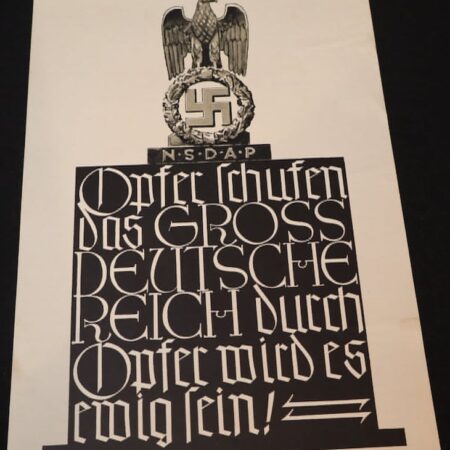
WWII German Propaganda Poster – 1941 NSDAP “Wochenspruch” (Weekly Motto) Propaganda Poster
$120.00Description Original 1941 NSDAP “Wochenspruch” (Weekly Motto) Propaganda Poster. This original German propaganda poster features a bold black-and-white typographic design topped by the Nazi Party eagle and swastika emblem. The text presents a slogan emphasizing sacrifice and collective effort as the foundation of the German Reich, reflecting one of the central themes of Nazi wartime propaganda. Issued as part of the “Wochenspruch der NSDAP” series by the Reich Propaganda Directorate, the poster is Issue 11, covering 16–22 March 1941, and was published by the Zentralverlag der NSDAP, Munich, the official publishing house of the Nazi Party. The poster retains its original margins and publication details, with light age toning and minor foxing consistent with its age. As an authentic wartime artifact, it represents an example of the printed propaganda used to encourage public support, unity, and sacrifice in Germany during the Second World War. English Translation “Sacrifice creates the Greater German Reich; through sacrifice it will remain victorious!”— NSDAP (National Socialist German Workers’ Party)
-

Original WWII German Propaganda Poster – August 1941 – NSDAP “Wochenspruch” (Weekly Motto) Propaganda Poster
$95.00Original 1941 NSDAP “Wochenspruch” (Weekly Motto) Propaganda Poster. This original German propaganda poster features an imposing display of Nazi Party, military, and state standards rendered in monochrome, symbolizing unity between the Party, the armed forces, and the German state during the Second World War. The bold text beneath the illustration presents a message promoting the role of the standard-bearers as defenders of Europe against Bolshevism, reflecting one of the central propaganda themes used following the launch of Operation Barbarossa in June 1941. The poster was issued as part of the “Wochenspruch der NSDAP” series by the Reich Propaganda Directorate, Issue 31, covering 3–9 August 1941, and was published by the Zentralverlag der NSDAP, Munich, the official publishing house of the Nazi Party. It retains its original margins and publication details, with light age toning and minor handling wear consistent with its age. As an authentic wartime artifact, it represents an example of the visual propaganda used to encourage support for Germany’s military campaign on the Eastern Front. English Translation “You carry the flags and standards and are the guarantors of Europe’s liberation from Bolshevism.” Size is a little bigger than A4
-

Original WWII German Propaganda Poster – New Year 1942 Dr Goebbels Speech – 1942 NSDAP “Wochenspruch” (Weekly Motto) Propaganda Poster
$95.00Original 1942 NSDAP “Wochenspruch” (Weekly Motto) Propaganda Poster. This original German propaganda poster features a clean typographic design in red and green, headed by the year 1942 framed with oak leaves and a swastika emblem. The central text is a New Year’s message by Dr. Joseph Goebbels, calling upon the German people to remain steadfast, resilient, and determined in their efforts to achieve victory during the Second World War. Issued as part of the “Wochenspruch der NSDAP” series by the Reich Propaganda Directorate, the poster is Issue 1, covering 4–10 January 1942, and was published by the Zentralverlag der NSDAP, Munich, the official publishing house of the Nazi Party. It retains its original margins and publication details, with light age toning and minor foxing consistent with its age. As an authentic wartime artifact, it represents an example of the Nazi regime’s use of printed propaganda to promote unity, perseverance, and support for the war effort during the opening months of 1942. English Translation “1942. The New Year shall strengthen our people in endurance and perseverance and, above all, give them the strength to fight for victory and for the peace that victory will bring to Germany and to all people of goodwill.”— Dr. Joseph Goebbels
-

Original WWII German Propaganda Poster – Adolf Hitler Speech – 1941 NSDAP “Wochenspruch” (Weekly Motto) Propaganda Poster
$125.00Original 1941 NSDAP “Wochenspruch” (Weekly Motto) Propaganda Poster. This original German propaganda poster features a striking typographic design in black and red, with a stylized sword and industrial symbols representing wartime production. The central text is a quotation attributed to Adolf Hitler emphasizing the duty of the German people to support the fighting front through increased armaments production. The poster bears the artist’s signature Wittig-Friesen and was issued as part of the “Wochenspruch der NSDAP” series by the Reich Propaganda Directorate, Issue 26, covering 22–28 June 1941. It was published by the Zentralverlag der NSDAP, Munich, the official publishing house of the Nazi Party. The poster retains its original margins and publication details, with light age toning and minor foxing consistent with its age. As an authentic wartime artifact, it is an example of the propaganda used to encourage civilian support for Germany’s military production during the Second World War. Translation of the text: “It is the highest duty of the German people, with the fighting front in mind, to do everything possible to provide it with the weapons it needs.”— Adolf Hitler
-
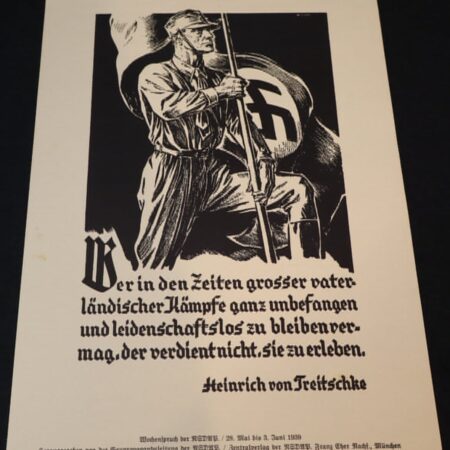
Original WWII German Propaganda Poster – 1939 NSDAP Wall Propaganda Poster (Wandzeitung der NSDAP)
$95.00Original 1939 NSDAP Wall Propaganda Poster (Wandzeitung der NSDAP). This striking black-and-white poster features an idealized standard-bearer carrying the Nazi Party flag, rendered in a bold woodcut-style illustration typical of pre-war German propaganda art. Beneath the image is a quotation by the German historian Heinrich von Treitschke encouraging unwavering commitment during times of national struggle. The lower margin identifies the piece as “Wandzeitung der NSDAP”, Issue 28, covering 28 May to 3 June 1939, published by the Gau Propaganda Directorate of the NSDAP and printed by the Zentralverlag der NSDAP, Franz Eher Nachf., Munich. The poster retains its original margins and printing details, with light age toning and minor foxing consistent with its age. An authentic historical artifact from the final months before the outbreak of the Second World War, it represents an example of the visual propaganda used by the Nazi Party to promote its political ideology.


