Showing 856–864 of 1271 resultsSorted by latest
-

KM/Heer Soldbuch – Obergefreiter Mack – Panzer Kompanie C (ND) 224 (346 Inf Div) – Flamethrowing Panzer – Holland (Sold)
Soldbuch for Walter Mack
Issued in April 1945 because he lost his other Soldbuch!
His unit was Panzer Kompanie C (ND) 224
The Panzer-Kompanie 224 was formed on 1 July 1943 and was equipped with captured French tanks. It was converted flame thrower tanks in April 1944 and was one of the armored units sent against the Allied landings at Arnhem in September under Panzerjäger-Abteilung 657.
346 Inf Div
The 346. Infanterie-Division was formed in September 1942 and served as an occupation, security and coastal defense unit in France. It fought in Normandy and was largely destroyed there in August 1944. It withdrew to the Netherlands where it was reformed and fought until surrendering to the British north of Arnhem in May 1945.
Awards
- Iron Cross Second Class
- Panzer Badge in Silver
Sadly this is a second edition and so late, but finding anything about this unit is very difficult!
There is a book on this very Panzer Kompanie in Holland.


-

Luftwaffe Soldbuch – Oberwachtmeister ‘Der Spieß’ Schilling – Flak Abteilung 456 – 8 Awards – France 1944 & Holland 1945!n (Sold)
Great little group to an important NCO!
Oberwachtmeister Schilling was already a member of the Armed forces as early as 1933!
He served in various Flak and Artillery units most importantly with the following:
Flak Regiment 11
Flak Abteilung 852
He served most of the war with this unit, most interestingly they were stationed in St Nazaire and spent then most of their time in Rennes in Brittany France, and pushed back to Colmar later that year.
It would seem that by 1945 he was sent to a few units in a short period, although this proves to be an interesting path in Holland into Germany:
In February 1945 Achterluk (Holland) to the Geldern area. On March 1, 1945, the brigade was deployed on a mobile basis in the area to the left of the Rhine, where it also took over the units of the 4th Flak Division deployed there. On March 9, 1945, the command area then moved to the right bank of the Rhine.
On March 18, 1945, the brigade command post was in Oestrich west of Dorsten, and on March 31, 1945 in Münster i.W. In mid-April 1945 the brigade staff moved to Oldenburg and at the end of April to the Elbe in the Cuxhaven area.
Flak Abteilung 456
It would seem right at the end of the war, Shilling won the Luftwaffe Ground Combat Badge fighting near Cuxhaven against the allies.
Awards:
- Service Medal 4th Class
- Medal for Memory of the Annexation 1938
- Iron Cross Second Class
- Flak Specialist (?)
- Unknown
- Black Wounds Badge (Wounded fighting on the Westfront) with Award Cert
- Flak Badge
- Luftwaffe Ground Assault Badge (April 1945!) With Award Cert – Signed by Oberst Nabakowski (German Cross in Gold Holder)
Issued a MP40
Summary; a nice Soldbuch grouping to a West Front Flak unit, could be further researched as I am sure there are some nice facts to find out!
-
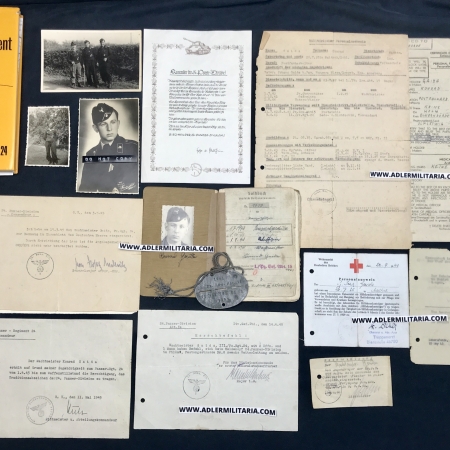
Heer Soldbuch – Wachmeister Gaida – Panzer 4 Commander – Panzer Regiment 24 (24 Panzer Division) – Pz Badge 25 – Honor Roll Clasp – 11 Tank KILLS! 49 Panzer Days! (SOLD)
Incredible Grouping to a well recorded tank commander in on of the most famous units!
I have yet to be offered anywhere such a jaw dropping Panzer Soldbuch, never mind see one for sale.
Conrad Gaida was born in July 1925, by 1942 he was in a Panzer replacement unit and working the post room (humble start).
On the 9th of April 1943 he was fully trained and sent to Panzer Regiment 24, trained as a Gunner and Tank Commander.
24th Panzer Division
In April 1943 the 24th Panzer Division was reorganized in the Lisieux area in France. At the end of July 1943, the division was relocated to northern Italy in the Modena-Florence-Pisa-Livorno area, where it was used for coastal protection.
In September 1943, the division took part in the disarmament of the Italian armed forces. From mid-October 1943 she fought in the southern section of the Eastern Front and took part in the defensive battles on the Dnieper near Novo Staro Dub. Further defensive battles followed in the Dnepropetrovsk – Krivoy Rog area.
From December 1943 to February 1944 the division defended the Nikopol bridgehead.
At the beginning of March 1944 it fought north of Nikolajew and then withdrew to the Romanian Carpathian foothills via the Bug and the Vltava by March 22, 1944. From March 28, 1944, the division had to face defensive battles in northern Besserabia.
From mid-May defensive battles followed on the upper Vltava as well as the counterattack north of Jassy until the beginning of June 1944. Subsequently, the division was taken from the front and refreshed until July 1944. After, the division was transferred to Galicia.
From August to early September 1944, the division carried out counter-attacks between the San and the Vistula.
On September 15, the division moved to the Beskids, where it was used to defend the Dukla Pass. From October 11th, the division was moved by rail to the Szolnok bridgehead in Hungary on the Tisza. The division fought defensive battles between Theiss and Ipel until January 12, 1945.
Sent then via train transport, leaving behind the heavy weapons and armoured vehicles to Marienburg / Elbing (East Prussia). In the Elbing area, makeshift refitting with weapons and vehicles was carried out. The division was then used for defense and counter-attacks in South-East Prussia.
From February 21 to March 27, 1945 defensive battles followed in Warmia and the retreat to the bridgehead at Heiligenbeil. At the end of March 1945 the division was still transported across the Baltic Sea to the Fresh Spit near Pillau.
In mid-April the remnants of the division (approx. 4 – 5000 soldiers) were evacuated to Schleswig-Holstein. There the surrender took place.
Awards:
- 7.11.1943 – Panzer Badge in Silver
- 3.12.1943 – Wounds Bade in Black
- 26.1.1944 – Iron Cross Second Class
- 28.3.1944 – Iron Cross First Class
- 19.4.1944 – Panzer Badge – 25
- 15.3.1945 – Honor Roll Clasp of the German Army
Wounded:
- 5.11.1943 – Splinter in the left hand
- 23.3.1944 – Grenadier Splinter chest
Other documents and photos included:
- A Certificate allowing him to wear the Traditional Badge of the 24th Panzer Division! ”Leaping Horse” Signed by Knights Cross Holder Major Kuls (Kuls, Wolfgang 24.02.1945 Rittmeister Kdr III./Pz.Rgt 24)
- Marching Order – 14.4.1945 – They were reported to go to Pillau to report. Likely without their tank at this stage! Signed by: Knights Cross Holder Major von Knebel-Doeberitz (11.05.1945 Major i.G. Ia 24. Pz.Div)
- A certificate stating that Gaida, was mentioned in the Honor Roll of the German Army. Signed by Knights Cross Holder: Generalmajor Gustav-Adolf von Nostitz-Wallwitz (very rare signature as he died in 1945).
- 24 Panzer Division Flyer – These are also rarely seen a personal speech from von Edelsheim to the men of the 24th Panzer Division!
- 25 May 1945 – Eckernforde – Gaida is allowed to carry a rifle with 10 rounds, he is now employed by the Military Police
- Discharge Papers – Gaida was discharged and send home in 1946
- Military Personal Evidence Sheet – listing all his awards, his battles and injuries and training. A great document detailing many of his battles!
- Photos. 1 Portrait of Gaida wearing the Iron Cross First Class and Panzer Badge and EK2 Ribbon. One of Gaida standing facing the camera in 1944. One of Gaida, Hunger and Maar. Note the Traditional badges on their side caps and Numbered Tank Badges. The photo was taken in Ludwigsburg in May 1945.
- Certificate that Gaida was allowed to be considered to be a Helping Medic, likely a useful tool if captured!
- Certificate that Gaida is now a member of Rittmeister Fischers Command in Palmnicken – 9.4.1945 signed by Fischer (Likely German Cross in Gold Holder:
Soldbuch & Tag
Gaida raised the ranks till Wachmeister in 1945!
The Soldbuch is his first issue Soldbuch and would have been on his person from the date of issue. His matching Tag was also first issue, and still retains the neck cord.
He was issued a P39 Pistol, pocket lamp.
Interesting on page 8 of the Soldbuch is that he is allowed to wear yellow waffenfarbe on his cap to signify Cavalry! An amazing entry that I have never seen before and was unique to the 24 Panzer Division!
The most interesting and detailed battle calendar for any Tank Commander, 49 days are listed! One day away from earning the prestigious Panzer Badge 50!
When researching these final days, It would seem that Gaida proved his resilience and battle knowledge.
The following quotes are taken from the book: Unser Regiment, Panzer Regiment 24, Weidman, 1984
Page 283: Already the next day our tanks had to defend against an enemy tank attack on Deutschendorf, around 15 KM north east of Krawitten. The most forward tank was under the leadership of Oberlt Rehäuser, arriving in the night they immediately spotted a large number of heavy enemy tanks right opposite us! Commander of the first tank is Wachmesiter Gaida. In a report to the division, a special attention was given to the unusual circumstances of the attack. In near darkness, Gaida drove forward at a range of 200 meters in front of a row of enemy tanks, that were preparing to advance on Deutschendorf. Wachmeister Gaida shot immediately on the first tank into flames. Now in the lite up battlefield, and taking enemy fire in a lightning speed shot six more tanks! As a result, the enemy tanks broke up, the others retreated. Because of his actions, the dangerous attack was unsuccessful in this sector of the front (…) the next day Wachmeister Gaida fought in the forest and bushes destroying another 5 from 7 tanks that broke through the lines. This report highlights, how by the fighting in Eastern Prussia the individual actions of single tank commanders and their crews could master the situation.”
Last 20 Tanks for the division, ‘Kampfgruppe von Einem‘
Page 286: Last 10 tanks for the division, Gaia, Kobbe, Bachor, Hippler – Fighting for days at Mertensdorf and Anticken.
Summary, this Soldbuch grouping is astounding, and as far as I have collected IDs, I have yet to see 49 Panzer days entered in a Soldbuch! His awards, and his brave actions are well recorded and this grouping will be hard to top if your interested in owning a Panzer Commander!
Another Interesting fact: Pictured are tanks of the Regiment in late 1944 and 1945.


-
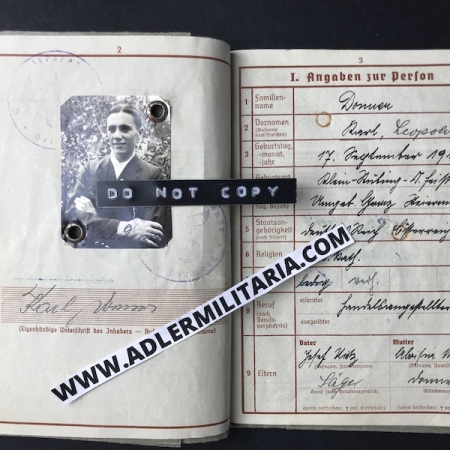
Heer Wehrpass – Hauptmann Donner – Grenadier Regiment 380 (215 ID) – Company Commander – KIA Latvia 1944 (Offer Accepted)
Wehrpass to Hauptmann Karl Donner, born in 1918 in Austria.
He spent a short time in Graz, in the RAD.
His frontline units are as follows:
Infanterie Regiment 738 (718. Infanterie-Division)
From 5.1941 till 12..1941
For more info: https://www.lexikon-der-wehrmacht.de/Gliederungen/Infanteriedivisionen/718ID.htm
Infanterie Regiment 380 – (215 Inf Div)
Following the refresher, the division was deployed in front of Leningrad and fought at Staro Panowo and Urizk. In 1943 the division stood at Schliisselburg, on the Ssinjawino Heights and at Krassny Bor, later at Mga, on the Neva knee and between Pushkin and Alexandrowka. From January 1944 the division had to withdraw to Pleskau via the Ishora and the Luga. The division was then placed in the “Panther” position, where trench warfare took place until May 1944. After a brief refresher, there were defensive battles north of Ostrow, which were followed by a retreat via Dünaburg and Birsen to Bauske and, from October 1944, to Courland. The division fought here until February 1945.
Awards:
- Iron Cross Second Class
- Infantry Assault Badge
- Iron Cross First Class
- Wounds Badge in Black
He was killed due to grenade splinters south of Dunaburg, likely on the border with Belarus.
Summary, the Wehrpass comes with a photo of Donners grave, stating his old rank. This Wehrpass for a Company commander is rather rare, as it is very hard to find company commanders!
-

Heer Soldbuch – Uffz Burger – Grenadier Regiment 728 (728 VGD) Normandy 1944 – MP40 (Sold)
Heer Soldbuch to Till Burger from Munich.
The Soldbuch was opened in 1939, and used to the end of the war.
His frontline units of interest are:
Artillerie Abteilung 758
Artillerie Regiment 262
Artillerie Abteilung 1708 (1944)
Grenadier Regiment 728 (1944) (708 Volksgrenadier Division)
At the end of July, the division was moved towards the invasion front in northern France. By August 2, the motorized parts of the division had reached the area south of Angers and the other parts of Niort. By August 5, 1944, the division had reached parts of the Domfront, Laval and west of Le Mans areas. Here the division met allied units. On August 6th, after heavy fighting, the western part of Laval was lost and the bridges over the Mayenne were blown up. The division set up fuses in the line Bernay – Sable-sur-Sathe, the Fusilier battalion secured in Laval. On August 8, 1944, after heavy fighting, Le Mans was lost and the Domfront area could be held. On August 10, 1944, the remnants of the division were in the line 3 km west of Domfont – creek section to north of Ambrieres – 4 km of Ambrieres – 3 km to the east of Mayenne. On August 13th, the division of the 7th Army was directly subordinated and secured the line Domfront – hard south of Starße Domfront – Alencon to the area west of Pre en Pail. On August 14, American units broke the division’s security and advanced north. The remnants of the division were pushed back to the heights south of Lonlai by the following day. The remnants of the division had been destroyed by the end of August. The division commander, Major General Arndt, fell to Les Loges Margueron on August 24, 1944.
Awards:
- Wounds Badge in Black – 5.12.1942
- Infantry Assault Badge – Issued by Arbeitsstab Stalingrad! 10.7.1943
Equipment:
MP40
Mixed Iron Rations
In summary, this is a very nice Normandy Soldbuch, of which there are hardly any available on the market. Burger was captured by US Troops as his Soldbuch displays the usual 31G POW Number.
-

Heer Soldbuch and Wehrpass – Uffz Reuter – Killed by US Fighter Plane – Berchtesgaden April 1945
Soldbuch and Wehrpass, including the death letters and correspondence.
Reuter was from Düsseldorf, and served pre war in:
Schützen Regiment 1 (Gera)
Although he spent most of the war with:
Grenz Abschnitt Nachrichten Kompanie 9 (526 Inf Div)
It would seem that he spent most of the war in Occupied France.
During the closing stages of the war he was assigned to s communications unit and was driving a truck in a convoy.
He was according to the letters, hit by a fighter plane bullet, which hit him in the lung. The commanding officer recorded his body and brought the body in the night to a morgue in order to bury him properly.
His grave is in Berchtesgaden today.
See below, footage of air raids by US Aircraft on ground targets, most of these were filmed by onboard gun cameras.
In the rear of the Soldbuch was a racist poem, and a declaration that he is not of Jewish decent.
This is a detailed set, directly connected to the US Airforce targeting troops on the ground.
-
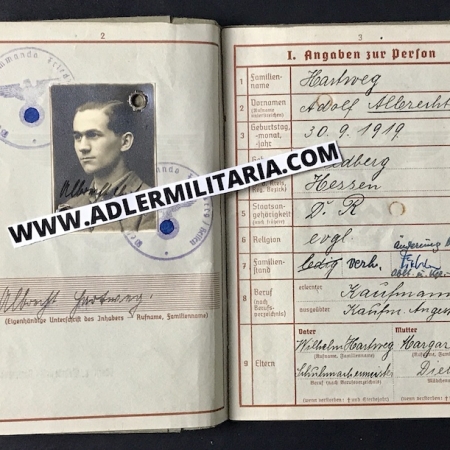
Heer Wehrpass – Uffz Hartweg – Feste Nach Aufkl Stelle 12 – Communications Intelligence – ‘Coder’ (Sold)
Heer Wehrpass for Funker Hartweg.
He served mainly in Intelligence Communications.
There is very little information online about these units, given the nature of their activities.
Although the following information is from a book called: Codeword Overlord: Axis Espionage and the D-Day Landings: By Nigel West
That one of his units were based in France in Saint Germain en Laye, then later in Euskirchen. They consisted of around 120 personell and were listing to all radio communications.
Interestingly, Hartweg was listed as Schüssler also known as a Coder, used to code messages this could incorporate the Enigma also!
He was also trained as a radio man in a recon unit.
He has a quite impressive battle list.
The units would require further research.
Awards
- Eastern Front Medal
- Wounds Badge in Black (31B – Splinter)
-

Heer Wehrpass – Gefreiter Geipel – Panzer-Aufklärungs-Abteilung 231 (11 Panzer Division) – KIA Ultra Rare Grave Map – Killed by Partisans (Sold)
Wehrpass Grouping to Gefreiter Geipel
After a short stint in the RAD he volunteered to join Panzer Regiment 2.
Although it would seem he would not actually be assigned to the Panzer Regiment, and served in a home front unit until September 1940:
His frontline unit was:
Panzer-Aufklärungs-Abteilung 231 (11 Panzer Division)
After being set up, the division moved to Romania as a teaching force in mid-January 1941 and from there took part in the invasion of Bulgaria in March 1941. In April 1941 the division was used to advance on Belgrade during the Balkan campaign. After conquering it, the division advanced on Sarajevo. After the end of the Yugoslavia campaign, they remained as an occupying force in Yugoslavia and then marched back to their garrison location at the end of April. From the beginning of June 1941 the division in Poland was made ready for the Russian campaign. From June 22nd the division fought in Russia. After the Bug crossing and the breakthrough through the Russian border fortifications, the tank battle at Radziechow and fighting over the Styr crossings at Szcznrowice and Berestezko took place on June 23. By June 25, the division reached the Stalin Line via Horyn. Fights for Ostrow and the Wilja and Horyn crossings followed. In heavy fighting, the division broke through the Stalin line from July 2nd to 5th and then the Russian positions at Miropol. Then there were fighting at Starokonstantynow and Lubar and until mid-July 1941 at Cudnow – Berditschew. Then the division advanced by July 20 on Uman, which was fought for until August 8. This was followed by cleansing battles in the Dnieper bend and in the Boguslav – Cherkassy area until mid-August. The deployment in the operational area of the 6th Army for the battle of Kiev followed by August 22nd. This began for the division on August 23 with fighting around the Gornostaipol-Osztjer bridgehead and ended at the end of August 1941. Subsequently, the division was in the operational area of Army Group South and Center. At the end of September 1941, the division took part in the defensive battle of Yelnya and Smolensk. The double battle at Vyazma and Bryansk followed by mid-October, followed by the advance on Moscow. The Moscow protective position could be breached by the end of October. and overcome the Istra by the beginning of December. From December 5, the division was put on the defensive, there were defensive battles in front of Moscow, in the Rusa-Wolokolamsk position, east of Gshatsk and in the winter position Juchnow – Gshatsk – Subzoff.
According to his Officer in command in a letter to Geipels father:
”1.2.1942 – on an attack to the village Boldyrewo. There is a train station near Mitino, the line is Smolensk-Wjasma. The place was occupied by partisans and enemy paratroopers. During the attck we noticed that the enemy was stronger than we imagined. To prevent further losses we pulled back, and your son was hit by a machine gun blast, he died on the spot. We were unable to take him with us. His personal items were robbed by the Russians, as we went back there the next day and found him with six others. We buried them near the train station.”
On further investigation with this map, a search team was dispatched in 2012 to the location to try and locate the missing graves, but to no avail.
Finding a map in such detail is extremely rare.
-

Heer Wehrpass – Gefreiter Thoma – Infanterie Regiment 380 (215 Inf Div) – Killed by Partisan Patrol – Death letters (On Hold)
Wehrpass issued to Gefreiter Wilhelm Thoma
He served with:
Infanterie Regiment 380 (215 Inf Division)
On June 19, the attack of the 215th Infantry Division began on the Maginot Line near Lembach-Wörth. The regiment was deployed on the right side of the division section. The 1st / Infantry Regiment 435 and the 1st / Pioneer Battalion 204 were assigned to him. The aim of the regiment was the breakthrough at Nehweiler. By the evening of June 19, the breakthrough had been achieved and 18 plants had been taken from the regiment. The III. Battalion of fallen 3 NCOs and 3 men, 1st Battalion 1 dead officer. A total of 31 men were wounded. By evening the regiment reached Hagenau and captured two bridges prepared for demolition. On the night of June 20th the regiment began to advance through Alsace. Across the Rhine-Marne Canal to Fort Mutzig, which was evacuated by the French. The Romannsweiler – Westhofen – Molsheim line was reached on June 21. On June 22nd, the regiment encountered the enemy again during its advance, with some major fighting. On that day the advance of the regiment and the entire division ended, shortly afterwards France surrendered.

Subsequently, the 215th Infantry Division was used to secure prisoners of war in the Belfort – Geradmer – Strasbourg area. At the beginning of December 1940 it was relocated to the Moulins area on the Loire. Here the regiment operated intensive training and securing the demarcation line. In the summer of 1940 the regiment provided a guard company for the capital Paris. On February 28, 1941, the 13th Company was transferred to the IR 282 and replaced on November 13, 1941 by the 13th / IR 338. On October 1, 1941, the regiment was the only one in the division to be transferred to the le Valdahon military training area for intensive training. In November 1941 the regiment was relocated to the northern section of the Eastern Front. It was unloaded in Chadovo on the Volkhov on the road to Tikhvin. Immediately after unloading, the regiment was deployed. The III. The battalion took up positions on the east bank of the Wochow near Grusino. The 2nd Battalion arrived here on November 27th and released the III. Battalion, which was then able to relieve the trapped Meschnik. In the following three days there were heavy defensive battles around the place, whereby after the arrival of the 1st battalion of the regiment, it was used as a closed unit at Meschnik. It was supported by the 1st / Artillery Regiment 215. The regiment suffered first frostbite. Around 60 men per battalion suffered from frostbite. There was increased patrol activity on both sides.
On December 18, the front was withdrawn behind the Volkhov, where the regiment moved or had to set up new positions. The transfer to these positions took place gradually until December 23rd. There were violent attacks by Russian troops, some of them fierce.
It was here that Thoma was according to his NCO at the time in a letter to Thomas father. The 2 and half page report, goes into depth about the unit situation at the time, the NCO was also wounded the day before and states that Thoma was killed like this:
” The road was meant to be free from enemy. We did not have to pay special attention to that. Around 2 KM outside Glady on the main road, our commander spotted a small forest, we went there for something to eat. And as the luck would have it a strong enemy patrol attacked us. Because of the thick forest, they were only 50 meters away. Wilhelm was with four other soldiers, as there was a massive machine gun blast towards them and the vehicle, a burst hit him and he fell before there was time to think about cover. We took up arms, and pushed the Patrol back towards Glady. Some lost their lives on this action. Also we left many vehicles, and many horses were shot up. There was no time left, we had to leave the dead… I lost 5 of my best friends in one action. ”


