Website Updated: 23.02.2026 - FREE World Wide Shipping - Lifetime Guarantee on Originality!

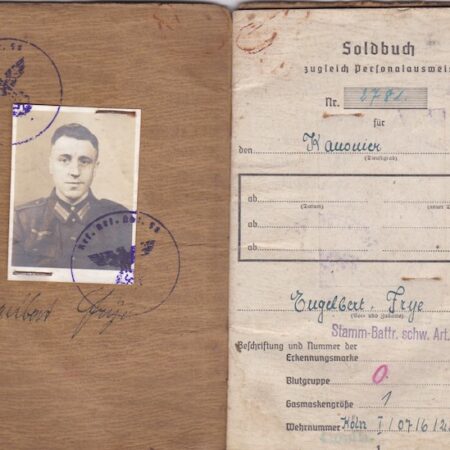
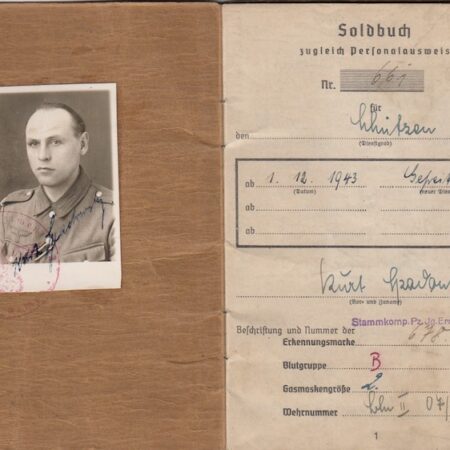
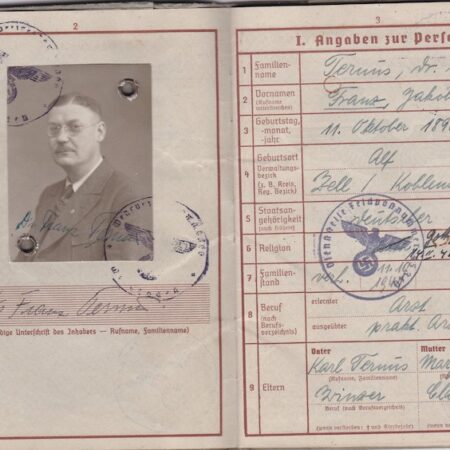
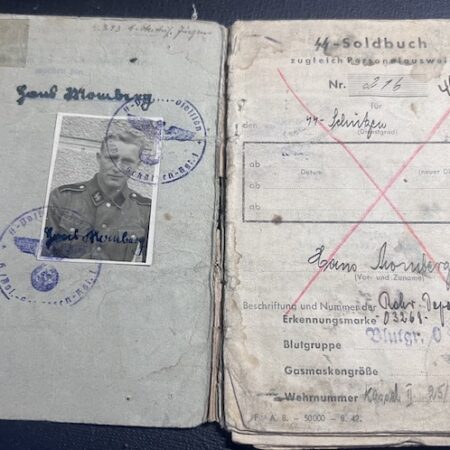
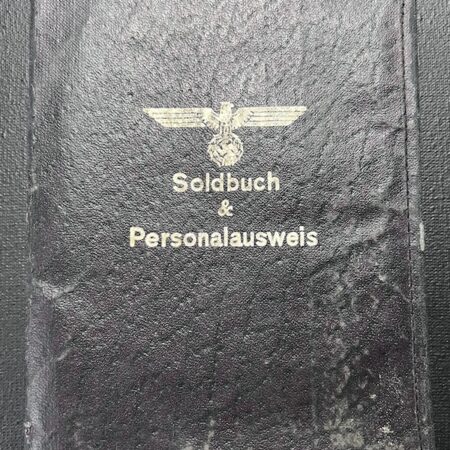
  • Original WWII German Wehrmacht Soldbuch - Obergefr Riechmann - Festung Lorient - Festung Lorient -  Bataillon Böck - RARE!

    Original WWII German Wehrmacht Soldbuch – Obergefr Riechmann – Festung Lorient – Festung Lorient –  Bataillon Böck – RARE!

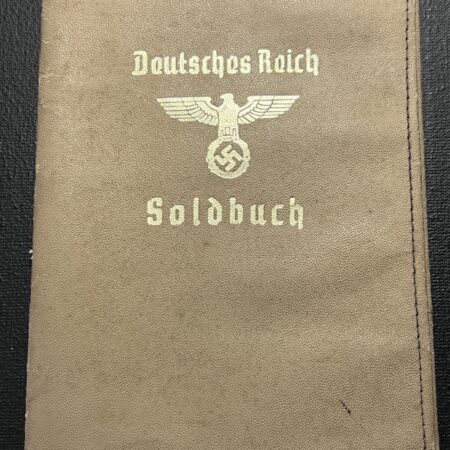
    Soldbuch opened in 1942 to Karl Reichmann. Served in the following frontline units: Reserve-Grenadier-Bataillon 467 Reserve-Grenadier-Bataillon 497  Reserve-Grenadier-Bataillon 487  Grenadier Regiment 535 On February 17, 1943, the reorganization of the regiment began within the 15th Army in France. The first units of the new regiment were assembled in the St. Omer area. After only eight weeks, the already formed elements of the regiment were relocated to the Atlantic coast of Brittany, to the area between Carnac and Saint-Nazaire, to complete their formation and be deployed for coastal defense. Festungs Stamm Reserve Kompanie XXV After the Allied landings in Normandy (June 6, 1944), the corps, under Commanding General Wilhelm Fahrmbacher, fought against the VIII US Corps (under General Troy H. Middleton with the 83rd Infantry Division, 4th and 6th Armored Divisions) in the fortresses of St. Malo, Brest, Lorient, and St. Nazaire. During the Battle of Brittany, the main attack on the fortress of Brest was launched on August 25, 1944, by the 29th Infantry Division from the west, the 8th Infantry Division from the northeast, and the 2nd Infantry Division from the east. By mid-September 1944, the 265th and remnants of the 343rd, 2nd Parachute, and 266th Infantry Divisions were under its command. Finally, only the 265th Infantry Division remained subordinate to the XXV Corps Command in the fortress of Lorient. Festung Lorient –  Bataillon Böck Lorient, on the Bay of Biscay, had been an important French naval base until June 1940. With the capture of the base in the same month by German troops (see France campaign), the town in succession got more and more of strategic importance for the German Navy. This concerned above all the submarine construction with its bunker buildings on the peninsula Kéroman. U-Baot Bunker Kéroman III in Lorient In August / September 1944, following the Allied invasion of Normandy, the port and town of Lorient were completely enclosed by US and British forces, with some 22,000 German soldiers. Adolf Hitler thereupon declared the city a fortress. During the eight-month siege, which ended with the surrender of the remaining German forces on May 10th, 1945, there were some fighting going on. Battalion Böck (referred to as “Boeck” in the book) participated as a fortress assault reserve on April 30th to May 1st, 1945, in the occupation of the islands of Houat and Haedic as part of a combined sea and land operation. Mentioned in the book: Black Flag: The Surrender of Germany’s U-Boat Forces on Land and at Sea The book by Fahrmbacher: “Lorient”, 2nd edition, Prinz Eugen Verlag Weissenburg: P. 107. “The Chief of Staff of the XXV General Command, Colonel i. Gen. St. Bader, was recalled by radio order to another position in the Reich( ……………….) The Chief’s duties were now assumed by the 1st General Staff Officer, Lieutenant Colonel i. G. von Raven, and he was replaced by a proven young Ostmark native, Captain Böck.” P. 120: (Surrender) “The commanding general went there, accompanied by Lieutenant Colonel i. G. Raven, Captain Böck, and Lieutenant i. R. Buck…” At the beginning of the encirclement of the fortress of Lorient (August 10, 1944), approximately 26,000-28,000 soldiers entered the fortress, but only a very small number of these were trained infantrymen (according to FMS B-731, only approximately 800 soldiers). In addition, there were soldiers or individuals who were only partially eligible for infantry use of auxiliary weapons (approximately 3,000 soldiers for grenade launchers, anti-tank guns, 2cm anti-aircraft guns, etc.). Thus, initially, only approximately 3,800 soldiers were available for planned infantry training and further education who were even eligible for infantry use. Over time, other encircled members of the Wehrmacht, the Todt Organization, etc., were found who were ultimately trained and deployed as infantry personnel: 1,100 soldiers of the Marine Flak Artillery, 2,050 soldiers of the Marine Aircraft Personnel (including Battalion Böck, Marine Artillery Detachments 681, 683, and 688), 1,200 soldiers of the Air Force, 600 soldiers of the Signal Corps, Supply and Order Services, and the Supply Corps, as well as 1,200 members of the shipyard. Thus, a total of almost 7,000 soldiers were gathered (plus the 800 previous infantrymen), who were ultimately trained and deployed in a more or less infantry-like manner. The personnel target calculated for this, a minimal defense (need for infantry), was again, due to the circumstances (priorities, length of the front, etc.), at approximately 10,000 soldiers. Weapons  K98K  

  • Original WWII German Soldbuch Grouping & EKM- Obgefr Albert Kahut - Captured in Normandy 1944 - Died a POW in Cherbourg - Letter Translated - Rare (Payments)

    Original WWII German Soldbuch Grouping & EKM- Obgefr Albert Kahut – Captured in Normandy 1944 – Died a POW in Cherbourg – Letter Translated – Rare (Payments)

    £263.00

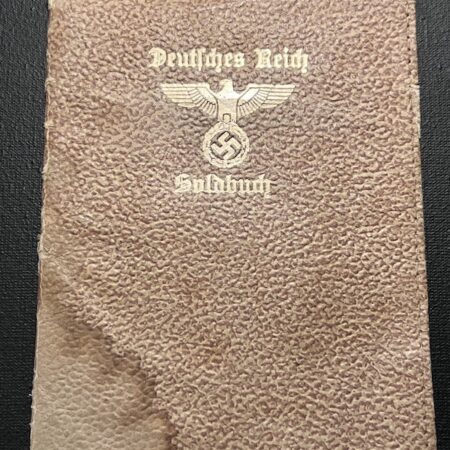
    Soldbuch issued to Albert Kahut borin on the 21.8.1900 in Gablenz, Grimmitschau. Issued in February 1940. He served in the following frontline units: Infanterie Regiment 515  Bau Batl Grimma  Personal Einheit 22 B  Bau Batl 22  Landeschutzen batl 387  Betriebstoffverwaltungskompanie – Belgian / Nordfrankreich  Festungs St Res Kp bei O.B West  Betriebstoff Verwaltungs Kompanie 698  Captured in Normandy in 1944, an entry on the back of the Soldbuch reads: Im amerik Gefangenlarger 24 auf Sealbiusne, Cherborg France 1945 In an American POW Camp Nr 24 Sealbiusne, Cherbourg France 1945. Weapons / Equipment  Dutch Rifle ! Some sort of Rifle made in 1917! Belgian Rifle. Medals Hindenburg Cross – 1935   Included are his WWI Shooting Book, and his WWI Soldbuch front cover.It seems he was for a short time in the Imperial Army in 1918 and there is a letter confirming he was with – Infanterie Regts Nr 105. Included is his Hindenburg Cross Certificate.   POW Letter from him to his wife and kids… Translated 19 May 1945 – US POW CAMP France  My dear Mutti and Dieter! As you, dear ones, can already see from the letter, I am in American captivity. Maybe you have received my red card. My dear ones, don’t worry about me, I am still doing very well, which of course I also wish for you, my dear ones. My dear Mutti, of course I can’t write to you every day; you must wait a little longer. Hopefully the war has not passed too hard for you and you are all still alive. Many warm greetings to all acquaintances. Until a healthy and soon reunion, best regards and kisses.    His EKM is broken, he died a POW and is listed on the Volksbund website.   

  • Original WWII German Soldbuch Grouping - Uffz Haarhaus - Heeres-Baupionier-Brigade 686 - Son Killed 1945 Kampfgruppe Becker - Sad last letters

    Original WWII German Soldbuch Grouping – Uffz Haarhaus – Heeres-Baupionier-Brigade 686 – Son Killed 1945 Kampfgruppe Becker – Sad last letters

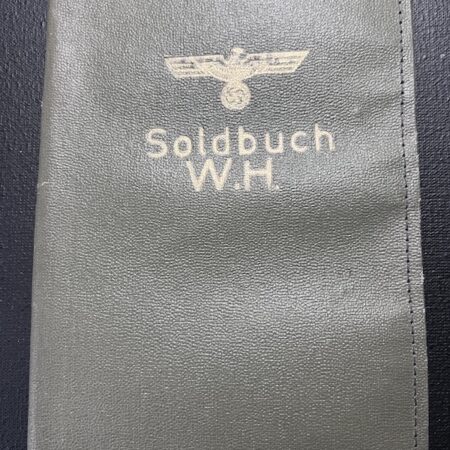
    Soldbuch Grouping to Family Haarhaus Soldbuch Issued on December 1939 – to Adolf Haarhaus from Wuppertal. Served in the following units on the frontline: Stellungsbau-Pionier-Bataillon 722 The Stellungsbau-Pionier-Bataillon 722 was established on 8 September 1943 at the Truppenübungsplatz Hammerstein, in Wehrkreis II. The battalion was raised as a Heerestruppe with 4 companies. After its formation, the battalion was transferred to the East. There, the battalion was deployed in southern Russia. On 30 May 1944, the battalion was renamed Baupionier-Bataillon 722. In the summer of 1944, the battalion served with Heeresgruppe A in northern Ukraine. In November 1944, the battalion, under Heeresgruppe A, formed the II. Bataillon of Heeres-Baupionier-Brigade 686. Heeres-Baupionier-Brigade 686 The Heeres-Baupionier-Brigade 686 was formed in July 1944. The brigade was established with Heeresgruppe A as a Heerestruppe. The staff of the brigade was formed from Pionier-Regimentsstab z.b.V. 686. In November 1944, the Bau-Pionier-Bataillone 402, 722, and 726 became the I. through III. Bataillon of the brigade. After its formation, the brigade was deployed in Galicia with Heeresgruppe A. Later, at the end of 1944, the brigade was employed in Poland. By the end of the war, the brigade was in action in Silesia.  In January of 1945 he was sent to the hospital in Bad Tölz for a code 34 (Accident) likely to his foot given the hospital was specialised in Orthopaedic treatment. In 1945 he was with his replacement unit, Baupionier-Ersatz- und Ausbildungs-Bataillon 4 according to Tessin they were sent into action as, Bau-Pionier-Bataillon 4. Awarded the following medals: Eastern Front Medal in August 1942, Krim Shield 11.1943 under order of Generalfeldmarschall von Manstein. According to the documents along with the Soldbuch, it would seem he kept a diary of where he was in a leather pouch. Along with some letters, and his release papers from a POW camp in Berlin 1945. He was released and given the documents to return home. Although, it would seem his son was Missing in Action after the war ended for some time until declared as Killed in Action. See below for the letters and translations. Son – Panzer Grenadier Adolf Günther Haarhaus – Kampfgruppe Becker  Letter to mother dated 8 March 1945 Raesfeld, 8.2.45 My dear Mother! I received your letter today; it was from 26.1.45. I was very happy to finally get mail from you again, since I have already been here in Raesfeld for five weeks. First of all, dear Mother, I want to give you my heartfelt thanks for your letter. I was especially pleased to hear that you and Father are still in good health. As for me, dear Mother, I am doing quite well, apart from a little homesickness, which is understandable. Otherwise, I am fine. Then, dear Mother, you wrote in your letter about whether I had received the Christmas parcel from Pfiff. Unfortunately, dear Mother, I have not received it yet, but maybe it will still arrive. Many thanks to Pfiff for sending it. I am just sorry that I cannot thank him directly. Your letter especially pleased me. Hopefully, I will soon receive another letter from you. Dear Mother, you asked whether I had already been in action. Yes, I already have. We were deployed once near Bochum in heavy combat and had to endure air raids there. I was also on a mission in the Ruhr area, where I experienced heavy bombing. But otherwise, everything is still bearable. The English and Americans are attacking us more and more, but our troops are still holding out bravely. How things will continue, we will see. Dear Mother, have you already received my soldier’s book? If so, please keep it carefully. Should I fall in service, it will be useful for the pension rights. Otherwise, dear Mother, I don’t know much more to write. Please don’t worry too much about me. I am always under God’s protection. Your loving son, Adolf Günter … Letter from Father requesting his sons death certificate.  Herewith I request the service office to send me the death certificate of my son, the Panzer-Grenadier Adolf Günter Haarhaus, born on 14 May 1924 in Bremen. According to the notifications I have received, he fell as a result of a head injury. To provide confirmation of his death and of his burial in their records, the authorities are asking me to present the official death certificate. I therefore respectfully request that the Service Office issue and send me the death certificate of my son. As this matter is very urgent for me, I kindly ask for prompt handling and dispatch. I thank you in advance for your efforts and remain respectfully yours, hoping that I will soon be able to receive the requested certificate. —– Letter from Panzer-Grenadier Adolf Günter Haarhaus to his Mr Eck dated 21st Feb 1945 in Raesfeld.  **Note this Letter was enclosed in the Feldpost, was later taken from his body and forwarded in 1948! ** See Below  Dear Mr. Eck You probably did not expect to hear from me again. As you may have heard from the Diecaster, I was drafted into a new group. I am now with the … [text partly crossed out] Kampfgruppe Becker. How are you doing? Are you still with the staff? How is your work going? How are Schopft and Vollmer doing, and where are they? Is Winter still in the RAD? Well, Mr. Ehl, I will close for today and hope you will write me a few lines in return. I would be very happy about that. Many warm greetings to you, also to all comrades. … Letter from Mayor of Lembeck to Mr Eck Lembeck, 13 February 1946 To Mr. Fritz Eck c/o Fa. Grmeier Wuppertal-Barmen Früher Strasse der Alten Garde 99–103 On 23 March 1945, Panzergrenadier Adolf Günter Haarhaus fell here a hero’s death. On the body were found only a breast pouch containing 20 Reichsmarks, the identity disc, and the enclosed card. I must apologize that the card is only being forwarded to you today. The belongings of…

  • Original WWII German Wehrpass Grouping - Gefreiter Erwin Zahn - Grenadier Regiment 348 - 216 Infanterie Division - Iron Cross -  Letters Fully Translated - Isle of Man Link! Rare

    Original WWII German Wehrpass Grouping – Gefreiter Erwin Zahn – Grenadier Regiment 348 – 216 Infanterie Division – Iron Cross – Letters Fully Translated – Isle of Man Link! Rare

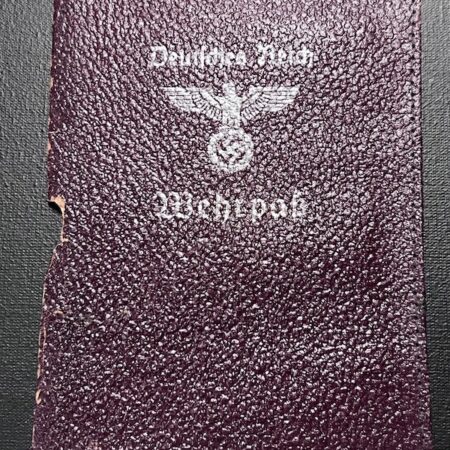
    Sad grouping to Family Zahn. Wehrpass – Issued to Erwin Zahn – Born 1924 – Holder of HJ Sport Badge – did his RAD service in Graz – called up in December 1942 – joined his frontline unit in September 1943. Grenadier Regiment 348 – 216 Infanterie Division In July 1943, the 216th Infantry Division participated in the Battle of Kursk, where it sustained heavy casualties while fighting on the northern shoulder of the Kursk salient as part of Generalfeldmarschall Model’s Ninth Army. The division was disbanded on 17 November 1943 after suffering heavy casualties during the retreat to the Dnieper River Defensive Line. Zahns death card and Iron Cross Second Class Certificate, one spare photo in the back pouch as well as his death certificate. He will killed on the 12.11.1943 – the letter to his mother Anna reads:  Lieutenant Leber,Field Post No. 21360 O.U., 14 April 1944 Mrs. Anna Zahn,Kowald No. 4,Voitsberg / Stmk. Dear Mrs. Zahn, Only today am I able to reply to your letter of 17.12.43. Due to operations, relocations, and my longer absence from the company, it was not possible for me to respond earlier. I spoke about your son with Sergeant Droste, the leader of the bicycle platoon to which your son belonged as a light machine gunner. On 12.11.43, the bicycle platoon was in reserve and carrying out entrenching work. Suddenly, enemy artillery fire began. A shell struck the pit in which your son and another comrade were working. Your son was fatally struck by multiple shell fragments. Sergeant Droste was in the immediate vicinity and ran to him at once, but he could provide no further help. A few hours later, after the enemy artillery fire subsided, your son was buried with Sergeant Droste and his comrades in a field grave on a hill in a small woodland west of Borschtschownka, a heavily destroyed small village. It was not possible to move your son further in order to bury him in a “heroes’ cemetery,” as the combat situation no longer allowed it. Since there was also no camera available, unfortunately no photographs of the grave could be taken. Soon after, this section of the front was abandoned. Your son was very popular with his immediate superiors and with all his comrades for his open, sincere nature and his always comradely conduct. It is with heavy hearts that we had to part from him! With best regards,Your [signature: Leber] The letter from the Doctor dated in 1945 relates to Annas Brother who was also Killed in Action.  Dr. Bantz, Staff Doctor Deputy Chief Doctor Field Post Number: 36 77 0 O.U., 29 January 1945 Dear Mrs. Zahn, It is my sad duty to inform you that your dear brother, Oberjäger Peter Zeltmeister, died on 28.1.1945 after being admitted to our field hospital. Your brother had sustained a severe head wound with brain involvement. Death occurred during transport to the hospital. For more detailed information, I would kindly ask you to contact the last field unit of your brother. Please accept my sincere condolences on this grievous loss. Your dear brother made the ultimate sacrifice for the Fatherland and homeland in heavy fighting. His comrades will remember him as a good soldier, and I ask you also to preserve a worthy memory of him. The deceased will be laid to rest on 30.1.1945, in a dignified ceremony, alongside his comrades in a single grave at the soldiers’ cemetery in Csatkornya (Hungary). All personal belongings found with the deceased will be forwarded to you. Heil Hitler! Yours, [signature] Dr. Bantz Staff Doctor and Deputy Chief Doctor Interestingly two POW Letters are included and are from Annas Sister Hedwig, who for some reason was in an all female POW on the Isle of Man – the only such camp for females in WWII! Port Erin Women’s Detention Camp was a World War II internment camp on the Isle of Man at Port Erin. It was Europe’s only all-female internment camp. Notable internees included Dora Diamant, the lover of Franz Kafka in the last year of his life, and Fay Taylour, champion motorcycle, speedway and racing car driver. See more on the camp here: https://www.bbc.com/news/world-europe-isle-of-man-32810383 Translations: 26.4.1943 My dear sister Anna, Many thanks for your letter of 28.1.43, which unfortunately arrived so late that I could not reply sooner. Dear Anna, I believe this heavy burden is even harder for you and your family than it already is. Instead of resigning yourself to the inevitable and trying to make the best of it, you lament and cry and thereby suffer much more. But apparently that is the way of millions of mothers. They have to bear much heavier sorrows. But Anna, I am sorry, yet I do not blame you. On the one hand, you have a cheerful spirit that often helps you to bear much adversity. For you and others like you, only sorrow and pain come again and again. But you, with heart and soul, must stand by the Fatherland in this difficult time, whether or not you believe in it. Believe me, Anna, I have seen much among friends, and it is only about one Fatherland — one Germany — defending our cause. If sacrifices are demanded, then one day everything will be good again. With love for Hilda, my Fatherland. Your sister, H Another Letter translated: “AVEN HOLME.” G.H. Post Erin I.O.M. 26.4.1943 My dear sister Anna, Many thanks for your letter of 28.1.43, which unfortunately arrived so late. Dear Anna, I believe you and your loved ones are making life even harder for yourselves than it already is. Instead of accepting the inevitable and trying to make the best of it, you lament and weep, and in doing so you suffer much more. Yet it seems that this is the way of millions of mothers, who must bear even heavier sorrows. Anna, I am sorry, but I do not reproach you. On the one hand, you always keep a cheerful…

  • Original WWII German Wehrmacht Officer Death/Burial Map & Death Notice - Red Cross Letter from Gulag - Leutnant Walter Heyl - Schützen Regiment 73 - 19 Panzer Division - Iron Cross Posthumus -  Fully Translated - Very Rare

    Original WWII German Wehrmacht Officer Death/Burial Map & Death Notice – Red Cross Letter from Gulag – Leutnant Walter Heyl – Schützen Regiment 73 – 19 Panzer Division – Iron Cross Posthumus – Fully Translated – Very Rare

    Here we have something quite rare and unique. The Death Notice and Map of where he died and was buried created by the Wehrmacht and sent to the family. Interestingly, his Award Document for the Panzer Assault Badge was sold here: https://www.lakesidetrader.com/item.php?ID=20437 He is not listed on the German Website for War Dead. Translation – Death Notice  Russia, 9 March 1942 Dear Mrs. Heyl, When you receive this letter, I ask you to hold yourself very firm and stay strong. Your son, my Lieutenant Heyl (Walter), was severely wounded on 28 February 1942, around 16:00 hours, by a headshot during the heroic defense of the village of Medwenke, while serving as platoon leader of Company S.R.73. According to the medical company 2/19, he was treated at the main dressing station in Miljatino and passed away on 2 March 1942 at 4:45 without regaining consciousness. The circumstances of his heroic death are as follows: Since 23 February, my battalion has been in the focal point of Russian attacks on the Roslavl–Juchnow railway and had to defend several villages, including Medwenke. Since 26 February, the Russians attacked Medwenke incessantly with infantry and heavy tanks and sought to unite all their forces there. Your son immediately took over command of the 7th Company upon his arrival at the battalion and led it from then on, defending the village of Medwenke. Under his dutiful and reliable leadership, all attacks broke down, and the number of dead Russians grew ever greater in front of our defensive line. The Russians then dug themselves in and began concentrated infantry fire. A shell struck him. He was immediately unconscious; under no circumstances could he have suffered pain. Shortly after he was wounded, I myself went to Medwenke, as the situation was critical (another company commander had just fallen), to check on matters. I found him lying unconscious, protected by a snow wall. He did not recognize me. I immediately ordered his evacuation. The attached document gives further details about his death. Dear Mrs. Heyl! I know it is pointless to try to comfort you. I only wish to say this: that your deep pain is bound together with pride for your son, who fell as a hero. The Iron Cross Second Class, which he had earned, will undoubtedly be awarded to him posthumously — may it be for you a token of his bravery and self-sacrifice. My officer corps and I valued him highly for his modest, kind, and trustworthy character. I too have lost much. Please accept, as his mother, my deepest sympathy. With most respectful regards, Your very devoted [signed] Bruns Commander II/S.R.73 Translation – HV1440  Red Cross Letter sent from Soviet Gulag by Walther Brother to his mother. 22 January 1948, Nr. 32 Mother! Dear ones at home! Since confirming my card 23, I have had no message from you! Now Christmas is approaching — it will be the saddest of my life. My 51st birthday again marked by separation for the 10th time! Bitter facts for us all. We can only cling to anxious hope in our thoughts, but only actual events can convince us. On 16 January, I had a strong inflammation on my right thumb operated on; it went well. The medical care is excellent and must be especially praised. How are the parents? Today, many motherly admonitions from my youth come back as true words of remembrance. Birthday greetings have arrived. Hopefully, fate will grant me the time to be with you again. Letters may still be permitted for you. If so, I will write more extensively to you. Quiet and lonely it is here around me. In my thoughts, I am gratefully with our cheerful family days again; father is no longer there. The harshness of fate struck us mercilessly — there is no solution. Learn to hate war! This realization must be a reminder for our political thinking and actions. Stay healthy and study diligently. Warm greetings to Gretchen, parents, Anna, and you, dear Mother. Yours, Kurt      

  • Original WWII German Propaganda for Germans! - Deutsche Volksgenossen! - Fully Translated - Rare

    Original WWII German Propaganda for Germans! – Deutsche Volksgenossen! – Fully Translated – Rare

    The leaflet is addressed to “Deutsche Volksgenossen!” (German compatriots!) and was designed to instruct civilians in occupied or soon-to-be occupied territories on how to behave when Allied forces advanced into their towns and cities. German Comrades! Although our heroically fighting soldiers have done everything in heavy battles and exemplary bravery to repel the enemy, he has penetrated into our Lower Rhenish homeland.If you now have to live under foreign occupation, then be aware that you have great duties towards your people and Führer, your fighting sons and fathers. The entire nation looks to you!The fallen call upon you! Ask yourselves, in every difficult situation, what is expected of you, and then act as is right. What is expected of you? How should you behave? 1. You must uphold the honor of your great nation.If the enemy proclaims: “Germany will collapse the moment our soldiers set foot across its borders,” then he has deceived himself.Prove to the enemy that you will never surrender your honor.Whoever forgets dignity and honor is despised not only by us but even more so by the enemy. 2. Whoever cooperates with the enemy, whoever gives voluntary assistance to the hostile military power, commits treason against Germany. 3. No German will consider the enemy worthy of even a glance, none will converse with him, none will associate with him. 4. Should anyone be found who betrays his honor, he will be despised and treated worse than the enemy himself, for he is a traitor. 5. If they force you under duress to perform services, remember the names of the units, officers, and officials; in due time they will not escape just punishment. 6. When you see the ruins of your cities and villages and see the enemy soldiers, then you see the criminals at the scene of the crime. If the enemy asks you the way, show him the way to the cemeteries where thousands of Rhineland men, women, and children are buried, murdered by this very enemy. If anyone says that the English and Americans are innocent, remember how many innocent women and children were horribly killed under their carpet bombings and in the infernos of fire. 7. If the enemy demands services from you, you have the right to refuse. You can rely on international law, the Hague Convention of October 18, 1907, signed by all states. The article reads:“Services and deliveries can be demanded from municipalities or inhabitants only for the needs of the occupying army. They must be proportionate to the resources of the country and of such a nature that they do not force the population to take part in military actions against their homeland.”You must therefore refuse any service that would aid the enemy army in its war against Germany. 8. Do not look at newspapers, leaflets, or printed matter distributed by the enemy. Do not listen to his radio. Let his films roll before empty benches, despise every amusement and distraction with which the enemy wants to ingratiate himself with you. For every hour that you indulge in such things, German soldiers and civilians are dying under his bombs and shells. 9. Do not grant the enemy any applause when he stages a military spectacle. Every hostile column must pass through a gauntlet of contempt. Not a single enemy soldier should feel comfortable for even one hour in our land. No one among you should allow it to be said that the Germans fight like lions in the field but behave like tame lambs at home. 10. No woman and no girl must ever show the enemy the slightest kindness. Above all, her honor must remain untouchable, for the honor of the woman is the honor of the entire nation. 11. The more sharply you reject the enemy, the more you close ranks as Germans. Help one another in your distress. Stand by each other as you have done in the nights of bombing, without orders, without command, and without reminder. The enemy has refused to believe that we were a united, content, socially advancing people. Prove to him how united we are and how unbreakable our cohesion is. Let it be read on our foreheads and in the eyes of every German person that no word of the enemy penetrates our hearts. We have a cause to defend, for which millions of Germans have already given their lives, and for which an entire people continues to fight. So be worthy and fight on! Our heroically fighting soldiers will return! Long live Germany!Long live the Führer!  

  • Original WWII German Propaganda Newspaper - "Das Neueste" - Panzerarmee - Anti-Partisian Operations - Rare

    Original WWII German Propaganda Newspaper – “Das Neueste” – Panzerarmee – Anti-Partisian Operations – Rare

    Issued by the propaganda company of a German Panzer Army front-line propaganda material. Date: Friday, 11 June 1943. Issue No. 135. Main headline: Großunternehmen gegen bolschewistische Banden (Major operation against Bolshevik bands). This refers to German anti-partisan campaigns in occupied Eastern territories. Other headlines: Starke Bandenkräfte im Waldgebiet südlich Pinsk vernichtet (Strong bandit forces in the forest area south of Pinsk destroyed). Highlighting supposed German successes against Soviet partisans, aiming to keep morale up at the front. There is also a blurry photo print of soldiers (caption: “Jeder ist Wächter der Front” – Everyone is a guardian of the front). Continuation of reports about anti-partisan operations. Sections on: “Schlagkräftige Züge” (Effective platoons) – praising German units’ efficiency. “Vom Feind” (From the enemy) – reports on Allied and Soviet movements, presented in a way to minimize German losses and emphasize enemy suffering. “Einzelschicksal – von den Hornen” (Individual fate – from the Horns) – a kind of war story highlighting the courage of German soldiers. Includes names of war correspondents (e.g., Heinz Brandt, Hans Zickel).

  • Original WWII German Propaganda Leaflet - Antisemitic - Rare (Sold)

    Original WWII German Propaganda Leaflet – Antisemitic – Rare (Sold)

    A really rare leaflet dropped by German Propaganda Units on Soviet Trenches to try and get them to surrender. Translation This pass is valid for an unlimited number of commanders and soldiers of the Red Army who cross over to the side of the German troops. The bearer of this, not wishing senseless bloodshed for the interests of Jews and commissars, leaves the defeated Red Army and crosses over to the side of the German Armed Forces. German officers and soldiers will receive the one crossing over well, feed him and arrange work for him. Commanders and fighters of the Red Army! Your situation is hopeless.The iron ring of German troops is tightening tighter and tighter around you.You lack ammunition, supplies, and food; your rulers and leaders are incapable of anything, they flee and abandon you to fate.Many of you have been oppressed until now, deprived of rights — now you are being used only to defend their regime. Your struggle is useless!Is it really permissible that your command, out of stubbornness, still drives you mercilessly to inevitable death?No — your life is dear! Save it for a better future and for your families. Cross over to the Germans — there you will find good treatment and food, as well as a quick return home. Hurry!In the areas occupied by them, the Germans have already begun resolving the land question. Red Army soldiers, do not delay, otherwise you will be left without land! Headline (Russian): “Beat the Jew–political commissar, his mug begs for a brick!”(antisemitic slogan, repeated twice on the page) Top image caption:“Commissars and political instructors force you into senseless resistance.” Bottom image caption:“Drive away the commissars and cross over to the Germans.Cross to the Germans using either the slogan or the pass:” Final Comments: This is an extremely rare historical item and is only sold for historical purposes. They are filled with propaganda, disinformation, and hate speech.

  • Original WWII Purple Heart - Pfc C R Splane - USMCR - Battle of Enewetak Atoll - Wounded in Action

    Original WWII Purple Heart – Pfc C R Splane – USMCR – Battle of Enewetak Atoll – Wounded in Action

    Here we have a nice Purple Heart with what seems to be a private engraving. After researching it, it would seem he was wounded in the Battle of Enewetak Atoll. Charles R Splane from Nevada Member of the 22nd Marine Regiment. Marshall Islands: Battle of Eniwetok (22nd Marines: Navy Unit Commendation, February 17 to 22, 1944) On February 18, 1944, the 22nd Marines under the command of Colonel John T. Walker, participated in the Battle of Eniwetok, in the northwest area of the Marshall Islands, capturing the islands of Engebi in 6 hours, Eniwetok Atoll on February 21 with the 1st and 3rd Battalions of the 106th Infantry Regiment of the 27th Infantry Division, and Parry on February 22. The 22nd Marine proceeded to take Kwajalein and Roi-Namur from March 7 to April 5. This was the first Marine Corps unit to formally employ fire team tactics in combat. On April 6, the Marine regiment was sent to Guadalcanal for rest, replacements, and further training. I found more information here:  https://genealogytrails.com/nev/state/ww2navyhonor.html https://en.wikipedia.org/wiki/22nd_Marine_Regiment https://www.history.navy.mil/content/history/museums/nmusn/explore/photography/wwii/wwii-pacific/gilbert-marshall-islands-campaign/invasion-marshall-islands.html  

×