Showing 28–36 of 1271 resultsSorted by latest
-
-
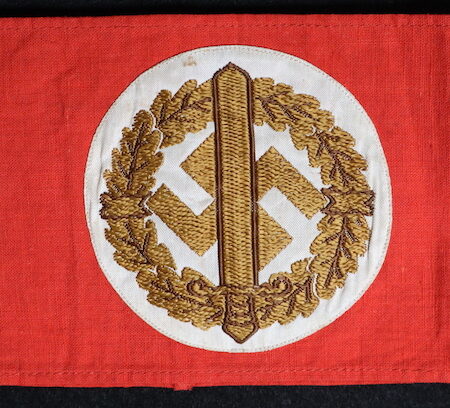
Original WWII German SA Wehrmannschaft Armband – RZM Tag – US Bring Back
FREE WW Tracked Postage Incl!
-
-
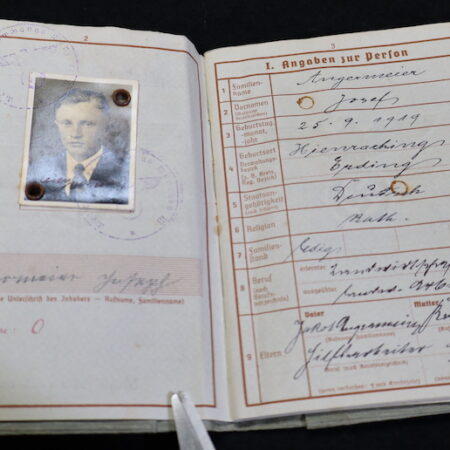
Original WWII German Wehrmacht Wehrpass ID – Gefr Josef Angermeier – Infanterie Regiment 488 -268. Infanterie-Division – KIA 1941 Russia
Angermeier served with Infanterie Regiment 488 – 268. Infanterie-Division From June 22, 1941, the 268th Infantry Division participated in the Russian campaign. It advanced to Bialystock and then, via Smolensk, to the Dnieper River south of Mogilev. After advancing to Yelnya, the division took part in the Battle of Vyazma and then moved to the area west of Tula. Here it was caught in the Russian winter offensive and forced to retreat to the greater Yukhnov area. Heavy defensive battles ensued at Nedelnoye, on the Ugra and Sobzha rivers, and at Krasnaya Gorka. These battles continued throughout 1942. He was killed on the 15th of August 1941 near Ljapy, Russia.
-
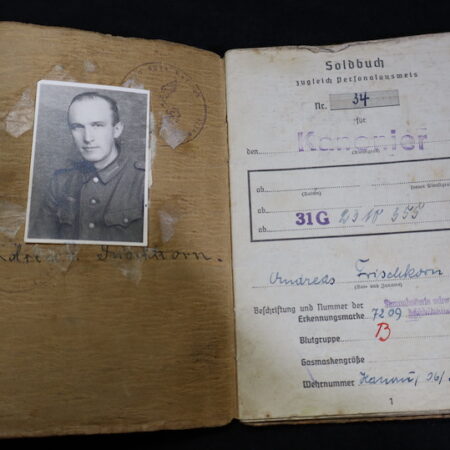
Original WWII German Wehrmacht Soldbuch – Andreas Frischkorn – Artillerie Regiment 369 (kroatisch) –
Served with the 369 Croatian Not sure if that is the original photo to the Soldbuch, even though it can be seen there was a stamp over the photo too. Hence the Price. Ending in late January 1944, these operations netted over 11,000 Partisan dead, butfailed to destroy the guerilla movement. Smaller scale operations continued throughout 1944. 369 Croatian By November the military situation in Croatia had become critical for the Axis. The 369.Infanterie-Division (kroat.)was in the Mostar region tryingto defend a large area with only a few fortress battalions added as reinforcements. In late January of 1945 a large Partisan offensiveon Mostar threatened to overwhelm the outnumbered Division, and February 15th 1945, Mostar was abandoned. The Division wasforced to retreat westwards, leaving much of its heavy equipment behind. The slow, terrible fighting withdrawl of the Axis forcesfrom Croatia into Austria continued, and the 369.Infanterie-Division (kroat.) was a part of this movement. Heavy losses were incurred by theunit and by late April of 1945 it had only about 500 men per regiment remaining! On May 11th, 1945 the 369.Infanterie-Division (kroat.) surrendered to British armored forces near Bleiburg, Austria. Most of the Croatian soldierswere promptly sent by the British back into Partisan hands where they were for the most part executed.
-
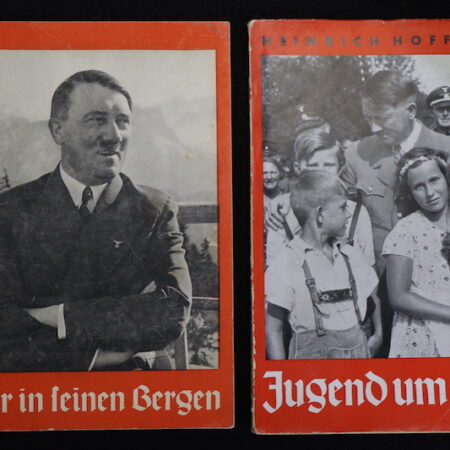
Original WWII German Books – Hitler in his Mountain – Youth Around Hitler – Obersalzburg – Berghof – Heinrich Hoffmann – Rare Books
Hitler in Seinen Bergen and Jugend Um Hitler, by Heinrich Hoffmann. “Hitler in Seinen Bergen” is a 96 page book published by Heinrich Hoffmann in 1935 with a foreword by Hitler Youth leader Baldur von Schirach. It contains an incredible compilation of 86 of Hoffmann’s photographs of Hitler “resting” at the Berghof: playing with his dogs, hiking in the snow, and hanging out with locals in his neighborhood. This collection of pictures provided a thorough and excellent overview of Adolf Hitler’s “unofficial” life in the one place he continually found peace and refuge from all the complications and pressures associated with statesmanship. Jugend um Hitler “This pictorial work is a typical example of the Nazi German propaganda item. It reflects how the public’s attitude towards Adolf Hitler was manipulated through the publication and dissemination of corresponding photographs, by introducing a kind-hearted, child-loving father figure and documenting the enthusiasm of the youth for him. The highly illustrated photobook, with a number of Adolf Hitler portraits, was compiled and edited by Heinrich Hoffmann, Reich reporter of the NSDAP, with forewords by Baldur von Schirach, youth leader of the Third Reich.”
-
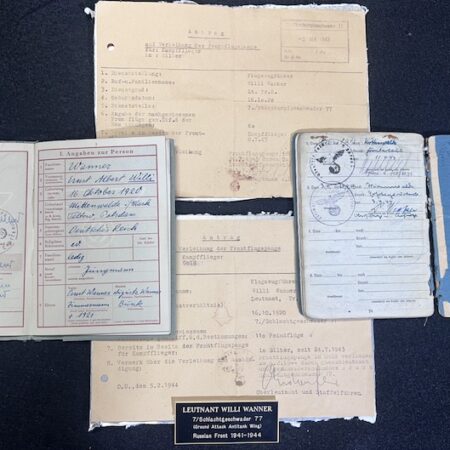
WWII Luftwaffe Stuka Pilot Oblt Wanner Soldbuch & Wehrpass Set – Ju 87 D-5 – 189 Missions! – Missing in Action – FFS Gold – Ultra Rare (Sold)
We lately got in a set of nice documents, coupled by the former collector with original awards. Although they were not the pilots awards and are offered here separately, we do not split groups that belong together. Oberleutnant Will Wanner Born in 1920, he was enlisted after volunteering in the Luftwaffe in 1940. He went though almost three years of schooling on the Stuka before joining his Stuka unit in December of 1942. Wanner served with III/ Sturzkampfgeschwader 77 1943 SG 77 seen extensive action on the Eastern Front. By 20 December 1942 III./StG 77 had only seven serviceable dive-bombers. III./StG 77 lost 29 ground crew on the retreat from Rossosh to Kharkov. It probably took part in the air battles but was decimated and withdrawn to Würzburg. It was rebuilt with 37 Ju 87s and 245 officers and sent to Luftflotte 2, II. Fliegerkorps. The group moved to Cagliari, but was not to be used until the Allied invasion of Sicily (Operation Husky). In the event, the airfields were so badly damaged on the island it was ordered to return to IV. Fliegerkorps on 27 April 1943 On 8 July, StG 77 supported the Großdeutschland against the fortified village of Syrtsevo. StG 77 lost five Ju 87s and another damaged in combat with the 240 IAP. The air corps claimed, with contributions from SG 1, 84 Soviet tanks destroyed, 21 damaged, 40 vehicles destroyed, and five artillery pieces along with two anti-aircraft guns and two rocket launchers. By the evening of 8 July, 16 dive-bombers had been lost. The Germans halved the amount of Stuka sorties over the ensuing days. On 11 July, 9./StG 77, under III./StG 77 lost another five Ju 87s as it supported attacks against the 69th Army. The 183 IAP were their attackers. In the afternoon, 50 Ju 87s supported the 1st SS Panzer Division Leibstandarte SS Adolf Hitler’s attack on Hill 252.2. On 12 July StG 77 was involved in the Battle of Prokhorovka. While the Ju 87s could only fly 150 sorties in support, but with StG 2 the attacked with great success against Soviet armour advancing in the open. The 31st Tank Brigade, of the 29th Tank Corps, suffered heavy casualties. The 36th Tank Brigade’s commander was wounded by aircraft when his tank was destroyed. On 14 July, another six Ju 87s were lost supporting the XXXXVIII Panzer Corps The German offensive continued in the southern sector, but Operation Roland failed and the Red Army took time to begin the counter offensive, Operation Polkovodets Rumyantsev. Soviet forces slowly pressed the Germans back. On 19 July 7./StG 77 was wiped out by a Soviet attack on the base at Kramatorskaya and 4./StG 77 lost another three to Soviet fighters. At the beginning of August 1943, the Soviet summer counter offensives began. StG 77 lost 24 dive-bombers and 30 damaged between 5 and 31 July 1943. Their losses from July to December 1942 were just 23. The Stuka arm had also lost eight Knight’s Cross of the Iron Cross holders—Karl Fitzner of 5./StG 77 was one of them; he was shot down and killed on 8 July.III./StG 77 operated in the Kharkov and Belgorod sectors, after the fall of the latter on 5 August. From 6 to 12 August it lost four Ju 87s in combat and another three in the retreat to prevent their capture. On 17 August it was at Poltava, and the following day 7./StG 77 lost another four in combat near Sumy; four men were killed and two wounded. The group retreated to Stalino and lost another three on 2 and 3 September while 8. and 9. Staffel lost two Ju 87s near Kharkov on 5 September. Awards 4.12.1941 – Pilots Badge 8.7.1943 – Iron Cross Second Class 8.7.1943 – Front Flying Clasp in Bronze 26.7.1943 – Iron Cross First Class 24.7.1943 – Front Flying Clasp in Silver 6.2.1944 – Front Flying Clasp in Gold He flew a total of 189 Missions, according to the Luftwaffe Officer Lists he was shot down by Anti Aircraft Fire over Bialystok. WANNER, Willi. 01.06.44 promo to Oblt./A1. 27.07.44 Oblt., 7./SG 77 MIA – Ju 87 D-5 (S2+CR) shotdown by AA vic Bialystok. According to the German War graves online archive he was never buried… The both Certificates for the Front Clasps are attached to a card by the previous collector. Condition is as photographed.
-
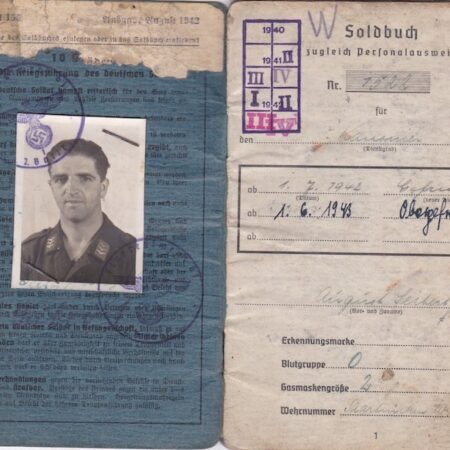
Original WWII German Luftwaffe Soldbuch – Obergefreiter August Seibert – Flak Regiment 61 (mot) – Eastern Front Medal – Black Wounds Badge
Seibert was born in November 1910 in Saarbrücken, Germany His Soldbuch was issued in May 1941. Served with: 1941 – 8.1942 with : Flak Ersatz Abteilung 6 4.1943 – 3.1944 – Flak Regiment 19 – In Southern Russia and Ukraine. 3.1944 – April 1945 – Flak Regiment 61 (mot) – Fought in South East Germany at the end of the war. Issued Equipment Camo Jacket (Tarnjacke), K98 Rifle – a few times Medals/Awards Trade Badge for Drivers – 1943, Eastern Front Medal – 1942, Black Wounds Badge – September 1943. He was lightly wounded in Ukraine, and seems stationed in Kyiv. Remember all our items are sold with shipping included!
-
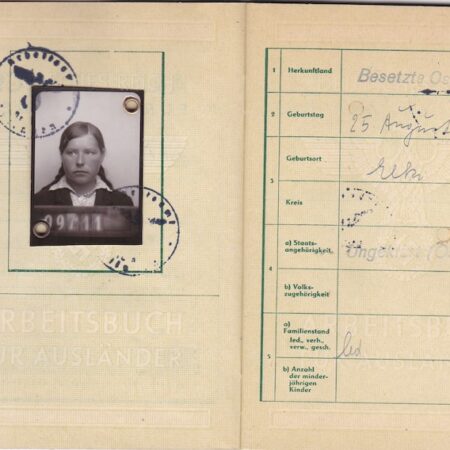
WWII German Arbeitsbuch Für Ausländer – Anastasia Starolowa – Gebrüder Hartkopf Bayonet Maker in Solingen Germany – Company still exists!
Interesting Work book for a young lady from Belarus, Gomel area. She was put to work in the Hammerwerk (Hammer Work Area) of the Bayonet Manufacturing plant of Gebrüder Hartkopf in Solingen, Germany. Interestingly, the the company is still in operation!


