Website Updated: 23.02.2026 - FREE World Wide Shipping - Lifetime Guarantee on Originality!

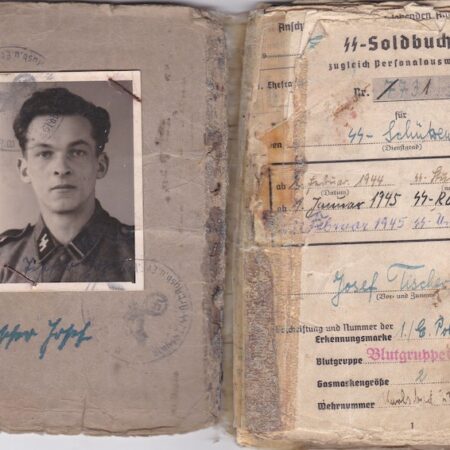
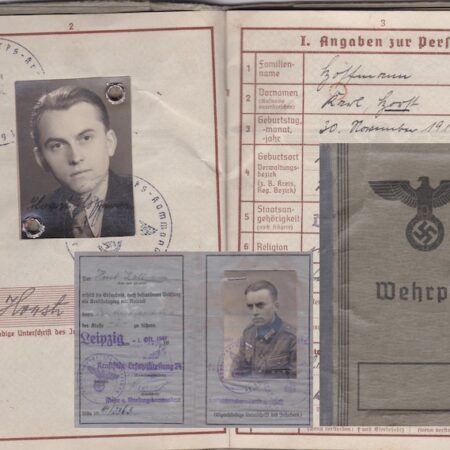
  • Original Waffen-SS Soldbuch Grouping - SS Unterscharführer Roland Huy-Prech - SS-Freiwilligen-Gebirgs-Jäger-Regiment 14 „Skanderbeg“ - 7 SS Division Prinz Eugen - RARE! (Reserved)

    Original Waffen-SS Soldbuch Grouping – SS Unterscharführer Roland Huy-Prech – SS-Freiwilligen-Gebirgs-Jäger-Regiment 14 „Skanderbeg“ – 7 SS Division Prinz Eugen – RARE! (Reserved)

    Very interesting and rare SS Soldbuch set to a unit hardly ever seen on the market. SS Soldbuch and Drivers licence issued to Roland Huy-Prech, who was a driver and technical NCO in the Stab of two Prinz Eugen GJ Regiments! Frontline units: July 1942: SS Gebirgsjäger Regiment 2 – Stabskompanie 1944/1945: SS-Freiwilligen-Gebirgs-Jäger-Regiment 14 „Skanderbeg“ Although the division was designated a “volunteer” division, very few of its men were actually volunteers. Rather, the Banat region had been declared German territory, and the men had been drafted into the Waffen-SS. The division’s equipment consisted largely of captured French, Polish, Czech, and Yugoslavian weapons and equipment. The division’s formation was completed in October 1942. It comprised 11,000 ethnic German volunteers, 22,000 ethnic Germans from Romania, 2,500 ethnic Germans from Croatia, and 2,000 Reich Germans as cadre personnel. That same month, the division was transferred to the area of Užice-Čačak-Novi Pazar-Mitrovica. On October 12, 1942, the division saw its first action against partisan units in the Kopaonik Mountains. This initial engagement, however, was largely unsuccessful. In December 1942, orders were issued to transfer to the Zagreb (Agram) area. On December 31, 1942, the division had a strength of 411 officers and 19,424 non-commissioned officers and enlisted men. In January 1943, the division, advancing from the Karlovac area towards Slunj, participated in a major operation against partisan groups in western Bosnia, targeting Bihac. This operation, codenamed “White,” also involved the 369th, 717th, and 714th Infantry Divisions. The Italian 2nd Army contributed three divisions. On January 27, 1943, the division occupied Bihac. The advance then continued on both sides of the Bihac-Bosn. Petrovac road. The division then marched south via Drvar to Bosn. Grahovo. Hindered by heavy snowfall, Drvar could not be occupied until February 27, 1943. Tito had fled the town the day before. The division assembled here until March 3rd and then attacked Bosn. Grahovo. Mostar was reached on March 15th, where the division concluded Operation White. No major operations took place in April 1943. From May 15th, 1943, the division participated in Operation Black, in which the 1st Mountain Division, the 104th Jäger Division, the 369th Infantry Division, and two Bulgarian regiments also took part. During the operation, which lasted until June 15th, there was heavy fighting with partisan units. After the operation’s conclusion, the division marched into the area north and east of Sarajevo. In July 1943, the General Command of the V SS Mountain Corps was formed from elements of the divisional staff. After some minor anti-partisan operations, the division was transferred to Herzegovina at the beginning of August 1943, with its headquarters in Mostar. Following the Italian surrender, the division received orders on September 9, 1943, to occupy the Dalmatian coast, which was largely occupied by Italian troops. The 2nd SS Volunteer Mountain Infantry Regiment was ordered to capture the strategically important city of Ragusa (Dubrovnik). Since the Italian VI Corps stationed there refused to surrender the city, the regiment was forced to capture it after a German air raid on September 12. On October 22, 1943, the division’s units were numbered. The division was now designated the “7th SS Volunteer Mountain Division ‘Prinz Eugen’,” and the mountain infantry regiments were designated “SS Volunteer Mountain Infantry Regiments 13″ and 14.” The remaining divisional units also received the number 7. From October 23rd, the division participated in Operation “Autumn Storm.” The reinforced SS Volunteer Mountain Infantry Regiment 13 was tasked with occupying the islands of Brač, Hvar, Korkula, and the Pelješac peninsula. The fighting on Pelješac, in particular, resulted in heavy losses on both sides. While this fighting continued, the reinforced SS Volunteer Mountain Infantry Regiment 14 was assigned to Operation “Landsturm” (Home Guard). The objective was to liberate the coastal strip between Split and Metković from partisans. After little success, the operation was called off in mid-November 1943. On December 2nd, 1943, the division then participated in Operation Operation “Kugelblitz” (Lightning Bolt) was launched. In cooperation with the 1st Mountain Division, the 369th Infantry Division, the 187th Reserve Division, and the Bulgarian 24th Infantry Division, three divisions of the Yugoslav People’s Liberation Army were to be destroyed in eastern Bosnia. Advancing from the southwest, the division marched via Gorazde into the area east of Sarajevo. On December 7th, it met up with the 1st Mountain Division near Gorazde and attempted to encircle the Yugoslav forces in the area of Zvornik – Priboj – Plevlja – Gorazde – Sarajevo. However, the Yugoslav units managed to break through and escape near Han Pijesac during the night of December 15th, 1943. The operation was then called off. On December 18th, 1943, Operation “Schneesturm” (Snowstorm) followed. to destroy the escaped partisan units. Heavy fighting and enemy counterattacks ensued, forcing the division to abandon this operation as well. As of December 31, 1943, the division had a strength of 21,102 men, exceeding its authorized strength by over 2,000. At this time, the division was located in the area north of Mostar. On January 4, 1944, Operation “Waldrausch” (Forest Frenzy) began, aimed at destroying the partisan groups west of the Bosna River. During this operation, on January 6, 1944, the 1st Battalion of the 13th SS Volunteer Mountain Infantry Regiment was completely destroyed. The exhausted division was briefly transferred back to Dalmatia at the end of January 1944, to the Ragusa-Split sector, and then, at the beginning of March 1944, to the area east of Sarajevo. On March 28, 1944, elements of the division were driving partisans through the towns of Otok, Gruda, and Dolac gathered the villagers in the village squares and murdered them. The likely trigger for the massacre was the Ustaša government’s plans in Zagreb to resettle ethnic German inhabitants of Slavonia. The murders were thus an act of revenge by the ethnic Germans against their Croatian allies. On April 26, 1944, Operation “Maypole” began. Its aim was to prevent Yugoslav units from crossing the Drina River into Serbia. The operation ended in mid-May 1944 with heavy losses for the Yugoslav…

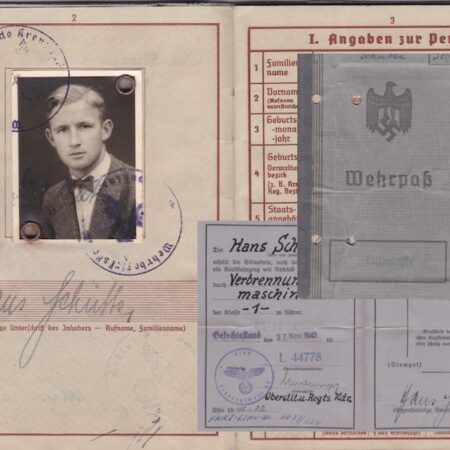
  • WWII Wehrmacht Soldbuch - Gefreiter Alfred Unsinn - Child Soldier 16 Years Old - Belfort Gap France 1944 - 159 Infanterie Division

    WWII Wehrmacht Soldbuch – Gefreiter Alfred Unsinn – Child Soldier 16 Years Old – Belfort Gap France 1944 – 159 Infanterie Division

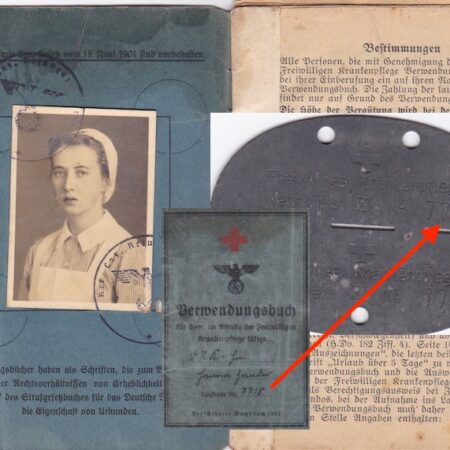
    Alfred Unsinn was born in August 1928 and was called up for duty at a very young age in 1943. In 1944 he was only 16 years old! Served with: Leichte Reserve Artillerie Abteilung 9  In December 1943 they were stationed in La Valbonne, France. Fought under: 159 Reserve Division / 159 Infanterie Division On January 8, 1944, the division was transferred to southern France and deployed to protect the Atlantic coast. After the Allied landings in southern France, the division retreated to Belfort, suffering heavy losses. Other details from the Soldbuch: Signature on Page 3 – 4. Batterie, Batterieführer, Oberleutnant Günther Nostitz It seems he was likely captured, the last entries are June 1944 and I was unable to find any references to him online. Given the fact the Swastica is removed it is a sign he may have been captured.

  • WWII Wehrmacht Soldbuch - Gefreiter Theodor Fischer - Grenzwach Regiment 46 - Siege of the Belgian Fortress Aubin-Neufchâteau 1940 !

    WWII Wehrmacht Soldbuch – Gefreiter Theodor Fischer – Grenzwach Regiment 46 – Siege of the Belgian Fortress Aubin-Neufchâteau 1940 !

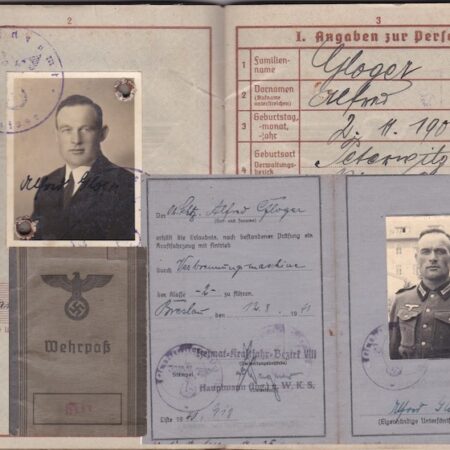
    Gefreiter Theodor Fischer from Richterich (Aachen) Germany, born in 1912 – in his civilian life he was a Miner! Soldbuch was issued in September 1939 with: Grenzwacht-Regiment 46 Unit was made up of Border troops from the Aachen area and took part in the Siege of the Belgian Fortress Aubin-Neufchâteau which was one of the forts in the Position Fortifiée de Liège (Festung Lüttich). During the 1940 Belgian campaign, Grenzwacht-Regiment 46 was known for its role in the brutal siege of the Fortress of Aubin-Neufchâteau, one of the forts in the Liège fortified position. After the fall of Fort Eben-Emael, Fort Aubin-Neufchâteau held out for eleven days against a massive German assault, including artillery, air attacks, and infantry assaults, before surrendering on May 21, 1940, due to exhaustion and lack of ammunition. The German forces, particularly the airborne troops, used a combination of glider landings, explosives, and flamethrowers to overcome the defenses, but the garrison’s valiant resistance impressed the attacking forces. Served also with: Radfahr-Bataillon 404 of the 263. Infanterie-Division in occupied Norway, and Radfahr-Abteilung 30 of the 30. Infanterie-Division. Until sometime in 1944 when he contracted some sort of stomach/intestine complains and was sent to various replacement units till the wars end.  Soldbuch comes with his NSDAP Gesundheitspass which was in the rear of the Soldbuch.  

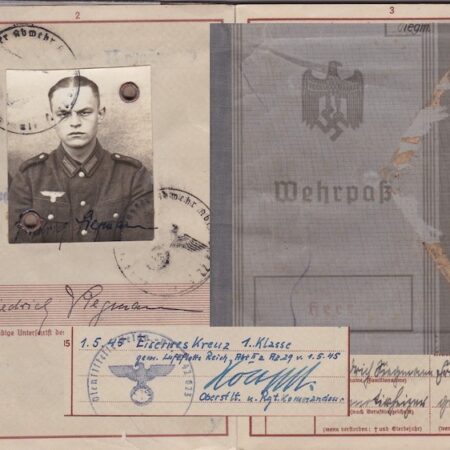
  • WWII Wehrmacht Soldbuch - Obergefreiter Heinrich Bosbach - Ost Batl 618 (Russisch) 15th Armee in Pas de Calais - Destroyed in Normandy 1944 - Rare!

    WWII Wehrmacht Soldbuch – Obergefreiter Heinrich Bosbach – Ost Batl 618 (Russisch) 15th Armee in Pas de Calais – Destroyed in Normandy 1944 – Rare!

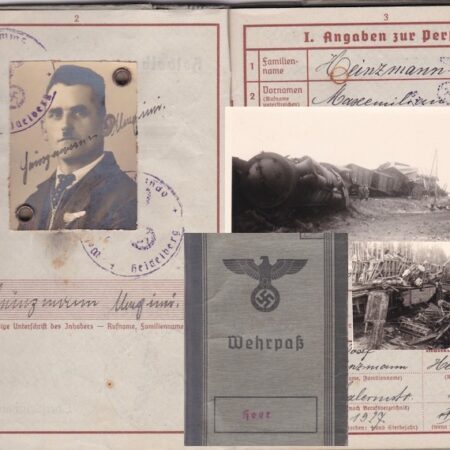
    Here we have a rather beat up but original Soldbuch to a really hard to find Westfront unit… Issued to Heinrich Bosbach who served with various Festung and Pioneer Units, until his deployment in 1944 with a rather rare unit! He was also awarded the War Merit Cross with the Ost Batl 618 in France in April 1944 (LXXXII Armee Korps).  Ost Batl 618 (Russisch) –  15th Armee In the winter of 1943/44, most of the Ost battalions were detached from their divisions and corps and transferred to France after the Commander-in-Chief West had freed up corresponding German battalions for deployment on the Eastern Front. Some battalions went to Italy and Denmark. In the spring of 1944, most of these battalions were fully integrated into German regiments, partly as replacements for the detached battalions, partly as 4th Battalions. The Eastern Front battalions were mostly deployed in fortified positions along the English Channel, the Atlantic coast, or the Mediterranean coast. In the winter of 1944/45, the remnants of the battalions, most of which had been destroyed in France, were gathered at the Münsingen training area and used there to form Vlasov’s Russian Liberation Army (ROA). Ost Batl 618 was attached to the 15th Armee in Normandy where it was destroyed according to the Lexicon der Wehrmacht.  I am not sure what happened to Bosbach, although the Soldbuch is not in the best condition, loose and missing the back cover.  

  • WWII Luftwaffe Soldbuch - Unteroffizier Herbert Richter - Schwere Flak Abteilung 231 - Iron Cross First Class / Flak Badge - 8.8cm Flak - Portrait Photos  - Oder 1945

    WWII Luftwaffe Soldbuch – Unteroffizier Herbert Richter – Schwere Flak Abteilung 231 – Iron Cross First Class / Flak Badge – 8.8cm Flak – Portrait Photos – Oder 1945

    Richter was issued his Soldbuch in September of 1939 with the then Reserve Flak Abteilung 231. He would serve the most of the war with: Schwere Flak Abteilung 231  In 1939, the unit was stationed in Dresden, in 1940 in Belgium, and in 1941 in France. In the summer of 1942, the unit was deployed in the Bremen area. In July 1942, the unit was renamed Heavy Flak Battalion 231.. From 1943 to 1945, the unit functioned as Flak Group Vechta. By 1945 they were sent to the Oder Front. They are responsible in 1942 for claiming the downing of RAF Aircraft that crashed in Holland – info can be found on the web.  He was awarded the Annexation Medal 1.10.1938, Iron Cross Second Class, Iron Cross First Class (not entered but he is wearing it in photos!), Flak Badge. A really neat little bit of paper at the front states that he was to get to his battery as soon aa any air raid was underway! His speciality was a Waffen Personal and he attended many courses as a Weapons Uffz!

  • WWII Wehrmacht Soldbuch Grouping - Uffz Paul Berenbaum - Born in France! - Incredible Story Buried Alive by US Artillery - Grenadier Regiment 713 - 416 Inf Div West Wall 1945  - Mortar Team Leader - Rare!

    WWII Wehrmacht Soldbuch Grouping – Uffz Paul Berenbaum – Born in France! – Incredible Story Buried Alive by US Artillery – Grenadier Regiment 713 – 416 Inf Div West Wall 1945 – Mortar Team Leader – Rare!

    Here we have a really tragic Soldbuch Grouping… Paul Berenbaum was born in Wallern (Vallieres Les Metz) France. He was enlisted into the German Army in February 1940. In 1940/1941 he served with:  Infanterie Regiment 178 – 76 Infanterie Division – On the Western Front then in Poland. In 1942 he served with: Infanterie Regiment 441 – 416 Infanterie Division They served in Denmark, more can be found here including the places in which they were posted: https://www.lexikon-der-wehrmacht.de/Gliederungen/Infanteriedivisionen/416ID.htm In 1943/44 he served with Landeschützen Regiment 930 shortly before being assigned to Grenadier Regiment 713 in late 1942/early 1943. But by late 1944 he was assigned to the Feld Ersatz Batl 476 – 416. Infanterie-Division Issued a MP40 Machine Pistol On October 11, 1944, the division established a command post in Keuchingen near Mettlach/Saar. After the start of the Allied offensive across the Moselle on November 9, 1944, elements of the division were deployed in the ensuing defensive battles around Freching and Kerling. On November 17, 1944, the division’s command post was located in Tünsdorf, on November 18 in Orscholz, and on November 19 in Trassem. On November 28, the division headquarters was in Taben, and on December 3 in Taben-Rodt. On December 4, 1944, after a month of defensive fighting, the division still had a combat strength of 2,400 men, of whom 1,550 were infantry. Heavy fighting ensued around the West Wall, followed by a retreat to the Mettlach area and the Orscholz ridge. On January 14, 1945, the division still had a strength of 3,016 men. In the following weeks, the fierce defensive battles continued at the Orscholz ridge/Saar-Moselle triangle. Between February 7 and 28, 1945, the division suffered 2,195 casualties. According to his wounding tags, he was delivered on the 15.1.1945 in St Wendel with a suspected broken bone from being stuck/squeezed. According to a rather rare (never seen before) Soldbuch Paper which was to be put into the Soldbuch given by the main aid station (Hauptverbandplatz): “Verschüttet durch Artillerie einschlag mit Bewusstlosigkeit; kein erbrechen rechten unter arm eingequetscht”  “Buried by artillery fire, unconscious; no vomiting, right arm crushed” After being examined the Doctor found his right arm was broken at the elbow, and he was suffering from concussion. He was transferred to Bad Wimpfen where he was to rest according to another piece of paper issued by the Hospital, although he would get a Telegram from his Wife that his relative Hilde was killed during an allied bombing raid on the 4th of March 1945. He would spend till the 28th of May 1945 in hospital recovering, before going into a POW Camp Nr 172 in Vernet d Àviege which was in fact a former Concentration Camp. https://en.wikipedia.org/wiki/Camp_Vernet Two Letters sent by his friend Julius Niggemann in 1947 read: My dear Paul! Warmest greetings from Julius. I hope you are in good health. When will you finally come home? Considering the circumstances, we hope that the situation in Germany will soon improve. I wish you all the best and a speedy return home – your Julius! My dear Paul! With heartfelt thanks I received your kind lines. I am glad to hear that you are still healthy and in good spirits — as far as I can say, I am as well. During my last visit to Düsseldorf, I unfortunately learned of the death of your dear wife. You must come to terms with this sad fact, however difficult the loss must be for you. I do hope now, with confidence, that you will soon be released. It truly is about time that our authorities finally come to that realization as well. Düsseldorf looks desolate, and yet, despite everything, new life is springing up from the ruins again. I am always amazed at how people manage to carry on with life. For today, I wish you all the best. Stay healthy and in good spirits until we can have a joyful reunion back home. Your ever-thoughtful friend. It seems his wife Thea Berenbaum died in December of 1945.  Lastly a letter dated 18.6.1948 to the now released Paul Berenbaum living in the British Zone of Germany in Munster / Westfalhen shows that he made it out alive. Last comments His story is a tragic story, from being buried alive in combat and miraculously being pulled from the rubble unconscious, loosing family by bombing raids and later his wife whilst he was interned in a former Concentration Camp. A horrible time he experienced, one can only hope he lived peacefully after the war.

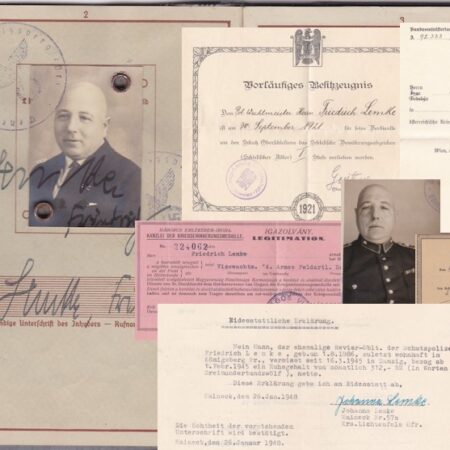
  • WWII German Wehrmacht Wehrpass KIA Grouping -Oberfeldwebel Pflüger - Saar Offensive 1939 Action Report -  IR81 WIA France 1940 - Black Wounds Badge Certificate Le Hamal (Rare version!) Streifendienst - Grenadier Regiment Lublin

    WWII German Wehrmacht Wehrpass KIA Grouping -Oberfeldwebel Pflüger – Saar Offensive 1939 Action Report – IR81 WIA France 1940 – Black Wounds Badge Certificate Le Hamal (Rare version!) Streifendienst – Grenadier Regiment Lublin

    Interesting little grouping to Oberfeldwebel Pflüger Very interesting and unusual entry is that in September of 1939, he took part in the battle known as the Saar Offensive – when France invaded the Saarland in 1939!! “During a reconnaissance operation carried out by the 9th Company on 27 September 1939, despite difficult circumstances (captured prisoners, heavy rain, and several French soldiers put out of action), the mission was successfully completed. Through exceptional prudence and execution of the operation, it was possible to achieve success with minimal own losses.I express my recognition to the leader of the reconnaissance patrol” He was fighting in France with Infanterie Regiment 81, and was injured in a battle with French Soldiers in Le Hamal in June 1940. Medals: West Wall Medal, Iron Cross, Wounds Badge in Black He would serve in various other units including Streifendienst! Not often seen! He was later killed in action with Grenadier Regiment Lublin in Poland 1944. Final Comments The fact that he was involved in operations in September 1939 makes this grouping one of a kind, not many units actually took part in the fighting during the Saar Offensive, but having the typed letter naming him surely makes this quite a desirable item.

  • Original WWII German Wehrmacht - Soldbuch Gefr Adolf Edelkraut - Wounded in France July 1944 - 159 Reserve Division - Grenadier Regiment 74 - 19 VGD - Shot in Stomach -  US 44th Infantry Division - Germany 1945

    Original WWII German Wehrmacht – Soldbuch Gefr Adolf Edelkraut – Wounded in France July 1944 – 159 Reserve Division – Grenadier Regiment 74 – 19 VGD – Shot in Stomach – US 44th Infantry Division – Germany 1945

    Soldbuch issued to Adolf Edelkraut born in Duisburg in 1907. Reserve Grenadier Batl 57 As part of the 159 Reserve Division they were stationed near Bordeaux France. On January 8, 1944, the division was deployed to southern France and deployed to protect the Atlantic coast. After the Allied landings in southern France, the division withdrew to Belfort, suffering heavy losses. Edelkraut was wounded with a Grenade Splinter (Soldbuch Code 31b) and delivered to hospital in Dax, France. Grenadier Regiment 74 – 19 Volks Grenadier Division In Early 1945, after healing he was deployed once again. January 3, 1945, the division was suffering heavy losses. The following weeks were characterized by hard fighting and hesitant resistance. On January 13, the division still had a combat strength of 1,500 to 2,000 men. After the costly retreat, the divisions of the XIII SS Army Corps were in the defense between Saarbrücken and Bitsch. No decisive fighting took place until the end of January 1945. Priority was given to the development of field positions and the reinforcement of the West Wall. On February 6, 1945, the US troops began a local attack against the right wing of the already severely weakened 19th Volksgrenadier Division. During these attacks, the US troops were able to capture the Blies Heights near the town of Saarguemines. The division was able to hold the remaining positions in front of the West Wall, but shrank to the strength of a weak divisional combat group. On March 15, the main attack by the American forces took place on a broad front against the West Wall. The defensive strength of the 19th Volksgrenadier Division declined rapidly, and the division was thrown back to the West Wall. On March 19, the division received orders to disengage from the front line with the remaining remnants and return to the Kaiserslautern area. In the following days, the remnants of the division were again dispersed. On March 24, it still had a strength of 400 men. On March 26, 1945, the division was officially disbanded. All that remained was the division headquarters. The remaining elements were combined into a combat group and assigned to the 2nd Mountain Division. At the beginning of April 1945, the remnants of the combat group were south of Dörzbach on the Jagst River. On April 21, the remnants of the combat group withdrew from the Crailsheim area toward Dinkelsbühl. From here, they continued toward Gingen an der Brenz. Here, their trail ends. More info: As the Allied counter-offensive against Operation Nordwind gained ground they were pushed by the US 44th Infantry Division. They fought alongside in February, then absorbed in March, the 340. Volksgrenadierdivision. The division was disbanded on 26 March 1945 in Waldangelloch, Bavaria, Germany and units were parcelled out to reinforce other units. It seems he was captured by US Forces, was badly wounded with a bullet wound in the stomach. He was quarantined due to the fact he had Typhus, and another bout of Malaria which he already had in 1943. As well as a back injury.   He was released in the summer of 1946 and told to return home according to the Doctors Papers. His brother was killed in Normandy in 1944  – Wilhelm Edelkraut.

  • Original WWII German Luftwaffe Soldbuch - Kanonier Heinrich Helmecke - Flak-Ersatz-Abteilung 12 - Berlin 1945

    Original WWII German Luftwaffe Soldbuch – Kanonier Heinrich Helmecke – Flak-Ersatz-Abteilung 12 – Berlin 1945

    Soldbuch issued in August 1943 to Kanonier Heinrich Helmecke. He was serving with – Schwere Flak Ersatz Abtlg 36  In 1944 his unit was stationed in Berlin: Schwere / Flak-Ersatz-Abteilung 12 1941/42 converted to schwere Flak-Ersatz-Abteilung 12. In 6.42 divided into: Flak-Ersatz-Abteilung 12 in Berlin-Lankwitz Flak-Ausbildungs-Abteilung 12 in Berlin-Lankwitz Service: 8.39 – 9.40 in Berlin-Lankwitz under Luftgau-Kommando III 9.40 – 8.41 in Berlin-Lankwitz under Kommandeur der Flakersatzabteilungen beim Luftgau III 8.41 – 5.45 in Berlin-Lankwitz It would seem this Soldbuch was outside for sometime, is it that he was KIA or Lost it? I was unable to find any definitive answer to this. 

×