Showing 586–594 of 1271 resultsSorted by latest
-

WWII German Soldbuch – Oberfeldwebel Vaupel – Panzer Aufklärungs Abt 122 (Panzerspäh-Kompanie) – 22 Infanterie Division – Holland 1940 – Greece/Kreta 1941 – Kurland 1945 – 6 Medals – Close Combat Days (Lay Away)
Soldbuch Issued to Günther Vaupel in August of 1939. Vaupel was from Görlitz and was a painter in his civil profession, he was not married. Panzer Aufklärungs Abt 22 (22 Infanterie Division LL ) At the end of October 1939, the division was transferred to the Sennelager military training area to be trained for airborne operations. At the beginning of the western campaign, the division was used as part of the 7th Flieger-Division for airborne operations. The 16th Infantry Regiment landed in the Waalhaven area, the 47th Infantry Regiment in the Katwijk-Valkenburg area and the 65th Infantry Regiment in the Ypenburg area. During these operations, the division suffered heavy casualties. In June 1940 the division was transferred to St. Quentin and in July to the area northeast of Antwerp for refreshment. The division stayed here until December and then moved to the Stendal-Magdeburg area. In the winter of 1940/41. In April 1941 the division came to Ploesti to secure the Romanian oil fields. In June 1941, the division moved into its staging area northwest of Jassy in Romania. From here the division took part in the Russian campaign from July 2nd. The division crossed the Prut, in mid-July the Dniester south-east of Mogilev and in August the Dnieper at Berislav. The division then marched to the Sea of Azov, broke through the Perekop Isthmus to Crimea and took part in the first attacks on the Sevastopol fortress. The division was then transferred to security tasks in the eastern part of the Crimean Peninsula. From January to April 1942, the division was in trench warfare in front of Sevastopol and from May 8 took part in the battles to regain the Kerch Peninsula. In June she took part in the storming of Sevastopol. After the end of the fighting, the division was transferred to Greece and refreshed in the Athens and Salonica area. By order of the General Army Office of July 29, 1942, the division was to be reorganized for airborne use and received the additional designation (L.L. motorized trop.). There were also reclassifications in the units. On October 1, 1942, the airborne use was lifted again. The division has now been reorganized for use in Crete. Later Panzer Aufklärungs Abt 122 (122 Infanterie Division) It seems that towards the end of 1944, Vaupel is in Kurland, Latvia. His unit is developed in some of the heaviest fighting in Kurland, around the Saldus (Frauenburg) area. Parts of the unit were sent to the Cieceres Lake West side according to Lexicon der Wehrmacht. Interestingly, Vaupel was in the Panzerspäh Company, these would have had Sdkfz 221/222 Armoured Recon Vehicles. It is unknown what happened with Vaupel, he is not recorded as killed in action. Equipment/Issued: Issued K98 Rifle, Italian Pistol, Compass, Saw and Lamp. Other remarks: Found Fit for tropical service, Eye inspection in Kreta, Awards: Iron Cross Second Class General Assault Badge . 1941 Wounds Badge in Black – Jan 1942 War Merit Cross with Swords – July 1942 Eastern Front Medal – July 1942 Krim Campaign Sheild – March 1943 Close Combat Days in Southern Russia : 18.9.1941 – Rodionowka 28.10.1941 – Ongernay 1.11.1941 – Bachtshissaraj Signatures: There is a detailed list of the officers here. Could be matched to a nice signature in the Soldbuch : https://www.historic.de/Militar/22.%20ID/AufklAbt22/AA22Main.htm Final Comments: A super Soldbuch for Panzer Recon, these are really hard to find. He seen around, Holland in 1940, Greece and Crete, then to Russia, and finally to Latvian territories for the final battles of WW2 in the Kurland Pocket. A very nice Soldbuch, from a desirable unit, something for the real advanced Panzer Recon Collectors. Super photo in the Soldbuch in Tropical Gear. Vaupel is not listed as KIA or MIA. Although his Soldbuch drops off around March 1945.
-

WWII German Soldbuch Grouping – Hauptmann Eigner – Tank Commander – Panzerjäger Abl 543 – Jagdpanzer IV – Iron Cross First Class – Attempt for Budapest Breakout 1945 – Ultra Rare (Sold)
Soldbuch issued to Officer Cadet Dr Helmut Eigner in September 1939 with: Infanterie Panzer Abwehr Ersatz Kompanie 3 – Infantry replacement unit, Tank Destruction His first deployment was with: Panzer Abwehr Kompanie 188 – Panzerjäger Abt 188 (88 Infanterie Division) He was awarded his EK2 for actions in France June 1940. In mid-May 1940, the division moved to the Trier area as an OKH reserve and marched from there from May 16, 1940 through Luxembourg and northern France to the Marne. On June 12, 1940, the division experienced its baptism of fire when crossing the river in the Dormans – Trekop area. The division then pursued the retreating French units to the Loire. After the end of the western campaign, the division remained on the Loire in the Bourges area until July 1 and then returned home. He then was redeployed with: Schnelle Abteilung 296 / Panzerjäger Abt 296 (296 Infanterie Division) There is a large divisional history on this unit here: https://www.lexikon-der-wehrmacht.de/Gliederungen/Infanteriedivisionen/296ID.htm They fought in Southern Russia, Ukraine, and were destroyed there in 1944 in the Bobruisk area. Panzerjäger Abteilung 543 (Zerstörer Kompanie) – 3rd Panzer Division really nice company entry here, Zerstörer Company means the Tank destroying Company. According to the book, Days of battle by Szamveber. This unit was equip with 17 Jagdpanzer IVs In December 1944, the division at Army Group Center was refreshed and given new field post numbers. On December 10, the 3rd Panzer Division was moved south again to western Hungary near Székesfehérvár. From January 18, 1945, she took part in the unsuccessful relief attack for the enclosed Budapest. After Operation Spring Awakening, which had started in February and was also unsuccessful, the division withdrew to Austria, where it surrendered on May 8, 1945 and was taken prisoner of war by the Americans. Awards: Iron Cross Second Class – June 1940 – France August 1942 – Wounds Badge July 1942 – Eastern Front Medal March 1943 – Iron Cross First Class April 1943 – General Assault Badge April 1945 – War Merit Cross with Swords – Second Class (3 Panzer Division) Close Combat Days September 1941 – Kyiv Ukraine March 1942 – Attack Troops on Hill 26012 Award Certificates: Iron Cross Second Class – France, Passy Crigny – Signed Knighs Cross Winner – Friedrich Gollwitzer (27 April 1889 – 25 March 1977) Iron Cross First Class – Divisional HQ – Knights Cross with Oak Leaf – Arthur Kullmer (17 August 1896 – 28 March 1953) Eastern Front Medal – 296 Pz Jäger – Signed by Major and Abt Commander. General Assault Badge – 296 Pz Jäger – signed by Captain i.v Wounds badge in Black – Signed again by Major and Abt Commander Other Documents: Happy Christmas – Hand Drawn from Company in 1943 Hand Drawn invite to a event organised by the unit Final Comments: Extraordinary! This is a top shelf for any real advanced Panzer Collector, the Jagdpnazer IV was an extremely rare Tank Hunter. It will be hard to beat this Soldbuch Grouping if your after any tank Hunters. Note the amazing photo of Eigner in his Panzer Wrap Uniform and his Iron Cross on display, a pretty amazing imagine.
-
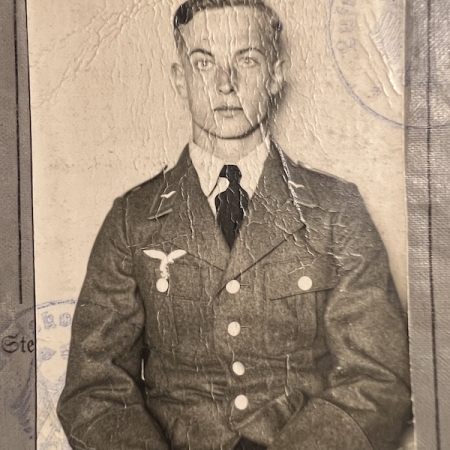
WWII German Luftwaffe Drivers Licence – Fliegerhorst Fassberg – Flieger Freudenberg – Halftack Licence (Sold)
A not so often seen style of military drivers licence, showing Freudenberg dressed in Luftwaffe Uniform. It was issued prewar but used throughout. Started with a normal car licence, then processed through to HalfTrack (10 ton) and Fully Tracked till 15 Ton. Another interesting entry, is that he is permitted to drive a vehicle with a Wood Burning Engine.
-

WWII German Army – Wehrmacht Drivers Licence – Fliegerhorst Halberstadt – Walter Zeller (sold)
Original Wehrmacht Drivers Licence for a Car. Issued to Walter Zeller, uniformed photo shows him in the ReichsPost Uniform.
-

WWII German Soldbuch – Oberstleutnant Clarenkamp von Stenkhoff – Sicherungs Batl 356 – Croatia 1944 – Captured in the West
Soldbuch issued in August 1939 to Carl Clarnekamp von Stenkhoff from Hannover. He was born in August 1899. He was married to Hildgegard born Neuhaus. He served in the following units: Mostly providing protection to rail infrastructure and security tasks. Sicherungs Batl 265 – Page 19 – States he was in the last two units in 1944/45 Landeschuztzen Btl 925 – Popvaca 1945 – Croatia Sicherungs Batl 356 – 1945 – Deutscher Eisenbahn-Sicherungs-Stab Kroatien – More can be found here on the unit movements in the later part of the war. https://www.lexikon-der-wehrmacht.de/Gliederungen/SichBat/Gliederung.htm He only had one award, the War Merit Cross With Swords in January 1944. He was captured by allied soldiers and given a prisoner of war number. Final Comments: A little water damage through the book, although it is for a rather senior officer with a very fancy name.
-
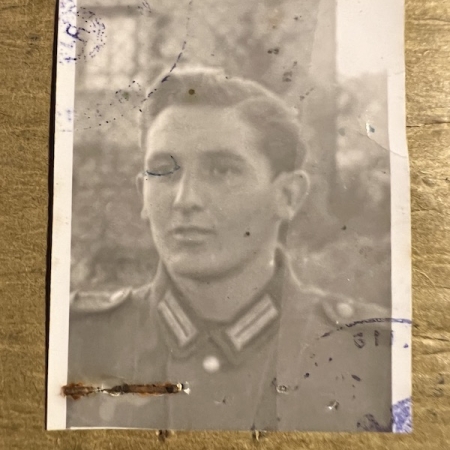
WWII German Soldbuch – Gefreiter Bauer – Grenadier Regiment 116 (9 Inf Div) – Machine Gun Team – 19 Volks Grenadier Division – West Wall 1945 – Fought against US Troops (Sold)
The Soldbuch was opened in July 1942, issued to Bauer born in 1923 in Gera District, Germany. He fought in many different units in a short period on the Russian Front. Res Inf Btl 205 – Infanterie Regiment 214 – MG Reserve Grenadier Kompanie 471 MG Reserve Grenadier Btl 388 – (Change of rank title: 2.1943) – Issued a Gewehr 24 T – A CZ Made and designed Mauser action rifle. Grenadier Regiment 116 – MG Kompanie – Wounded in September of 1943, Bauer was in Hospital till December of 1943. Grenadier Regiment 116 – MG Kompanie – But in April 1944, he was wounded once again this time a 31a, Infantry Bullet. He spent till August 1944 in recovery. Bauer woud only received the black wounds badge, although entitled to the silver grade for his second wounding. Divisions Fusilier Kompanie 19 – 1.1.1945 (Rank title change) – 19 Volks Grenadier Division 22.12.1944 – Iron Rations given out, 4.2.1945 – K98K Rifle Issued On February 6, 1945, US troops launched a local attack against the right wing of the already severely weakened 19th Volksgrenadier Division. During these attacks, the US troops were able to take possession of the Blieshöhen not far from the city of Saareguemines. The division was able to hold the other positions in front of the West Wall, but shrank to the strength of a weak divisional combat group. On March 15, the main attack by American forces took place on a broad front against the West Wall. The defenses of the 19th Volksgrenadier Division fell rapidly and the division was thrown back onto the West Wall. On March 19, the division received the order to disengage from the front with the remaining remnants and to go back to the Kaiserslautern area. In the days that followed, the remnants of the division were again crushed. On March 24 they still had a strength of 400 men. On March 26, 1945, the division was officially disbanded. The division staff remained. The remaining parts were combined into a combat group and sent to the 2nd Mountain Division. The remains of the combat group were in early April 1945 south of Dörzbach an der Jagst. On April 21, the remnants of the combat group left the Crailsheim area in the direction of Dinkelsbühl. From here we continued in the direction of Gingen an der Brenz. Here their trace is lost. Final comments: Interesting photo in this Soldbuch, not often do you see such backgrounds. Over all a less often met Western Front 1945 Soldbuch. I did not find him on the lists of KIA. Although it is highly likely he was a POW afterwards.
-

WWII German Army Wehrpass – Obergefreiter Wylezik – Grenzausweis – Wehrmacht Driver – Large Battle Calendar – Eastern Front Medal
$145.00Wehrpass issued to Ernst Wylezik, from Ratibor. He served in an Artillery Unit for the beginning of the war, but in 1941 he was transferred red to be a driver. KW Tansport Abt 353 According to his battle Calendar he fought in the following areas: 1. Poland 2. France 3. Russia 4. Ukraine Medals 1. Eastern Front Medal 2. Drivers Badge in Bronze 3. War Merit Cross with Swords This set comes with a Grenzauswiess, a rather odd document prewar to allow him to travel over the border. As well as some other small mixed documents.
-

WWII German Soldbuch – Uffz Meller – 34 Infanterie Division – Luxembourg / France 1940 – Captured by US Troops Rhine April 1945 – Infantry Assault Badge (On Hold)
Meller earned the following awards: Wounds Badge in Black – 12.1941 Infantry Assault Badge in Silver – 15.3.1942 He served with Infanterie Regiment 107 – 34 Infanterie Division After minor battles in the apron, the division was relocated to the Eifel at the turn of the year 1939/1940. At the beginning of the western campaign on May 10, 1940, the division crossed the Our at Wormeldange and occupied the city of Luxembourg. Then the division turned away via Longwy-Dudelingen and remained here as flank protection in front of the Maginot Line. During the second phase of the campaign, the “Battle of France”, the division fought its way to the Aisne, forced the river crossing at Guignicourt and stormed eastwards from Reims to the Marne and then to the Loire to the Allier. After the armistice, the division secured the demarcation line and, in July 1940, moved to the area south-east of Boulogne as an occupying force. In September 1940, the division then moved to the coastal defense on the Channel coast. In December 1940, the third battalions were given up for re-establishments and replaced. At the end of May 1941, the division was transported to Poland by rail and prepared for the Russian campaign before Brest-Litovsk. On June 22, 1941, the division broke through the border fortifications south of Brest-Litovsk and then advanced across the Berezina to the Dnieper south of Mogilev. Subsequently, the division crossed the Ssosh, and then in early September, north of Bryansk, the Dessna. From October 1941, the division took part in the advance on Moscow and the occupation of Bryansk. This was followed by the advance to the Ugra in the Torvakowo area and further via the Protva and the Nara to the Tarutino area in the Maloyaroslavets area. Here the division met the Russian counter-offensive, so that it had to retreat to the Schanja position west of Medyn after heavy defensive fighting. In November of 1941, Meller was hit with shrapnel in the left lung. by 1941 with Infanterie Regiment 256 / Grenadier Regiment 258 – 112 Infanterie Division The division was formed in December 1940 from elements of 34th Infantry division and 33rd infantry division, as part of the 12th wave of German mobilization. The 112th Infantry Division remained in OKH reserve during the opening phase of operation Barbarossa, and was committed to the southern wing in the second half of July during the battle of Smolensk. Here elements of the Soviet 21st Army had pushed back forward German elements and advanced up to 80 kilometers in to the German rear. At the beginning of August, the 112th division was manning defensive positions on the Army group’s southern flank, as part of 2nd Armies XII Corps. As Guderian’s 2nd Panzer group started its wheel from Smolensk to the south on 8 August, 2nd Army, on its right flank, was slow to join in because of poor weather, ammunition shortages, and the hesitancy of General Weichs, its Army commander. On 12 August the 2nd Army finally launched its attack south-east of Bobrusk. It broke through the defenses of the Soviet 21st Army, and in three days fighting, encircled the bulk of the soviet 63rd Rifle corps, in a pocket at Zhlobin. Lacking in mobile units, the 112th division, still part of XII Army Corps, formed the eastern pincer of the attack; breaking through successive defensive lines and eventually linking up with 267th Infantry division coming from the other way, near the village of Ljuschowskaja and the Saltanovka railway station, on the Zhlobin – Gomel rail line. Stretching a thin barrier across the Soviet Corps escape route, the 112th Division spent the next 3 days fending off repeated, and increasingly desperate escape attempts. By 20 August General Feldt’s 1st Cavalry Division had captured Gormel, and 2nd army tallied its accomplishments, totalling 78,000 prisoners, 700 guns, and 144 tanks; many of these from the Shobin pocket. The Soviet machine gunner covers attacking infantry near Tula, in November 1941 By the tail end of October the encirclement battles around Briansk were over, the 112th crossed the Oka river south of Belev, inching its way forward slowly through the mud. However the advance was breaking down due to deteriorating road conditions and supply difficulties. The long eastern flank of 2 panzer group was a problem, and Generaloberst Guderian shifted the 112th division as part of the LIII corps to his right to shore up the protection there. The division, redeploying to the region south of Tula, met forces from the Soviet 13th Army near Teploye, who were attempting to drive on Tula from the east and disrupt the German armoured thrust towards Moscow. The Soviets using the superior mobility of their cavalry units, delayed the LIII corps mission so much that Guderian had to reinforce it with tanks, artillery and flak, a move which slowed the whole advance of the Panzer Gruppe. With the aid of the reinforcements, the 112th infantry division drove the 13th Army forces off to the east and advanced towards Stalinogorsk. Here it was attacked by newly arrived Siberian 239th Rifle Division, supported by tanks, suffered a severe reverse, and showed ‘signs of panic’. [6] Unprepared for the winter conditions, each infantry regiment had already lost 500 men to frostbite, and in the severe cold, machine guns often failed to fire. The division was now very weak and unable to advance further. On 2 November 1942 the division was disbanded. Meller was attached to: Marsch Batl XII/3 – This unit saw combat in the Rhine area defences in April of 1945 in Germany. Under the XII Armee Korps. He was taken prisoner his allied western front issued POW Number 31G954902
-

WWII German Wehrmacht Soldbuch – Major Walther Bätz – Beobachtungs Abteilung 69 – Walther PPK – Iron Cross First Class (sold)
Soldbuch is a replacement issued to Bätz in March 1943 with Beobachtungs Abteilung 16 Active in Southern Russia, the unit description can be found here. In 1943 Major Bätz was assigned to: Beobachtungs Abteilung 69 After formation, was transferred to the southern eastern front by rail transport in October 1943. In the spring of 1944, the unit was deployed in the Tarnopol area. In the fall of 1944, withdrew to the Carpathians. In January 1945, was pushed back into Slovakia by the Soviet large-scale attack. The bulk of the unit fell into Russian captivity at the end of the war. Bätz was issued a camo net and had a private Walther PPK Major Bätz had the following awards: 1936 – German Army Service Award – 4th Class 1940 – Westwall Medal July 1941 – Iron Cross Second Class November 1941 – War Merit Cross First Class With Swords August 1942 – Eastern Front Medal January 1943 – Iron Cross First Class July 1943 – General Assault Badge January 1945 – Wounds Badge in Black Final Comments: A Very nice Majors Soldbuch, the picture on this is what makes this second issue really nice, his Iron Cross First Class, Assault Badge and War Merit Cross First Class on one pocket!


