
Showing 10–18 of 1271 resultsSorted by latest
-
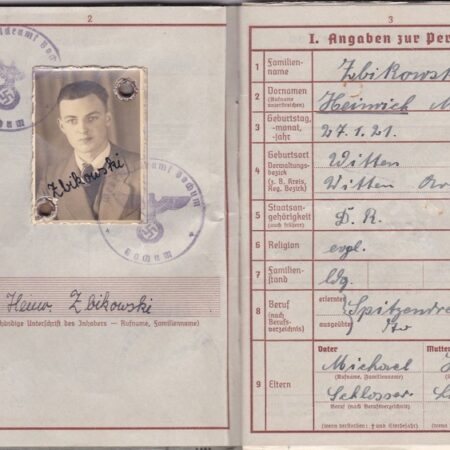
WWII German Luftwaffe Wehrpass – Obgefr Zbikowski – 246th Volksgrenadier Division – Went Missing in Battle of Aachen 1944
Obgefr Zbikowski He went though some flight training and later some engineer training. But by late 1944, he was assigned to Luftwaffen-Festungs-Bataillon XIX With the same order, the designation also changed to Luftwaffe Fortress Battalion XIX. The battalion arrived in Stolberg on September 10, 1944, and subsequently moved on to Aachen. On September 30, 1944, the battalion was subordinated to the 246th Volksgrenadier Division.
-
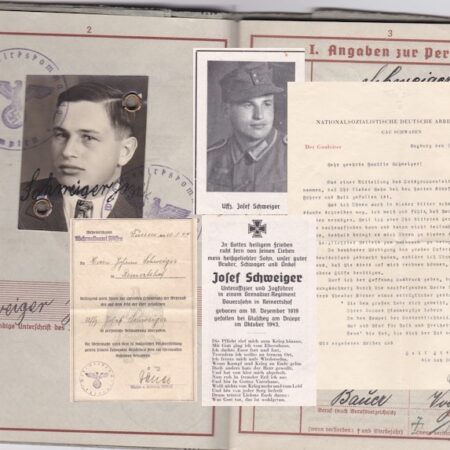
WWII German Wehrmacht KIA Wehrpass Grouping – Uffz Schweiger – Grenadier Regiment 61 – Letter from SS-Obergruppenführer Karl Wahl !
A sad grouping from the family estate. Schweiger served in the following frontline units: Infanterie Regiment 468 At the back of the Wehrpass he has had assault days entered with town names! Grenadier Regiment 61 He was killed on the Dnieper River at Gluschey in October 1943 after spending 11 days with the regiment. He was likely buried by his unit, but he has no grave to this day. The Grouping includes: Wehrpass Death Card Print from Newspaper about his death Letter / ID for his Bike used in the Army Letter dated 11 days before he was killed to his parents. Certificate for the official Return of the Wehrpass to his father Two letters from him to his family in 1943 Letter Signed – WAHL, Karl. NSDAP-Gauleiter Schwaben, SS-Obergruppenführer (1892-1981) to the family. Rare Signature valued at around 200 Euro! (https://en.wikipedia.org/wiki/Karl_Wahl)
-
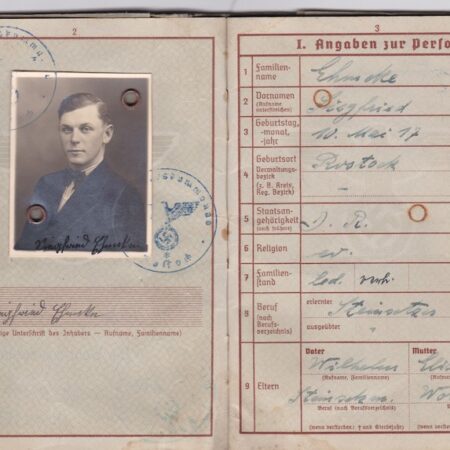
WWII German Wehrmacht Wehrpass – Obergefr Ehmcke – Grenadier Regiment 478 (Wounded in Operation Citadel) – Döberitz- Infanterie Schule/Berlin 1945
An interesting Wehrpass with a great battle calendar to a real veteran! Ehmcke served in: Infanterie Regiment 478 Grenadier Regiment 478 (258. Infanterie-Division) Operation Citadel (German: Unternehmen Zitadelle) He was badly wounded, with grenade fragments in the face, neck in the Operation. Grenadier Regiment 1149 It seems he only spent over a week with them before being moved again. Schießschule Döberitz – Berlin Shooting School of the Infantry in Döberitz Wehrmacht Base. Likely he was in the battle of Berlin, as many of the units at Döberitz where sent into the defence sectors. He was trained on the Panzerfaust and Panzerschreck! Awards: Infantry Assault Badge, Eastern Front Medal, Silver Wounds Badge Unknown what happened to him, his Wehrpass was never closed and he does not come up on the KIA lists.
-
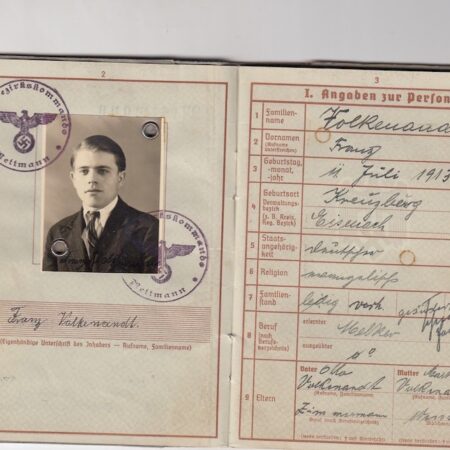
WWII German Luftwaffe Wehrpass – Obergfr Volkenandt – Fallschirm Artillerie Regiment 6 – Führerhauptquartier Wolfsschlucht II
Volkenandt served in the following units: Flak Regiment 64 – Düsseldorf Reserve Flak Abteilung 142 It seems that he was defending the the main Führer headquarters in France – Wolfsschlucht II near Margival and Laffaux (northern France) according to the Wehrpass. Fallschirm Artillerie Regiment 6 The actual service of this unit is not very clear, also the fact that on 11.8.1944 he was reassigned/closed? Awards: Flak Badge, Oct 1938 Medal, Medal for the Fight against Communism.
-
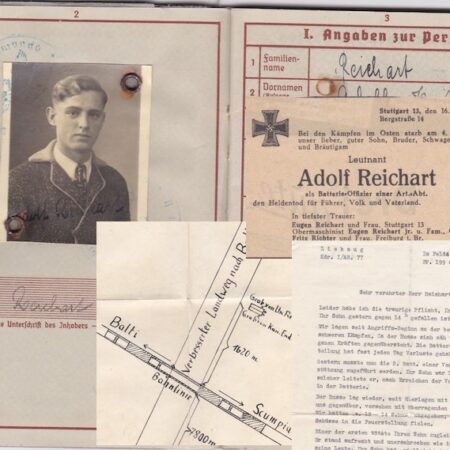
WWII German Wehrmacht Wehrpass KIA Grouping – Leutnant Reichart – Artillerie Regiment 77 – Grave Map – KIA Moldova 1941
Reichart served with AR 77 During the push towards the Ukrainian border he was killed, the maps detailing the place he still rests as according to the German Archive he was never reburied. A quick look on google maps show that this is just a field at the side of the road. This is a big grouping of documents and is really detailing everything about his death. He was awarded the Iron Cross Second Class in July 1940, and the German Westwall Medal in 1940.
-
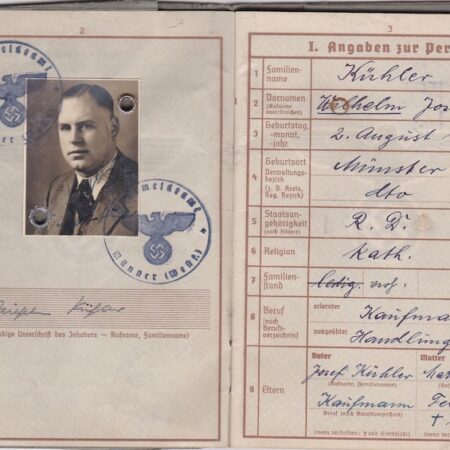
WWII German Luftwaffe Large Wehrpass Grouping – Uffz Kühler – Africa Korps – Leichte Flak Abteilung 733 – Huge Grouping IDs & Photos!
Here we have a very large grouping to Kühler. Many photos, many documents, including his Wartime documents and his postwar documents, and a large lot of Post he sent to his wife when fighting/away from home. Interestingly he served with the Afrikakorps with Leichte Flak Abteilung 733 According to his Wehrpass he was in Africa protecting the Ground troops with his flak unit. He made it back and can be seen in the many photos with his wife wearing the Africa Korps Cuftitle. Included is his War Merit Cross Cert. This is a huge group! Not all is photographed individually as its too many things! See the last few photos for an idea!
-
-

WWII German Wehrmacht Soldbuch – Hauptmann Gehrke – 246 Volksgrenadier Division – Aachen – Iron Cross First Class Aachen Battles against US Troops – Captured Rare
The pay book belonged to customs inspector Richard Gehrke, who was born in 1904, and was issued on January 26, 1943 by the Grenadier Replacement Battalion 110. Interestingly, it bears the number 1. At this time Gehrke was a first lieutenant in the reserve. The Gren.Ers.Btl. represented the replacement for the 79th Infantry Division, which was on the Eastern Front at the time, so that Gehrke’s presumably first deployment to the front took him to the 886 Grenadier Regiment of this very division. During his deployment on the Eastern Front, he contracted typhoid fever in September 1943, which kept him busy for a good two months, led him to various hospitals and finally to the Truscawiecz army convalescent home (presumably located in Poland). However, the infection seems to have healed without any consequences and Gehrke returned to his troops, because on February 4, 1944 he was awarded the EK2 by the 79th ID. He also changed units within the division at an unspecified point in time and was deployed to Grenadier Regiment 212 for a while (coming from Grenadier Replacement Battalion 212). At the end of April 1944, Gehrke was admitted to a hospital with an injury that he must have sustained in an accident (code 34). On July 1, 1944, Gehrke was promoted to captain in the reserve, and here an inconsistency occurs: The promotion was carried out by the unit with the field post number 23353 (if I deciphered the number correctly), which is assigned to the field replacement battalion 246. However, this unit does not appear on page 4 as a replacement unit, especially since the 246th ID no longer existed at that point. However, I can’t imagine that this could be a coincidence or wrong. Perhaps he was briefly intended for the division’s re-formation as the 246th VGD? Be that as it may, his stay with the 149th Staff and Grenadier Regiment of the 49th Infantry Division is assured. This division was a ground-based, non-mobile unit in the Boulogne area and did NOT take part in the fighting there after the landing in Normandy. Instead, it withdrew to the area west of Paris and had initial enemy contact in the defense of the Seine crossings. The bulk of the division was captured in the Mons pocket. Gehrke was not one of them; he appears to have been one of only around 1,500 men to escape the cauldron. With regular enemy contact, the division withdrew further towards Reich territory via Belgium and Holland and crossed the border at Aachen. At the end of September, on the eve of the 2nd Battle of Aachen, the division was reorganized and fresh troops were added to it. On October 1st it had a combat strength of around 5,100 men (9,400 total) and was fighting on the northern edge of Aachen (Alsdorf, Merkstein, Palenberg, Kohlscheid for those who know their way around) against the American 29th US Infantry -Division. Gehrkte probably experienced these fights first hand. At Aachen the division was again almost completely wiped out. It lost so much of its fighting strength that it virtually ceased to exist and on October 23rd the pitiful remnants were incorporated into the 246th VGD, which had also been badly beaten near Aachen, on the arbitrary orders of Field Marshal Models. Gehrke’s unit, the Grenadier Regiment 149, was probably incorporated into the Grenadier Regiment 689. Once again, as in Mons, Gehrke must have been one of the few in his unit who survived the Aachen disaster and were not taken prisoner, because on November 19th the 246th VGD awarded him the EK1. At this point the 246th VGD was standing. in the defensive battle east of Aachen an der Rur. The EK1 is the last official entry, but the prisoner of war number written in bold on page 1 proves that Gehrke also survived the later fighting and was taken prisoner either in the North or Schnee Eifel (the division was for a short time in the Monschau area next to the 272nd VGD was deployed, but was later relocated to the area west of Stadtkyll to strengthen the former Ardennes Front). Removed from Consignment
-
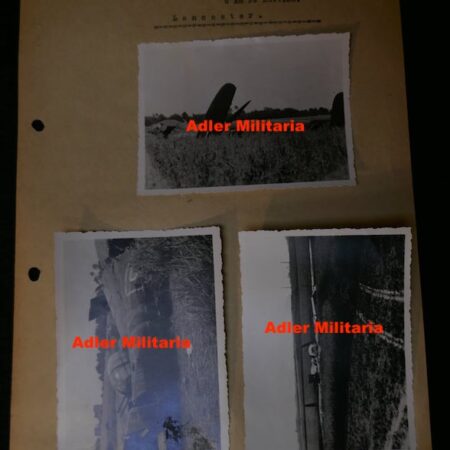
Original WWII German Luftwaffe Night Fighter Kill Report – Nachtjagdgeschwader 1 – RAF Lancaster Lantin/Heverlee Belgium – Photos – RARE
Here we ave an extremely rare Abschussmeldung for NG1. Lancaster ED 781 (DX-J) I of 57 Squadron, took off at 2252 from RAF Scampton on 24 June 1943 for its target Wuppertal in the heart of Germany’s Rhur industrial region. The aircraft was intercepted and shot down by a German nightfighter from Stab/II/NJG1 flown by Oberltnt Wilhelm Telge. The aircraft crashed at 0120 near Lantin, 8km from the centre of Liege in Belgium. Only Sgt Lambdin, the Bomb Aimer, managed to bale out and was taken POW; the rest of the crew are buried at the cemetery of Heverlee.


