Original WWII German Army Soldbuch & Personalausweis Cover Black
Really nice one! Came in a collection of covers, sadly they had nothing inside! Remember all our items include Free Shipping!
Website Updated: 01.02.2026 - FREE World Wide Shipping - Lifetime Guarantee on Originality!
Showing 28–36 of 1163 resultsSorted by latest

Really nice one! Came in a collection of covers, sadly they had nothing inside! Remember all our items include Free Shipping!

Buttons work fine! Came in a collection of covers, sadly they had nothing inside! Remember all our items include Free Shipping!

The Buttons are broken. But can still hold a Wehrpass the pouch itself is fine. Came in a collection of covers, sadly they had nothing inside! Remember all our items include Free Shipping!

The Buttons are broken, one is missing. But can still hold a Wehrpass the pouch itself is fine. Remember all our items include Free Shipping!

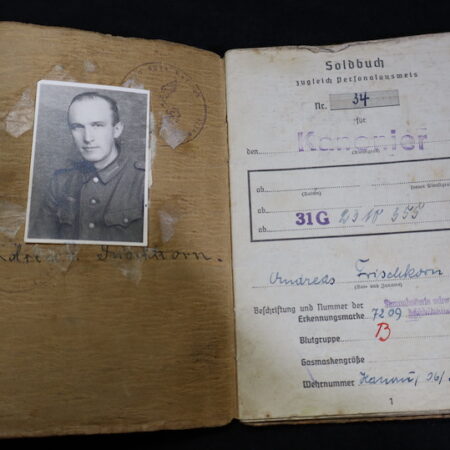
Interesting Soldbuch, (although sadly missing pages) issued at Döberitz Training base to Kurt Weber, from Berlin Karlshorst. He was awarded the War Merit Cross with the HVA in Wunsdorf. (Units and Personal Information are still inside along with a photo of Weber in Uniform!) He served with: Heeresverflegungsamt Döberitz Interesting Barracks, today in ruins outside Berlin and can be visited on tours. Döberitz military training area, a major military installation near Berlin used by the Prussian Army, the Wehrmacht, and later Soviet forces until 1992. It served as a large-scale training ground for troops, a site for officer and pilot training, and a testing area for new aircraft and motor vehicles. During World War II, it was also a site for training various German units, including foreign volunteers, and housed a subcamp of the Sachsenhausen concentration camp. Heeresverflegungsamt Wunsdorf Wünsdorf–Zossen military complex, south of Berlin was one of the most important German command centers during both world wars. By WWII it served primarily as: Headquarters of the Oberkommando des Heeres (OKH) – the German Army High Command. Part of the Oberkommando der Wehrmacht (OKW) – the High Command of the Armed Forces also operated from the complex. A huge underground bunker system including the famous Maybach I, Maybach II, and the Zeppelin bunker, all designed to withstand bombing. A major communications hub using the Amt 500 complex with advanced telephone, teleprinter, and cipher services. Because of its role, Wünsdorf-Zossen was sometimes referred to as “the brain of the Wehrmacht.” What happened there in April 1945 During the Soviet offensive on Berlin, the Wünsdorf–Zossen area became a major target. Key events (April 20–24, 1945): 20–21 April: Soviet forces of the 3rd Guards Tank Army and 28th Army reached the area during their rapid advance toward Berlin. Fighting around the base occurred as German rear units and training formations attempted to defend the complex. The Luftwaffe bombed nearby areas trying unsuccessfully to halt the Soviet breakthrough. 22–23 April: The Soviets overran the positions around Zossen. The Maybach bunkers and the OKH/OKW command complex were captured almost intact because German forces had evacuated most leadership personnel shortly beforehand. 24 April: The entire Wünsdorf military complex fell under Soviet control. Large stores of documents, communications equipment, and intact bunkers were seized. Weber was in March of 1945 in Wunsdorf, and seems he was captured by the Red Army shortly after during the Battle of Berlin and for some reason was pressed into some sort of service given there is entries of payments by the Red Army in Russian language.

Soldbuch to Raimund Glanbauf Page 1 is sadly missing, but the important information still is inside. He served with Pioneer Batl 80 – 44 Reichsgrenadier Division – Hoch und Deutschmeister From the Alpine border to Monte Cassino Following the armistice between Italy and the Allies on 8 September 1943, the division played a central role in disarming and interning Italian troops in the Trentino and South Tyrol regions. In October 1943, it was transferred to the Operational Zone of the Adriatic Littoral, where it engaged in anti-partisan operations in Istria and Slovenia. In late November 1943, the division was redeployed to Southern Italy, holding positions along the Gustav Line near Monte Cairo and the surrounding area. It took part in the Battle of Monte Cassino, suffering heavy casualties during the fighting. On 4 June 1944, near the Capistrello train station, soldiers from Pioneer Battalion 80 executed a group of Italian civilians arrested during these searches. The massacre of Capistrello At the start of the Allied offensive in May 1944, the division was stationed in the sector east and northeast of Roccasecca. Following the collapse of the Gustav Line, its troops retreated along the Roveto Valley toward Balsorano. During the retreat, they conducted search operations in the hills around Capistrello, where partisans and British parachutists were believed to be hiding. On 4 June 1944, near the Capistrello train station, soldiers from Pioneer Battalion 80 executed a group of Italian civilians arrested during these searches. The retreat through Umbria and the Casentino In its continued retreat, the division moved through the Sabina region in Latium toward Rieti and Leonessa, eventually advancing into Umbria. Along its route north, it passed through towns such as Terni, Assisi, Città di Castello, Umbertide, Sansepolcro, and Pieve Santo Stefano. In early July 1944, the division carried out anti-partisan search operations in the Monte Santa Maria Tiberina area and engaged in combat in the Perugia region. Crossing into Tuscany, the division advanced through the Casentino mountain region and established positions at the Passo dei Mandrioli. On 20 and 21 August 1944, its units carried out a major operation, code-named Maskenball, near the pass and the village of Badia Prataglia. The operation aimed to clear the area of partisan forces. The Sassoleone reprisal action and combing operations in Budrio and Medicina In September 1944, the division was positioned in the northern Apennines, south of Imola and Castel San Pietro. On 24 September, the Pioneer Battalion conducted a reprisal operation in Sassoleone, during which 23 civilians were killed in response to the killing of a German officer in a partisan ambush. After suffering heavy losses in the fighting in Valsanterno, the division withdrew to the area around Budrio to reorganise. On 9 October 1944, one of its battalions carried out search operations in the towns of Budrio, Medicina, and Sesto Imolese, detaining 269 men. Two were identified as partisans and immediately executed, while 120 others were deported to Germany for forced labour. Transfer to Hungary and the end of the war In November 1944, the division was transferred to Hungary, where it fought in the Lake Balaton area. Toward the end of the war, its remaining units retreated to the Austrian-Hungarian border. To avoid capture by the Red Army, these units withdrew to Linz, where they surrendered to American forces. Other notes: He was issued either a MG42 or MG34 in 1944 – MG (Machinengehwehr) is not to be confused with MP (Machinenpistole) ! Glanbauf stepped on a mine in February of 1945, damaging the right side of his face and his right leg. For which he was given the Wounds Badge in Black. He was found fit for service again in April 1945, but what happened to him after that I was unable to find anything out. Also a really nice and rare page is entered in at the start of the Soldbuch – This describes that he is a member of a Traditions Unit and this comes with benefits. That he belongs only to that unit and that he is to be returned to the unit in the case of injury or sickness. That this paper must be shown when asked for and that it is not to be removed from the Soldbuch. Under order of the Divisions Commander! On his Photo it can be seen he is wearing his Combat Equipment Y Straps and the photo was likely taken in Italy as it is dated 1944! For more information on this unit: https://www.ns-taeter-italien.org/en/perpetrators/44th-hoch-und-deutschmeister-reichsgrenadier-division https://en.wikipedia.org/wiki/44th_Infantry_Division_%28Wehrmacht%29

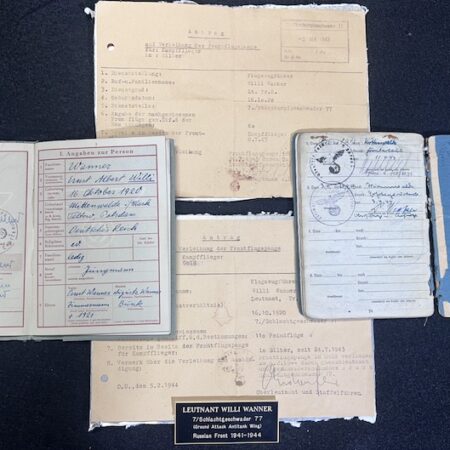
We lately got in a set of nice documents, coupled by the former collector with original awards. Although they were not the pilots awards and are offered here separately, we do not split groups that belong together. Oberleutnant Will Wanner Born in 1920, he was enlisted after volunteering in the Luftwaffe in 1940. He went though almost three years of schooling on the Stuka before joining his Stuka unit in December of 1942. Wanner served with III/ Sturzkampfgeschwader 77 1943 SG 77 seen extensive action on the Eastern Front. By 20 December 1942 III./StG 77 had only seven serviceable dive-bombers. III./StG 77 lost 29 ground crew on the retreat from Rossosh to Kharkov. It probably took part in the air battles but was decimated and withdrawn to Würzburg. It was rebuilt with 37 Ju 87s and 245 officers and sent to Luftflotte 2, II. Fliegerkorps. The group moved to Cagliari, but was not to be used until the Allied invasion of Sicily (Operation Husky). In the event, the airfields were so badly damaged on the island it was ordered to return to IV. Fliegerkorps on 27 April 1943 On 8 July, StG 77 supported the Großdeutschland against the fortified village of Syrtsevo. StG 77 lost five Ju 87s and another damaged in combat with the 240 IAP. The air corps claimed, with contributions from SG 1, 84 Soviet tanks destroyed, 21 damaged, 40 vehicles destroyed, and five artillery pieces along with two anti-aircraft guns and two rocket launchers. By the evening of 8 July, 16 dive-bombers had been lost. The Germans halved the amount of Stuka sorties over the ensuing days. On 11 July, 9./StG 77, under III./StG 77 lost another five Ju 87s as it supported attacks against the 69th Army. The 183 IAP were their attackers. In the afternoon, 50 Ju 87s supported the 1st SS Panzer Division Leibstandarte SS Adolf Hitler’s attack on Hill 252.2. On 12 July StG 77 was involved in the Battle of Prokhorovka. While the Ju 87s could only fly 150 sorties in support, but with StG 2 the attacked with great success against Soviet armour advancing in the open. The 31st Tank Brigade, of the 29th Tank Corps, suffered heavy casualties. The 36th Tank Brigade’s commander was wounded by aircraft when his tank was destroyed. On 14 July, another six Ju 87s were lost supporting the XXXXVIII Panzer Corps The German offensive continued in the southern sector, but Operation Roland failed and the Red Army took time to begin the counter offensive, Operation Polkovodets Rumyantsev. Soviet forces slowly pressed the Germans back. On 19 July 7./StG 77 was wiped out by a Soviet attack on the base at Kramatorskaya and 4./StG 77 lost another three to Soviet fighters. At the beginning of August 1943, the Soviet summer counter offensives began. StG 77 lost 24 dive-bombers and 30 damaged between 5 and 31 July 1943. Their losses from July to December 1942 were just 23. The Stuka arm had also lost eight Knight’s Cross of the Iron Cross holders—Karl Fitzner of 5./StG 77 was one of them; he was shot down and killed on 8 July.III./StG 77 operated in the Kharkov and Belgorod sectors, after the fall of the latter on 5 August. From 6 to 12 August it lost four Ju 87s in combat and another three in the retreat to prevent their capture. On 17 August it was at Poltava, and the following day 7./StG 77 lost another four in combat near Sumy; four men were killed and two wounded. The group retreated to Stalino and lost another three on 2 and 3 September while 8. and 9. Staffel lost two Ju 87s near Kharkov on 5 September. Awards 4.12.1941 – Pilots Badge 8.7.1943 – Iron Cross Second Class 8.7.1943 – Front Flying Clasp in Bronze 26.7.1943 – Iron Cross First Class 24.7.1943 – Front Flying Clasp in Silver 6.2.1944 – Front Flying Clasp in Gold He flew a total of 189 Missions, according to the Luftwaffe Officer Lists he was shot down by Anti Aircraft Fire over Bialystok. WANNER, Willi. 01.06.44 promo to Oblt./A1. 27.07.44 Oblt., 7./SG 77 MIA – Ju 87 D-5 (S2+CR) shotdown by AA vic Bialystok. According to the German War graves online archive he was never buried… The both Certificates for the Front Clasps are attached to a card by the previous collector. Condition is as photographed.

Very interesting and rare SS Soldbuch set to a unit hardly ever seen on the market. SS Soldbuch and Drivers licence issued to Roland Huy-Prech, who was a driver and technical NCO in the Stab of two Prinz Eugen GJ Regiments! Frontline units: July 1942: SS Gebirgsjäger Regiment 2 – Stabskompanie 1944/1945: SS-Freiwilligen-Gebirgs-Jäger-Regiment 14 „Skanderbeg“ Although the division was designated a “volunteer” division, very few of its men were actually volunteers. Rather, the Banat region had been declared German territory, and the men had been drafted into the Waffen-SS. The division’s equipment consisted largely of captured French, Polish, Czech, and Yugoslavian weapons and equipment. The division’s formation was completed in October 1942. It comprised 11,000 ethnic German volunteers, 22,000 ethnic Germans from Romania, 2,500 ethnic Germans from Croatia, and 2,000 Reich Germans as cadre personnel. That same month, the division was transferred to the area of Užice-Čačak-Novi Pazar-Mitrovica. On October 12, 1942, the division saw its first action against partisan units in the Kopaonik Mountains. This initial engagement, however, was largely unsuccessful. In December 1942, orders were issued to transfer to the Zagreb (Agram) area. On December 31, 1942, the division had a strength of 411 officers and 19,424 non-commissioned officers and enlisted men. In January 1943, the division, advancing from the Karlovac area towards Slunj, participated in a major operation against partisan groups in western Bosnia, targeting Bihac. This operation, codenamed “White,” also involved the 369th, 717th, and 714th Infantry Divisions. The Italian 2nd Army contributed three divisions. On January 27, 1943, the division occupied Bihac. The advance then continued on both sides of the Bihac-Bosn. Petrovac road. The division then marched south via Drvar to Bosn. Grahovo. Hindered by heavy snowfall, Drvar could not be occupied until February 27, 1943. Tito had fled the town the day before. The division assembled here until March 3rd and then attacked Bosn. Grahovo. Mostar was reached on March 15th, where the division concluded Operation White. No major operations took place in April 1943. From May 15th, 1943, the division participated in Operation Black, in which the 1st Mountain Division, the 104th Jäger Division, the 369th Infantry Division, and two Bulgarian regiments also took part. During the operation, which lasted until June 15th, there was heavy fighting with partisan units. After the operation’s conclusion, the division marched into the area north and east of Sarajevo. In July 1943, the General Command of the V SS Mountain Corps was formed from elements of the divisional staff. After some minor anti-partisan operations, the division was transferred to Herzegovina at the beginning of August 1943, with its headquarters in Mostar. Following the Italian surrender, the division received orders on September 9, 1943, to occupy the Dalmatian coast, which was largely occupied by Italian troops. The 2nd SS Volunteer Mountain Infantry Regiment was ordered to capture the strategically important city of Ragusa (Dubrovnik). Since the Italian VI Corps stationed there refused to surrender the city, the regiment was forced to capture it after a German air raid on September 12. On October 22, 1943, the division’s units were numbered. The division was now designated the “7th SS Volunteer Mountain Division ‘Prinz Eugen’,” and the mountain infantry regiments were designated “SS Volunteer Mountain Infantry Regiments 13″ and 14.” The remaining divisional units also received the number 7. From October 23rd, the division participated in Operation “Autumn Storm.” The reinforced SS Volunteer Mountain Infantry Regiment 13 was tasked with occupying the islands of Brač, Hvar, Korkula, and the Pelješac peninsula. The fighting on Pelješac, in particular, resulted in heavy losses on both sides. While this fighting continued, the reinforced SS Volunteer Mountain Infantry Regiment 14 was assigned to Operation “Landsturm” (Home Guard). The objective was to liberate the coastal strip between Split and Metković from partisans. After little success, the operation was called off in mid-November 1943. On December 2nd, 1943, the division then participated in Operation Operation “Kugelblitz” (Lightning Bolt) was launched. In cooperation with the 1st Mountain Division, the 369th Infantry Division, the 187th Reserve Division, and the Bulgarian 24th Infantry Division, three divisions of the Yugoslav People’s Liberation Army were to be destroyed in eastern Bosnia. Advancing from the southwest, the division marched via Gorazde into the area east of Sarajevo. On December 7th, it met up with the 1st Mountain Division near Gorazde and attempted to encircle the Yugoslav forces in the area of Zvornik – Priboj – Plevlja – Gorazde – Sarajevo. However, the Yugoslav units managed to break through and escape near Han Pijesac during the night of December 15th, 1943. The operation was then called off. On December 18th, 1943, Operation “Schneesturm” (Snowstorm) followed. to destroy the escaped partisan units. Heavy fighting and enemy counterattacks ensued, forcing the division to abandon this operation as well. As of December 31, 1943, the division had a strength of 21,102 men, exceeding its authorized strength by over 2,000. At this time, the division was located in the area north of Mostar. On January 4, 1944, Operation “Waldrausch” (Forest Frenzy) began, aimed at destroying the partisan groups west of the Bosna River. During this operation, on January 6, 1944, the 1st Battalion of the 13th SS Volunteer Mountain Infantry Regiment was completely destroyed. The exhausted division was briefly transferred back to Dalmatia at the end of January 1944, to the Ragusa-Split sector, and then, at the beginning of March 1944, to the area east of Sarajevo. On March 28, 1944, elements of the division were driving partisans through the towns of Otok, Gruda, and Dolac gathered the villagers in the village squares and murdered them. The likely trigger for the massacre was the Ustaša government’s plans in Zagreb to resettle ethnic German inhabitants of Slavonia. The murders were thus an act of revenge by the ethnic Germans against their Croatian allies. On April 26, 1944, Operation “Maypole” began. Its aim was to prevent Yugoslav units from crossing the Drina River into Serbia. The operation ended in mid-May 1944 with heavy losses for the Yugoslav…

Gefreiter Theodor Fischer from Richterich (Aachen) Germany, born in 1912 – in his civilian life he was a Miner! Soldbuch was issued in September 1939 with: Grenzwacht-Regiment 46 Unit was made up of Border troops from the Aachen area and took part in the Siege of the Belgian Fortress Aubin-Neufchâteau which was one of the forts in the Position Fortifiée de Liège (Festung Lüttich). During the 1940 Belgian campaign, Grenzwacht-Regiment 46 was known for its role in the brutal siege of the Fortress of Aubin-Neufchâteau, one of the forts in the Liège fortified position. After the fall of Fort Eben-Emael, Fort Aubin-Neufchâteau held out for eleven days against a massive German assault, including artillery, air attacks, and infantry assaults, before surrendering on May 21, 1940, due to exhaustion and lack of ammunition. The German forces, particularly the airborne troops, used a combination of glider landings, explosives, and flamethrowers to overcome the defenses, but the garrison’s valiant resistance impressed the attacking forces. Served also with: Radfahr-Bataillon 404 of the 263. Infanterie-Division in occupied Norway, and Radfahr-Abteilung 30 of the 30. Infanterie-Division. Until sometime in 1944 when he contracted some sort of stomach/intestine complains and was sent to various replacement units till the wars end. Soldbuch comes with his NSDAP Gesundheitspass which was in the rear of the Soldbuch.
Adler Militaria specializes in rare original artefacts, particularly from the Third Reich period, catering to collectors, researchers, and museums.
Our eBay – Adler Militaria – currently have sold over 109,000 original items and have over 68,000 Positive Reviews!
© 2013 – 2026 Adler Militaria