
Showing 532–540 of 1179 resultsSorted by latest
-

WWII German SD-Hauptamt Service ID – SS Scharführer Werner Hahn – Heydrichs Staff – SD Berlin 1942 – Ultra Rare Grouping (On Hold)
This exceptional wartime SD identification paper gained access to the most horrible buildings in Berlin. The SD Hauptamt on Prinz Albrecht Strasse in Berlin. This little grouping is one of a kind, a similar one was found for a Police Man serving in the building but not seen any for the SS/SD staff. These permits enabled the holder to not only gain entry but was allowed to carry a side arm. SS Scharführer Werner Hahn, was shortly before the war a member of the German Police. It seems according to the Heydrich office promotion documents to Hahn that he was already in Heydrichs staff from the beginning of the war. Final Comments I do not think this will come up again anytime soon, such an SS/SD ID is extremely rare and such items are not available often. I have no doubt on the authenticity and we give a lifetime guarantee. Price is shipped tracked worldwide.
-
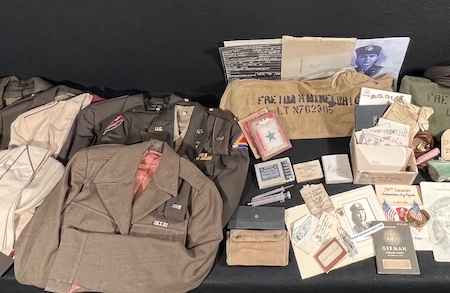
WWII US Army Medical Corps – 1st Leiutenant Himmelwright – United States 7th Army – Arrived December 1944 – Rhineland Germany 1945 – Super Grouping (Reserved)
Wonderful Estate Collection of 1st Lieutenant Freida M. Himelwright N762305 who arrived 10 December 1944 in Europe and received Campaign Credits for Central Europe and Rhineland with the US Army Nurse Corps. This collection of her military uniforms, hats, documents, and ephemera tell the story of a WAC Women’s Army Corps Nurse who served in the European Theater of Operations with the United States 7th Army. Highlights of the collection are her extensive uniform grouping to include two Field Service Uniform Jackets one chocolate brown WAC Service Uniform with Advanced Base & 7th Army SSI Shoulder Patches, 1st Lieutenant Rank Insignia, Army Medical Corps Nurse N Branch Lapel Insignia, and Ribbons; additionally, the English Tailored WAC Coat and Nurse Officers WAC Service Hat. Further Uniform items include: WAC Overseas Garrison Cap with Rank and Nurse Branch Insignia, WAC Overseas Cap Chocolate Brown, WAC Doeskin Overcoat by ‘Schwartz Cincinnati’, Service Uniforms Chocolate Brown ‘Jacket Service Tropical Worsted Nurses Dark OD 10R Lyonelle Modes Dated May 1944’, Khaki Shirt & Tie, WAC Skirt with stitched laundry number, & White Uniform Jacket with 7th Army SSI Shoulder Patch and 2 Overseas Service Bars ‘Mary Sachs Tailors Harrisburg’, White WAC Officers Hat by KNOX, Khaki Tie, Two White Garrison Caps, ‘Jacket Wool OD Women’s Officers 10S Giacobbe Brothers Dated Dec 1943’, White dinner jacket, Four Additional Skirts Including One 1945 Dated French Made, Low Quarter Leather Shoes, WAC leather boots, leather riding boots, and assorted socks and garments. Exceptional Personal ID Identification Bracelet France 1945 with Army Nurse Corps Branch Insignia and Custom engraved and numbered interior to Freida Himelwright. Assorted insignia and small items to include German Occupation made 3rd Infantry Division SSI Shoulder Patch, patches, coins, 2nd Lieutenant Rank Insignia Bars, Branch Army Nurse Corps Insignia, and other small personal pieces and patriotic items. WAC Officers Bedding Roll WAC Canvas Clothing Bag Personal Embroidered Pillow, SAKS Fifth Avenue make up compact with birds of paradise to the cover and American Red Cross Shoes with Gift Sleeve Medical Officers Cases, Canvas Case by ‘Superior Surgical’, Surgical Instruments Assortment, Glass Syringes, and Spare Needles Various books and pamphlets: German Phrase Book 30-606, 274th Infantry Independence Day Regatta Wiesbaden on the Rhine Germany 4 July 1945, My Military Missel, USO Red Cross Pad, and small papers / letters. Documents: Military Record and Report of Separation Certificate of Service and Embossed Army of The United States Certificate of Service, Commonwealth of Pennsylvania Veterans Compensation, Department of Commerce Student Pilot Certificate 1946, Photograph of 1st Lieutenant Himelwright Several pencil sketches Post-War Civilian Private Pilot’s Log Book *Estate Auction Acquisition* – Presented as Acquired, Ribbons on the First WAC Service Uniform Coat: Army Commendation, EAME 2 Stars, and Asiatic Pacific Campaign are Incorrect per her service records but exactly as found. The price is shipped in the US, if you are from somewhere else and buy it contact us for the actual shipping cost
-

WWII United States Army – Medical Corps Officer – Footlocker of Captain Parham (Landed on Beach Normandy, France / D- Day Plus) – Bringbacks K98 Bayonet – Super Rare – Theater Embroidered Combat Medic Badge
The Extensive Footlocker Estate Grouping of Capt. Leroy Parham United States Army Medical Officer who “landed on Normandy Beach shortly after D-Day” (Obituary of Leroy Parham). This unique footlocker grouping tells the story of a Combat Medic / Administrative Medical Officer Captain Leroy Parham who served in the CCC and then US Medical Corps during WWII. He was attached to the U.S. 7 th & 9 th Armies. Captain Parham’s 1942 Dated 35R Service Officers “Ike” Jacket is a true highlight of this impressive collection – it has one of the finest theater embroidered Combat Medic Badges ever seen, Occupation tailored U.S. 7 th Army Patch, 9 th Army previous unit, Rank; Branch Insignia, three Overseas Service Bars bullion tailored and three ribbon bar: American Campaign, Europe Africa Middle East Campaign with Two Stars, and World War Two Victory. All contained in his original trunk this is a tremendous opportunity to add an exceptional Medical Officers grouping to any advanced collection. Further Uniform pieces include: M-1943 Field Jacket 36 Regular by ‘The Spaide Shirt Co’ – Fine Condition and early production dated 1943, Overseas Officers Garrison Caps Khaki & Chocolate Brown with Captain’s Rank, Officers Pink Trousers; Chocolate Brown Trousers, Class A Officers Chocolate Brown Service Uniform with bullion tailored 7 th Army SSI shoulder patch, US Medical Corps ‘A’ Administrative lapel insignia, Captain’s rank, and three Overseas Service Bars – Officers Sam Browne Belt, and a Officers wool shirt by ‘Vanguard’. Featured prominently above the photo of the Ike Jacket on the top of the footlocker is a European Theater Field Hospital Unit Photograph Exceptional Field Medic Geneva Convention Numbered Arm Brassard ‘M316243’ A large assortment of personal books and pamphlets including: Military Medical Manual, Officers Handbook of Information, German Phrase Book TM 30-606, Army Officers Notebook, Easter 1945, Commissary Price List, Company Administrative Records, A Short Guide to Great Britain, London Illustrated Guide Book, Central Europe Map, Westminster Abbey Pamphlet, Welcome to the Riviera, Nice, Cannes, Monaco, Paris Guides, Several Road Maps / Red Cross Maps and Going Back to Civilian Life amongst many others. A nice collection of additional insignia and patches: Theater tailored Occupation Era 7 th Army bullion SSI, 7 th & 4 th Army patches, Captain’s rank, Europe Middle East Africa ribbons, Ruptured Ducks, crests, bullion tailored Overseas Service Bars and unused Officers Service Hat Insignia. Various Photographs and Orders Honorable Discharge from the CCC Civilian Conservation Corps Franklin Roosevelt Expeditionary Forces Letter Several Large Maps of German Areas of Operation Several Newspapers including the ‘Al Hambra Echo Dec 12, 1945’ featuring the story General Patton Unchanged Capture Paper Signed by Maj. Thadeus Bugelski MC 86 th Medical Battalion authorizing the capture and bring back of 1 Luger Pistol, German Camera and German Field Glasses Souvenir K98 Bayonet by Carl Eickhorn 1938 (numbers matching) Leather Souvenir Box and other miscellaneous souvenirs including a fine little cup from Lourdes. Please make inquiry about shipping as this is a standard footlocker of WW2 and loaded is fairly heavy. The total includes Free Shipping in the United States.
-

WWII German Untouched Tiger 1 Ausf E (Late) 8.8cm Optic “TFZ9C – HGU – Friedenauer Technische Werkstätte GmbH, Berlin-Friedenau” – Ultra Rare
This incredibly rare item was a bring back to the USA after WW2 by a former GI. This was likely taken in Normandy or at the Bulge. The optic itself is still incased in the mount and has the rare optic protection device still attached. The light-up system has not been tested but can be hooked up to light-box, inside must be a reticle with the 8.8cm Tiger Main Gun optic. This optic was effective to the following ranges with the 8.8cm KwK36 – Armoured Piercing – 4,000 Meters, MG 1200 Meters, HE, 4000 Meters, Indirect 8,000 Meters. This particular maker – HGU – Friedenauer Technische Werkstätte GmbH, Berlin-Friedenau has not been seen before, with the more common BLC maker for earlier models seen in collections without mounts. I could try and explain how rare this is to come up, but the numbers produced must have been very small batches. It would look amazing in front of a Gunners Wrap, as a static display perhaps lit up to view through it. I will leave you with my favourite video of the Tiger 1 and King Tiger… https://www.youtube.com/watch?v=boVZuC_siC0 IMPORTANT Due to the weight and size of the item, if you want to own it the price is below for the item only, and this sale does not cover the postage. We can arrange a courier from the USA, our have it ready for your courier. This item is located in our storage in the USA. If your interested in buying this and want to get a quote for shipping get in touch with us.
-
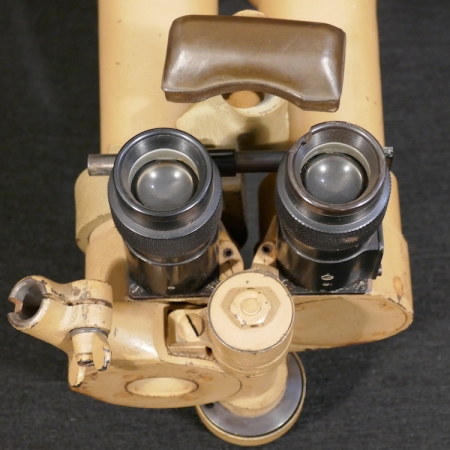
WWII German Optic – Panzer Tank Commanders SF14 Z – With Forehead Rest – Untouched – Rare (Sold)
Here we have a nice set of Tank Commanders Optics – this SF14 Z set up is one of the hardest and rarest to find, for use in the turret of the commanders cupola. These were used in various tanks including the StuG and Tank Hunters. This particular set was a GI Bringback likely from the European Theater of Operations . Important: We can send US inclusive, but for all other countries we need to charge the shipping cost.
-

WWII Waffen SS Soldbuch – Ukrainian Born SS-Schütze Neudorf – SS-Wehrgeologen – Massacre in Italy & France 1944 – Ultra Rare Unit max 600 Men (Sold)
Neudorf was born in Ukraine and served in one of the oddest Waffen SS units known. I was unable to find any other Soldbuch for a member of this unit. Apart from doing excavations and preparing special defences, they engaged partisans in Italy, and are mentioned by various sources for taking part in the Pedescala massacre in Italy. His Soldbuch was issued by, Prof. Gustav Riek (see below for his career – Himmlers Staff) The unit:Himmler ‘s SS had set up a special department of geologists: it was the ” SS-Wehrgeologen Bataillon (mot) 500″ set up between 1941 and 1942 in Hamburg-Langerhorn. Then in the summer of 1943 a department was sent to Italy , in the Reggio Emilia area , while the other units were sent, on March 16, 1944 , to the Breton region in France . In Italy they had to officially prepare the fortifications for the “Blaue Linien” between Trentino and Veneto . After 8 September 1943 , at least 200 Italians, including 5 officers, joined that unit, so that by April 1944 the unit had a strength of 12 officers, 50 non-commissioned officers and 580 men, with the following armament: 27 MG, 6 mittl. Gr.Werfer, 60 machine guns, 450 rifles. In the spring of 1945 the “SS-Wehrgeologen Btl ” was stationed on the Folgaria plateau in Trentino, and was under the command of Obersturmbannführer (Lieutenant Colonel) Rolf Hohne, born on 26 September 1908 , who had led in 1936 the excavations in the castle of Quedlinburg , where the skull of Henry I the Fowler was found , the mythical king of the Saxons, of which the head of the SS , Heinrich Himmler, believed to be the reincarnation. Some of the purposes of this special SS unit was also the search for sources of water, minerals and precious stones. Research carried out above all on the Carpathians, through excavations in archaeological sites and explorations of natural caves. Now, this SS Unitt was inspired by the studies of Wilhelm Teudt , director of the “Ortungslinienforschung” department of the Ahnenerbe , and by those of Josef Heinsch relating to the theory of the “Heilige-linien” , who maintained that Trieste could be the place of contact or one of the doors to the afterlife, or one of the crossing points to another world. In 1943-1945, when the impending defeat of the Third Reich became obvious, the SS geologists were sent to southern France and Italy, to work on the Blue Line. Blu line was a system of fortifications, to be built in the Prealps, to stop the allies, invading at the time Sicily during ‘Operation Husky.’ An even more ambitious plan included the idea to use the mountains as the Alpenfestung, the Alps-fortress, as a last refugium for the Nazis. At this time the unit comprised more than 600 men, including geologists and soldiers. In the Italian city of Trieste, the Wehrgeologen helped in the construction of ‘Small Berlin’, a system of underground bunkers. During this operation, the geologists explored also caves and ancient mines, in part for minerals and resources, but also searching for the mythical entrance to a supposed ancient underground reign. Supposedly, strange galleries of unknown origin were discovered. At least some members also studied supposed earth-force-fields. Wilhelm Teudt and Josef Heinsch, both researchers at the Ahnenerbe, believed that streams of energy, following Ley-Lines, crossed beneath the city of Trieste. Today, Nazi geologists searching the entrance to the Hollow Earth sounds like the plot for a bad movie. This should not hide the cruel reality of the war and the regime. The SS Wehrgeologen were also involved in war crimes. In the village of Laita various civilians were executed by the bataillon 500. The villages of Pedescala and Settecà, in the province of Trentino, were both burned to the ground and 83 civilians killed. This happened during the withdraw of the German troops in the last days of World War II, an involvement of the SS geologists seems also possible in this case. Signatures: Page 2 – Johannes Gustav Riek (May 23, 1900 in Stuttgart − November 1, 1976 in Feldstetten) was a German archaeologist from the University of Tübingen who worked with the SS Ahnenerbe in their excavations, and led the teams that excavated the Vogelherd Cave in 1931, the Heuneburg Tumulus burial mounds in 1937 and the Brillenhöhle 1955–63. At Vogelherd, Riek discovered ivory figurines of the Aurignacian archeological tradition. Gustav Riek studied geology and was a scientific assistant in Halle/Saale and at the Prehistoric Institute of the University of Tübingen. In 1934 he habilitated with the work Die Eiszeitjägerstation am Vogelherd in the Lonetal and became a lecturer at the University of Tübingen. In 1935 Riek was appointed associate professor and director of the Institute for Prehistory and Early History. In 1929 he became a member of the NSDAP, in 1933 he joined the SA and was a block warden as well as archive and press warden. In 1937 Riek became a member of the SS. From 1933 he was also a member of the Reich Association of German Civil Servants (RDB), from 1934 in the NS-People’s Welfare (NSV) and in the NS-Altherrenbund (NSAHB), from 1935 in the NS-Dozentenbund (NSDDB) and for this man of trust at the Mathematical -Faculty of natural sciences at the University of Tübingen and in the same year a member of the Reichskolonialbund (RKB). In the SS Ahnenerbe he worked on Germanic prehistoric research. In March 1941, Riek was appointed to the personal staff of Reichsfuhrer SS (RFSS) Heinrich Himmler. In December 1941 Riek received the SS Totenkopfring and the Julgabe of the ancestral heritage. From January 1940 to March 1942 he was responsible for the political training of prisoners in the SS special camp in Hinzert, first as Obersturmfuhrer and then as Hauptsturmfuhrer of the Waffen-SS. In the fall of 1941, Riek was involved in the murder of 70 Soviet prisoners of war by injecting potassium cyanide. According to Strobel 2003, p. 452, Riek…
-
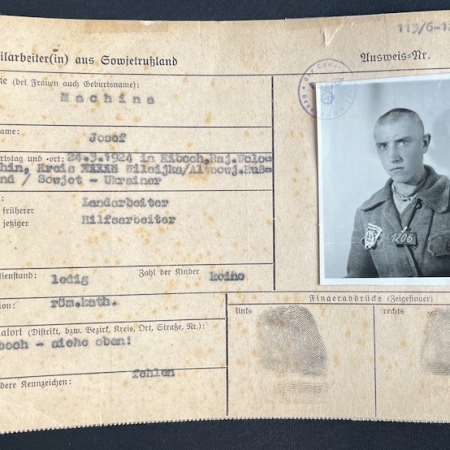
WW2 German Ost Worker Card – Ukrainian ran away never found – Sent to Braunau am Inn Hitlers Birthplace (Sold)
An Interesting document with period picture, can be seen the OST Patch in wear. Josef Machina was from Ukraine, and was sent to Austria to work on a farm, but seven days after he arrived to work in Braunau am Inn he ran away in the summer of 1942. After looking in various archives, I was unable to find him mentioned ever again. Although, it is hard to think that Josef made it far from his captives. If caught he was most certainly face strong punishment or even death. Comments: An odd document, many items are seen for OST workers, but rarely is it recorded that they ran away.
-
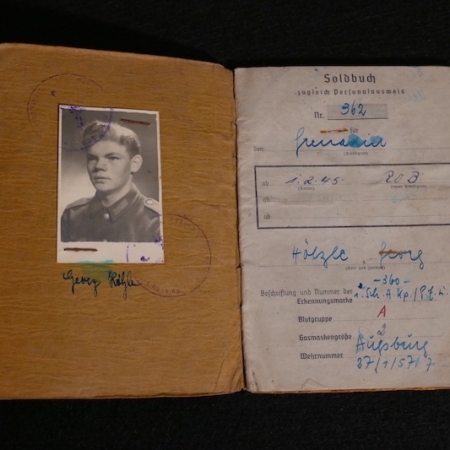
WWII German Soldbuch – Officer Cadet Holzle – Bloodstained – ROB Lehrgang VII (533 Volks Grenadier Division) Combat against US Troops 1945 (Sold)
George Holzle, was born in 1927 in Augsburg Germany, by November 1944 he was called up for service. After a short stint in a replacement unit he was promoted to Officer Cadet and sent to: ROB Lehrgang für Infantrie VII Lenggreis. According to my research this unit was plunged into action in 1945. This unit fought at the beginning of April 45 on the Tauber and was also largely destroyed there, part of it came to the Heilbronn area, including to the 246th VGD and in the Jagst-Kocher area, including to the 553rd VGD. The remnants moved through Niederstetten, Craislheim, Rothenburg o.d. Tauber, Schwäbisch Hall, Rems-Murr-Kreis Gaildorf, Aalen, Heidenheim, Ulm, Günzburg, Mindelheim further back into the Alps. Hölzle survived WW2 and died in 2001.
-
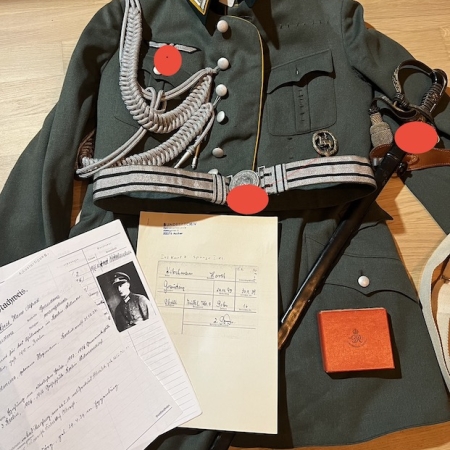
WWII German Uniform / Medal / Sword / Belt – Attributed to Oberst Horst Kitschmann – Regimental Commander – Panzer Aufklärungs Abteilung 5 – Kavallarie – Military Attache to London/Kabul/Helsinki – With Archive Documents – Worn in London pre WW2 – Super Rare (Sold)
Directly out of the woodwork, this amazing story of Oberst Horst Kitschmann. Amazing Uniform was worn in London in 1937! Interestingly, he had the tailor add some material to the inners of the tunic for his left shoulder, as he badly wounded in WW1. Items included: Period Tunic of the Regimental Commander A.A 5 Aiguillette (never removed from Tunic) Officer Parade Belt and Buckle Officers Sword and Internal carrying strap English Medal for the Coronation 1937 with Sweetheart Ribbon German Horseman’s Badge in Silver Kitschmann had an impressive career, the new owner will receive a copy of the 78 Page Folder from the German Archives. Here is a brief synopsis of his career, found below. Kitschmann, Horst Hans Alfred *24.02.1895 in Graudenz †11.11.1975 Vater: Oskar Kitschmann, Dezernent für das Schulwesen in Berlin, †1918 Mutter: Wilhelmine, geb. Heymann, †31.12.1934 Ehefrau: Gertrud, geb. Albrecht, *21.12.1903, verheiratet den 26.05.1938 2 Söhne (*1939 / *194x) Promotions: 27.01.1915 Fähnrich 31.05.1915 Leutnant (Patent vom 11.09.1915) 01.07.1922 RDA vom 01.09.1915 (134) erhalten 31.07.1925 Oberleutnant mit RDA vom 01.04.1925 (110) 01.04.1930 Rittmeister (15) 01.12.1935 Major (21) 01.01.1939 Oberstleutnant (19) 01.11.1941 Oberst (13) Career: 18.08.1914 als Kriegsfreiwilliger in das Füsilier-Regiment Nr. 35 eingetreten 05.11.1914 als Fahnenjunker im Füsilier-Regiment Nr. 35 übernommen 07.01.1915 verwundet 02.06.1915 dem I. Ersatz-Bataillon des Füsilier-Regiments Nr. 35 überwiesen 04.09.1915 zur 2. Ersatz-M.G.-Kompanie des III. Armeekorps kommandiert (bis 29.02.1916) 26.09.1916 zur Lehr-M.G.-Kompanie des Rekruten-Depots 56 kommandiert 02.11.1916 verwundet 04.08.1917 zur 2. Ersatz-M.G.-Kompanie des III. Armeekorps 07.01.1918 in das Radfahr-Bataillon Nr. 1 versetzt 16.02.1918 erkrankt 07.11.1918 zur Ersatz-M.G.-Kompanie des III. Armeekorps kommandiert 21.02.1919 beim Freiwilligen Detachement Graf Stillfried 01.06.1919 mit dem Detachement in das Reichswehr-Infanterie-Regiment 5 übergetreten 29.03.1920 in das Reiter-Regiment 6 versetzt 19.05.1922 im 6. (Preuß.) Reiter-Regiment (Umbenennung) 01.04.1929 in das 1. (Preuß.) Reiter-Regiment versetzt 01.10.1930 in das 7. (Preuß.) Reiter-Regiment versetzt 01.04.1934 als Hauptmann in das Kraftfahrlehrkommando Zossen versetzt 30.01.1935 Hauptmann beim Kommandostabe 01.06.1935 Chef der 7. Kompanie 20.06.1935 Hauptmann beim Kommandostabe 15.10.1935 im Panzer-Regiment 5 (laut Stellenbesetzung) 15.02.1936 zum Generalstabe des Heeres (3. Abteilung) kommandiert (bis 31.03.1936) 26.02.1936 mit dem 01.04.1936 als Gehilfe zum Militär-Attaché bei der Deutschen Botschaft in London versetzt 25.03.1938 mit dem 01.04.1938 zum Kommandeur der Aufklärungs-Abteilung 5 ernannt 17.10.1940 mit dem 09.10.1940 Führerreserve OKH unter gleichzeitiger Kommandierung zur Panzertruppenschule 20.12.1940 Kommandierung aufgehoben 24.01.1941 mit dem 15.01.1941 zum Panzer-Regiment 201 kommandiert 21.02.1941 mit dem 10.02.1941 zum Kommandeur des Panzer-Regiments 202 ernannt 12.07.1941 Führerreserve OKH 04.10.1941 mit dem 26.09.1941 als Vertreter des Militär-Attachés zur Deutschen Gesandschaft in Helsinki kommandiert 29.11.1941 Kommandierung beendet mit dem 17.11.1941 (Dienst regelt der Chef des Generalstabes des Heeres (Attachéabteilung)) 20.01.1942 mit dem 05.02.1942 zum Militär-Attaché in Helsinki ernannt 01.10.1944 Führerreserve des stellv. Generalkommandos des II. Armeekorps 05.02.1945 zur Schießschule der Panzertruppen Putlos kommandiert 19.02.1945 zum Lehrtrupp der Panzertruppenschule Bergen kommandiert (bis 05.03.1945) Auszeichnungen: 18.11.1916 1914 Eisernes Kreuz 2. Klasse 16.05.1919 1914 Eisernes Kreuz 1. Klasse xx.xx.1918 Verwundetenabzeichen in schwarz xx.xx.1934 Ehrenkreuz für Frontkämpfer 02.10.1936 Wehrmacht (Heer) Dienstauszeichnung 4. bis 2. Klasse xx.xx.1939 Wehrmacht (Heer) Dienstauszeichnung 4. Klasse 27.08.1937 Großbritannische Krönungsmedaille König George VI (Genehmigung zur Annahme) 27.09.1939 1939 Spange zum Eisernen Kreuze 2. Klasse 30.09.1939 1939 Spange zum Eisernen Kreuze 1. Klasse 17.12.1940 Allgemeines Sturmabzeichen 20.04.1944 Kriegsverdienstkreuz 2. Klasse mit Schwertern He was also the winner of a Hungarian Medal worn around his neck, as well as Finnish Awards. _____________________________________________ Final comments, Kitschmann was imprisoned in Moscow along with Raoul Wallenberg and was even played in a character in the series about Raoul Wallenberg. Kitschmann is mentioned in many articles because of this link. Military Attache in London: extremely rare to find any German Militaria related to the UK. There are many references to Kitschmann in Helsinki as he was the leader of the Military Attache till the wars end. Price includes worldwide shipping


