Showing 928–936 of 1271 resultsSorted by latest
-

Soldbuch – Leutnant Gerhard Thiele – Volks Artillerie Korps 401 – Normandy / Ardennes / Rhein Battles – CCC & EK1 (HOLD)
Leutnant Gerhard Thiele Thiele was born in the Zwickau area of Germany on the 18th of January 1914. In His Civilian life he was a Technical drawer, married and living with his wife. Soldbuch is a second issue, issued to Thiele at the : Schwere Artillerie Ersatz und Ausbildungs Abteilung (mot) 38 in November 1944. Frontline Unit Served from 1939 till 1944 with: Artillerie Regiment 711 / 711 Infantry Division From Normandy to Belgium In June 1944 the division was in Normandy north of Liseux and thus exactly east of the Allied landing area. The division formed the westernmost division of the 15th Army. During June 6, 1944, Allied paratroopers jumped in the area of the division, which had the task of securing the area east of the landing heads. The division was able to use two companies against the Allied paratroopers. Since the division was not set for a fight with the Allies, the 346th Infantry Division was inserted between the division and the landing heads. The 711th Infantry Division then occupied the previously uncontested stretch of coast between Cabourg and Le Havre. From mid-August 1944, this stretch of coast came within reach of the Allied units and the division had to intervene in the fighting. The units that were arriving were involved in the fighting to varying degrees up to August 20, 1944. By early September 1944, the division was pushed back to the area south of Dunkirk and southeast of Boulogne. On the 5th September 1944, the not yet refreshed division had to withdraw to Courtrai. On September 10, 1944, the “Kampfgruppe 711 Infantry Division” was in the Oostsonbourg area, 3 km north of Vlissingen. On September 11th, the combat group marched off in the direction of Antwerp. It must have been here that Thiele was wounded for the 3rd time in his career. On November 5, 1944, the division held a 9 km deep bridgehead south of the Meuse, 12 km north-northwest of Breda. It would seem that the wounding was not so serious, and he was wounded once again now the fourth time on the 18th of November 1944. Thile was awarded the Iron Cross First Class for his actions in November 1944. Ardennes 1944 Thiele was with: Heeres Artillerie Batterie 1092 , armed with a rare 12.8cm K44 Pak. It is highly likely that Thiele was a Batterie Commander. 7th Army – Its role was to protect the southern flank of the Fifth Panzer Army and the entire Ardennes Offensive. Like the other two German armies in the offensive, the 7th Army took substantial losses. The 7th Army defended against the northward attack of the US 3rd Army, but ultimately failed to halt General George S. Patton‘s drive to Bastogne and Houffalize. The 7th Army, however, managed to avoid encirclement and retreated again to the Westwall. It seems that Thiele was then wounded by shrapnel on December 22nd, 1945. Thiele would on his release from hospital join the: Volks Artillerie Korps 401 / 1. Fallschirm-Armee – “Operation Plunder” Thiele was once again posted to an artillery unit, and was once again wounded by shrapnel. His unit was involved in actions between March 23 and 27, 1945, the army took part in the defense against the Allied Operation “Plunder” and was unable to prevent the Allied units from crossing the Rhine. Thiele was then sent to a hospital in Zwickau, and on the 15th of April 1945 he was on the way to his hometown, to check in at the hospital. According to his family a strange event took place, when he was mistaken for a war criminal due to his name, he was handed over by Soviets to the US Army. This story is also recorded in a book: “Gardelegen Holocaust – By Torsten Haarseim” – It was reported on the 16th of April in the New York Times that the war criminal was found, although they had the wrong man. They had arrested the wrong Thiele. His grandson wrote this on a German Forum: “My grandpa didn’t tell much about the war. My great aunt said that he suddenly cried out at night and got up drenched in sweat. But rather came from captivity. A few days before the surrender he was at home in full gear (Werdau near Plauen). I assume that his unit was wiped out or surrendered. There he then hid until he reported to a Russian commandant’s office, where he was first taken into Russian captivity. Now that’s a bit strange. This is what my grandpa told his sister-in-law shortly before he died (my great aunt). My grandpa was extradited to the Americans because they were looking for someone from the SS who had the same name as my grandpa. He came to Dachau, there it was probably to be interrogated (from which the nightmares came). He was probably only able to stay afloat because he repaired American shoes from old tires. It must have been around 1951 when he was released from captivity. When he arrived in Berlin he found his wife in Berlin Tempelhof, from there he went by plane to Frankfurt and by bus to Sachsenheim (near Bietigheim – Bissingen). There he got an apartment and worked. My father told me that my grandfather had a lot of pictures from the Eastern campaign, probably also interesting ones through the telescopic sight, inquiries with the relatives did not yield anything. I must have some at home and want to have no idea. But I think you know such problems, if not you can be happy. I was able to save something. As you can see, he was technically gifted, this beautiful box is now 40-50 years old. Alt. He died in 1997 at the age of 81. “ Awards 6.9.1941 – War Merit Cross with Swords 8.9.1942 – Eastern Front Medal 28.8.1942 – Iron Cross Second Class 30.6.1942 – Wounds Badge in Black 12.5.1944 – Close Combat Clasp in Bronze 22.10.1944 – Wounds…
-
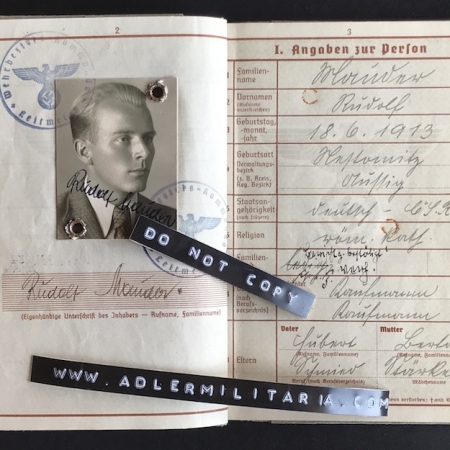
Wehrpass – Obergefreiter Rudolf Mauder – Panzergrenadier Regiment 382 / 164. Leicht Afrika Division – Killed at El Alamein, October 1942 (Sold)
Obergefreiter Rudolf Mauder Rudolf Mauder was born in Czechoslovakia, on the 18.6.1913 into a Roman Catholic family. Rudolf married during the war, and in his civilian life he was a salesman. His Wehrpass was issued in March 1939, and he was called up in January 1940 with an infantry replacement unit he was trained on the MG18, and K98 Rifle, as well as how to be an aimer/gunner. It would seem that he was the gunner on the Regiments infantry support weapon, likely a 7.5 cm leichtes Infanteriegeschütz 18. Frontline Units February 1940 – August 1942 Infanterie Regiment 382, 13 Kompanie, Infanterie Geschütz (164. Infanterie Division) After the Battle of France, Mauder was deployed in Greece, Romania, Yugoslavia and later Creta. 1.9.1942 – 24.10.1942 Panzergrenadier Regiment 382, 13 Kompanie, Infanterie Geschütz (164. Leichte Afrika-Division) Mauder was killed on the first day of the Second Battle of El Alamein that took place near the Egyptian railway halt of El Alamein. Wounds Malaria contracted in Greece Awards German Italian Campaign Medal Comments An interesting grouping, Mauder was killed at a very important battle in North Africa. He is buried in his own grave in El Alamein.
-

Soldbuch – Unteroffizier Willi Zabel – Panzerjäger Lehr Abteilung 130 – Normandy 1944 / Ardennes 1945 – Jagdpanzer IV(Sold)
Unteroffizier Willi Zabel Zabel was born on the 13th of August 1918 into a protestant family in Kassel. Zables Soldbuch was issued in April 1940 with a Schützen Replacement unit. Frontline Units Schützen Regiment 6 Under the 7th Panzer Division, Zabel was wounded in Russia with the Regiment. Panzer Grenadier Regiment 59 Under the 20th Panzer Division in Russia, Zabel was shot this time with an infantry bullet. Panzer Jäger Lehr Abteilung 130 Zabel served with: – Stabs Kompanie (Later in Versorgungs Kompanie) Pz.Jg.Lehr-Abt. 130 was armed with31 Jagdpanzer Model IV distributed among Stab (3), 1. and 2. Kp. (14 each) but by 1.6.1944 4 were with the Stab while 1., 2. and 3. Kp. each had 9 plus 4 7,5 cm Pak 40 mot.Z. According to the Soldbuch, Zabel was with the Abteilung from April 1944 til his capture in 1945. On D-Day itself, the division was near Paris under the control of the I SS Panzer Corps as part of the OKW (Oberkommando der Wehrmacht – High Command of the German Armed Forces) armoured reserve. The division was immediately ordered forward but in doing so, suffered delays and equipment losses (mainly soft-skinned vehicles) due to the Allied air superiority over Normandy. Entering the line next to the 12th SS Panzer Division ‘Hitlerjugend’ near Caen, it fought several British and Canadian attacks to a standstill, even managing (with elements of the 2nd Panzer Division and 101st SS Heavy Panzer Battalion) to retake the village of Villiers-Bocage in a counterattack after it was captured by the British 22nd Armoured Brigade. This battle also saw the famous action by panzer ace SS Obersturmführer Michael Wittman. The division was then relieved by the 276th Infantry Division and on 7 July transferred to the LXXXIV Corps opposite US forces as they prepared to breakout as part of Operation Cobra, which was launched on 25 July. It was immediately preceded by an aerial bombardment from 1,500 Allied bombers and although this caused a lot of disruption and badly hit morale, there is still debate as to the actual number of casualties and equipment losses this caused. Nevertheless, despite suffering from both personnel and equipment attrition, the division managed to hold the advance of the entire US VII Corps to less than two miles on the 25 July. By the beginning of August, the division was down to around 11,018 personnel and thirty-three operational tanks and assault guns, with another forty-four under repair but following the encirclement of German forces at Falaise, the division was split into three Kampfgruppen (battlegroups) who fought their way out to re-join German forces retreating eastwards, eventually reuniting at Senlis. It then retreated into the West Wall covering Bitburg, took part in the early battles for the Siegfried Line in Luxembourg with the LXXXI Corps before withdrawing to the Saar region and then Paderborn to be rebuilt and refitted under Sixth Panzer Army. It was then transferred to the First Army and helped prevent the collapse of Army Group G in November 1944 by counter attacking US forces advancing on the Saverne Gap. The division was then placed under the control of the XXXXVII Panzer Corps, part of the Fifth Panzer Army under General der Panzertruppen Hasso von Manteuffel which was due to take part in Operation Wacht am Rhein, more commonly known as the ‘Battle of the Bulge’. However, the premature commitment of several units (including Panzer Lehr) in order to stem the advance of US forces just weeks before, led to the operation being postponed while the units involved were brought back up to strength. Even so, Panzer Lehr was still under strength (twenty-seven PzKw IV, thirty Panthers and twenty Jagdpanzer IV/70s) by the time the operation commenced on 16 December and so was reinforced by two tank destroyer battalions and an assault gun brigade. The 26th Volksgrenadier Division was meant to clear the way for the division but became bogged down. Panzer Lehr, which had been part of the Fifth Panzer Army’s reserve (along with the Führer Begleit Brigade), entered the line where it besieged Bastogne (held by the US 101st Airborne Division) but could not take the town. When the offensive failed, the division relocated to the Netherlands and fought in the Battle for the Maas Line and then moved south to try to eliminate the American bridgehead at Remagen in early March 1945. By this time the division was merely a burnt out shell of its former self, being only a large battalion battle group in size. It then retreated into the Ruhr Pocket, surrendering to the US 99th Infantry Division on 15 April 1945. Wounded 31.8.1941 – Grenader Splinter left side 4.1.1943 – Shot with a Infantry bullet Awards 3.1.1941 – Black Wounds Badge 22.12.1941 – Tank Assault Badge in Bronze 8. 1943 – Sports Badge in Bronze 1. 1945- War Merit Cross with Swords Equipment Zabel had a model 35 Pistol Comments An interesting Soldbuch to a Normandy/Ardennes fighter, highly desirable unit, so much information online about this division on the web. Very nice picture taken with Zabel in Panzer Black uniform. Sadly, Zabel died as a POW in France September 1945 in Mont de Huisnes France when he is now buried. Moreover, the damage on the Soldbuch would indicate it was burned, although the information was wrote around the burn which could indicate that the damage was wartime.
-
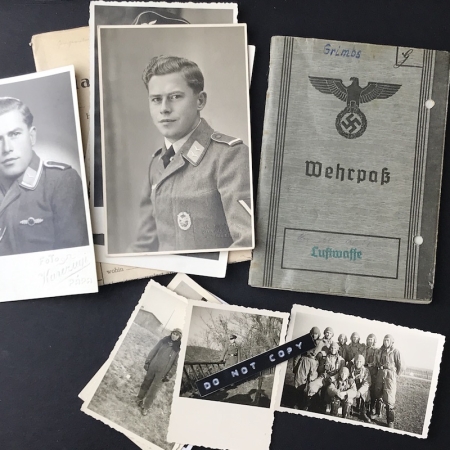
Wehrpass – Unteroffizier Alois Grimbs – Kampfgeschwader 4 General Wever – HE 177 Bomber – Survived a Plane Crash – EK1/FFSG (On Hold)
Unteroffizier Alois Grimbs Alois Grimbs a mechanic born 1921 in Riedelsbach living in Peisselberg. He volunteered the military in 1939 and served: Oct.39 with Flak-Ersatz-Abteilung 351 in Friedrichshafen(?); Oct.-Dec.39 with Luftwaffe-Bau-Kompanie 21/VII; discharged Dec.39; called-up again 1941; Aug.-Oct.41 with Luftnachrichten-Kompanie Flieger-Bereitschaft Ansbach; Oct.41-Apr.42 with Luftnachrichten-Stelle Regensburg; Apr.-Jun.42 with Luftnachrichten-Stelle Ansbach; Jun.-Jul.42 with Luftnachrichten-Stelle Crailsheim; Jul.42-Apr.43 board radio operator schooling at Luftflotten-Nachrichten-Schule 2 in Königgrätz; Apr.-Jul.43 with flight school Blindflug-Schule 5 home based at the airfield in Belgrade-Semlin Serbia. Jul.43 till Apr.45 he served as a He 177 heavy bomber plane board radio operator with: Kampfgeschwader 4 „General Wever“. The wing was named after General Walther Wever, the prime pre-war proponent for a strategic bombing capability for the Luftwaffe, who was killed in an aircraft accident in 1936. In the period 1943-45 the Kampfgeschwader covered the continuous retreat of the Wehrmacht at the Eastern Front until the end of the war, in the tactical and supply role. Bases where he flew his missions from during this period: 1943 Avord (France); 1943-44 Sarabus (Crimea) , Nikolayev (Ukraine); 1944 Odessa (Ukraine), Sarabus (Crimea), Krosno (Poland), Milec (Albania), Focsani (Romania), Zilistea (Romania), Buzau (Romania), Grosswarden (Rumania), Debrecen (Hungary), Budapest (Hungary), Papa (Hungary), Novy Dvor; 1945 Novy Dvor (Belarus), Dresden. He got severely wounded Apr.45 when his plane crashed on 11.4.45. He burned both his hands and his face (1st and 2nd degree burns) and was hospitalised in Heiligenstad-Königsgrätz and Miesbach. Discharged Jun.45 with burning scars on hands and face, as mentioned on the POW release document. Awards: Front Flying Clasp in Bronze (13.1.44), Iron Cross 2nd Class (26.2.44), Iron Cross 1st Class, Front Flying clasp in Silver, Front Flying Clasp in Gold (30.1.45). 1) Wehrpass, 2.5.39. One staple of the cover loose. 2) Krankenblatt, 1945. Medical document. 3) POW certificate of discharge, 27.6.45. 4) 10 very nice uniform photos. Three postcard sized. Wearing flying gear, with bomber clasps etc. Comment Nice grouping to a desirable unit and a combat experienced airman, who was lucky to survive his plane crashing.
-
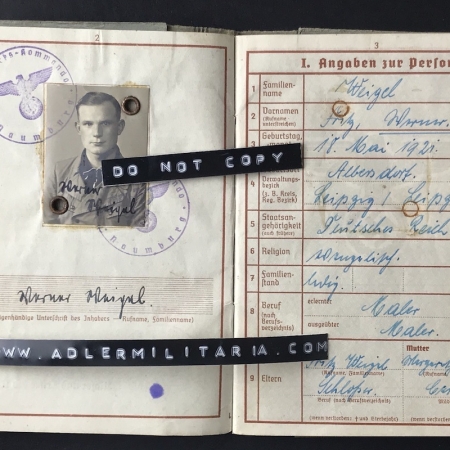
Wehrpass – Unteroffizier Werner Weigel – Kampfgeschwader 55 – Survived a Crash landing – FFS/EK2/VWA (on Hold)
Unteroffizier Werner Weigel Werner Weigel was born on the 18th of May 1921 in Albersdorf Leipzig, in his civilian career he was a painter. Weigel was enlisted in the RAD on the 3rd of October 1940, he spent only 3 months in the RAD before he was called up to the Wehrmacht. He arrived for training on the 10th of February 1941, by July he was sent for training as an Observer. Interestingly he was found fit for all roles in the aircraft and was sent for training. After successful training, Weigel was assigned on the 16th of August 1942 to the: 12th Staffel, Kampfgeschwader 55 Weigel would spend until March 1943 with the IV Gruppe in Dijon France, the unit was mainly used for training runs from France to Germany, they were dropping concrete bombs. They flew the Heinkel 111, and reported only a few losses. For more information of their stay in France, including pictures: https://www.histavia21.net/LIEUX-HISTOIRE/BA-102/LONG-0007a1.htm On the 14th of April 1943, Weigel joined the II Gruppe, 6th Staffel, Kampfgeschwader 55 In 1943, from June 5th to 22nd, it took part in the air raids on Gorky and Yaroslavl. In night raids, together with other combat squadrons, the “Molotov” armored car plant and the Yaroslavl synthetic rubber plant were to be attacked. 282 people were killed in Gorki, 527 injured and 52 buildings of the plant were destroyed. In Yaroslavl, over 120 people were killed, around 150 others injured and over 200 buildings (including some of the rubber works) completely destroyed. Then the staff, the II. And III./KG 55 took part in the Operation Citadel. It seems that in such a short time Weigel had earned himself the Front Flying Clasp in Bronze as well as the Iron Cross Second Class in the space of one month. On the 16th of June 1943 until Weigel was wounded in an emergency landing in a Heinkel 111 due to an engine fire due to enemy fire, the crash was so bad that two crew members were killed in the crash Weigel. Below the details of the Crash as well as the name of the young Pilot Officer who was killed in the landing. Weigel acting as Observer survived a crash landing due to a fire on board on their return from a combat mission, in which the pilot and another crew member was killed. WUNDERLICH, Otto. (DOB: 01.05.21 in Postelberg, Krs. Saaz/Bohemia). 17.05.43 Lt., 6./KG 55 KIA – emergency landing due to engine fire – vic Bakhekolkhos farm near Krichevo. Buried at Donezk. Comments An interesting Wehrpass from a highly sought after KG, Weigel flew 32 combat missions in a very short time. Weigel was extremely lucky to survive the crash, but he would never fly again. A Heinkel 111 from KG 55
-

Document Grouping – Oberwachtmeister Erich Thrun – Cherkassy Breakout 1944- Met GFM von Manstein & Goebbels! (HOLD)
Grouping to Oberwachtmeister Erich Thurn Cherkassy Breakout Erich Thurn was born in Hagen/Haspe on January 1915, and worked in his civilian life as a Saddler. Thrun was a volunteer and started his career in Wehrmacht in 1937. During the war, Thrun was serving with the Artillerie Regiment 389 with the 389 Infanterie Division. Thurn survived the downfall at Stalingrad and somehow made it out, and was later encircled in 1944 in the famous Cherkassy Pocket. Interestingly, Thurn had displayed extreme courage earning the Iron Cross First Class. He featured in various wartime Newspapers some of the highlights are listed below. Thrun explained to the newspapers that the Soviets had tried their hardest to get the Germans to surrender using leaflets, loudspeakers and propaganda. As well as constant air attacks on their positions on the ground. Thurn found himself knee deep in a cold swamp trying to push out of the encirclement, Thrun explains that the villages around him left and right were all on fire. Their group made it through the swamp and seen a tank and could hear German, they had reached the German lines! After three weeks trapped in the Pocket. Thurn was presented to Feldmarschall von Manstein after the breakout! Original photo included! After which he was sent on leave to Berlin where he would be presented to Propaganda Minister Goebbels. Included in the Grouping is the following Three Newspaper articles displaying Thrun and his story Photo with GFM von Manstein – Original Photo printed on Agfa Brovira Iron Cross Second Class Medal Iron Cross Second Class Document – July 1942 Signed by Generaloberst Erwin Jaenecke (Knights Cross winner, wounded at the Battle of Stalingrad was flown out!) Wounds Badge in Black Wounds Badge Document Marriage Certificate from 1943 A Certificate confirming his awards in August 1945 from the field police. Certificate of Discharge 1945 Three letters from the Bundesarchive A Certificate thanking Thrun for helping to rebuild his hometown of Hagen in 1947 An unusual grouping, but very interesting to find anything related specifically to the battles at Cherkassy!
-
Soldbuch – Unteroffizier Richard Scherzer – Flak Abt 13400 – KIA Paris 1944 – FFI & US Army Battles (Hold)
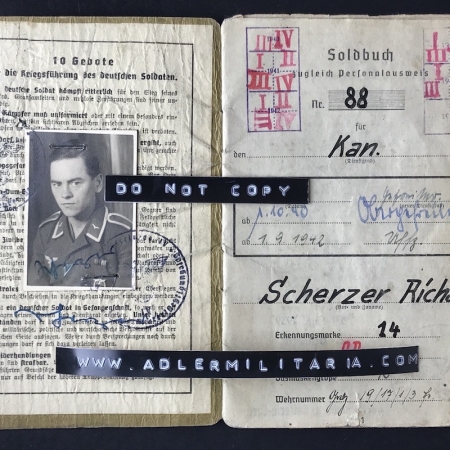
Unteroffizier Richard Scherzer Richard Scherzer was born on the 16th of August 1919 in Germany. He was enlisted in the Luftwaffe with: 1./Flak Regiment 38. They supported the 5th Panzer Division during the Polish campaign. Then the department was in Regensburg and took part in the French campaign in May 1940 under the staff of Flak Regiment 102 under the I. Flak Corps. The department was then located in Le Havre and, from January 1941, in Sicily. From June 1941 she took part in the Russian campaign with the I. Flak Corps. In 1943 the department was on the Don. From November 1943, the division was under the 10th Flak Division in southern Russia. On the 12th of June 1944, Scherzer was with: Schwere Flak Abteilung 13400 (mot) in North France. Interestingly, by August/September 1944, Scherzers unit had clashed with the FFI also known as the Maquis on the outskirts of Paris. According to the FFI Museum: ‘’American forces bypass Paris to the east. In the lead, the recognition of the 4th Cavalry Group followed by the 3rd Armored . The 1st German Army strives to put up roadblocks behind the capital. In La Queue en Brie and in Plessis Trevisse a battalion of the Flak arrives in the early morning. The FFI surprised, can only slip away in the face of the irruption of nearly 600 men with many guns. At La Queue, one or two batteries with 150 men take up positions on the plateau around the village. This is probably Major Krebs’ Battalion 13400, Schwer Flak Abteilung 13400. This heavy, motorized battalion was made available to the 48th German division on a barrage mission. Shortly afterwards, the positions of the camouflaged guns were overflown by a few American planes which suffered a few gusts. The first clashes took place around 6 a.m. with the FFI. The position was abandoned after half an hour of fighting. The Germans fall back towards Chennevières. At 7 p.m., the American armored vehicles ( 3rd Armored and 1st Infantry ) arrived through the woods and took up position at the Pavé de Pontault. Exchanges of fire take place. The tanks of the 634 Tank Destroyer accompanying the 26th Infantry Regiment pounded the battery. At Plessis-Trevisse, a column of American armored vehicles also opened fire on a German formation. The Flak artillerymen left the sector during the night of August 27 to 28. The next day, we find on the ground, at La Queue, two abandoned 88 and three 20 mm guns, a mortar, three trucks and a car loaded with ammunition. In Plessis-Trevisse, the FFI found a tractor and its 88 gun, machine guns. ’’ Scherzer was reported missing or killed on the 24th of August 1944, either by members of the FFI or the US Army and is buried today in Champigny-St.André near Paris. Pictures of the abandoned Flak of Scherzers Abteilung can be seen here: http://museedelaresistanceenligne.org/media4437-ArrivA Below French Resistance Fighters take on Germans on the Streets of Paris. Although for some reason Scherzers award page is missing, it is very odd as the page can be clearly seen to be ripped out. Was it done by Scherzer to conceal something, we will never know the answer. Although it can be clearly seen on his photo that he is wearing the following awards: Iron Cross Second Class Luftwaffe Ground Assault Badge Black Wounds Badge Small Clasp with Annexation Medal Bars Comments Scherzer saw both fronts and was decorated for his combat experiences, he raised the ranks from a simple Kanonier to a Unteroffizer. Killed in Northern France in 1944, this Soldbuch is still very sought after even though the awards page have been taken out.
-
Wehrpass – Gefreiter Arnold Huesmann – Landesschützen Batl 660 – KIA Italy Cassino February 1944
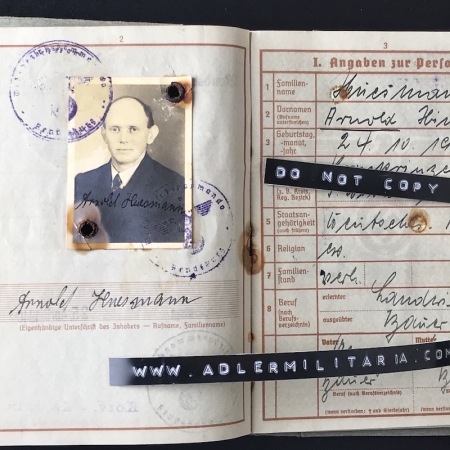
Gefreiter Arnold Huesmann Huesmann was born on the 24th of October 1905 in Germany into a Protestant family. He was married and worked in his civilian life as a farmer. His Wehrpass was issued in April 1940, and by October 1940, he had sworn an allegiance to Adolf Hitler with a Infantry replacement unit in Heide. He served as a guard with Landesschützen Batl 660 in the Munsterlarger for nearly two years before being sent to the Front. Huesmann arrived in Italy with Landesschützen Batl 686, and was killed in Anagni, Italy on the day before the official Battle for Cassino began. According to online sources the town was badly smashed on the Allied advance lines by heavy aerial bombardment. Huesmann was killed and buried in Anagni, but it seems he was later reburied in the main German Cemetery at Cassino, Italy.
-

Wehrpass – Stabsfeldwebel Waldemar Ullmann – Battle of Moscow / Ardennes Offensive – POW Remagen – 17 Years of Service! (on Hold)
Stabsfeldwebel Waldemar Ullmann Ullmann was born on the 17th of March 1910 in the area of Reuthen, Germany into a catholic family. Ullmann married during his service in 1941, although oddly it seems his wife was removed as next of kin. Ullmann volunteered for service in October 1929, with Infanterie Regiment 7 , as part of the 100,000 Man Reichswehr! His Kompanie was the 13th Kompanie which was named in honour: Schlesisches Füsilier-Regiment “General-Feldmarschall Graf Moltke” Nr. 38 Infanterie Regiment 470 / 260 Infanterie Division – From Belarus to Moscow! According to Ullmanns Wehrpass he served in the following actions, here an extract from the history books. The move to the eastern front began on June 30, 1941. The train went to Siedlce, which was reached on July 4th. Unloading took place here and the march into the Wysokie Litowskie area was carried out until July 6th. As a corps reserve, the division then marched via Pruzana and Baranowicze to Lubany. There IR 470 had its first skirmishes with Russian units. On July 19, the march continued in the direction of Berezovka and on July 20, parts of the regiment attacked Romanishche together with the IR 460. At 8:20 p.m. the location could be taken. The attack continued on July 21st. The regiment crossed the Rudyanka River, passed through Pess’tschanya, and took Chernin in the evening. On July 23, the battle of Romanishche broke out and was to be retaken by the Russians. This was prevented by the 260th Infantry Division. On July 27th the regiment marched further north. After Rudjaanka was reached, the division and the regiment set up to secure the front. From August 5th, an attack to the south was launched to close the gap between Army Groups Central and South. On August 10, the division was replaced by the 45th Infantry Division and marched north again. On the night of August 12th the Berezina was crossed at Shazilki and the Dnieper at Streschin on August 13th. They then met their army corps and attempted to prevent the enemy forces from breaking out between Rogachev and Shlobin. The regiment had to fend off difficult enemy breakthrough attempts. On August 19th the encirclement was over and the regiment marched south again towards Gomel. On August 23, the movement began with an attack in the direction of Chernigov in order to enclose the enemy armies near Kiev. Parts of the division had reached Desna by August 30th. On September 1, the regiment began its attack on Kisseleska from the heights around Tschernisch. When the 5th Company reached the bank of the Desna, a platoon succeeded in crossing the river with river boats and forming a bridgehead. The regiment extended the bridgehead to the villages of Poski, Wibli and Uborki. The next day it had to fend off severe counterattacks. Via Chernigov, Kiev was advanced further and the return route of the Russian troops was cut off. The division established itself on the Chernigov-Kiev road and repelled all Russian attacks. The badly battered division and thus the regiment no longer took part in the further fighting during the Battle of Kiev. It stayed in the positions it had reached and rested. It was not until September 14 that the regiment marched again, this time to the northeast in the direction of Bryansk and then further north to Dubrovka. The first frost occurred on September 27th. At the end of September the 52nd Infantry Division was relieved at Dubrowka. On the night of October 2, the regiment began to attack Moscow. The regiment crossed the Dessna and formed a bridgehead. By the evening 120 bunkers had been knocked down and 200 prisoners taken. The first snow fell on October 6th. On October 7th, the Kaluga-Brjansk railway line was taken, and it continued in the direction of Kaluga. But on October 21st, the advance in the baseless mud was stopped. The regiment took up position in the Okatal. At the beginning of November the regiment and the division moved into the Kremenki bridgehead. When the German attack on Moscow resumed on November 13th, the regiment moved into its staging area on either side of Browna and made a deep break in the enemy frontline on the first day of the attack. In spite of this, the division and regiment’s attack remained concentrated in the increasingly fierce enemy resistance. On November 14th, the initiative passed to the Red Army and breached the frontline on the wings of the regiment. The attacks of the regiment did not abate on November 15 either, and only the 260 Artillery Regiment, which fired 2050 shells that day, was able to prevent a breakthrough. But the attacks began again on December 8th. On December 15, Russian units succeeded in breaking through the 52nd Infantry Division, so that the Kremenki bridgehead had to be evacuated. On December 17, the regiment repelled a Soviet attack into the seams of the 260th and 52nd divisions. At noon, the regiment was overrun by Russian tanks and 40 soldiers were killed. The regiment went back to Radenki. The division was trapped by Russian forces and had to free itself from the encirclement at Christmas. The division withdrew to the Detschino area and moved to the new line on December 31st. Ullmann was wounded in these breakout fights and was lucky to have made it out. It was not until January 1943 until he was back on the frontline again, now healed from his wounds and now a Stabsfeldwebel. Serving with the Machine Gun Company of Infanterie Regiment 684 / 335 Infanterie Division The division was then transferred to France as an occupying force and used to secure the coast in Brittany and near Marseille. In October 1942 the division was reclassified into an attack division and in February 1943 it was transferred to the 1st Panzer Army on the Don. Heavy defensive battles followed on the Donets and in the Voroshilovgrad area by August 1943. In September and…


