Showing 487–495 of 1403 resultsSorted by latest
-
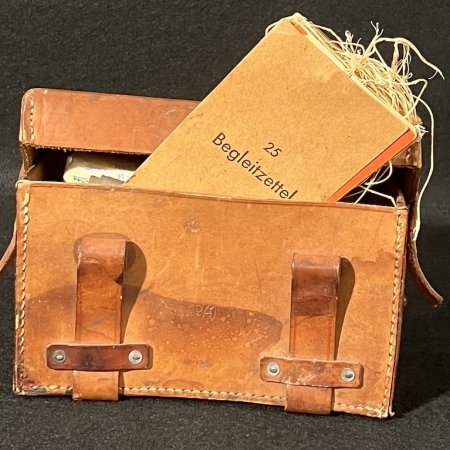
WWII Original German Army Medical Pouch 1941 with Original Contents
A really nice pouch with the wound tags still inside. The Liquid looks to have ran out a long time ago.
-

WWI & WWII Kreigsmarine Wehrpass & Marine Militärpass Matrosen Stolz – SMS Nassau – Battle of Riga – Battle of Jutland – Dog Tag WW2
Here we have a really interesting KM Grouping. This grouping comes with a Photo on board the SMS Nassau which is modelled in the below video really well: It seems he was called up in WWII and did a small service, for which his WWII KM Tag was added to his Wehrpass when he was discharged. Battle of Jutland
-

WWI German Militärpass & Wehrpass Grouping – Johann Steigerwald – Infanterie Regiment Nr 40 – Battle of Riga 1916 Iron Cross – Captured in Soissons 1918
$150.00An Interesting little grouping to Johann Steigerwald, Who served with Infanterie Regiment Nr 40 on both the Eastern and Western Front during World War One. Interestingly he fought at the battle of Riga in Latvia and earns the Iron Cross Second Class, and in 1918 he was captured in Soissons, France he was released in September 1919. During the Third Reich he was issued a Wehrpass which confirms his service in WW1. Could make a really nice research project.
-
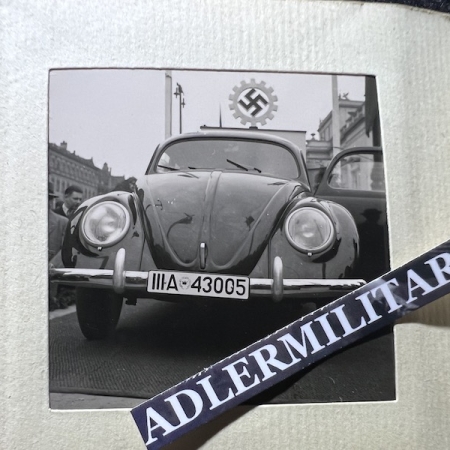
WWII German Min Photo Album Leipzig KDF Wagen Volkswagen Beetle Art Museums Streets with Flags
$225.00An interesting original album of a civilian in Leipzig. Many street photos with the Nazi era banners. The most interesting photo by far is of the KdF Wagen.
-

WWII Photos of Obersalzburg – Hitlers House – Eagles Nest – Berchtesgaden – Berghof – Haus Wachenfeld – SS Base (Offer Accepted)
Interesting photos showing personal spaces around Hitlers Berghof residence, many famous places shown here. These were removed from an Album.
-

WWI & WWII US Army Generals Mess Dress – Lt General William Morris – Distinguished Service Cross & Purple Heart – Battle of Saint-Mihiel France 1918 – Rare
$3,950.00Here we have a wonderful original and in fine condition for its age. (Over 100 Years Old) Mess Dress and trousers bought in West Point Military Academy in 1912 – named to W Morris. His Min Bar has never been removed and is from the Interwar Period. Showing his awards at that time. History William Morris was born in the Ocean Grove section of Neptune Township, New Jersey, on March 22, 1890. After graduating from grammar school and high school he was appointed by Congressman Benjamin Franklin Howell to the United States Military Academy (USMA) at West Point, New York, in 1907. He graduated from there in June 1911. After graduation he was commissioned as a second lieutenant into the Infantry Branch of the United States Army and was assigned to the 19th Infantry Regiment at Camp Jossman, Philippine Islands. He then served at Fort McKinley, afterwards transferring to the 15th Infantry Regiment with duty in Tientsin, China, where he served from 1912 to 1914. In 1914, Morris was assigned to the 9th Infantry Regiment in Laredo, Texas, where he served until 1916. While there he married Ida Marguerite Downing, who he met soon after being commissioned in 1911. Morris was then appointed as a Reserve Officers’ Training Corps (ROTC) instructor and basketball coach at Texas Agricultural and Mechanical College (now Texas A&M University), where he served until 1917, when he returned to the 9th Infantry Regiment as its S-2 intelligence officer. WWI Morris was promoted to captain on May 15, 1917, over a month after the American entry into World War I. Thirteen months later he was a major. In July 1918 he was sent to the Western Front and was appointed commanding officer (CO) of the 1st Battalion, 360th Infantry Regiment, part of the 90th Division of the American Expeditionary Force (AEF). He led his battalion in the Battle of Saint-Mihiel and in the Meuse–Argonne offensive. He was wounded on November 1, just ten days before the end of hostilities on November 11, 1918, an action for which he received the Distinguished Service Cross, the nation’s second highest award for valor in the face of the enemy, and the Purple Heart. He remained in Europe with the Army of occupation, commanding his battalion in Germany, and then serving on the staffs of the (AEF) General Headquarters (GHQ) and the IX Corps. Citation for Distinguished Service Cross For extraordinary heroism in action near Villers-devant-Dun, France, November 1, 1918. During darkness he led his battalion in an attack under heavy artillery and machine-gun fire. Upon reaching a hill he exposed himself to heavy fire to reconnoiter personally the enemy position, and then, although wounded by a machine-gun bullet, heroically led his battalion in their advance, refusing to be evacuated, inspiring his men by his personal courage. WW2 In February 1942, two months after the United States entered World War II, Morris, by now promoted to the one-star general officer rank of brigadier general, raised the 6th Armored Division as its first Commanding General (CG). He was promoted to the two-star rank of major general fifteen months later, in May 1943. In 1943 he was CG of the II Armored Corps. He was sent to Italy as a Ground Force Observer for the Salerno landings in September 1943. He returned to the United States and became CG of the XVIII Corps. Upon hearing of the death of Major General Paul Newgarden, CG of the 10th Armored Division, who died in a plane accident, in July 1944, he contacted General George C. Marshall, the U.S. Army Chief of Staff, and requested demotion to command of the 10th Armored Division, then preparing for transfer to the European Theater of Operations (ETO). His request was granted and he led the division overseas on the Western Front, where it played a played a vital role in the relief of Bastogne during the Battle of the Bulge, the largest battle fought by the American Army during World War II. Following this he was assigned to command VI Corps in Lieutenant General Alexander Patch’s U.S. Seventh Army in the U.S. Sixth Army Group, under Lieutenant General Jacob L. Devers, which drove from the Rhine to Italy in the spring of 1945. He would earn the Silver and Bronze Star in WW2.
-

WWII German M42 Helmet – Trophy from Italy 1944 – “Killed by Alpin Troops & Charles” – Rare (Offer Accepted)
An unusual but great M42 German Helmet. Like many of our helmets they are bring backs, but not many are like this. The Alpin Troops – 10th Mountain Division in Italy 1944 Price is Posted Tracked World Wide
-

WWII German Waffen SS – M43 Feldmütze – Field Cap – 1010/44 – Dachau 1944 Produced – GI Bring Back 63rd Infantry Division April 1945 Germany ( With COA ) – Rare (Offer Accepted)
This is a wonderful issued M43 SS, in a rarer pattern for these 1010/44 (Dachau) from my research his version with the white inside of the visor is not a common model/production run. Condition: It is an issued M43 with the classic look to it as they often folded these away into pack/pocket when not used. Minimal wear. Maker: 1010/44 – Dachau, production year 1944. This Waffen SS M43 was a bring back from: Ernest, Lawrence A. Pfc. 36833006 – 253 Inf Reg, 63rd Infantry Division – US Army https://en.wikipedia.org/wiki/63rd_Infantry_Division_(United_States) Ernest is mentioned in a book also for the battles in April in Germany, he was wounded in early April 1945. Battle Between the Jagst and Kocher Rivers, 4-12 April 1945 – 1997 These series of battles which was captured in some part on video can be viewed here, Ernests exact company can be seen taking hoards of German POWs in April 1945 in Germany. Interestingly, the 63rd Infantry Division was accused of shooting 17 year old Waffen SS recruits in April of 1945. Is this one of these caps? We will never know sadly. More on the killing can be found here: https://en.wikipedia.org/wiki/Jungholzhausen_massacre This M43 was sold by a very reputable dealer in the USA who also made a COA at a value of 3,500 USD. It will be forwarded to the next owner. Please remember, the price shown is including World Wide Tracked Shipping.
-
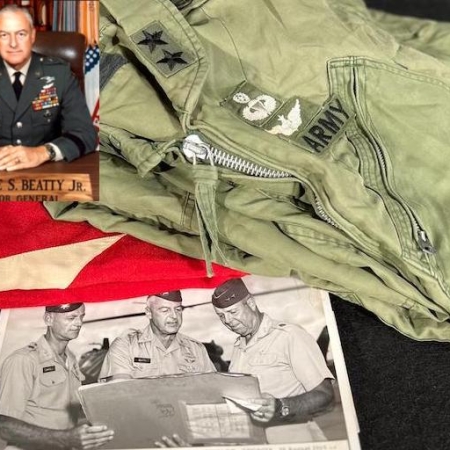
Vietnam War Era US Army – Chief of Staff 1st Cavalry Division (Air Assault) Major General George S Beatty Jr – Generals Flag and Flight Suit – Photos – Rare
NAME: George S. Beatty, Jr. RANK: Major General BRANCH: INF STATUS: Retired SERVICE: 35 years DOB: 26 October 1917 SERVICE INFORMATION HOURS FLOWN: 2483 COMBAT HOURS: 126 FLT/NCO CLASS: 60-1 SCHOOL: MILITARY SCHOOL: Naval War College AVN DESIGNATION: Senior Army Aviator AIRCRAFT INFORMATION CV-2B OV-1 A/B OH-1 A/E OH-13 E/G/H/S T-42 & U-21A U-6 A U-8 D/F UH-1 B/D/H COMBAT EXPERIENCE World War II – Saipan, Okinawa 1941-1945 Korea – 187th ABN RCT 1952-1953 Vietnam – 1st Air CAV 1965-1966 UNIT ASSIGNMENTS 1963-1965 11th Air Assault Division 1965-1966 1st Air Cavalry Division POSITIONS HELD Group Commander CG, Army Flight Training Center DECORATIONS Distinguished Service Medal [11] Legion of Merit [3] Bronze Star w/V device Air Medal [8] SIGNIFICANT ACHIEVEMENTS Howze Board 1962 1st Brigade Commanding Officer Aviation Group Commanding Officer Chief of Staff, 1st Brigade Chairman, AAMF Board During the 1960’s when the Army’s Air Mobility concept was born, tested, and proven in combat, George Beatty played key roles in each of the phases. In 1962 he was assigned to the Army’s Tactical Mobility Requirements Board (“Howze Board”) where he was instrumental in the writing of the plan for the accomplishment of the Board’s mission. He supervised the running and recording of the field tests of all aspects of the Board’s interest. Upon completion of the Board report, he and Colonel (later Lieutenant General) John Norton went to Washington to brief the Board’s findings and recommendations to the Secretary of Defense and other interested Federal Agencies. He was assigned to the 11th Air Assault Division (AAD) in January 1963 as Commanding Officer, 1st Brigade and commanded that Brigade through all of the testing and field exercises. He briefly commanded the 11th Aviation Group in 1965 during which time a composite Aviation Company was formed and sent to the Dominican Republic to support the XVIII Corps. When the 11th AAD was redesignated as the 1st Cavalry Division (Airmobile), Beatty was assigned as Chief of Staff where he coordinated the planning and loading out of the division. In Vietnam, he served as Chief of Staff, and then Brigade Commander of the 1st Brigade. During this eventful year he saw the air assault concept, which he had helped pioneer, proven under fire and accepted by the U.S. Army. From 1968 to 1970, he commanded the Army Flight Training Center at Hunter Army Airfield at Fort Stewart, Georgia where several hundred rotary wing pilots were graduated every two weeks. Training of South Vietnamese students was initiated during this period, and their unfamiliarity with the English language required the introduction of special innovative teaching techniques to enable those students to succeed. Throughout his career, General Beatty was involved in many pioneering developments in the concepts, training, organization, tactics, and equipment that have been incorporated into Army Aviation as we know it today.


