Showing 19–27 of 1445 resultsSorted by latest
-

Original WWII German Propaganda Poster – New Year 1942 Dr Goebbels Speech – 1942 NSDAP “Wochenspruch” (Weekly Motto) Propaganda Poster
$95.00Original 1942 NSDAP “Wochenspruch” (Weekly Motto) Propaganda Poster. This original German propaganda poster features a clean typographic design in red and green, headed by the year 1942 framed with oak leaves and a swastika emblem. The central text is a New Year’s message by Dr. Joseph Goebbels, calling upon the German people to remain steadfast, resilient, and determined in their efforts to achieve victory during the Second World War. Issued as part of the “Wochenspruch der NSDAP” series by the Reich Propaganda Directorate, the poster is Issue 1, covering 4–10 January 1942, and was published by the Zentralverlag der NSDAP, Munich, the official publishing house of the Nazi Party. It retains its original margins and publication details, with light age toning and minor foxing consistent with its age. As an authentic wartime artifact, it represents an example of the Nazi regime’s use of printed propaganda to promote unity, perseverance, and support for the war effort during the opening months of 1942. English Translation “1942. The New Year shall strengthen our people in endurance and perseverance and, above all, give them the strength to fight for victory and for the peace that victory will bring to Germany and to all people of goodwill.”— Dr. Joseph Goebbels
-

Original WWII German Propaganda Poster – Adolf Hitler Speech – 1941 NSDAP “Wochenspruch” (Weekly Motto) Propaganda Poster
$125.00Original 1941 NSDAP “Wochenspruch” (Weekly Motto) Propaganda Poster. This original German propaganda poster features a striking typographic design in black and red, with a stylized sword and industrial symbols representing wartime production. The central text is a quotation attributed to Adolf Hitler emphasizing the duty of the German people to support the fighting front through increased armaments production. The poster bears the artist’s signature Wittig-Friesen and was issued as part of the “Wochenspruch der NSDAP” series by the Reich Propaganda Directorate, Issue 26, covering 22–28 June 1941. It was published by the Zentralverlag der NSDAP, Munich, the official publishing house of the Nazi Party. The poster retains its original margins and publication details, with light age toning and minor foxing consistent with its age. As an authentic wartime artifact, it is an example of the propaganda used to encourage civilian support for Germany’s military production during the Second World War. Translation of the text: “It is the highest duty of the German people, with the fighting front in mind, to do everything possible to provide it with the weapons it needs.”— Adolf Hitler
-
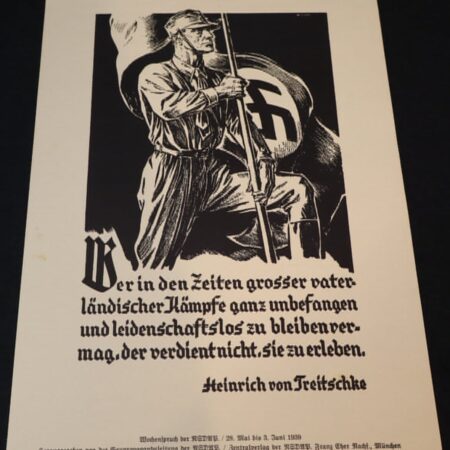
Original WWII German Propaganda Poster – 1939 NSDAP Wall Propaganda Poster (Wandzeitung der NSDAP)
$95.00Original 1939 NSDAP Wall Propaganda Poster (Wandzeitung der NSDAP). This striking black-and-white poster features an idealized standard-bearer carrying the Nazi Party flag, rendered in a bold woodcut-style illustration typical of pre-war German propaganda art. Beneath the image is a quotation by the German historian Heinrich von Treitschke encouraging unwavering commitment during times of national struggle. The lower margin identifies the piece as “Wandzeitung der NSDAP”, Issue 28, covering 28 May to 3 June 1939, published by the Gau Propaganda Directorate of the NSDAP and printed by the Zentralverlag der NSDAP, Franz Eher Nachf., Munich. The poster retains its original margins and printing details, with light age toning and minor foxing consistent with its age. An authentic historical artifact from the final months before the outbreak of the Second World War, it represents an example of the visual propaganda used by the Nazi Party to promote its political ideology.
-

Original WWII German Propaganda Poster “Victory of the Swastika” – Hermann Göring – 1942
“Without the victory of the swastika, there would today be no German armed forces, just as there would be no German honor and no German freedom.” — Hermann Göring The small print at the bottom identifies it as a weekly slogan of the NSDAP, issued by the Reich Propaganda Directorate, dated 1942 Size is a bit bigger than A4
-
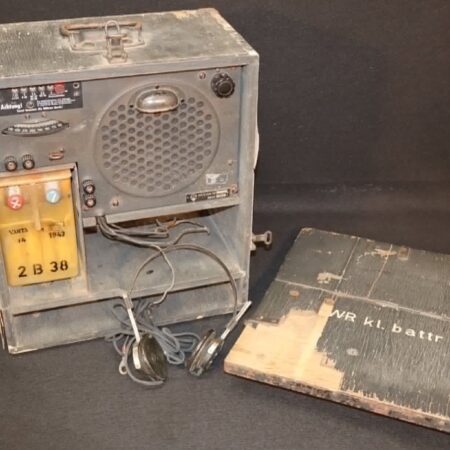
Original German Army WWII Wehrmacht-Rundfunkempfänger – WR kl.battr – 1943 Blaupunkt – Original Rare radio!
$1,750.00WR kl. Battr. abbreviates Wehrmacht-Rundfunkempfänger, klein, Batteriebetrieb—roughly, “small Wehrmacht radio receiver, battery-operated.” It was a portable German WWII troop entertainment and broadcast receiver, not primarily a tactical field-communications set. Typical examples were: A five-valve, six-circuit superheterodyne receiver Powered by separate low- and high-voltage batteries Designed for long-wave and medium-wave reception Made by Blaupunkt production in 1943 Housed in a rugged military carrying case with a removable lid The set was essentially a simplified, compact version of the larger WR 1 Wehrmacht receiver. US SALES ONLY
-
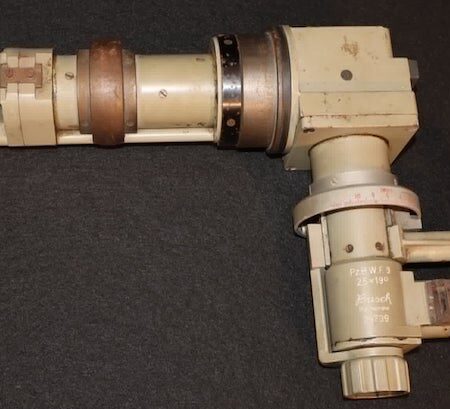
Original German Army WWII Panzer Tank Optic Pz.B.W.F 9 – Panzer-Beobachtungs-Winkel-Fernrohr 9 – Busch Rathenow
$1,500.00The Pz.B.W.F. 9 (Panzer-Beobachtungs-Winkel-Fernrohr 9) is a rare German armored observation periscope used during World War II. If yours is marked: Pz.B.W.F. 9 Busch Rathenow 2.5 × 19° Manufactured by Emil Busch AG in Rathenow, Germany, one of the Wehrmacht’s principal optical manufacturers. Specifications Manufacturer: Emil Busch AG, Rathenow Magnification: 2.5× Field of view: 19° Purpose: Wide-angle observation from inside armored vehicles and fortified positions Rotation: Head prism rotates approximately 180° Illuminated reticle: Many examples were fitted with illuminated aiming/observation reticles Condition as seen, not tested – US Sales only.
-
-
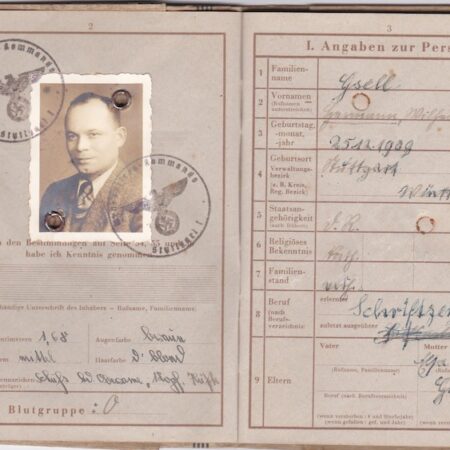
WWII German Wehrmacht Wehrpass – Gefeiter Gsell – Panzer Grenadier Regiment 128 – 23 Panzer Division – Panzer Assault Bronze – KIA Jassy Ukraine 1944
Gsell served with Panzer Grenadier Regiment 128 (23 Panzer Division) on the frontline a few times. On 20 November 1943, 23rd Panzer Division possessed 27 tanks, of which 16 were operational. The 23rd Panzer Division was part of the German defence and retreat in the southern Ukraine, frequently being moved between crisis points. Between April and July 1944 it was a part of the 8th Army within the Army Group South Ukraine defending the area to the north of Jassy Awards: Wounds Badge in Black, Wounds Badge in Silver, Panzer Assault Badge in Bronze His first Wehrpas He was killed on 10.7.1944
-
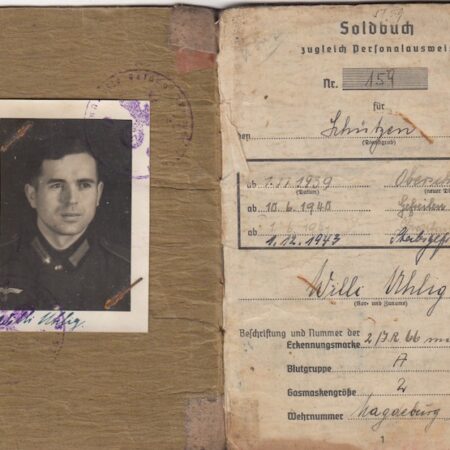
WWII German Wehrmacht Soldbuch – Stabsgefreiter Uhlig – Führerbegleit Brigade (FBB) – MP44 – Fought in battle of the Bulge at St Vith & Bastogne !!
Willi Uhlig served in the German Army prior to the war starting. He was in Infanterie Regiment 66 (13 Inf Division) After the invasion of Poland on September 1, 1939, the regiment was still stationed in the Brieg area. It wasn’t until September 3, 1939, that the order was given to attack Poland. The regiment crossed the border and participated in the attacks on the Warta and Widawka river crossings, establishing bridgeheads across the river. After fighting around the Widawka position, the regiment advanced to the area south of Radom, where it engaged in skirmishes with Polish units. On September 13, 1939, the advance on Pulawy continued, which was reached the following day. Bridgeheads were established at Pulawy and Deblin, and from September 19, 1939, these bridgeheads were expanded, and reconnaissance operations were conducted east of the Vistula River. On October 2, 1939, there was further engagement with Polish units in the Kock area. At the outbreak of war in the west, the 13th Infantry Division, as in Poland, remained in reserve and did not cross the border until May 13, 1940. On May 14, 1940, it reached Ettelbrück in Luxembourg. The regiment marched through Luxembourg, southern Belgium, and northern France to the Meuse River and participated in the defensive battles west of the Meuse near Sissonne. From May 20, 1940, it engaged in defensive battles in the Serre sector, and from May 22, 1940, it advanced to the Somme River and participated in defensive battles near Péronne and Corbie. The regiment was then deployed to the Doullens/Authie area and subsequently participated in the Battle of Dunkirk. Afterward, the regiment remained on the Channel coast as coastal defense until June 1, 1940. By June 6, 1940, the regiment had moved to its assembly area for the Battle of France in the Amiens bridgehead. Following the breakthrough battle on the Somme, the regiment was deployed north of Roye on June 11, 1940, and marched via Petit Morin to the Seine. This was followed by pursuit battles to the Langres Plateau and on both sides of the Côte d’Or. After attacks against the Western Alps, fighting took place on the upper Rhône and at Lac de Bourget. Following the armistice, the regiment assumed security duties near Coluz and began marching back to its garrisons on July 5, 1940. Upon reaching the garrisons on July 10, 1940, the regiment immediately began restoring operational readiness. As early as August 30, 1940, the regiment, along with the division, had to transfer to Vienna to serve as a training unit in Romania. On September 28, 1940, the III Battalion was disbanded, and the regiment was redesignated as Training Infantry Regiment 66. The regiment marched to its security and training area near Roman and Focsani. Following the severe earthquake in Romania on November 10, 1940, the regiment led the rescue and cleanup efforts. Unit was renamed: Schützen Regiment 66 (13 Panzer Division) Schützen Regiment 66 was formed on May 12, 1941. The regiment was created through the reorganization of Infantry Regiment 66. It remained subordinate to the 13th Panzer Division. Tactically, the regiment was subordinated to Rifle Brigade 13. The regiment was stationed in Upper Silesia and was transferred in June 1941 to its assembly area west of Hrubieszow. It was not until June 23, 1941, that it crossed the Bug River with the division. Rowno was captured by June 28, 1941, and the Stalin Line near Hulsk was reached on July 6, 1941. The line was breached by July 9, 1941, and the advance continued towards the Irpen River. Defensive fighting ensued there from July 11, 1941, and the advance to Fastow was not possible until July 20, 1941. A bridgehead was established there across the Unava River. Security battles ensued near Mironovka and Korsum. August 4th and 5th, 1941, were rest days before the regiment participated in security battles near Ivanovka and Dacha from August 6th, 1941. From August 19th, 1941, offensive battles took place in the Ssula sector, and on August 22nd, 1941, the regiment deployed to Dnipropetrovsk. Fighting around the city continued until the end of the month. After the heavy fighting, the regiment was withdrawn from the front and replenished south of Dnipropetrovsk. However, the replacements were far from sufficient to fill the gaps. From September 16th, 1941, the regiment moved to the assembly area and bridgehead of Kremenchug. From September 21, 1941, the regiment engaged in defensive battles along the Ssula River sector until September 24, 1941, when it launched another offensive towards Dnipropetrovsk as part of the Battle of Kiev. After the conclusion of the Battle of Kiev and a day of rest, the regiment marched to the Sea of Azov and reached Mariupol on October 10, 1941. From October 12, 1941, it advanced and engaged in offensive operations along the Mius and Zambek river sectors. By the end of October, the regiment had only 50% of its manpower remaining. Following the failed attack on Rostov in mid-November, the regiment, along with the division, was forced to retreat to Babinsky and was placed on standby there. At the beginning of December, the regiment occupied the Zambek-Mius line. It held this position throughout the winter of 1941/42, until July 1942, resisting all Russian attacks. He was trying to hide his unit by removing page 17, although he did not hide his Feldpost Number: 05952 But on closer inspection he was assigned to the 6. Kompanie, Grenadier Führer-Grenadier-Brigade . He was issued many interesting items, including a MP44 in November 1944 as well as Iron Rations. The Führerbegleit Brigade (FBB) was an elite German Army unit originally formed as a guard and escort force for Adolf Hitler. By late 1944, it had expanded into a combat formation and was committed to frontline operations during the Battle of the Bulge. During the Ardennes Offensive in December 1944, the Führerbegleit Brigade was attached to the German Fifth Panzer Army under General Hasso von Manteuffel. Its role was to support the main German thrust through…


