
Showing 46–54 of 77 resultsSorted by latest
-

WWII German Wehrmacht Soldbuch & Wehrpass – Kanonier Karl Lüddeke -Bautzen 1945 – 15cm Nebelwerfer 41 – Werfer-Ersatz- und Ausbildungs-Abteilung 1 – Ausbildungs-Division 404
$265.00Karl Lüddeke was born in Goslar 1927, his Soldbuch was issued in December 1944. He was enlisted into a Werfer training unit, where he was trained on the 98K Rifle, 15cm Nebelwerfer 41, MG34, Luger P08 and the Machine Pistol. He was promoted on the 19.3.1945 as a RUB – Reserve–Unteroffizierbewerber – an NCO candidate. Although by April 1945, his training school was deployed into the Ausbildungs Division 404 – The Division 404 was set up in April 1945 by renaming Division No. 404 in the Lübben – Görlitz – Bautzen area, including all the training units still remaining in this area. The division was deployed with the training troops against the Red Army and against the Americans. The division headquarters was in Dorfhain. Nice complete set to a late war very young Soldier.
-

WWII German Passport ID – Reispass – Berlin Tempelhof 1935 – Film Industry Worker
$85.00Here we have an original German Passport for a Lady from Berlin Tempelhof. She worked in the German Film Industry, sticking film together. Tempelhof was known for the Film Studios, some ruins remain there today from the former studios. Price includes shipping.
-

WWII German Flugblatt for Red Army Soldiers to Surrender
$75.00Interesting piece offering the Red Army Soldier safety if he surrenders and shows this. These were shot over the Red Army positions.
-

WWII German Newspapers Late 1945 – Woman Fighting! – Last ditch Propaganda – On Hold
Some last ditch propaganda, not often to find such later newspapers like this. Very interesting text for the German speaker and late war images.
-
Sale!

WWII German Berlin Verkehrs Betriebe BVG Ausweis – U-Bahn – January 1945 –
Original price was: $85.00.$45.00Current price is: $45.00.WWII German Berlin Berkehrs Betriebe BVG Ausweis – U-Bahn – January 1945 – Issued by the Commander of Berlin (See stamp) Rare
-
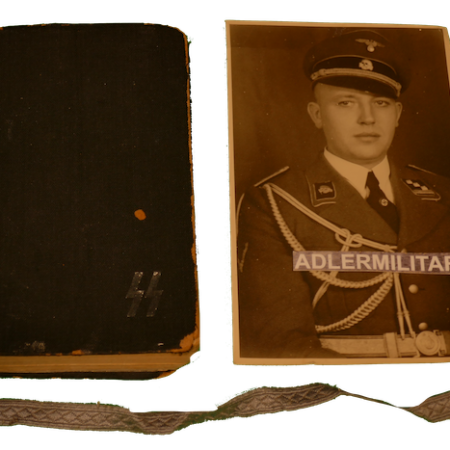
WWII Waffen-SS Grouping – SS-Obersturmfuhrer Georg Kinzler (DKiG) – Totenkopf Division 1942 SS Pocket Diary – One of Kind – Very Rare (Offer / Reserved)
SS Obersturmfuhrer Georg Kinzler (DKiG) This incredible SS Diary details the Demyansk Pocket 1942, transcribed into 53 Pages into English with Annotations. It is completed with a USB Drive with the 53 Pages. All Inside a Ring Binder. Extra Research Demyansk Pocket The Demyansk Pocket was the name given to the pocket of German troops encircled by the Red Army around Demyansk, south of Leningrad, during World War II’s Eastern Front. The pocket existed mainly from 8 February to 21 April 1942. A much smaller force was surrounded in the Kholm Pocket at the town of Kholm, about 100 km (62 mi) to the southwest. Both resulted from the German retreat after its defeat during the Battle of Moscow. The successful defence of Demyansk was achieved by using an airbridge and was a significant development in modern warfare. Its success was a major contributor to the decision by the Army High Command to try the same tactic during the Battle of Stalingrad, but it then failed to save the Sixth Army, commanded by Friedrich Paulus. In April 1941, the Totenkopf Division was ordered East to join Field Marshal Wilhelm von Leeb’s Army Group North. Leeb’s force was tasked with advancing on Leningrad and formed the northern wing of Operation Barbarossa. Totenkopf took part in the advance through Lithuania and Latvia, and by July had breached the Stalin Line. The division then advanced past Demyansk to Leningrad where it was involved in heavy fighting in August. During Soviet winter counter-offensive, the division was encircled for several months near Demyansk in what became known as the Demyansk Pocket. During the fighting in the pocket, it was re-designated “Kampfgruppe Eicke” due to its reduced size. In April 1942, the division broke out of the pocket. At Demyansk, about 80% of its men were killed, wounded or missing in action. The division was sent to France to be refitted in late October 1942. Comments This diary is a historical insight into the war year of 1942 with the Totenkopf Division, including in the Demjansk Pocket in 1942. Kinzler seemed to be very calculated, many original notes of orders numbers etc Battle of Kursk Kinzler is mentioned in the Battle of Kursk literature, LAST VICTORY IN RUSSIA , The SS-Panzerkorps and Manstein’s Kharkov Counteroffensive February-March 1943, George M. Nipe, Jr, Schiffer Military History Atglen, PA, Page 172 There were a number of forward defensive positions controlling the approaches to the village from the west and they held up the battalion until nightfall. After eliminating these defenders and driving the main body of Russians out of the town, Schubach rested and reorganized his battalion, planning to resume his attack at 0100 hours. 26 Meanwhile, SS-Hauptsturmführer Wilhelm Schulze’s II./Regiment “Totenkopf’ had begun its advance toward Pavlograd after the departure of Schubach’s battalion from Pereshschepino, taking a different road out of the town. Schulze’s objective was to assemble in the area to the north of Pavlograd, in preparation for attacking the town from the northwest. The battalion was reinforced by motorcycle troops, an artillery battery and the division’s Panzer-Pioniere Kompanie, led by SS-Obersturmführer Georg Kinzler. The long column, moving over narrow, icy roads, advanced slowly to the southeast of Pereshschepino, although its passage through the darkness was unimpeded, until just after midnight. At that point it ran into a detachment of Soviet cavalry troops, at the village of Popassnoje, fifteen km northwest of Pavlograd. The column deployed for battle and assaulted the village, supported by fire from a battery of 10cm howitzers. By daylight Popassnoje was in German hands and the Soviet cavalrymen had been put to flight, but the battalion was delayed and could not support “Das Reich’s” attack on Pavlograd. When the advance resumed Russian cavalry, numbering about 150-200 men, appeared on the flank of the march route, forcing Schulze to deal with them. A Kampfgruppe of the SS Panzer Pioniere-Kompanie, two assault guns, an SPW and the howitzer battery, set off in pursuit. The commander of the battery, SS Hauptsturmführer Friedrich Messerle, remembered the chase as a ‘crazy hunt out of the wild west.” Following the tracks of the Russian horses, the Germans made their way to a Soviet town, which was typically spread out along the road which ran through its center. By this time, nightfall was approaching and the Germans did not want to risk entering the village and stumbling into an ambush in the dark. The small Kampfgruppe circled its vehicles like wagon train threatened by Indians and positioned its howitzers along the perimeter, ready to go into action at a seconds notice. Just before the dawn, the SS Pioniere cautiously entered the village, feeling their way down both sides of the main street. This flushed out the Soviet cavalry, which suddenly took off across the snow, galloping hard for a hill behind the village. Messerle’s howitzers fired into their midst, but within seconds the Russians reached the edge of the hill, after suffering only a few casualties. By 1945, Kinzler was on the staff of the SS Pioneer School. SS-Pionierschule command structure was the following one. March 1945, the school staff was formed with the following officers : Kdr. : SS-Obf. Klein Adjutant : SS-Ostuf. Nägele Ia : SS-Ostubaf. Deschner (then SS-Hstuf. Kinzler in April) Ib : SS-Staf. Hermann IVa : SS-Hstuf. Förster IVd : SS-Ostuf. Hohl V Pi. : SS-Hstuf. Otto-Karl Witt TFK : SS-Hstuf. Paduch 01 : SS-Ostuf. Stelzenmüller Stamm-Kp. : SS-Hstuf. Schwarz SS-Pionier-Sperr-Bataillon “Brosow” April 1945 – defended bridges while the school was being evacuated and its remaining personnel withdrawn. Kinzler was awarded the German Cross in Gold as per, Mark C Yergers book in 1945. We have chosen not to share the complete content of Georg Kinzler. Due to the fact that many details of the battle have not yet been published. This is a prime, first hand item for any serious Military Archive or Museum or an advanced Private Archive.
-
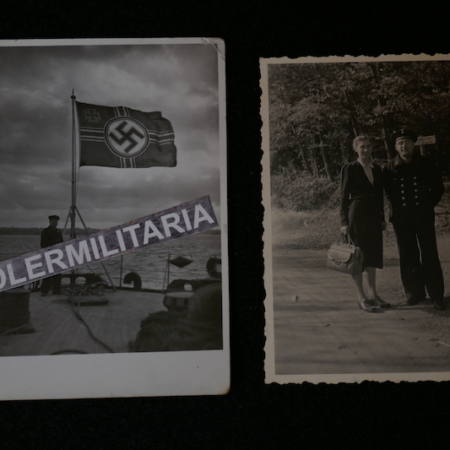
WWII German Kriegsmarine Photo of Flag onboard “Panzerschiff Deutschland 1936 – Neue Fahne”
$65.00Two Original photos, one taken on board the Panzerschiff Deutschland 1936. Great photo for a flag collector.
-
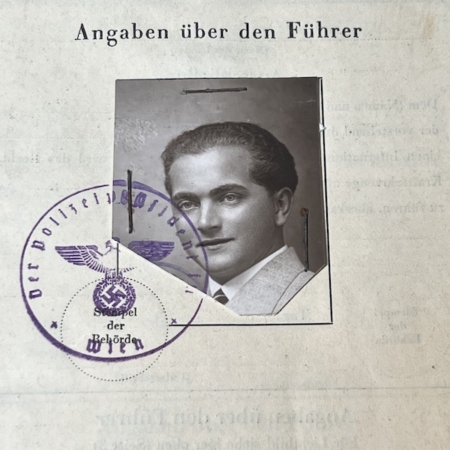
WWII German International Driving Licence – 1936 Vienna Austria – Rudolf Augesky
$135.00Not so often seen document, but there is a photo inside as well as three stamps at the rear with his name and address.
-
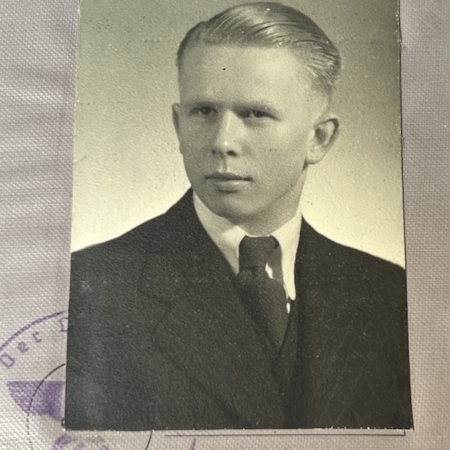
WWII German Passport Original Drivers Licence issued in 1939
$65.00Original Drivers Licence issued in 1939


