Showing 10–18 of 77 resultsSorted by latest
-
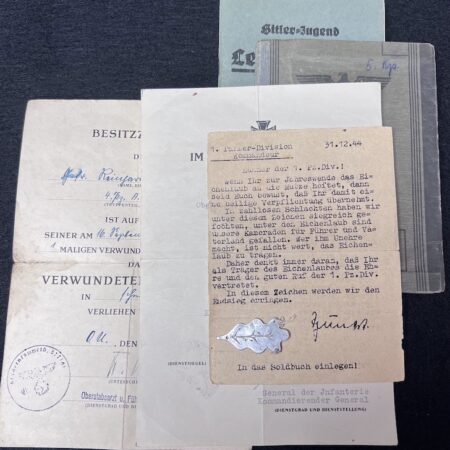
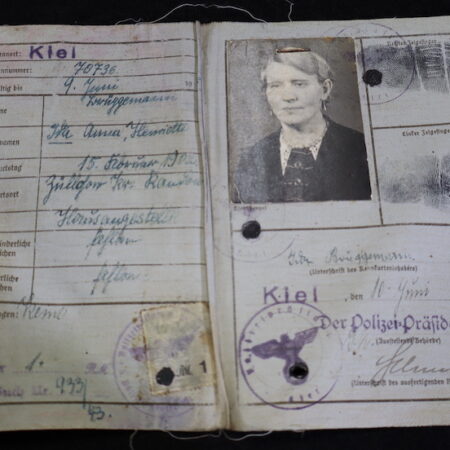
Original WWII German Wehrmacht Wehrpass & Traditions Badge Grouping – Obgefr Reinhold Zschau – Panzer-Aufklärungs-Abteilung 1 – 1 Panzer Division – Iron Cross Certificate – RARE!
$1,550.00Here we have a unique an amazing 1st Panzer Division Grouping. Trained on the 98K, Luger Pistol, MG34, Pak 3,7cm, Pak 38 (5cm) and Pistol P38. His frontline unit he joined in December of 1943 Panzer-Aufklärungs-Abteilung 1 – 1st Panzer Division The 1st Panzer Division was engaged in the southern sector of the Eastern Front to serve alternately within the 1st and 4th Panzer Army as an emergency force. It was constantly thrown from crisis location to crisis location as the German front lines retreated, taking part in battles at Kiev, Zhitomir and Cherkassy. The latter battle saw the division attempting to break through to the cauldron but falling just short. By March 1944, the division had been reduced to just over 25 percent of its nominal strength. Retreating further westwards, the division was part of the Kamenets-Podolsky pocket and, from there, took part in the defence of eastern Poland and Hungary. It was engaged in defensive operations around Lake Balaton and took part in the unsuccessful attempt to break through to the Siege of Budapest and once more suffered heavy losses.[9] The final month of the Second World War saw the division engaged in the defence of Styria. From there, it retreated westwards to surrender to US forces rather than Soviet ones, successfully crossing the demarcation line between the two. It surrendered on 8 May 1945 in southern Bavaria and most of its soldiers were released from captivity soon after. It seems he was awarded the Iron Cross Second Class in April 1945 with the division in Hungary. A really nice set with the Traditional Badge for the Division with the Paperwork with it! Some HJ related paperwork also comes with it.
-
-
-
-
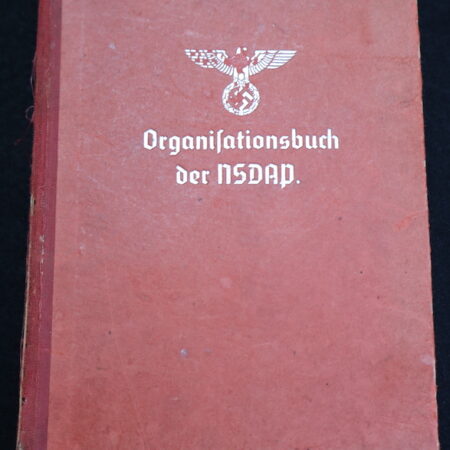
Original WWII German – Organisationsbuch der NSDAP – 1943 Edition – Rare book!
$545.00Free World Wide Shipping
-

WWII German Arbeitsbuch ID – Italian Lady Irma Parmisari – From Castelnuovo Italy
$75.00Issued to a lady from Italy, born in Castelmioov (Castelnuovo) She worked in a Newspaper printing office then was hired as a helper in a Furniture store in Germany. Price is Shipped!
-
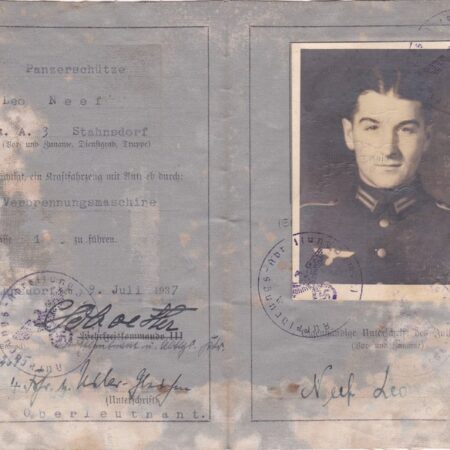
Original WWII German Militär-Führerschein – Panzerschütze Leo Neef – Aufklärungs Abteilung 3 – 21st Panzer Division – KIA Normandy Beuvrigny 1944 Marigny
$169.00Neef served with the Aufklärungs Abteilung 3 – 21st Panzer Division In 1944, he was a Feldwebel and was killed in August 1944 in Beuvrigny. The 21st Panzer Division of the German Army was heavily engaged in defensive battles around the British and Canadian sectors (specifically Sword and Juno beaches) during the Battle of Normandy in June and July 1944. The small village of Beuvrigny is located significantly west of this main engagement area, near the American sector, suggesting the division was likely not present there until the later stages of the campaign (late July/August) or was part of smaller, specific movements. 21st Panzer Division’s Role in Normandy Initial Engagement Area: On D-Day (June 6, 1944), the 21st Panzer Division was the only German armored division positioned close enough to the coast to launch an immediate counterattack. This attack occurred north of the city of Caen, between the British Sword and Canadian Juno beaches, in an attempt to drive a wedge to the sea and push the Allies back. The counterattack failed with heavy losses due to Allied naval gunfire, air superiority, and determined resistance. Defense of Caen: For the rest of June and into July, the division was a core component of the tenacious German defense around Caen, preventing a British and Canadian breakout for over a month. Movement to the West: As the battle progressed and American forces achieved a breakthrough in the west during Operation Cobra in late July, German forces, including remnants of the 21st Panzer Division, were shifted to defend against the Allied advances and were eventually encircled in the Falaise Pocket in August 1944. Beuvrigny is located in the general area the battle moved into as the front line shifted west and south.
-
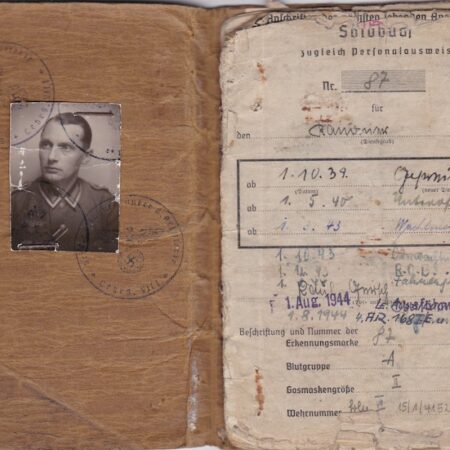
WWII German Army Soldbuch – Wehrmacht Leutnant Gersch – Berliner – Artillerie Regiment 168 – 38 Infanterie Division – Sturmtage – Iron Cross First Class
$275.00Soldbuch opened in August 1939 with Artillery Regiment 168. Issued to Paul Gersch from Berlin Rudow He served with Art Reg 168 till late 1943. The division was already operational at the beginning of the Polish campaign, so that on September 1, 1939 the division became an army reserve of the 4th Army. From the area north of Kraków, the division advanced through Sandomierz to Janow. After the end of the Polish campaign, the division was used as an occupation force in Poland until November 1939 and then transferred to the 16th Army on the Moselle north of Trier. At the beginning of the western campaign, the division was the army reserve of AOK 16 and only took part in the second phase of the campaign, the “Battle of France”. They marched from south of Sedan to Epinal. Already in July 1940 the division was transferred to eastern Poland for border security. On October 15, 1940, the division sold a third of its inventory (Stab IR 196, I./169, I./118 I./196) to the 340th Infantry Division. The levies have been replaced. From June 22, 1941, the division took part in the Russian campaign. The division advanced across the San from the Yaroslav area. The division advanced past Lemberg via Vinnitsa to the Cherkassy area. Here the division formed the flank protection of the 6th and 17th armies. In October 1941 the division continued its advance through Poltava to Kharkov. Heavy winter fighting then broke out in the Izyum am Donets area. These were to last until May 1942. After that, the division took part in offensive battles on Izyum and Znamenka. In the summer of 1942 the division marched to Voronezh-on-Don. Here the division remained in trench warfare until February 1943, when the division had to join the German retreat after the defeat of Stalingrad. Defensive battles and positional battles followed on the Oskol, near Gorshetsnoye and in the Ssumy area west of Kursk. In July 1943, defensive and retreat battles followed on the Dnieper. The division then stood until November 1943. On November 1, 1943, the division was converted into an infantry division of a new type 44 and the third battalions of the three regiments were dissolved. In November 1943 the division moved to the Radomyshl area and was in December 1943 near Zhitomir. It was in this room that it was smashed in January 1944. The remnants of the division were pulled from the front and collected and refreshed at the Demba military training area He then was a trainer at the: Schule für Fahnenjunker der Artillerie Lehrgang VIII School for Officer Cadets of the Artillerie In March of 1945, Gersch was wounded with an infantry bullet (I.G) and in May of 1945 he is back again in hospital in Hamburg due to a code 34: accident of self mutilation. So one thing is clear he certainly seen action after his training. Issued a FN Pistol and later a Mod 27 Pistol. Medals Eastern Front Medal Iron Cross Second Class Iron Cross First Class Assault Days 28.01.1943 – Alarm Regiment 1 (Einheit Embacher) 29.01.1943 – Alarm Regiment 1 Included in the back of the Soldbuch are the 10 Rules for German Soldiers. Final Comments: A nice Soldbuch to a real combat Officer. Awarded both classes of the Iron Cross. Interestingly, after his deployment with his Officer rank it seems he once again seen combat, although I am unsure with who. Maybe the School or maybe back to his old unit? Missing one page 13/14
-
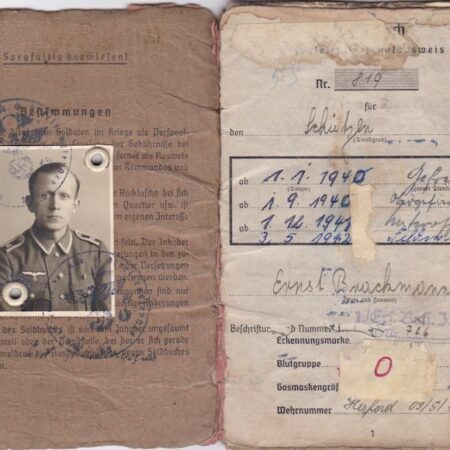
WWII German Wehrmacht Soldbuch ID – Unteroffizier Ernst Brackmann – Festungs Pak Verband 5/XXVI – 8,8 cm Pak 43 – Wounded Frankfurt-Oder April 1945 (HOLD)
$165.00Unteroffizier Ernst Brackmann Served with many units, although the most interesting is: Festungs Pak Verband 5/XXVI The staff of Fortress Anti-Tank Unit XXVI was established in January 1945 in Military District V as an army unit. In March 1945, the Fortress Anti-Tank Companies 1./XXVI to 10./XXVI were formed in Military District III (Berlin). The unit was deployed in the Frankfurt an der Oder area. They were armed with the 8,8 cm Pak 43 Wounded with grenade splinters – 18.4.1945 – arrived at Beelitz in a Reserve Hospital. Awards – War Merit Cross with Swords – Wounds Badge in Silver Final Notes He himself entered in a Promotion and EK1 & EK2 – I believe these to be self promotions and likely postwar as its with a ball point pen. Also the entry on page 17, “Schwere Jagdpanzer” is phoney. But still is an interesting Soldbuch given the small issues.


