Showing 883–891 of 1271 resultsSorted by latest
-
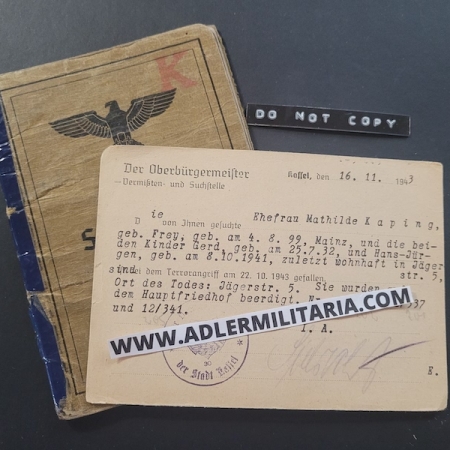
Heer Soldbuch – Uffz Kaping – Panzer Regiment 201 (Paris) & Panzer Regiment 2 – KIA in 1945 – Sad Story (on Hold)
Soldbuch to Horst Kaping,
He raised the ranks from Schütze up to Unteroffizier.
The Soldbuch was issued in October 1940.
Frontline Units:
Panzer Regiment 201
On November 19, 1940, the Army High Command, Chief HRüst and BdE, ordered the establishment of Panzer Regiment 201 to take over the French tank stocks captured in the western campaign and make them ready for use in the field by the Wehrmacht. On December 1, 1940, the line-up begins under the responsibility of Military District Command V, Stuttgart. After investigations by the new regimental commander, Lieutenant Colonel Conze, the installation site was determined to be the Caserne Mortier in Paris, Porte des Lilas. Lieutenant Colonel Conze will soon leave due to illness, his successor will be Colonel Werner-Ehrenfeucht. The commanders of the two departments are Major von Heydebreck and Captain Wolff. In December, the personnel units from several tank regiments and replacement units of the military districts IV, V, VI, VII and XIII arrive to form the regimental staff and two tank divisions of three combat companies each. On December 11th, the regimental headquarters company and one headquarters company for each of the departments are set up. They are recruited from military districts V and XIII. On December 13th, the first type 35 Somua 38 Hotchkiss tanks were taken over. Wheeled vehicles are allocated from French, Belgian and British booty stocks, hand weapons from French booty stocks. In terms of supplies, the regiment is placed under the 16th Motorized Infantry Division at the turn of the year. At this time, the Wehrmacht High Command was preparing the operation against Gibraltar.
In a very short time, the department with equipment from the 201 Panzer Regiment, housed in the barracks of the French Air Force Ministry in Paris, Place Balard, was made ready for use. The Commander-in-Chief of the Army, Field Marshal von Brauchitsch, inspected the tank department on February 11, 1941 and expressed his special appreciation for the work carried out. For political reasons, the Gibraltar operation was not possible.
On April 25, 1941, she was placed under the AOK Norway and left Paris by rail. At the beginning of the Eastern campaign it was the only German tank division to be deployed in Finland and successfully fought near Salla, where it played a major role in the capture of the city 3rd Company equipped with the heavy French 32-ton tank B 2 (Renault) and separated from the regimental unit. On June 4, 1941, it was combined with a similarly equipped company from Panzer Regiment 202 in Panzer Division (F) 102 and was deployed in the storming of Przemysl at the end of June 1941. During May, engineer platoons and light columns are set up in the departments. The workshop trains that have been created in the meantime are combined to form a tank workshop company. Regardless of the unrest caused by the setups and adjustments, Panzer Regiment 201 fulfilled its mission. The French tanks are converted and rebuilt after extensive attempts to drive, fire and shoot, they receive radio equipment and are adjusted to the tactical German requirements. The regiment companies carry out training on the Vincennes training area at the gates of Paris, as well as target practice up to the plateau on the Mer du Sable site. In a stay of several weeks at the large military training area Mailly le Camp near Chalons as well as in Suippes, cooperation in the division, regiment and brigade association is practiced during the summer months. Together with the air force, artillery and infantry, exercises of combined weapons are carried out, at the same time the cadres of the regiments 203 and 204 to be set up – the former later as army troops, then with a division each in the tank regiment “Greater Germany” and in the tank regiment 1 used, the latter later with the 22nd Panzer Division – as well as Romanian tank officers trained. Generalfeldmarsmall von Witzleben and Colonel General von Blaskowitz visit the regiment. The latter in particular promotes training in the association very significantly. Hardly having returned to Paris, the regiment had to be deployed as a result of the increased activity of the resistance movements. Regimental headquarters and 1st division are temporarily relocated to Belgium in the Mons – Charleroi area, the II. Division to Brittany – Carhaix area [east of Brest) – in order to carry out security tasks and combat partisans there. Meanwhile, on August 1, 1941, the 7th Company was re-established as a Panzerjäger (Sfl.) Company in Paris. Panzer Regiment 201 provides 50 percent of the staff, the rest comes from tank destroyer units of AOK 1. In Paris, the long-awaited conversion of the regiment to German equipment begins in October as an advance notice of later frontline deployment in the east. On December 12, 1941 Major General von Boineburg-Lengsfeld admitted Panzer Regiment 201 to the 23rd Panzer Division as part of a parade on the polygon on Avenue Viktor. On December 23, 1941, the regiment was rearmed for German Panzer 2, Panzer 3 and Panzer 4. At the same time, the 7th (PzJäg) Kp. reclassified into a light tank company. The sister company of Panzer Regiment 202, which was also reclassified, was taken over as 3rd Company in Panzer Regiment 201. The light columns of both departments move to the Panzer Divisions Supply Leader 128 to form Kw columns. The workshop company receives a 3rd platoon. On February 2, 1942, the OKH ordered the formation of the III. Department under Major Illig. For this purpose, the 1st Division hand over the 3rd Company, and the 2nd Division the 7th Company. Headquarters company and 12th company are formed from Panzer-Ersatz -teilung 100, Schwetzingen, and charges from Wehrkreiskommando IX, Kassel. The department moves into the Dupleix barracks in Paris. At the same time, the other parts of the regiment received winter and shooting training with the new device at the Le Valdahon training area in the French Jura.
Seen below – Panzer Regiment 201 in Paris!

It would seem he served very shortly with Panzer Aüfklarungs Abteilung 7, before being posted in early 1943 with:
Panzer Regiment 2
It is clear that Horst was not in a supply unit and actually in one of the Panzer Companies, (member of 4th Company).
For the last days of his life a report was written on the movements and actions of the 1st Abteilung, of Panzer Regiment 2.
When the regiment found itself in the Vistula bridgehead south of Kielce after the hard and changeable summer fighting at the end of August 1944, there was not much left of an operational tank regiment. Only a few Panzer V and a few Panzer IV are still operational. The months up to January 1945 are marked by hard training and preparation work for the expected major Russian attack. The units are initially housed in self-made forest bunkers and later, when winter sets in, in primitive Polish peasant huts. According to orders, the tanks must be half buried in so-called pit positions. Fir roofs are built so that the aviators cannot see them and the batteries are brought from the tanks to the accommodations to protect against the cold. The men, NCOs and officers march once a week, armed with entrenchments, near the front to help build positions (corps entrenchment day!). The numerous simulation games and target practice are a welcome change in the monotonous service life. On reconnaissance trips, the company commanders and platoon leaders get to know the surrounding area and the future operational areas. In larger exercises in the division association in the area of Morowica and in the 19th Panzer Division, all troops prepare in every possible way for the coming mission. Since the division is to be used as an army reserve (1st Panzer Army) behind the infantry units lying in the front, the responsible authorities in the division, the corps and the army consider it absolutely essential that the division’s staging rooms, and such, are in question yes, with these accommodations, so that the division can really be deployed operationally in the event of a Russian attack. The staging rooms must therefore be at least 50 km behind the front, if possible behind the Nida section. Unfortunately, the headquarters refuses to accept these justified proposals, which also apply in the same way to the neighboring armored divisions. So the regiment remains 12 kilometers behind the front! These facts must be mentioned as they are necessary to understand the catastrophic development in the Vistula bridgehead. On December 24, 1944, the regiment celebrated the last Christmas of World War II in its bunkers and communal houses in and around Komorki. There had been enough time to prepare for this festival, and so everyone, apart from the parcels from home, found a rich table of gifts with food, drink and tobacco. When it comes to New Year’s Eve, there is deep snow, but the Russian still does not attack, and new attack dates are announced. After a big night shooting on New Year’s Eve, the year 1945 is welcomed in the old soldier style in the most atmospheric and outwardly carefree setting. On January 10, 1945, very specific news came from which it emerged that between January 12 and 15, 1945, the start of the Russian winter offensive was to be expected.
For more information on the regiment including pictures: https://www.lexikon-der-wehrmacht.de/Gliederungen/Panzerregimenter/PR2-R.htm
Items Issued:
Winter Clothes
Mixed Iron portion
Awards:
KVK 2 with Swords
Summary
In the rear of the Soldbuch was a post card to Horsts father, Heinrich stating that he had lost his wife and two children on a bombing raid on Kassel. The raid on Kassel was on the 22.October 1943 and killed around 10,000 people of the city and displaced over 100,000 people. Interestingly, Horst was allowed to go home for a few days because of the loss of the home and family. The sadness, would not end for the Kaping family, as Horst was killed in action also in Poland in January 1945. The father lost three children and his wife and his home in Kassel.
-

Luftwaffe Soldbuch & Wehrpass – Flieger Stuckenbrock – Berlin 1945 – Died in Rhine Meadow Camp ”D.E.F” (Sold)
A Soldbuch and Wehrpass issued to:
Flieger Hans Stuckenbrock, born in 1923 in Usedom, he was enlisted in 1944 into the Luftwaffe.
His Soldbuch was opened in October 1944:
Frontline Unit:
Flakbatterie z.b.v Marienfelde (Berlin)
le.Flakbatterie z.b.V 6516
It would seem that after defending Berlin till very early 1945, he left Berlin shortly before it was encircled and made it to the Western Front.
He was subsequently captured and was sent to the horrible Rhine Meadow Camps, where he died as a D.E.F – not a Prisoner of War. He has his own grave as listed on the Volksbund website.
-
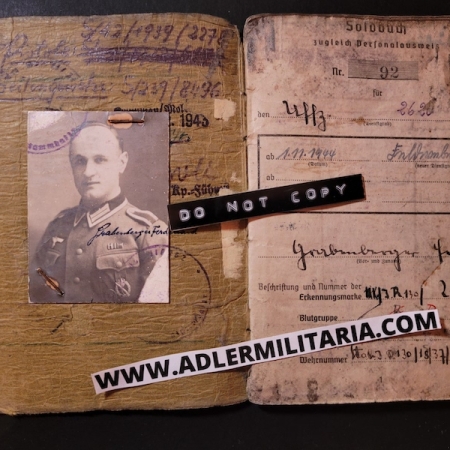
Heer Soldbuch – Feldwebel Grabenberg – Volksgrenadier Regiment 351 (183VGD) Battle of Aachen 1944/45 (On Hold)
Heer Soldbuch to Feldwebel Grabenberg.
Soldbuch was issued on August 1939 with:
Infanterie Regiment 130 (45 Infanterie Division)
The division took part in the invasion of the Sudetenland in 1938, followed by the invasion of Moravia in 1939. In August 1939 the division was mobilized and relocated to northern Slovakia. From the Friedeck area she crossed the Polish border on September 1, 1939 and marched over the Olsa to Bielitz. The division then moved south past Krakow and then on via Tarnow, Jaroslau and Oleszycze. Eventually the division reached Dobrosin north of Lemberg. After the end of the Polish campaign, the division was briefly deployed as an occupation force and then relocated to the home garrisons. In December 1939 the OKH Reserve Division was relocated to the Treysa area. Parts of the division (II./135) were handed over to the 297th Infantry Division on January 28, 1940. At the beginning of the western campaign, the division was Army Reserve and was followed by the fighting troops. In mid-May 1940, the division was pushed into the front and turned on the Aisne, which it reached on May 24 at Berry au Bac. At the beginning of the second phase of the campaign, the “Battle of France”, the division crossed the Aisne near Neufchateau on June 9, 1940, and then marched south-east. It passed Reims east and headed south on the east bank of the Marne. At Bar sur Seine she crossed the Seine and then marched to the Loire southeast of Nevers. After the end of the French campaign, the division was relocated to Belgium as an occupying force. On December 10, 1940, a third of the division was transferred to the 100th light division. At the end of May 1941, the division was relocated to eastern Poland, west of Brest-Litovsk. From June 22, 1941, the division took part in the Russian campaign. The division’s first objective was to take the Brest-Litovsk fortress. It took a week, however, before the fortress finally fell. The division suffered 482 dead and 1,000 wounded in these battles alone. After the end of the fighting for Brest-Litovsk, the division began the advance through the Pripjet marshland and then via Pinsk, Davidgrodek, the Pitsch to the Mosyr-Schlobin railway line. From here the division pushed past Chernigov to the east and then took part in the Kessel Battle in Kiev. The division advanced across the Dessna to Jagotin. During the attack on Moscow, the division pushed from the area south-east of Malo-Arkhangelsk, south of Livny, to Jelez. After the start of the Russian winter offensive, the division had to retreat through the Sossna and the Trudy section to the Kursk area with heavy losses. The division was split up into individual combat groups and fought at Foshnaya and Butyrki as well as in the Voronezh bridgehead. The withdrawal fighting in February 1943 brought the division to the Voronowo area, southeast of Orel. There the division was involved in heavy defensive and positional battles until August 1943. After the various battalions were disbanded, the IR 130 staff was also disbanded on June 17, 1943, and the division only had two infantry regiments. The IR 130 was only set up again in May 1944 from the field training regiment 637. During the withdrawal movements in August 1943, the division crossed the Dessna and the Snow and reached the bridgehead south of Gomel. Then there were heavy defensive battles on the Ssosh, so that the division reached the Jampol area and south of Retschitza after further withdrawals. Here the division defended the section of the front between Paritschi and Plessowitschi.
Volksgrenadier Regiment 351 (183 Volksgrenadier Division)
On October 4, 1944, the division lost 729 men. In the subsequent fighting for Geilenkirchen, the division suffered further heavy losses. In mid-November there was heavy fighting south of Immendorf. Immendorf and Loverich were lost, but the planned American breakthrough on Linnich and Gereonsweiler could be prevented by the weakened division. As a result, the 9th Panzer Division and the 15th Panzer Grenadier Division from the Prummers and Gereonsweiler areas were deployed, but with moderate success. The remnants of the 183rd Volksgrenadier Division that were still able to fight were placed under the two divisions. On November 19, the US troops succeeded in enclosing and occupying Geilenkirchen. The German counterattack that was then set up remained in the Niederheid area. After this fighting, the division was withdrawn from the front to freshen up. The refreshment had to be speeded up considerably, as the division again had to use its own resources to take the section northwest of the Wurm. The new HKL had to be completely rebuilt due to its relocation and was located at the end of November 1944 east on the Süggerath and Prummer line. From mid-December 1944, the division was to take part in the Ardennes offensive. For this purpose, she was subordinate to the Felber corps and was commissioned to advance into the area between the Meuse and Wurm with the aim of regaining the Aachen area occupied by the Americans. In the end, however, the division’s deployment for the Battle of the Bulge was canceled. However, the division had to provide personnel to replace the German divisions fighting in the Ardennes. So the division remained in its positions. On December 31, 1944, she took part in a diversionary attack on Tripsrath, but it failed. So the division remained on the right bank of the Rur in a constant defensive battle. On February 3, 1945 the combat strength of the division was 3,705 men. On February 23, 1945, the Allies launched a major attack over the Rur. The attack was primarily directed against the weak 59th Infantry Division. There American troops succeeded in building a bridgehead past Linnich on the east bank of the Rur. At the same time, the US units pushed north towards Baal, where they met resistance from the 183rd People’s Grenadier Division. The aim here was to prevent any further advance in the direction of Erkelenz. On February 26th, Hückelhoven was taken in the section of the 183rd Volksgrenadier Division, in the evening Erkelenz had to be surrendered. The forces of the 183rd People’s Grenadier Division were at an end. The division still had a strength of 500 men, so that the XII. SS Army Corps only spoke of a “regimental group 183rd VGD”. On March 2, 1945, the division was considered completely destroyed. Task of the XII. SS Army Corps should nevertheless be to build a new front on the Rhine on both sides of Düsseldorf with the 183rd VGD, the 338 ID and the 176 ID. On March 3, regimental group 183rd VGD was returned to the eastern bank of the Rhine for this purpose. After the formation of the Ruhr basin, the remnants of the division were pulled out of the Rhine front on April 6 and relocated to the area west of Siegen for new use. on the same day, US units attacked northwards via the victory. The remnants of the 183rd Volksgrenadier Division were then pushed into a provisional defensive front on both sides of Waldbröl. The last remnants of the division were smashed here.
Battle of Aachen
Equipment:
Issued a MP44, and a compass in October 1944!
Awards:
- Annexation Medal
- Infantry Assault Badge in Silver
- Eastern Front Medal
- Wounds Badge in Black
- War Merit Cross 2nd Class with Sword
Although the Soldbuch was denazified by its former owner, likely due to using this ID when he was captured. This is an exceptional West front Soldbuch directly linked to the Battle of Aachen!
-
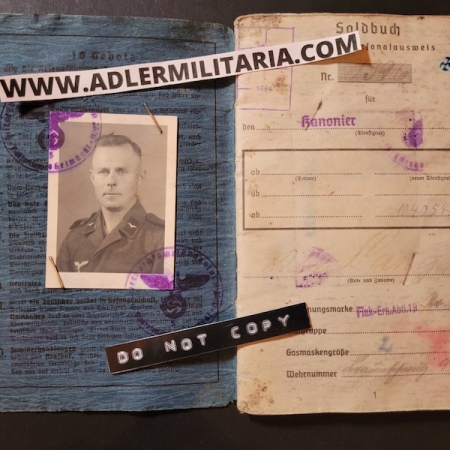
Luftwaffe Soldbuch – Schütze Lange – Landesschützen Batl 11- Hildesheim 1945 – Died as a POW Bourges/Dagneux
Luftwaffe Soldbuch to Karl Lange, he was initially in a Flak replacement unit in the Harz area from 1943 till 1945.
As the war was drawing to an end, he was found fit for frontline service, as per the interesting entry on Page 17!
He was given the new rank of Schütze and entered : Landesschützen-Ersatz- und Ausbildungs-Bataillon 11 which were stationed in Hildesheim.
It would seem shortly after his capture, in October 1945 he died in Bourges France, and is buried in Dagneux.
An interesting Soldbuch, it is very uncommon to find Soldbücher to soldiers who have died.
-
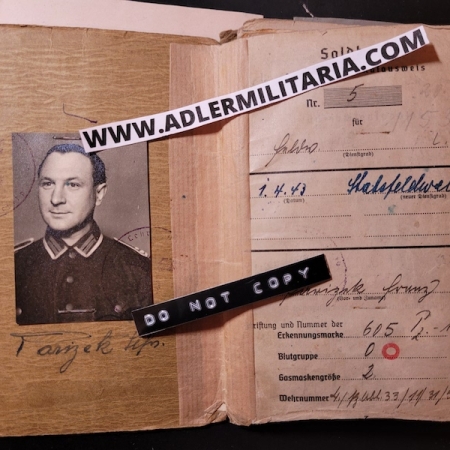
Heer Soldbuch – Stabsfeldwebel Parisek – Panzer Regiment 33/ Pz Reg 204 / Panzer Lehr Paderborn TIGER or TIGER 2 !
Wehrmacht Soldbuch to Stabsfeldwebel Franz Parisek from Vienna.
The Soldbuch was opened with Panzer Abteilung 33 in November 1939.
According to his Licence he was permitted to drive the Panzerwagen 1 since 1936!
Frontline Units:
Panzer Abteilung 33 – 4 Komp / Panzer Regiment 33 – 7 Komp (9th Panzer Division)
The regiment was also known interestingly as ‘Prinz Eugen’
The 9th Panzer Division was set up on January 3, 1940. It emerged from the 4th light division, which was reclassified accordingly for this purpose. In addition to its previous troop units, it received the headquarters of the 9th Rifle Brigade, the 85th Panzer Intelligence Department and, instead of a tank department, the 33rd Panzer Regiment. Before the start of the western campaign, the division was in the area around Limburg. At the beginning of the western campaign, the division then advanced from the Wesel area via Cleve to the Netherlands. It reached Moerdijk on May 12th via s’Hertogenbosch and Rotterdam on May 14th via Dordrecht. The division then crossed The Hague and Amsterdam, turned east and marched along the Meuse until May 17th to Roermond. The division then swung westwards via Hirson and reached Doullens on May 24th, where it was stopped in front of Dunkirk due to Hitler’s order to stop. After the German attack resumed, the division entered Dunkirk by June 1. Before the final fall of the city, the first phase of the western campaign for the division was over and the division moved to the area south of Amiens. During the second phase of the campaign, the “Battle of France”, the division broke through the “Weygand Line” north of Clermont, advanced on Coullommiers and reached Sens on June 15th. Roanne was reached by June 19th. From there the division turned to the northwest and marched via Orléans and Poitiers to Branne, which was reached on June 25. This is where the division’s campaign in the west ended and immediately afterwards they transferred to their home garrisons.
At the beginning of February 1941 the division moved to Romania and in March to Bulgaria. As part of the XXXX. Army Corps (12th Army), the division took part in the Balkan campaign from April 6, 1941. It crossed the Yugoslav border west of Küstendil and advanced on Skoplje. On April 9, the division reached the Albanian border at Prisren. From April 11, the division fought the British-Greek Central Army south of the Aliakmon. On April 14th, Kozani was taken. After crossing the Aliakmon, the division attacked the Servia position, but was turned away. Subsequently, the division embraced this position and marched on Oba. On April 26, the division moved via Larissa to the Pharsalos – Volos area on the Aegean Sea. Before the end of the fighting, the order to march north came and the division marched through Yugoslavia back to its home garrison. At the beginning of the Russian campaign, the division was subordinate to the XIV Army Corps in Army Group Center. Coming from Silesia, the division followed the German attack leaders and crossed the border to the Soviet Union at Annopol on June 28th. The first battles with Russian tanks took place near Zloszow. Zloszow was taken on July 1, Tarnopol was taken on July 2, and the Stalin line was broken at Podwolcczyska on July 7. On July 16, Biala Zerkiew was taken and the division then took part in the Battle of Uman. On August 16, the division took part in the capture of Krivoy-Rog and two days later reached the Dnieper, where it turned on Dnepropetrovsk. On September 11th the division crossed the Dnieper at Kremenchug and closed the Kiev pocket at Snjatin on September 15th. After the end of the Battle of Kiev, the division advanced in the direction of Orel until it was forced to stop by the first muddy period in early October 1941. It was not until November 2nd that the advance could continue and the city of Kursk was conquered. The division then advanced eastward on the Don, but the attack got stuck at Shchigry. The front around Shchigry was held until the spring of 1942. It was not until June 28, 1942, that the division was used again on the offensive from its positions. She crossed the Tim and marched to Kobylia Ssnowa. On July 6, the division had to turn to the north to secure its flanks and advance on Ssemlyansk. Here there is heavy fighting with Russian tank units. On August 4th, the division was withdrawn from the front to take part in the “Wirbelwind” operation, the advance on Ssuchinitschi, via Orel in the Bolchoff area. There were heavy and costly battles around the Shisdra section. By August 26th the own positions had to be taken back behind the Shisdra. From 9 September the division was withdrawn from the front and assigned to the 9th Army in the Gshatsk area as an army reserve.
Panzer Regiment 204 – (22 Panzer Division)
The regiment was transferred to the Crimea to support the beleaguered 46th Infantry Division in their defensive battle on the Kerch peninsula. The unit was hastily thrown into operation without prior investigation and suffered correspondingly high losses. At the end of April 1942, the new III. Department also in the Crimea. Since the staff was still insufficiently trained, training units from the Putlos tank shooting school, which were flown in specially by the Army High Command of the 1st Tank Army, were trained. By May 11, the regiment had advanced eastward and reached the coast of the Sea of Azov near Kerch. At the end of May 1942 the regiment marched to the Donets in the area south of Slavyansk. The III. Division remained as part of the “Kampfgruppe Rodt” until the end of the fighting in the Crimea.
In Kramatorskaya, south of Slavyansk, the regiment was refreshed close to the front and continued its training. Staff and I. Department were at the end of May southeast of Kharkov as part of the III. Panzer Corps deployed. After the return of the staff and the II. Division, the regiment reported at the end of May 1942 without the III. Division 10 Panzer II, 36 Panzer 38 (t), 8 Panzer III long, 6 Panzer IV long, 6 Panzer IV short. Above all, the mass of Panzer II and Panzer 38 (t) greatly reduced the combat value of the regiment. At the beginning of June the regiment then moved to the area southeast of Kharkov as part of the 22nd Panzer Division in order to take part in the “Wilhelm” operation. From the area north of Chugujew it hit the north-east of Krasn on June 10 in two days. Army berth in front. Here, on June 13th, the connection to the left, encircling wing of the 6th Army, advancing east of Kharkov, was established, thus enclosing a larger enemy group. From June 20, the regiment was used in the “Battle of Kupyansk”. After a difficult relocation march back to the Don, the regiment attacked from the Balakleja area in a northeast / east direction in order to win the “Oskol sector” south of Kupyansk within five days of heavy fighting. After eight days of rest, the regiment advanced in early July 1942 as part of the German summer offensive against Rostov-on-Don until the end of July and took part in the battles to conquer the city. At the same time, the III. Division hived off from the regimental unit and transferred to the “Combat Group Michalik” of the 2nd Army.Later:
Panzer Ersatz Abt 500
Panzer-Ersatz- und Ausbildungs-Abteilung Paderborn (TIGER)
Interestingly, Parisek gets posted to the above unit, they were mainly a unit that trained Tiger and Tiger 2 crews, although as he was with them in September 1944. I have found the following information: During September 1944 Pz.Ers.Abt. 500 provided personnel and 15 Tiger I to form s.Pz.Kp. Paderborn (better known as s.Pz.Kp. “Hummel”).
It would seem that this unit fought at the Battle of Arnhem against English Paratroopers.
Unfortunately, the only page missing in the Soldbuch is page 17, so we will never know if he was the group that left for Arnhem in September 1944, but one thing is for sure. He would have known the Tiger or Tiger 2 inside out in order to train crews and with his experience it is unlikely that he would have been left behind. Further research would be needed!
Awards entered into the Soldbuch:
- Service Medal IV
- Marksmanship Lanyard
- Annexation Medal 1938
- Eastern Front Medal
- Krim Arm Shield
- War Merit Cross wit Swords
Equipment:
1942 issued with Binoculars and Walther P38
Here is a picture of the famous Tiger School in Paderborn, it is highly likely that Parisek is in this picture!


-
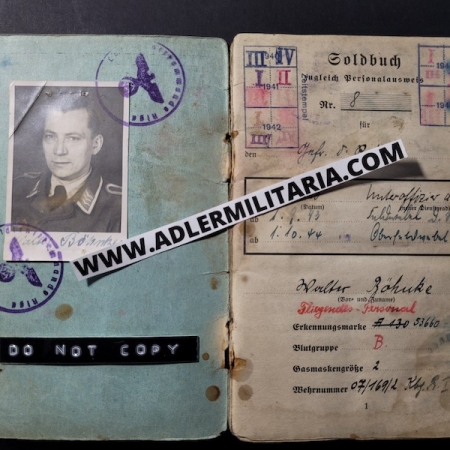
Luftwaffe Soldbuch – Oberfeldwebel Böhnke – Missing in Action Pilot – EK2/Transport Clasp Silver! (Sold)
Soldbuch to Oberfeldwebel Walter Böhnke.
A pilot in :
Luftdienstkommando Ostland
Flugzeugüberführungs-Geschwader 1 – Responsible for flying new aircraft to their units!
http://www.ww2.dk/air/misc/flug1.htm
Awards:
1.Pilots Badge
2. Transport Clasp Bronze
3. Transport Clasp Silver
4. Iron Cross Second Class
On 15th of October 1944, he did not return from one of his missions.
He is missing since and must have crashed somewhere in Poland. We will never know the real fate of this Pilot or what happened on his last flight…
The Soldbuch is a 100% complete with all pages and the portrait photo. Notice the rare light blue variant of the Luftwaffe Soldbuch which was made in Berlin Gatow!
-
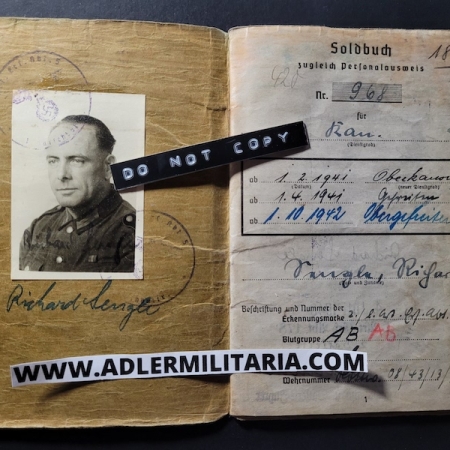
Heer Soldbuch – Obergefreiter Sengle – Artillerie Regiment 85 (101 Jäger Div) Kuban Shield
Wehrmacht Soldbuch opened in July of 1940.
Issued to Obergefreiter Richard Sengle
Frontline unit:
Artillerie Regiment 85 (101 Jäger Division)
The regiment was divided into four divisions. The I. to III. Division were equipped with 7.5 cm I.FH and 10 cm cannons, the IV. Division was 15 cm. s.FH. The regiment was under the 101st Light Infantry Division. The regiment was trained on the heights of the Brody forest until the end of March 1941, when it was relocated to the area south of Graz.
On April 7, 1941, the regiment began the Balkan campaign. The regiment marched through Lower Styria and Slovenia via Marburg an der Drau, Pettau and Krapina to the Save west of Agram. The 101st Light Infantry Division was no longer used and on April 2, 1941, relocated back to the Prague area, in the Protectorate of Bohemia and Moravia. After only a short stay, the regiment was transferred by rail via Kolin – Olmütz and Poprad to the Spiš around Käsmark. From here the regiment then marched to southern Galicia in the Neu-Sandez area. In mid-June it was moved to the area west of Przemysl. Here the regiment got ready for the attack on Russia. On June 22, 1941, the regiment broke through the Russian lines north of Przemysl. On June 28, 1941, there were fights at Rudki, which was followed by the breakthrough through the chain of lakes on both sides of Komarno. At the beginning of July 1941 there were persecution battles north of the Dniester near Chodorom, Halicz, Marjampol, Monasterzyska and Czortkow. On July 7, 1941, the Zburcz was crossed. The Stalin Line was reached at Jaltuszkoff by July 14, 1941 and broken through here on July 15 and 16, 1941. Then the Stalin line was rolled up southeast to Jaltuskoff. Fighting broke out at Myki, Maryanowka and Kopajgrod. After further pursuit battles, the Bug was crossed at Ladyshin on July 24, 1941 and the bridgehead there strengthened. From July 28, 1941, the road to Uman was approached in the direction of Gaiworon, which was reached on July 31, 1941. After the Battle of Golovanyevsk from August 6 to 8, 1941, the 101st Light Infantry Division became Army Group Reserve and was able to rest for a week.
Then the regiment marched to the Dnieper and forced the crossing over the river at Kremenchug between September 2 and 12, 1941. After the successful crossing of the river, pursuit battles followed, which led the regiment via Poltava to the Worskla. Subsequently, an advance was made to Bogoduchow. Defensive fighting broke out between October 13 and 16, 1941 near Murafa. Between October 17 and 27, 1941, the regiment and the division took part in the fighting and the conquest of the city of Kharkov. The Donets was reached by the end of October. Here the regiment strengthened the Staryj Ssaltoff bridgehead. At the beginning of December 1941 a march was made from Kharkov to Gorlowka. From January 6, 1942, heavy defensive battles broke out between Debaltsevo and Troitskoye. These dragged on in varying degrees until May 1942. On May 16, 1942, the regiment prepared to attack Isjum. Between May 17 and 19, 1942, the regiment managed to break through to the Donets. There were fights at Majaki, Chrestishche and Golaja Dolina. On May 19, 1942, there was fighting at Studenok. Defensive battles ensued between Raigorok and Ssemitschewo in the Donets Basin, which lasted until mid-June 1942. On June 22, 1942, the regiment then attacked the Donets between Oskol and Isjum as far as Podwyssokoje, and on June 24, 1942, Isjum was taken. The regiment was then transferred to the Ssiawiansk area to prepare for the breakthrough into the Donets Basin. On July 6, 1942, the 101st Light Infantry Division was renamed 101st Jäger Division. The first and second divisions were also re-armed to form the mountain division. The attack on southern Russia began on July 9, 1942 and led the regiment to the Kuban until August 7, 1942 and to the area around Maikop until mid-August. The regiment continued to advance into the Caucasus on both sides of the road to Tuapse. From October 3rd to October 14th, 1942 there was fighting over the Kurinkij Basin, on October 15th and 16th, 1942 the Yelissvaetpolsky Pass was stormed and the Shoamyan was taken afterwards. From October 20, 1942, the regiment had to defend itself at Zarya Gora and the Jelissavetpolsij pass. The positions reached in the Caucasus had to be held until January 15, 1943, when the retreat from the Caucasus to the Kuban bridgehead began. There were battles at Tochtamukai, Schendschij, Krasnodar, Auscheds, Ssadowij, Krimskaya and Novorossisk, among others. After the fighting in the Kuban bridgehead until July 15, 1943, the regiment took over a stretch of coast near Temryuk to secure the Taman peninsula.
On September 13, 1943, the regiment was transferred across the Crimea to the Votan position south of Zaporozhye. On September 19, 1943, the defensive battle over the Wotan employment began. In November 1943 defensive battles followed on the lower Dnieper on both sides of Berislav. At the beginning of January 1944 the regiment was relocated to the Vinnitsa area. Heavy offensive and defensive battles broke out here, including in the places Komarow, Voronowzy, Latanzy, Potoki, Schenderiwka and Rotmistriwka. The fighting in the Vinnitsa area lasted until March 1944. This was followed by retreat and boiler fighting as part of the 1st Panzer Army near Vinnitsa, Brailoff, Bar, Novaya-Uschiza, Kamenez-Podolsk and Uszieocko. On April 10, 1944, the attack battles began over the Stypa and the Dnjetr at Wozilow, Snowidow and Isakow, which dragged on until April 20, 1944. This was followed by fighting in the forest northwest of Zukow near Brotniki, which was followed by fighting near Peczeniyzn. From July 16 to 27, 1944, the regiment took part in the Battle of Lemberg and then in the defensive battles south of the Dniester. On August 8, 1944, the settling over the Carpathian Mountains began, followed by fighting at Turka. On September 20, 1944, the Turka position had to be given up. The regiment withdrew across the Carpathian ridge to the defensive position northwest of Ungvar, which was reached on October 28, 1944. Via Jeszenö, Szobranc and Michalowec it went to the Gisela position near Kosice until December 10, 1944. From December 27, 1944 to January 12, 1945 the regiment moved to the area south of Schemnitz east of the Gran Valley. From the middle of the month there were heavy defensive battles that brought the regiment to Altsohl, the Grantal and Neusohl in March. In March 1945 and April 1945 the regiment was fighting in the Great Tatras in the Neusohl area. At the end of April 1945 the regiment was relocated to the Malacky area west of the Little Carpathians. Further fighting broke out on the west bank of the March and in the Marchfeld, and the retreat continued via Angern, Prottes and Matzen. At the beginning of May 1945 the regiment stood at Hollabrunn and returned to Nesselbach via Horn, Weitra, Deutsch-Beneschau, Kaplitz and Rosenberg. Here the regiment came into American captivity.
Awards:
Eastern Front Medal
Black Wounds Badge
Kuban Arm Shield
Issued: K98.
He was wounded in December of 1943, although his wounds pages are not inside the Soldbuch (price reflects this) its still a highly desirable Eastern Front Campaign, and the entries for the Kuban Medal are not seen so often.
A fact worth noting for the film fans among us, The 1977 movie “Cross of Iron”, based on the book “The Willing Flesh” by Willie Heinrich, directed by Sam Peckinpah is inspired by the authors service in 101. Jäger-Division.
-
Sale!
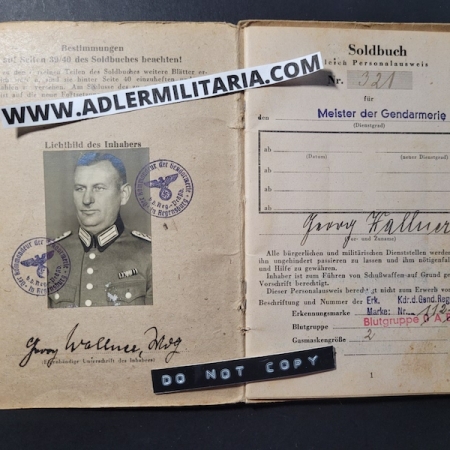
Police Soldbuch – Meister der Gendarmerie Wallner – Police in Regensburg – 9 Medals! (Layaway)
Original price was: $185.00.$165.00Current price is: $165.00.Police Soldbuch
Meister der Gendarmerie Georg Wallner, serving in Regensburg during the war.
His medals are as follows:
- Iron Cross Second Class
- Military merit cross 3 class with swords
- Cross of honor for combatants at the front
- Austrian war memorial medal
- Police Service award – level 2
- Police Service award – level 1
- Wounds Badge in Black
- SA Badge in Bronze
- Medal for the Memory – October 1st 1938
A nice Soldbuch for a Gendarmerie with plenty of awards, these are uncommon with awards entered.
The city of Regensburg was subject to heavy Allied bombing raids towards the end of the war.
-

Heer Soldbuch – San Feldwebel Embacher – 88 Infanterie Division – Cherkassy EK1! Combat Medic!
Heeres Soldbuch for a Medical NCO
San-Feldwebel Siegfried Embacher
Soldbuch was opened in April 1941.
Frontline units:
Führungs-Nachrichten-Regiment 40
Plus various Medical Units on the frontline,
San.Komp (Mot) 2/188 – – 88 Infanterie Division (In 1944)
The division was trapped and some elements succeded to break out of the Korsun – Cherkassy Pocket in 1944.
According to the Soldbuch on Page 21, Embacher won both classes of the Iron Cross, and interestingly his certificates were recorded as being lost in the Cherkassy pocket. The entry specifically states that he is entitled to wear both classes of the Iron Cross!

Footage of the Korsun – Cherkassy Pocket
Issued:
Pistols. Luger P08 and a Radom
Pocket Lamp
It would seem that he was sent to a replacement unit after the destruction fo the division, in the area of Kassel. Where he was captured by US Forces, the capture paper in the back of his Soldbuch. Included in this lot was the Police Drivers licence for his son who was in the West German Police.
An interesting Soldbuch to a real Combat medic with both classes of the Iron Cross!


