Showing 829–837 of 1179 resultsSorted by latest
-

Soldbuch – Obergefreiter Otto Stock – 3 Panzergrendier Division – Bastogne 1944 – Died as POW in France 1945 (Hold)
Soldbuch to Obergefreiter Otto Stock Stock was born on the 7.11.1921 in Germany. Soldbuch was issued on the 31.10.1944 in Naumburg with an Infantry replacement unit. Although Stock must have had another Soldbuch as he was previously serving in the Luftwaffe with Kampfgruppe z.b.v 4 and Kampfgruppe z.b.v 40 Stock was awarded previously with the Front Flying Clasp in Bronze for Transport. It seems he won this award whilst on flights (Not a Pilot) into Stalingrad and out with a Junkers JU52. As well as flying in and out of the Kuban Bridgehead. Stock must have had at least 20 flights to be awarded the Bronze award. His flying career started early, as in 1939 he had both A + B Classes of the Glider Badge. 1943 Stock was awarded the War Merit Cross with Swords. In November 1944 Stock was also awarded the Medal for the Fight against Communism. By late 1944, Stock was now transferred to the Wehrmacht and after a short training on how to fire both a rifle and Machine gun he joined his frontline unit Feldersatz Bataillon 3 under the 3rd Panzergrenadier Division just in time for the Ardennes Offensive. In the middle of December 1944, the division was briefly refreshed in preparation for the Ardennes offensive and then, from December 20, 1944, was deployed to protect the northern flank of the German Ardennes offensive. The division fought in the Krinkelt – Elsenborn area until December 26th and then marched into the section west of Bastogne. Defensive battles followed around Chenogne and in January 1945 at Flamière and the retreat to the area west of Houffalize. At Lichtenborn the division was withdrawn from the front in order to move to the north at the end of January 1945. The division was used to defend the Gmünd-Schleiden section. From February the division fought on the Erft section and then withdrew over the southern edge of Cologne to the right bank of the Rhine. It must have been around February 1945 when Stock was captured, as his last entry was for injections at that time. It seems he was captured by Allied Soldiers as his POW number 31G indicates on page 1, sadly it seems that Stock passed away in a POW Camp in France and is mentioned in the German War Graves Commision lists as such having passed away on the 18.5.1945
-

Urkunden Grouping – Feldwebel Alois Brosig – Infanterie Regiment 183 (Sold)
Document Grouping to Unteroffizier Alois Brosig Brosig served with Infanterie Regiment 183 / 62 Infanterie Division The 62nd Infantry Division was set up on August 26, 1939 in Kanth near Breslau. After the establishment, the Army Reserve Division of the AOK 10 in the Opole area and then took part in the advance on Crete. After the end of the Polish campaign, the division was relocated to the Schnee-Eifel. From May 10, 1940, she took part in the western campaign, crossed Belgium and attacked across the Aisne west of Soissons in the area of Ham on the Somme. The division then took over security in the Orleans and Blois area at short notice. In June 1940 the division was relocated to Poland. On October 24, 1940, a third of the division (Staff 190, I./164, I./183, I./190) was transferred to the 323rd Infantry Division. From June 22, 1941, the division took part in the Russian campaign and attacked south of Cholm over the Bug Iron Cross Second Class – 12. July 1941 – Signed by Generalleutnant and Commander of the 62 ID – Walther Keiner (Knights Cross Winner) Infantry Assault Badge – 1st of August 1941 – Signed by the Regimental Commander Wounds Badge in Silver – 24th of June 1941 – Signed in Breslau Promotion Document – 5 July 1941 – Signed by the Company Commander It would seem that Alois lost a limb or had a severe wounding rendering him as not suitable for service anymore and he was thus discharged.
-

Wehrmacht Führerschein – Leutnant Claus Rienäcker – Fliegerhorst Lübeck Blankensee (HOLD)
Wehrmacht Führerschein – Leutnant Claus Rienäcker Rienäcker was born on the 4th of June 1919 in Berlin Charlottenburg. Posted at the: Luftnachrichten Stelle des Flughafenbereiches Lübeck-Blankensee
-
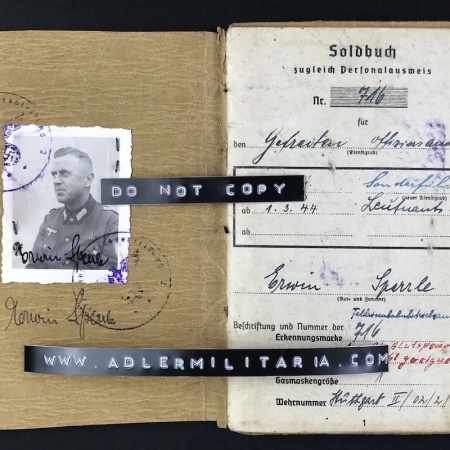
Soldbuch – Sonderführer (Z) Erwin Sperrle – Feldeisenbahn Betriebs Abt 2 – Krim/Ost/KVK2 (Sold)
Sonderführer (Z) Erwin Sperrle Sperrle was born in Ulm, Germany into a Catholic family on the 7th of March 1902. In his civilian career he was a Reichsbahn Inspector, inspecting trains. He was married and lived with his wife in Ludwigsburg. In October 1944, according to the Soldbuch, Sperrle lost his house to an allied bombing raid, luckily his wife Frieda survived but was forced to live in a hotel. His Soldbuch was issued on the 29 of March 1941, with: Feldeisenbahn Betriebs Amt 2 The field railway operations department 2 was set up on March 15, 1941 in military district VII as an army force. On March 23, 1942 it was renamed field railway operations department 2. from 1941 to 1943 it was deployed in southern Russia. December 1941 in the Feodosia area, December 1942 to February 1943 in the Millerowo and Rossosh area, from August 1943 in Greece, 1944 in Macedonia Skoplje station. Sperrle would join another unit in late 1944: Feldeisenbahn Betriebs Amt 5 Serving in Croatia, in Slavonski Brod. Equipment Pistol – FN Browning MP 40 – 4 Magazines Nice entries for items such as Officer Cap etc. He was given a Führergeschenk ( Packet with nice items) Interestingly, a stamp for a bottle of sparkling wine is entered. Awards 7.8.1942 – Eastern Front Medal – Documents signed by Captain of the unit. 15.11.1942 – War Merit Cross with Swords – Document signed by: General Rudolf Gercke (Winner of the Knightscross of the War Merit Cross with Swords – rare signature. A lot of info online about Gercke who passed away in a POW camp in 1947). 6.3.1943 – Crimean Campaign Shield Interestingly, at the rear of the Soldbuch in the pouch is the small Spange for the Eastern Front and KVK that he is wearing in the picture. Wounds Malaria 1.3.1945 – wound spent till September 1945 healing. He saw the end of the war in a hospital in Agram, Yugoslavia. Post War It seems he was used almost immediately after his illness was gone, serving in various Allied controlled Labour Units. Comments A must have Soldbuch Grouping for the Reichsbahn/Train Collector, I have not seen another unit like this. Moreover, Sperrle could be a relation of the famous Luftwaffe General Sperrle. The photo in the Soldbuch is very nice showing his awards, and the special insignia for a Sonderführer.
-
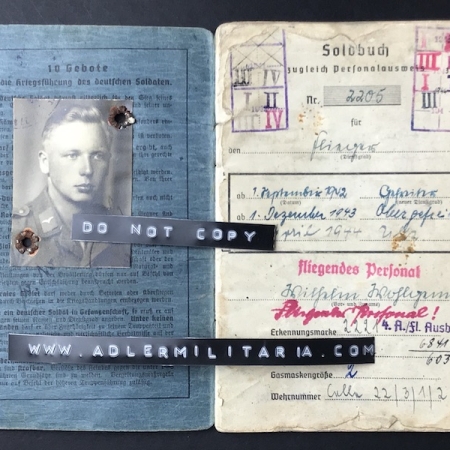
Soldbuch – Unteroffizier Wilhelm Wohlgemuth – Fighter Pilot – Bf109 G-6 “Blaue 8” Shot Down 1944 (SOLD)
Unteroffizier Wilhelm Wohlgemuth Wohlgemuth was born on the 4th of July 1922, and was trained as a salesman. Interestingly he was an NSFK member, learning how to fly various glider aircraft, the NSFK Flugbuch details many flights, and it displays a very clear picture of him in the Hitler Jugend. His Soldbuch was issued on the 19th of August 1941, after successful fighter pilot training with: Jagdgeschwader 105 & Jagdgeschwader 102 By August of 1944, Wohlgemuth was a trusted fighter pilot and was assigned for a very short time to: Jagdgruppe Süd The formation order for the Jagdgeschwader Süd goes back to the beginning of summer 1943. The squadron should not be a “normal” squadron association, but a special association to combat the British Mosquito aircraft flying in at high altitudes. The squadron should only have a strength of 20 machines, so only as strong as half a day-hunting group. The installation began on June 1, 1943 in Wiesbaden-Erbenheim, the group was equipped with the Messerschmitt Bf 109 G-5. On the 24th of August 1944, Wohlgemuth arrived at his final frontline unit. Jagdgeschwader 4 / 12 Staffel This was equipped with the Messerschmitt Bf 109 G and was then used in the Reich Air Defense. In September 1944, the group began to be converted to the Messerschmitt Bf 109 K. Wohlgemuth took to the skies on the 11th of September 1944 to intercept US Bombers, when they met the aircraft of the 55th Fighter Group. During the aerial combat Wohlgemuth was extremely lucky to have survived his aircraft getting shot down, although as he made an escape from the aircraft and was rescued, he lost his left arm due to the wounds. Seen below the pictures of the others from JG 4 that were not lucky to survive. Parts of his aircraft that came down over Craiwinkel on display in the JG Exhibition, of which some can be seen online. From the archive: Uffz. Wilhelm Wohlgemuth (12.) * 04.07.22 Verw. Bf 109 G-6 441 666 „Blaue 8” Oberhof/Thüringen, Luftkampf Some information can be found in the following book: “Courtesies of the Heart” – By Kenneth Breaux¨ Wohlgemuth gave interviews to the author and gave his recollections. Wohlgemuth was awarded the following medals/licenses: Glider Pilot License Pilots Badge Wounds Badge in Black Wounds Badge in Silver Interestingly, according to Wolhgemuths Pilot License he was allowed to fly the following aircraft. Bü131 & 181 Kl.35 AR66 & 96 FW58 Bü133 Fw56 He51 Bf108 Bf109 (D,E,G) MCC 202 – Italian Figher Potez 63 – French Bomber BL155 Fi156 Comments An interesting Grouping to a named pilot, who seems to have flown even as an old man up to 1993. Wohlgemuth is well recorded as are details of the day his plane was shot down. A very nice grouping to a very lucky fighter pilot.
-

Soldbuch – Matrosenobergefreiter Felix Kämmerer – 22 Marine Bordflak Abt – Italy 1944 – Survived his boat sinking – Blockade Breaker / EK2 (Sold)
Felix Kämmerer Kämerer was born in Langfuhr, Danzig (today: Wrzeszcz, Gdańsk, Poland) on the 18th of November 1911 and worked as a gardener. He would enter the Kriegsmarine in 1941 although his Soldbuch was issued on the 9th of December 1943. Kämmerer served with the: 22. Marine-Bordflak-Abteilung / 2./ Marine-Bordflak-Abteilung Süd Stab / Stabszug in Castellammare Kompanie in Livorno Kompanie in Triest Kompanie in Forte dei Marmi Kompanie in Livorno Kompanie in Forte dei Marmi According to research it would seem that the 2. Kompanie, in which Kämmerer was a member of was onboard the Minesweeper “Mosor” – on the 31st of December, it is reported that Partisans captured 24 German sailors from the minesweeper “Mosor” which had run aground on the eastern shore of the Ist island (21 miles NW of Zadar). It would seem that Kämmerer was not captured and somehow was found around 12 days later, likely in a raft or at sea. He arrived at a hospital in Italy with breathing problems, likely due to exposure. He recovered in a Hospital in Naples, Italy. After a short while he was found fit again for service, he was awarded the Iron Cross Second Class and the Blockade Breaker Medal. More about the the badge for blockade breakers was awarded to crews of seagoing ships under the following conditions: a) Successful breakthrough of the ship through the enemy blockade. b) Destruction of the ship if it is threatened by enemy forces. c) The existence of particularly stored cases which have led to the maintenance or destruction of the ship and cargo in the interests of the people and the economy and which have demonstrated a high level of commitment. d) To survivors of a ship that was lost to enemy action. e) In special cases to the wounded. In addition, worthiness and good conduct were required for the award of the badge. There are two forum threads detailing some extra facts about the fate of the sailors who were captured. They were handed over to the British. According to the Red Cross, there are still many sailors missing from the 2. Kompanine in the Adriatic Sea. https://forum.axishistory.com/viewtopic.php?t=127825 https://www.forum-marinearchiv.de/smf/index.php?topic=18586.0 Comments This is a fine example of a very lucky Kriegsmarine sailor who managed to evade capture, and his boat sinking. Kämmerer has a desirable award not often seen anymore.
-

Soldbuch – Feldwebel Hans Probst – Feldjäger Regiment (mot) 2 – “Kettenhund” – EK1/ ISA / VWAS (SOLD)
Feldwebel Hans Probst Hans Probst was born on the 8th of April 1920 in Oberröbling, Germany. Probst had his Soldbuch issued on the 4th of October 1940, after an Infantry training, he was sent to the front with: Infanterie Regiment 53 / 14 Infanterie Division Probst joined the unit in early 1941, and from June 1941 the division took part in the Russian campaign and fought in the central section of the Eastern Front in the Smolensk and Rzhev area. Probst proved his skills as a soldier in a short time earning the following medals: August 1941 – Black Wounds Badge – wounded by shrapnel (31b) January 1942 – Iron Cross Second Class February 1942 – Infantry Assault Badge in Silver April 1942 – Iron Cross First Class October 1942 – Eastern Front Medal After Probst had recovered he joined a new unit, as an infamous “Kettenhund” Feldjäger Bataillon 2 (Later: Feldjäger Regiment 2) Formed 25 December 1943 from a mixture of Heer, Luftwaffe and Waffen-SS personnel organised into five fully motorised Kompanien. It operated exclusively on the Eastern Front. Use: Spring 1944 South Poland-Galicia; Summer 1944 Belarus – Baltic States (Grodno-Kovno); from October 1944 East Prussia (Lyck, Bischofsburg); from January 1945 west of the Vistula, then in Silesia (Schweidnitz); most recently at Heeregruppe Center. By August 1944, Probst was promoted to a Feldwebel and was wounded once again by shrapnel. Equipment Issued a Erfurt pistol and later a Singer pistol. In 1944 a small lamp. Feldjägerkorps During the second half of the war, as Germany’s military fortunes waned, morale and motivation of the German front line troops began to decline. Indiscipline and desertion rates increased to worrying proportions. In addition it rapidly became clear that huge levels of manpower and equipment was being effectively wasted in the occupied areas, especially in countries like France where occupation troops often lived in what seemed like luxurious circumstances compared to their comrades on the Eastern Front. One of the major factors leading to the creation of the Feldjägerkorps was a visit to occupied France by Generaloberst Jodl to inspect the preparations for the anticipated allied invasion. Jodl was shocked at the relative luxury in which senior command elements had housed themselves, clean luxury hotels or châteaux with carpeted floors, comfortably furnished and richly decorated. One unit which he reportedly went to visit were all absent on a hunt! In addition, as front line units were decimated in fighting on the eastern front, there resulted a large number of non-combatant elements which existed to supply these combat units, but had no units left to support. Clearly the situation of bloated rear area formations living in relative safety and luxury, consuming vast amounts of food, fuel and manpower whilst the front line combat units suffered could not be allowed to continue. In December 1943, a Führer decree was issued creating the Feldjägerkommandos. The Feldjägerkommandos and battalions are Wehrmacht troops and are directly subordinate to the OKW. The have the task of checking and combing out units of the army, navy air-force and Waffen-SS. These tasks will be carried out in close connection with the territorial commanders. The commanders of the Feldjägerkommandos are responsible solely to the Chief of the OKW. Enforcement measures, task forces, patrol services should be made available to the Feldjägerkommandos. So we can see that not only were the Feldjägerkommandos given supreme authority to carry out their tasks in relation to Wehrmacht forces, but Waffen-SS also, and that they had the power to call on whatever support they needed from the local commanders. The following definitions of the tasks of the Feldjäger were published by the OKH (Oberkommando des Heeres—High Command of the Army) in September 1944 (O.K.H. (Ch H Rüst u. BdE), 15 September 44—7378/44—Stab/.Ia2.) and also in a special supplement to army orders bulletin (Heeresmitteilungsblatt) as H.M. 1944, Issue Nr 24. Feldjäger have the task, as ordered by the Führer and under direct command of the Chief of the Oberkomando der Wehrmacht in the rear areas, to maintain temporary and complete authority, military discipline and order in all situations, if necessary by ruthless measures up to the immediate use of firearms. Feldjäger are special, proven front soldiers, whose activities have the sole aim of supporting the front line. They ensure the area behind the front is kept secure. They expect therefore and with good reason the greatest appreciation for their difficult task, primarily from frontline soldiers of all ranks. Feldjäger have received from the Führer, in order to accomplish their assigned tasks, particularly wide ranging power and authority over members of all parts of the armed forces, the Waffen-SS and organisations used in the support of the armed forces (OT, NSKK etc.) Feldjäger co-operate closely with all Order services in the area in which they are employed (Wehrmachtstreifendienst, Feldgendarmerie, Kommandanturen, Polizei, Guards, Patrols and Sentries of all kinds). They carry out their tasks as required by the prevailing situation at the front. Criticisms of, or resistance to, Feldjäger orders are unjustified and are also considered as proof of the lack of correct military attitude and insight due to indiscipline. Feldjäger eliminates all possibility of mismanagement in the area between fighting front and homeland front, which disparage the great sacrifices of every good German and the combatants of the armed forces. Feldjäger ensure the delivery of redundant and surplus personnel and material from rear agencies and units and the supply of personnel and material fit for the front, to the fighting troops. Feldjäger fight behind the front against disobedience, desertion, self-interest, neglect and sloppy work of any type. They are strictly monitored in the performance of their duties by their superiors, with any misdemeanours particularly severely punished and discharged from the Feldjägerkorps. Feldjäger on duty are recognizable by gorgets, red armbands and a special Ausweis. Their service is difficult, self sacrificing and highly responsible. All are required to help and to facilitate, by disciplined behaviour, the difficult task of the Feldjäger, because the military discipline of the German soldier…
-

Soldbuch – Leutnant Gerhard Thiele – Volks Artillerie Korps 401 – Normandy / Ardennes / Rhein Battles – CCC & EK1 (HOLD)
Leutnant Gerhard Thiele Thiele was born in the Zwickau area of Germany on the 18th of January 1914. In His Civilian life he was a Technical drawer, married and living with his wife. Soldbuch is a second issue, issued to Thiele at the : Schwere Artillerie Ersatz und Ausbildungs Abteilung (mot) 38 in November 1944. Frontline Unit Served from 1939 till 1944 with: Artillerie Regiment 711 / 711 Infantry Division From Normandy to Belgium In June 1944 the division was in Normandy north of Liseux and thus exactly east of the Allied landing area. The division formed the westernmost division of the 15th Army. During June 6, 1944, Allied paratroopers jumped in the area of the division, which had the task of securing the area east of the landing heads. The division was able to use two companies against the Allied paratroopers. Since the division was not set for a fight with the Allies, the 346th Infantry Division was inserted between the division and the landing heads. The 711th Infantry Division then occupied the previously uncontested stretch of coast between Cabourg and Le Havre. From mid-August 1944, this stretch of coast came within reach of the Allied units and the division had to intervene in the fighting. The units that were arriving were involved in the fighting to varying degrees up to August 20, 1944. By early September 1944, the division was pushed back to the area south of Dunkirk and southeast of Boulogne. On the 5th September 1944, the not yet refreshed division had to withdraw to Courtrai. On September 10, 1944, the “Kampfgruppe 711 Infantry Division” was in the Oostsonbourg area, 3 km north of Vlissingen. On September 11th, the combat group marched off in the direction of Antwerp. It must have been here that Thiele was wounded for the 3rd time in his career. On November 5, 1944, the division held a 9 km deep bridgehead south of the Meuse, 12 km north-northwest of Breda. It would seem that the wounding was not so serious, and he was wounded once again now the fourth time on the 18th of November 1944. Thile was awarded the Iron Cross First Class for his actions in November 1944. Ardennes 1944 Thiele was with: Heeres Artillerie Batterie 1092 , armed with a rare 12.8cm K44 Pak. It is highly likely that Thiele was a Batterie Commander. 7th Army – Its role was to protect the southern flank of the Fifth Panzer Army and the entire Ardennes Offensive. Like the other two German armies in the offensive, the 7th Army took substantial losses. The 7th Army defended against the northward attack of the US 3rd Army, but ultimately failed to halt General George S. Patton‘s drive to Bastogne and Houffalize. The 7th Army, however, managed to avoid encirclement and retreated again to the Westwall. It seems that Thiele was then wounded by shrapnel on December 22nd, 1945. Thiele would on his release from hospital join the: Volks Artillerie Korps 401 / 1. Fallschirm-Armee – “Operation Plunder” Thiele was once again posted to an artillery unit, and was once again wounded by shrapnel. His unit was involved in actions between March 23 and 27, 1945, the army took part in the defense against the Allied Operation “Plunder” and was unable to prevent the Allied units from crossing the Rhine. Thiele was then sent to a hospital in Zwickau, and on the 15th of April 1945 he was on the way to his hometown, to check in at the hospital. According to his family a strange event took place, when he was mistaken for a war criminal due to his name, he was handed over by Soviets to the US Army. This story is also recorded in a book: “Gardelegen Holocaust – By Torsten Haarseim” – It was reported on the 16th of April in the New York Times that the war criminal was found, although they had the wrong man. They had arrested the wrong Thiele. His grandson wrote this on a German Forum: “My grandpa didn’t tell much about the war. My great aunt said that he suddenly cried out at night and got up drenched in sweat. But rather came from captivity. A few days before the surrender he was at home in full gear (Werdau near Plauen). I assume that his unit was wiped out or surrendered. There he then hid until he reported to a Russian commandant’s office, where he was first taken into Russian captivity. Now that’s a bit strange. This is what my grandpa told his sister-in-law shortly before he died (my great aunt). My grandpa was extradited to the Americans because they were looking for someone from the SS who had the same name as my grandpa. He came to Dachau, there it was probably to be interrogated (from which the nightmares came). He was probably only able to stay afloat because he repaired American shoes from old tires. It must have been around 1951 when he was released from captivity. When he arrived in Berlin he found his wife in Berlin Tempelhof, from there he went by plane to Frankfurt and by bus to Sachsenheim (near Bietigheim – Bissingen). There he got an apartment and worked. My father told me that my grandfather had a lot of pictures from the Eastern campaign, probably also interesting ones through the telescopic sight, inquiries with the relatives did not yield anything. I must have some at home and want to have no idea. But I think you know such problems, if not you can be happy. I was able to save something. As you can see, he was technically gifted, this beautiful box is now 40-50 years old. Alt. He died in 1997 at the age of 81. “ Awards 6.9.1941 – War Merit Cross with Swords 8.9.1942 – Eastern Front Medal 28.8.1942 – Iron Cross Second Class 30.6.1942 – Wounds Badge in Black 12.5.1944 – Close Combat Clasp in Bronze 22.10.1944 – Wounds…
-
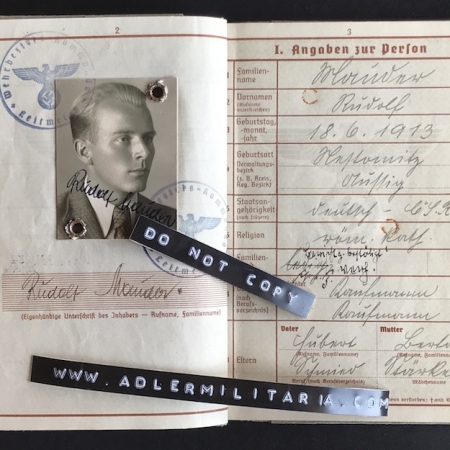
Wehrpass – Obergefreiter Rudolf Mauder – Panzergrenadier Regiment 382 / 164. Leicht Afrika Division – Killed at El Alamein, October 1942 (Sold)
Obergefreiter Rudolf Mauder Rudolf Mauder was born in Czechoslovakia, on the 18.6.1913 into a Roman Catholic family. Rudolf married during the war, and in his civilian life he was a salesman. His Wehrpass was issued in March 1939, and he was called up in January 1940 with an infantry replacement unit he was trained on the MG18, and K98 Rifle, as well as how to be an aimer/gunner. It would seem that he was the gunner on the Regiments infantry support weapon, likely a 7.5 cm leichtes Infanteriegeschütz 18. Frontline Units February 1940 – August 1942 Infanterie Regiment 382, 13 Kompanie, Infanterie Geschütz (164. Infanterie Division) After the Battle of France, Mauder was deployed in Greece, Romania, Yugoslavia and later Creta. 1.9.1942 – 24.10.1942 Panzergrenadier Regiment 382, 13 Kompanie, Infanterie Geschütz (164. Leichte Afrika-Division) Mauder was killed on the first day of the Second Battle of El Alamein that took place near the Egyptian railway halt of El Alamein. Wounds Malaria contracted in Greece Awards German Italian Campaign Medal Comments An interesting grouping, Mauder was killed at a very important battle in North Africa. He is buried in his own grave in El Alamein.


