Showing 784–792 of 1179 resultsSorted by latest
-
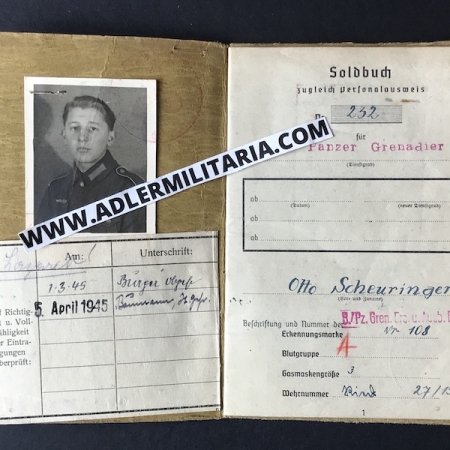
Heer Soldbuch – Panzer Grenadier Scheuringer – 232 Panzer Division – Kampfgruppe Fuchs Austria 1945 – 18 Year Old Captured! (Sold)
A late war Soldbuch, issued to a 18 year old called Otto Scheuringer in March 1945!
Interesting addition to the Soldbuch is the Inspection leaflet under the picture!
He would during his training be sent to the front, receiving a full combat kit including a rifle in March 1945!
He was with:
Panzergrenadier-Ersatz- und Ausbildungs-Bataillon 2 (232. Panzer-Division)
The division was broken up in the bridgehead on the Raab, Austria at the end of March 1945.
A nice late war Soldbuch, from a lucky young man as he survived the war.
-
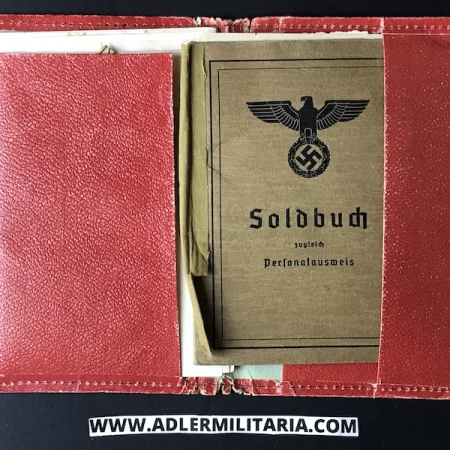
Heer Soldbuch – Schützen Neuböck – Artillerie Regiment 171 (71 ID) – Missing in City Stalingrad (on Hold)
Heer Soldbuch issued to Franz Neuböck from Austria.
His picture: Is named on the reverse along with his date of birth along with his Feldpost number.
After a short training he was sent to his frontline unit:
Artillerie Regiment 171 (71 ID)
In April 1942 the division was moved to the Kharkov area by express transport in order to take part in the fighting there. Parts of the division were in action in the area north of Isjum. The defensive battle for Kharkov followed and the defensive position on the Babka followed. Then the division advanced through Nikolayevka into the Oskol sector. The unit took part in pursuit battles via Belovodsk, Morozovskaya, the Tschir to the Don at Generalow. Further defensive battles developed to the west of Kalatsch. From August 1942, the 71st Infantry Division crossed the Don, taking Karpovka and Rossoshka, until they finally reached Stalingrad. Here the division was destroyed in January / February 1943.
Included in the grouping, is his Soldbuch (Sent to his wife). Also some letters stating that he was missing in the city of Stalingrad.
He is also on the German War Graves commission Website as still missing in the City.
Not often Stalingrad related IDs come up, especially for Missing in Action Soldiers.
-
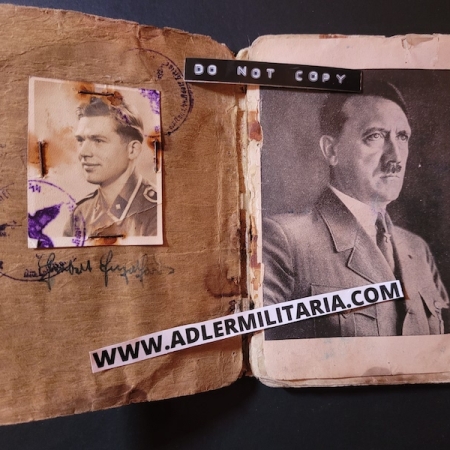
SS Soldbuch – SS-Standartenoberjunker Englehard – LSSAH – SS Junkerschule Tölz – ISA (On Hold)
SS Soldbuch for an early LAH member!
He raised the ranks, going through the war until his injury (31a – Gunshot wound) then he was posted to SS Junker Schule Tölz!
Needless to say this Soldbuch is super rare!
His career started out in 4th Kompanie, Leibstandarte Adolf Hitler!
Unit Synopsis:
On the 26th of February, 1935, a small group of LSSAH men was sent into the Saarland as an advanced group, and soon after, on the 28th of February, the 5./I.Btl, 6./I.Btl, 7./II.Btl, and 8./II.Btl, along with the Bataillone stabs, were sent into the Saarland to take part in the festivities marking the recent return of the Saarland to Germany. Later on the 1st of March, other units of the LSSAH joined the rest of their unit in the Saarland.
After the Polish Campaign, the LAH was pulled back into Germany for rest and refitting. The LAH then took part in the Western Campaign, first against the Low Countries and then against France. The LAH was initially in Army Reserve, while one of its motorcycle battalions linked up with the Fallschrimjager troops that had jumped into Rotterdam. After a lull in the action for the LAH, it fought against the shrinking beach-heads of the evacuating British Army at Dunkirk but were only able to maintain pressure against their lines. During the second phase of the Campaign in France, the LAH was once again organized as an independent regiment, this time under 14 Armee Korps(mot). 14th Armee Korp initially attacked south from a bridge-head at Amiens but was stopped by a severe French resistance. After limited successes and little advance, the 14th Armee Korp was withdrawn and transferred 75 miles to the East. This time the attack was very successful and the 14th Armee Korps rapidly advanced, crossing the Seine River, and moving to cut the retreat of numerous French units at Loire. After the Armistice was signed ending the Campaign in the West, the 14th Armee Korps continued down the French coast to the border with Spain, securing the rest of occupied France.
After the Campaign in France ended, the LAH was stationed in France for rest and refitting. Initially, the LAH was going to be given a partial lead role in the planned invasion of England. To prepare for the upcoming invasion, the LAH trained extensively in amphibious warfare. In August 1940, the LAH was raised to brigade status, although its title did not reflect this change.
The invasion of England was canceled, and in March of 1941, the LAH was moved to Rumania where it was to take part in the invasion of Yugoslavia and Greece. Now under the 40th Armee Korps, the LAH first broke into Yugoslavia, met the retreating Italians (Who the Germans were now rescuing), and then moved into Greece. The LAH then used a number of flanking maneuvers that continuously pushed the British further south into Greece, literally chasing them through Greece in 18 days. The LAH then crossed the Gulf of Corinth in fishing boats rather than follow the British to Thermopylae and managed to meet the retreating Allies on the Peloponnesus. By the end of April, the British had been forced into another situation like that at Dunkirk, this time at Kalamata, where they barely managed to retreat to the Island of Crete.
After the successful campaign in Yugoslavia and Greece, the LAH was refitted and brought up to divisional status, but only in name, and then attached to the 54th Armee Korps for the invasion of the Soviet Union. The LAH was part of Amy Group South, and as such, did not itself see combat until it was used to assault the Tarter Ditch blocking the way into the Crimea. Next, LAH was transferred to Panzer Group 1 to take part in the massive encirclement of the Kiev Pocket. Still, under Panzer Group 1, the LAH then took part in the drive on Rostov. The LAH took Rostov but was forced out by Soviet counter-attacks, pushing the LAH back across the Mius River where it set up defensive positions. In the Summer of 1942, the severely mauled LAH was pulled back to Paris to refit and was upgraded to a Panzer-Grenadier Division in name, although it had the strength of a full Panzer Division at the time. In 1943, the LAH was again recalled to the East Front where it took part in the massive battles for the recapture of Kharkov and in the largest tank battle in History during the epic struggle for Kursk in the Kursk Salient. After being stopped by fierce Soviet resistance in the Battle for Kursk, the LAH was pulled out and moved to Italy to be used in anti-partisan operations. Reequipped and renamed as a full Panzer Division the LAH was sent to rescue the crumbling situation on the Eastern Front.
He was wounded at the battle of Charkov, hit by bullet. It would take many months for his recovery, after which he was sent to SS Junkerschule Tölz for Officers training.
Awards:
- Annexation Medal
- Wounds Badge in Black
- Infantry Assault Badge in Silver
- Wounds Badge in Silver
- Sports Award (?)
It would seem he was sent to a Police School where he seen the end of the war. It is unknown if he survived the war or not, he is not listed as KIA or MIA.
This will not last long, so do not hesitate!
-
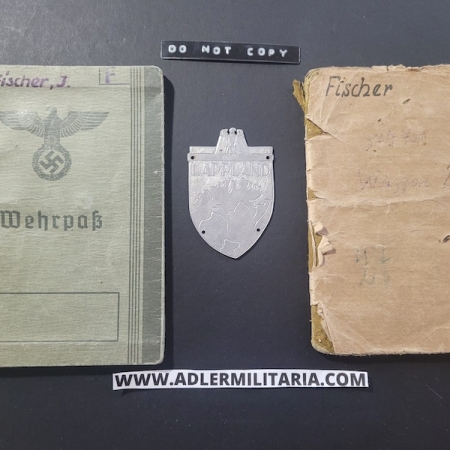
Heer Soldbuch – Uffz Fischer – Grenadier Regiment 388 (6.Geb Div) – Finland / Lappland / Norway – Lappland Schild – EK2 – ISA (Sold)
Heer Soldbuch issued to Johannes Fischer,
He worked his way from Schütze up to Unteroffizier.
First and foremost, this Soldbuch was issued to a fighter, 90% of the Lappland Medal Soldbücher offered for sale are for supply units, or units that seen little or no combat.
He was in a Machine Gun Company in:
Infanterie Regiment 388 (214 Infanterie Division)
At the beginning of April 1940, the division was relocated to the coast, loaded onto ships and transported to Norway in the Stavanger area. From here the division marched into the Kristiansand area, where it encountered the tips of the oncoming 163rd Infantry Division. After the end of the Norwegian campaign, the division remained as an occupying force in Norway.
Grenadier Regiment 388
The regiment was an army troop in northern Finland, where it was initially deployed on the Liza, later on the so-called “fisherman’s neck”. On September 24, 1943 there was a battle in the Pikschujev area. In particular parts of the officer corps of the regiment was accused of failure; two battalion commanders were personally replaced by the commanding General Schörner. The regiment was renamed on May 30, 1944 with the Artillery Division 930 as Grenadier Brigade 388.
Grenadier Brigade 388 (6 Gebirgsjäger Division)
Formed on May 30, 1944 through the reclassification of the reinforced 388 Grenadier Regiment as army troops for Finland and Norway. After the retreat from the Murman Front and from Northern Norway, the brigade was deployed in the Sweden-Norway-Finland triangle. In October 1944 she was in the Petsamo area.
Petsamo and Kirkenes 1944, The Soviet offensive in the Northern Arctic – the following book has many mentions of the GR388. Including details on the battles for Petsamo, where GR388 was heavily involved. Interestingly, the leader of Fischers unit, Hauptmann Schneeberger won the German Cross in Gold for his actions on the Speer Bridge at Pestasmo.
Points to note:
Fischer was wounded by an airplane, in the Vardö area of Norway.
Awards:
- Wounds Badge in Black – Airplane bullet – 30.6.1942 in Norway
- Eastern Front Medal
- Infantry Assault Badge in Silver
- Iron Cross Second Class – 1.11.1944
- War Merit Cross 2nd Class
- Lappland Shield – 28.7.1945
In the back pocket of the Soldbuch lay the original Lappland Shield!
He was trained on the following:
K98, MG34, Maschine Pistol, Pistol P38 & P08, 8cm Mortar. He was also trained on how to fight tanks in close combat!
Issued
Many items, but most interestingly he was issued a full set of Ski items and winter gear!
-
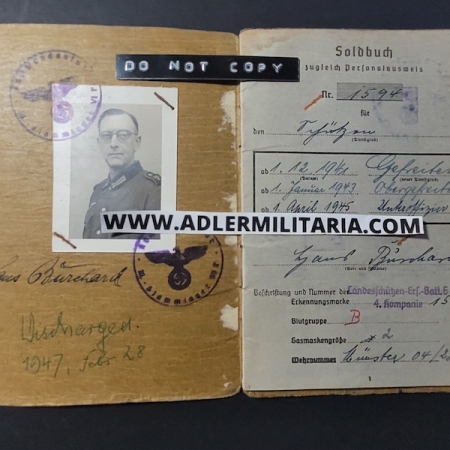
Heer Soldbuch – Uffz (Dr) Burchard – Stammlarger VI F Bocholt – Guard of the Camp – Iron Cross Second Class April 1945! (SOLD)
Soldbuch Issued to Dr Hans Burchard, who had a doctorate in Mathematics.
He would serve at Stalag VI F in Bocholt right to the wars end, winning the Iron Cross Second Class in April 1945 for: Bravery in the face of the enemy! An interesting and unusual entry for combat in the last stages of the war. Also nice to note is the fact that in the picture on the Soldbuch of Burchard, he is wearing a nice shoulder board displaying his unit.
Interesting fact about the camp was that during the Market Garden (Holland 1944) operation the camp was evacuated as it was too close to the frontline.
Beginning at the end of 1939, prisoners of war from Poland, the Netherlands, the United Kingdom, France and Senegal arrived at the camp, which was presumably set up in 1940 as “Stalag VI F” for prisoner-of-war crew ranks and NCOs. According to the Geneva POW of 1929, captured soldiers of the team ranks could be used by the detaining power for all kinds of work except in the armaments industry. This manpower reservoir was of considerable importance for the war economy, especially since the employment ban in the armaments industry was hardly observed during the course of the war. The camp was a central facility for supplying heavy industry with labor. The prisoners of war, including Russians since 1941, were used for labor service as far as the Ruhr area. On November 20, 1941, the Wehrmacht High Command (OKW) designated main camp VI F as a “general mining reception camp”.
The camp (with the exception of the camp section for the Soviet prisoners of war) was viewed by the Red Cross in 1940 as “one of the best camps” and in 1943 as “relatively bearable”. In 1941 the camp was considerably enlarged with emergency barracks. In total, far more than 1,736 Soviet prisoners of war died in the separate “Russian camp” from starvation, violence and typhus. They found their final resting place in nameless graves in a separate cemetery on Vardingholter Strasse in Bocholt. It was only recently that the names of 1,333 deceased could be clarified.
There is many references and links to the camp online, and would be worthy of further research.


-

Kriegsmarine Soldbuch – Matrosen-Artillerie Bergemann – Marine Falk Abteilung 244 – Wesermunde (Sold)
KM Soldbuch issued in Sylt, in April 1942 to Erich Bergemann.
He was stationed in Sylt for a while and served with Marine Flak Abteilung 244
They were armed with 8.8cm and 10.5cm Artillery in the Wesermunde area.
Nice complete and tidy KM Soldbuch, nothing missing!
-
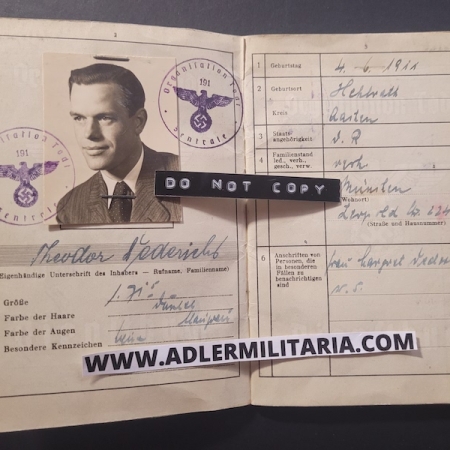
Organisation Todt Dienstbuch – OT-Bauführer Sedericht – Straflarger Eichkamp Berlin – OT Einsatz Baltöl – KVK2 (Sold)
OT Dienstbuch to Theodor Sedericht.
He was promoted to Hauptruppfüher and later to OT- Bauführer, both considerably high ranks in the OT.
He was part of OT-Einsatz Baltöl
Einsatzgruppe Russland Nord – Einsatz Baltöl. Einsatz Baltöl was a project where OT worked to get oil from the ground using many slave labourers from some concentration camps such as KL Vaivara, in Estonia, and some others. The horrible accounts and tasks can be researched in the following book:
Der Ort des Terrors: Riga-Kaiserwald, Warschau, Vaivara, Kauen : In this book, it goes into depth on how horrible the situation for the Jewish and Soviet POWs was at the same places mentioned in this very Dienstbuch. Working without proper clothing, half submerged and with little or no odds to survive.
Another entry in the book links another horrible history at Larger Eichkamp:
Larger Eichkamp: “foreign” or forced laborers from occupied territories, e.g. Poland, also prisoners of war, but also “unworthy of defense” Germans, e.g. homosexuals, politically persecuted people, “half-Jews” and, towards the end of the war, concentration camp prisoners from all countries who According to the protocols of the Wannsee Conference of January 20, 1942, they should also be murdered in principle. In some cases they were also temporarily housed there for onward transport to other areas of operation, e.g. to France (see above). There were residential barracks in which, in some cases, entire families of “foreign workers” with children who, as evidenced by medical records found, were forced to work, were also housed, as well as work barracks – also for women, e.g. sewing rooms for “Eastern workers”, sick barracks and shielded prison camps.
After evaluating a flight image, there were 18 standardized barracks in the center of the Eichkamp camp with around 2,000 people – around 100 per barracks – including guards.The actual Eichkamp camp, which was heavily bombed during the war, stretched between Harbigstrasse and Eichkampstrasse over an area of approx. Houses – (see photos below), the sports fields, as well as the forest elementary and forest high school. In the 1960s there was still a swimming pool on the “extended” school grounds of the Waldoberschule, which the students were forbidden to enter at the time, which the SS and the OT camp management used to operate a sauna. Today the basin has been filled up. Only meager remnants remind of the existence of this huge camp.
For his ‘efforts’ he was awarded the War Merit Cross with Swords in 1944, this is a rare OT Dienstbuch directly connected to the Holocaust and forced labour. It is worth of further research as many books have covered the OT Baltöl.
-
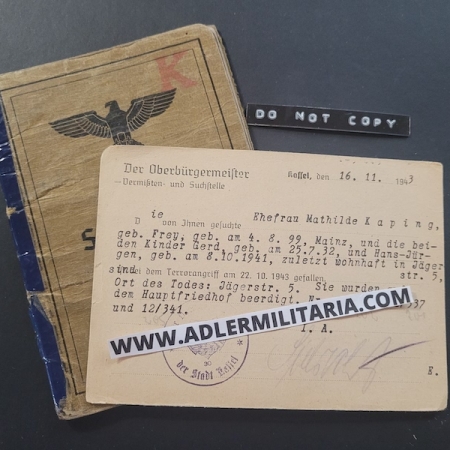
Heer Soldbuch – Uffz Kaping – Panzer Regiment 201 (Paris) & Panzer Regiment 2 – KIA in 1945 – Sad Story (on Hold)
Soldbuch to Horst Kaping,
He raised the ranks from Schütze up to Unteroffizier.
The Soldbuch was issued in October 1940.
Frontline Units:
Panzer Regiment 201
On November 19, 1940, the Army High Command, Chief HRüst and BdE, ordered the establishment of Panzer Regiment 201 to take over the French tank stocks captured in the western campaign and make them ready for use in the field by the Wehrmacht. On December 1, 1940, the line-up begins under the responsibility of Military District Command V, Stuttgart. After investigations by the new regimental commander, Lieutenant Colonel Conze, the installation site was determined to be the Caserne Mortier in Paris, Porte des Lilas. Lieutenant Colonel Conze will soon leave due to illness, his successor will be Colonel Werner-Ehrenfeucht. The commanders of the two departments are Major von Heydebreck and Captain Wolff. In December, the personnel units from several tank regiments and replacement units of the military districts IV, V, VI, VII and XIII arrive to form the regimental staff and two tank divisions of three combat companies each. On December 11th, the regimental headquarters company and one headquarters company for each of the departments are set up. They are recruited from military districts V and XIII. On December 13th, the first type 35 Somua 38 Hotchkiss tanks were taken over. Wheeled vehicles are allocated from French, Belgian and British booty stocks, hand weapons from French booty stocks. In terms of supplies, the regiment is placed under the 16th Motorized Infantry Division at the turn of the year. At this time, the Wehrmacht High Command was preparing the operation against Gibraltar.
In a very short time, the department with equipment from the 201 Panzer Regiment, housed in the barracks of the French Air Force Ministry in Paris, Place Balard, was made ready for use. The Commander-in-Chief of the Army, Field Marshal von Brauchitsch, inspected the tank department on February 11, 1941 and expressed his special appreciation for the work carried out. For political reasons, the Gibraltar operation was not possible.
On April 25, 1941, she was placed under the AOK Norway and left Paris by rail. At the beginning of the Eastern campaign it was the only German tank division to be deployed in Finland and successfully fought near Salla, where it played a major role in the capture of the city 3rd Company equipped with the heavy French 32-ton tank B 2 (Renault) and separated from the regimental unit. On June 4, 1941, it was combined with a similarly equipped company from Panzer Regiment 202 in Panzer Division (F) 102 and was deployed in the storming of Przemysl at the end of June 1941. During May, engineer platoons and light columns are set up in the departments. The workshop trains that have been created in the meantime are combined to form a tank workshop company. Regardless of the unrest caused by the setups and adjustments, Panzer Regiment 201 fulfilled its mission. The French tanks are converted and rebuilt after extensive attempts to drive, fire and shoot, they receive radio equipment and are adjusted to the tactical German requirements. The regiment companies carry out training on the Vincennes training area at the gates of Paris, as well as target practice up to the plateau on the Mer du Sable site. In a stay of several weeks at the large military training area Mailly le Camp near Chalons as well as in Suippes, cooperation in the division, regiment and brigade association is practiced during the summer months. Together with the air force, artillery and infantry, exercises of combined weapons are carried out, at the same time the cadres of the regiments 203 and 204 to be set up – the former later as army troops, then with a division each in the tank regiment “Greater Germany” and in the tank regiment 1 used, the latter later with the 22nd Panzer Division – as well as Romanian tank officers trained. Generalfeldmarsmall von Witzleben and Colonel General von Blaskowitz visit the regiment. The latter in particular promotes training in the association very significantly. Hardly having returned to Paris, the regiment had to be deployed as a result of the increased activity of the resistance movements. Regimental headquarters and 1st division are temporarily relocated to Belgium in the Mons – Charleroi area, the II. Division to Brittany – Carhaix area [east of Brest) – in order to carry out security tasks and combat partisans there. Meanwhile, on August 1, 1941, the 7th Company was re-established as a Panzerjäger (Sfl.) Company in Paris. Panzer Regiment 201 provides 50 percent of the staff, the rest comes from tank destroyer units of AOK 1. In Paris, the long-awaited conversion of the regiment to German equipment begins in October as an advance notice of later frontline deployment in the east. On December 12, 1941 Major General von Boineburg-Lengsfeld admitted Panzer Regiment 201 to the 23rd Panzer Division as part of a parade on the polygon on Avenue Viktor. On December 23, 1941, the regiment was rearmed for German Panzer 2, Panzer 3 and Panzer 4. At the same time, the 7th (PzJäg) Kp. reclassified into a light tank company. The sister company of Panzer Regiment 202, which was also reclassified, was taken over as 3rd Company in Panzer Regiment 201. The light columns of both departments move to the Panzer Divisions Supply Leader 128 to form Kw columns. The workshop company receives a 3rd platoon. On February 2, 1942, the OKH ordered the formation of the III. Department under Major Illig. For this purpose, the 1st Division hand over the 3rd Company, and the 2nd Division the 7th Company. Headquarters company and 12th company are formed from Panzer-Ersatz -teilung 100, Schwetzingen, and charges from Wehrkreiskommando IX, Kassel. The department moves into the Dupleix barracks in Paris. At the same time, the other parts of the regiment received winter and shooting training with the new device at the Le Valdahon training area in the French Jura.
Seen below – Panzer Regiment 201 in Paris!

It would seem he served very shortly with Panzer Aüfklarungs Abteilung 7, before being posted in early 1943 with:
Panzer Regiment 2
It is clear that Horst was not in a supply unit and actually in one of the Panzer Companies, (member of 4th Company).
For the last days of his life a report was written on the movements and actions of the 1st Abteilung, of Panzer Regiment 2.
When the regiment found itself in the Vistula bridgehead south of Kielce after the hard and changeable summer fighting at the end of August 1944, there was not much left of an operational tank regiment. Only a few Panzer V and a few Panzer IV are still operational. The months up to January 1945 are marked by hard training and preparation work for the expected major Russian attack. The units are initially housed in self-made forest bunkers and later, when winter sets in, in primitive Polish peasant huts. According to orders, the tanks must be half buried in so-called pit positions. Fir roofs are built so that the aviators cannot see them and the batteries are brought from the tanks to the accommodations to protect against the cold. The men, NCOs and officers march once a week, armed with entrenchments, near the front to help build positions (corps entrenchment day!). The numerous simulation games and target practice are a welcome change in the monotonous service life. On reconnaissance trips, the company commanders and platoon leaders get to know the surrounding area and the future operational areas. In larger exercises in the division association in the area of Morowica and in the 19th Panzer Division, all troops prepare in every possible way for the coming mission. Since the division is to be used as an army reserve (1st Panzer Army) behind the infantry units lying in the front, the responsible authorities in the division, the corps and the army consider it absolutely essential that the division’s staging rooms, and such, are in question yes, with these accommodations, so that the division can really be deployed operationally in the event of a Russian attack. The staging rooms must therefore be at least 50 km behind the front, if possible behind the Nida section. Unfortunately, the headquarters refuses to accept these justified proposals, which also apply in the same way to the neighboring armored divisions. So the regiment remains 12 kilometers behind the front! These facts must be mentioned as they are necessary to understand the catastrophic development in the Vistula bridgehead. On December 24, 1944, the regiment celebrated the last Christmas of World War II in its bunkers and communal houses in and around Komorki. There had been enough time to prepare for this festival, and so everyone, apart from the parcels from home, found a rich table of gifts with food, drink and tobacco. When it comes to New Year’s Eve, there is deep snow, but the Russian still does not attack, and new attack dates are announced. After a big night shooting on New Year’s Eve, the year 1945 is welcomed in the old soldier style in the most atmospheric and outwardly carefree setting. On January 10, 1945, very specific news came from which it emerged that between January 12 and 15, 1945, the start of the Russian winter offensive was to be expected.
For more information on the regiment including pictures: https://www.lexikon-der-wehrmacht.de/Gliederungen/Panzerregimenter/PR2-R.htm
Items Issued:
Winter Clothes
Mixed Iron portion
Awards:
KVK 2 with Swords
Summary
In the rear of the Soldbuch was a post card to Horsts father, Heinrich stating that he had lost his wife and two children on a bombing raid on Kassel. The raid on Kassel was on the 22.October 1943 and killed around 10,000 people of the city and displaced over 100,000 people. Interestingly, Horst was allowed to go home for a few days because of the loss of the home and family. The sadness, would not end for the Kaping family, as Horst was killed in action also in Poland in January 1945. The father lost three children and his wife and his home in Kassel.
-

Luftwaffe Soldbuch & Wehrpass – Flieger Stuckenbrock – Berlin 1945 – Died in Rhine Meadow Camp ”D.E.F” (Sold)
A Soldbuch and Wehrpass issued to:
Flieger Hans Stuckenbrock, born in 1923 in Usedom, he was enlisted in 1944 into the Luftwaffe.
His Soldbuch was opened in October 1944:
Frontline Unit:
Flakbatterie z.b.v Marienfelde (Berlin)
le.Flakbatterie z.b.V 6516
It would seem that after defending Berlin till very early 1945, he left Berlin shortly before it was encircled and made it to the Western Front.
He was subsequently captured and was sent to the horrible Rhine Meadow Camps, where he died as a D.E.F – not a Prisoner of War. He has his own grave as listed on the Volksbund website.


