
Showing 685–693 of 1179 resultsSorted by latest
-

Luftwaffe Soldbuch – Flieger-Hauptingenieur Breitkopf – RLM Berlin – Rare (On Hold)
98Very rare Berlin Soldbuch, for the infamous RLM Building which still stands in Berlin. Flieger-Hauptingenieur Walter Breitkopf was born in 1908 in Breslau (Today: Wroclaw in Poland). Breitkopf, an engineer that joined the Luftwaffe in 1938 worked in the RLM from the early days till the end of the war. Breitkopf was a member of the Fliegeringenieur-Korps (Flight Engineer Corps) admission to the Corps meant having had done a prior two year military service, be commissioned as an officer whilst holding a degree in engineering and whilst having the state exam for aircraft design. Breitkopf was assigned to the department GL4 (later TLR/B) responsible for testing new aircraft. Work was done inside the RLM building and in 1942 Breitkopf was moving back and forth from an airbase in near Paris. When on duty for the RLM in Paris in late 1943 he was sent home to Berlin due to his apartment being damaged due to an allied bombing raid. On the first of March, Breitkopf was promoted to Flieger-Hauptingenieur, a head engineer with the rank equivalent of a Capitan. In the final days of the war he was captured in Rostock, (2nd Belo Fr) likely at the Heinkel aircraft plant. The first page of his Soldbuch is stamped by the Soviet Command in Rostock. His prewar Dienstausweis (entry pass) into the RLM made of waterproof paper displays usage right the way till February 1945. His matching Erkennungsmarke (Dog Tag) and Luftwaffe issue Soldbuch. Interestingly, Breitkopf lived with his wife next to Germany’s oldest airport in Berlin-Johannisthal the many streets around there were home to all the top names in the German aircraft industry. It was from there that the first planes and Zeppelins took to the sky over Germany. The scene of one of the world’s first air disasters. A test flight of a Zeppelin exploded and crashed killing all 28 crew members. Today the former Johannisthal airport is an abandoned place slowly falling apart, the runways are now a nature park, the paths around it a popular spot for runners. Please note: This Soldbuch will feature alongside many other Berlin Soldbücher in a Book currently in he end phases.
-
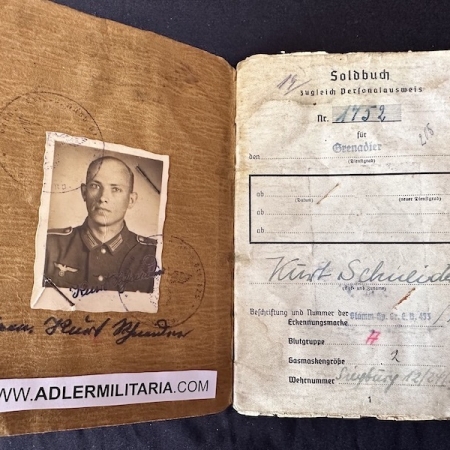
Wehrmacht Soldbuch – Grenadier Schneider – 36 Volksgrenadier Division – Operation Nordwind – Wounded fighting the US Army (sold)
Soldbuch issued in March 1943, to Grenadier Kurt Schneider from Siegland, Germany. He was born in November of 1912. He was not married and had a civilian job before he was called up. After a period training he was deployed into: Arriving in Russia in late 1943, with Ausbildungs Batl 453. He was wounded with them in March of 1944, after that he was sent in June to a replacement unit and made his way back to the front sometime in later 1944 with: Grenadier Regiment 894 ( 265 Infanterie Division) & Grenadier Regiment 165 (36th Volks Grenadier Division) – This time Schneider would fight in the Westfront exclusively. Wounded again in January of 1945 with a bullet wound, 31a in the Soldbuch. He was moved to another hospital in April of 1945 as the front drew closer and likely made it through the war. By the end of November the division had lost 50% of its personnel in the fighting in Lorraine. On December 5, the so-called “Forbach position” was occupied. Although completely exhausted, the division received the order on December 25, 1944 to move from the Saarbrücken area to positions in the St. Ingbert – Blieskastel area east of the Saar in order to break through the Maginot Line from there in a southerly direction. It was thus part of an attack in the lower Vosges to relieve the deadlocked Ardennes offensive in the north. The attack began on December 31, 1944 at 11 p.m. The division was unable to reach its attack objectives in the following days. As early as January 3, 1945, the attack was ordered to cease and the division went over to defense in the old main. In the weeks that followed, things remained relatively quiet at the main front line. The division was replaced, so that on February 3, 1945 it had a fighting strength of 3,165 men again. Interestingly the battles of Grenadier Regiment 165 are documented in the book: In Pursuit of Hitler Battles Through the Nazi Heartland March to May 1945 By Andrew Rawson · 2008 Comments: Interestingly, the NCO of the same Regiment and the first batl is for sale online, – Unteroffizier Hans Greiter (26.08.1920 † 01.10.2002) earned the Ritterkreuz on January 13, 1945 as Unteroffizier und Meldestaffelführer of the I. Bataillon/ Grenadier-Regiment 165 of the 36. Volksgrenadier-Division- Operation Nordwind
-
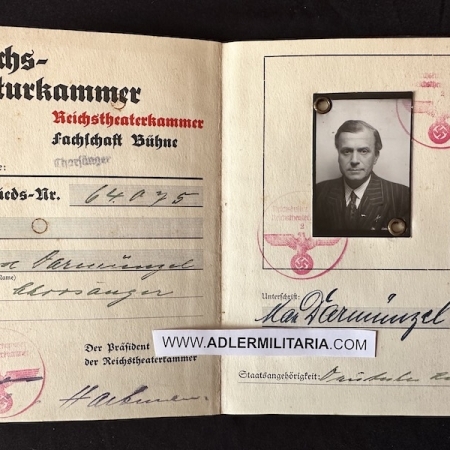
Reichskulturkammer – Choir Singer Darmünzel
$65.00Interesting Civilian ID for a professional choir singer for work on stage. Interestingly, he worked in Berlin and in the Deutsche Nationaltheater Weimar in 1943 and 1944. With the support of the conservative state government, the National Socialists had been holding regular party meetings in Weimar since 1924. In 1926, the first Reich Party Congress of the NSDAP was held in the theater after the ban was lifted. The General Manager Ernst Hardt left the theater in 1924 after there had been violent and defamatory protests against his performances from ethnic-nationalists. His successor Franz Ulbrich initially tried to continue playing contemporary authors such as Ernst Toller, Carl Sternheim and others, despite threats of censorship and calls for »cleansing« of the Weimar theater schedule. However, he increasingly made compromises with the National Socialists, who were involved in the state government from 1930 and demanded a “Jew-free theatre”. From 1933, Ernst Nobbe, a member of the NSDAP, took over the directorship, followed in 1936 by Hans Severus Ziegler, who, among other things, had co-initiated the decree »Against Negro culture for German nationality«. During the Nazi regime, a classical repertoire was mainly played, with Schiller’s drama in particular being placed in a National Socialist perspective. Hitler wanted to develop the Weimar Theater into one of the leading theaters in the German Reich and supported the DNT annually with private funds. History – National Theater Weimar The conversion of the auditorium and the renovation of the stage technology in 1939/40 devoured a sum of over 800,000 Reichsmarks, which Hitler personally campaigned for. The fact that such a sum came together during the war years illustrates the special importance of the DNT at that time. The theater also played for the entertainment of the SS members in the casino of the Buchenwald concentration camp. While Franz Lehár’s “The Land of Smiles” was being performed at the DNT, Fritz Löhner-Beda, the Jewish librettist of this operetta, was imprisoned just a few kilometers away in Buchenwald. His name was concealed in the program booklet. In autumn 1944 all theaters in Germany were closed. The DNT was leased to Siemens & Halske as a production facility. An American bombing raid on February 9, 1945 reduced the theater to rubble and ash except for the façade and the foyer.
-

Truppenausweis – Oberst Max Röhrs – Judge in Berlin Reichskriegsgericht – Sent “WinzenGruppe German Resistance -” leader to death
Truppenausweiss for Oberst Max Röhrs, born on the 26.01.1893 in Brake, Germany. Röhrs served as a Judge in the Reichskriegsgericht (German War Court). Super rare to find anything for the Reichskriegsgericht in Berlin-Charlottenburg. Röhrs was a Judge that sent Paul Winzer to death, the leader of the Winzengruppe. As well as that, Röhrs was a judge in other high profile cases such as the case against Werner Engel another German Resistance member. This Identification paper was used right up to 1944. He is wearing the WW1 Marine Wounds Badge as well as the Iron Cross First Class with WW2 Clasp. Paul Winzen * November 24, 1911 in Dortmund Paul was born as the youngest child of the Winzen family. It is no longer possible to determine when he left his parents’ house. In the Dortmund address book from 1941 he is still listed under this address, his profession is given as a stationer. Paul Winzen was a member and leading figure of a resistance group that had emerged from free-thinking/free-religious organizations. People met to go to the theater, visited exhibitions and discussed a wide variety of topics. Politically, they rejected both Soviet communism and social democracy. They advocated a humanistic social order. After 1933, the Dortmund group, which was also called the Winzen Group after its founder Paul Winzen, met in various places and organized the resistance: leaflets against the Nazi regime were printed and foreign radio stations were listened to. When an informer finally crept into the group in 1940 and betrayed the members, they were arrested as members of the Winzen group. The trial of Paul Winzen took place in February 1942 in Berlin before the People’s Court. He and another head of the group, Josef Kasel (see Stolperstein Gneisenaustr. 89) were sentenced to death for “undermining the military force” and “preparing for high treason”. Winzen was also convicted of “broadcasting crimes”. The judgment was carried out on June 12, 1942 in Berlin-Plötzensee.
-
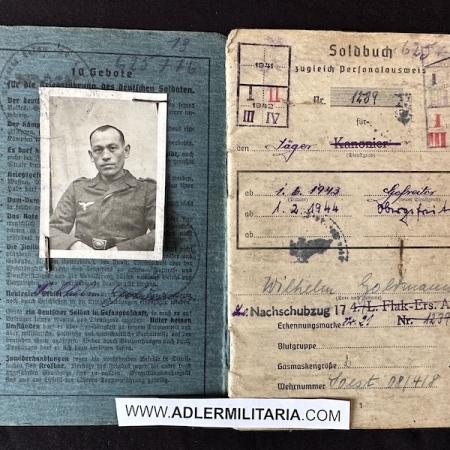
Luftwaffe Soldbuch – Obergefreiter GOLDMANN – 17. Luftwaffen-Feld-Division – 167 Volksgrenadier Division – France 1944 / Ardennes 1944/45 – Bastogne (SOLD)
Luftwaffe Soldbuch for Obergefrieter Goldmann, born in Ampen (Soest) Germany in 1908. Worked as a builder before the war and was a protestant. Married to Martha Goldmann, address in Warne an der Lippe, Germany. Soldbuch issued on the 13.January 1942 with: 13.1.1942 – 14.4.1942 Leicht Flak Ersatz Abteilung 94 15.4.9142 – 17.7.1942 – Reserve Flak Abteilung 921 14.7.1942 – 30.9.1942 – Reserve Flak Abteilung 251 – In Dresden 1.10.1942 – 29.1.1943 – Leichte Flak Abteilung 728 – In Dresden 20.1.1943 -1.2.1944 – Nachschub Kompanie 17 (L) – France 1944, Le Harve (17. Luftwaffen-Feld-Division) November 1, 1943 in the Le Havre area in northern France. The unit was created by taking over the Luftwaffe Field Division 17 from the Luftwaffe to the Army. With the formation, the unit was placed under the 17th Field Division (L). In northern France, the unit was destroyed in September 1944. On September 28, 1944, the unit was officially disbanded. Just a few weeks after it was formed, the division was assigned to Army Group D in January 1943 and moved to northern France. After the arrival of the last formations of the division in February 1943, it was used for coastal security in the area between Dieppe and Le Havre. On November 1, 1943, the division was taken over by the army (for the renaming of the division as Feld-Division 17 (L) see here). At the beginning of 1944, the division was converted into a native infantry division under the formation of the Jäger-Regiment 47 (L). The division remained in place after the Allied invasion began in June 1944. After the Allied formations broke out of the Caen bridgehead, the division was drawn into the general German retreat and in early September 1944 found itself in heavy defensive fighting against strong British and Canadian formations. Eventually the division between Ghent and St. Nicolas was broken up and officially dissolved on September 28, 1944. 12.10.1944 – POW – Versorgungs Regiment 167 The re-created division, now designated 167. Volksgrenadierdivision, took part in the Ardennes Offensive. On New Years Day, it, along with the 5th Parachute Division, aided the panzers in defending the area around the Belgian town of Lutrebois in Luxembourg. Alongside the 5th Fallschirm-Division, the 167.VGD advanced towards Bastogne and was then committed in fighting the Americans just east and south of the city once the encirclement broke in the last week of December 1944. While the three were able to hold off the approaching Americans and dealt heavy casualties to their enemies, the situation elsewhere in the Ardennes was different and the 167th was ordered to fall back. Soldbuch details: Found unfit for tropical service Security Stamp – Page 11 – Divisions Versorgungs Regiment 167 (167. Volksgrenadier-Division) Issued in 11.1944 a Red Cross Waterproof ID Equipment: Helmet with Camo Net Camo Jacket K98k with Bayonet – Interestingly he was issued twice a rifle in December 1944 and April 1945. He was issued also ammunition a few times. Medals: War Merit Cross with Swords – 17th LW Feld Division (1.4.1944) Comments: An interesting Luftwaffe Soldbuch career, taking part in defending Normandy, Goldmann survived his unit being wiped out, and was set up in a new division, which would go on to fight in the Ardennes Offensive. In a very sought after battle, the battle for Bastogne. He seems to have
-
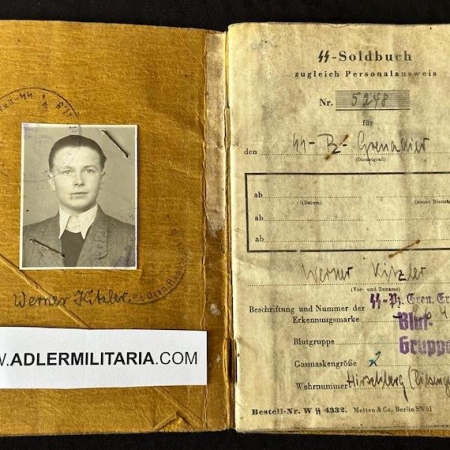
SS Soldbuch – SS Panzergrenadier Kitzler – SS- Panzer Jäger Abt 11 – NORDLAND – KURLAND 1944
SS Soldbuch issued to Werner Kitzler, born in November of 1926 in Seidorf (Kreis Hirshberg), Germany. He was trained in civilian life as a car mechanic. By the time he was called up he was still living at home with his parents and unmarried. SS Soldbuch was issued on the 2nd of May 1944, with SS Panzer Grenadier Ausbildungs und Ersatz Batl 9 in Stralsund. This is signed by an SS Obersturmführer who was the Stamm Kompanie leader. After training, this included training with the Stug training unit SS Panzer Jäger (Stu. Gesch) Ausb.u.Ers.Abt 3. According also to two security stamps in the Soldbuch Kitlzer was in Heidelarger on the 22nd of June 1944 training on the Stug, he was still there by September of 1944. Kitlzer was assigned to the SS Panzer Jäger Abteilung 11 – 11th SS Volunteer Panzergrenadier Division Nordland It is unknown how long Kitlzer spent with this active unit, which would have been armed with anti tank armoured fighting vehicle but it is safe to assume he made it out somehow and ended up as a Prisoner of War in the West. As payments are added to his Soldbuch post war as a POW in 1945. The Division fought in the Kurland Pocket From late October to December 1944, the Nordland Division fought fierce defensive battles in the Kurland Pocket. Though the division had been assembled at Priekulė for a breakout to the south, the Red Army had become aware of the German intentions. On 16 October 1944, the battles for Kurland Pocket began when Soviet troops met the division’s attack with full force. Nevertheless, the division was able to hold their positions. During a second attempt to break the German forces in Kurland, the division was able to maintain its lines.On 23 January 1945, a fourth Red Army attack to clear the Kurland Pocket, focused on Priekulė, was launched. Multiple Red Army assaults succeeded in breaking into the German positions. However, together with 14. Panzerdivision, Nordland was able to retake their positions after counterattacking. By early December the divisional strength was down to 9,000 men. Pomerania. At the end of January 1945, the division was finally pulled from the front and loaded onto ships in the Baltic port of Liepaja (Libau), where it was shipped out of the pocket to Pomerania.The division disembarked at Szczecin (Stettin), with the Panzer Battalion Hermann von Salza being sent on to Gotenhafen for refitting. In late January, Nordland Division was assigned to Steiner’s 11th SS-Panzer Army, which was now forming in anticipation of the defence of Berlin. In early February 1945, the refitted Panzer Battalion returned to the division, and a trickle of reinforcements began arriving. On 15 February 1945 Nordland was then moved to the staging area for Operation Solstice (Sonnenwende), the Pomeranian Offensive. The offensive had been conceived by Generaloberst Heinz Guderian as a massed assault all along the front but had then been reduced by Hitler to the level of a local counterattack. From the area of Reetz, the division attacked towards the encircled city of Arnswalde. Initially, Nordland’s attack achieved a total tactical surprise and the division soon advanced to the banks of Lake Ihna in all sectors.
-

Head of Yugoslavian Intelligence in WW2 – Agent Dr Ranko Brasic – Pavelic & Mihailovic collaboration 1945
Moved to our eBay Page – if you are keen on buying this contact us. This exceptional lot of IDs and documentation is phenomenally rare, nothing has been seen like this on the open market related to the topic. Brasic was a key player in the final days, acting as an agent between key players in the last days. Dr Ranko Brasic (Lawyer) (Royal Yugoslavian Army Officer) (Named: Agent) (Named head of Intelligence during WW2) (Political and Legal Adviser to King Peter II 1962 -1967). Chetnicks and Ustaša Colaboration (1945), Mihailovic had been eager to cooperate with the forces of the Croatian puppet state “because the common goal was the annihilation of the Communists” He sent his own emissary, a lawyer named Dr. Ranko Brasic, not only to Dr. Pavelic, the head of the Croatian puppet state, but also to the head of the Catholic Church in Croatia, Archbishop Alojzije Stepinac, and also to Dr. Macek, the head of the Croatian Peasant Party, who had passively opposed the quisling government. Although Mihailovic stated at his trial that Brasic was only empowered to contact representatives of the Croatian Peasant Party, it has been well established that Brasic saw Pavelic and Stepinac as well. (The Trial of Draza Mihailovic, pp. 289-96, 453-56). It should be noted that as early as 1943 representatives of Mihailovic and of the Croatian Peasant Party (to which in time many of the Domobran officers gave their support) had some discussions about the future of Yugoslavia. No agreements were reached, however, because the CPP would not recognize Mihailovic as commander in chief of all Yugoslav forces including the Domobrans, and Mihailovic would not agree to disown the Chetnik groups that had been responsible for mass terror against the Croatian population. Pavelic gave Brasic a supply of medicines for the treatment of typhus, which was widespread among the Chetnik troops in Bosnia. Besides Dr. Brasic:, Chetnik Major Zika Andric seems to have been a sort of steady contact with the Croatian military authorities in Zagreb during the last few months of the war. Finally, in mid-April 1945, Mihailovic sent General Svetomir Djukic supposedly on a mission to establish contact with the advancing Allied armies in northern Italy, but at the same time, while passing through Zagreb, to see Pavelic and discuss with him the possibility of cooperation between the Chetniks and Croatian troops and to obtain from him a series of concessions. To assist Djukic in his efforts in Zagreb, Mihailovic sent with him Vladimir Predavec, who had been for a long time a member of the Chetnik Central National Committee. Djukic, accompanied by Predavec and also Brasic and Andric, had two conferences with Pavelic, on April 17 and 22. In them, he asked for the following: release of a Chetnik hospital and its inmates captured by the Ustashas on Vucjak Mountain; release of 1,200 Serb civilians captured by the Ustashas and held in the town of gamac; medical supplies, ammunition, and food for the Chetniks; and free passage of Chetnik troops through Croatia on their way to Slovenia (but without Mihailovic, who would stay behind in the mountains). More information: Captain Nesko Nedic, the official commander of the Valjevo Chetnik Corps, otherwise Mihailovic’s emissary for negotiations with the Germans, traveled with them to Slavonski Brod. In Slavonski Brod they were accepted by the Ustasha Grand Prefect Sobalic. After completing his work, Nedic returned to Draza Mihailovic’s headquarters, and Djukic and Predavac Sobalic drove him to Zagreb in his official car, where they arrived on April 17. Djukic was welcomed by Ustasha generals Ante Maskov and Jozo Rukavina. Soon, Djukic was joined by lawyer Dr. Ranko Brasic, Mihailovic’s permanent representative to Pavelic, and Major Zika Andric, “a kind of Draza’s military attache to the Ustasha” (Karapandzic, 438). On the same day, a meeting was held in the old Ban Palace in Gornji Grad between representatives of the Chetniks, that is, Djukic and Predavac, and Ustasha officials Pavelic and Andrije Artukovic. The next day, a second meeting was held in Pavelic’s castle in Tuskanec. On that occasion, Predavac, Brasic and Andric were with Djukic, and with Pavelic were Ustasa generals Djordje Gruic and Vjekoslav Maks Luburic, the former commander of the Ustasa camp Jasenovac – the greatest strategist of the Serbs. The third meeting between Djukic and Pavelic was held only on April 22. The break was caused by the fact that Max Luburic traveled to Bosnia, where the Ustase massacred the Chetniks of Pavle Djurisic. The result of the negotiations between Mihailovic’s envoy, divisional general Djukic, and Chief Pavelic was that the greatest executioner of the Serbian people promised the Chetniks and did everything that Djukic asked for. As Djukic writes in his memoirs, Pavelic “according to our request, sent trucks with medicines and ammunition, and in addition issued the necessary orders to the competent authorities to allow Draza’s group to pass through Croatia in the direction of Slovenia”. A series of articles by General Djukic about his mission to Pavelic appeared in the monthly newspaper Srpska zastava (Buenos Aires) between December 1954 and May 1955 under the title “From the Forests into Emigration.” Djukic was answered by Ustasha General Luburic in an “Open Letter to the Serbian General Svetomir Djukic,” in Drina (Madrid) in December 1955. Pavelic also, in 1949 , published his recollections of these conferences. However, the events unfolded in their own way, everyone saved his own head, so Svetomir Djukic, Ranko Brasic and Zika Andric benefited the most from the negotiations with Pavelic. They, helped by the Ustas and together with them, fled abroad without hindrance. Society for the truth about the anti-fascist national liberation struggle in Yugoslavia 1941-1945. The Trial of Mihailović Brasic is mentioned numerous times in the trial, he was explicitly called an agent. Interestingly, the full trial in which Brasic is mentioned explicitly around 20 times can be downloaded online for free. Here are some extracts from the trial mentioning Brasic: THE CONNECTION OF THE ACCUSED MIHAILOVIC WITH PAVELIC AND…
-
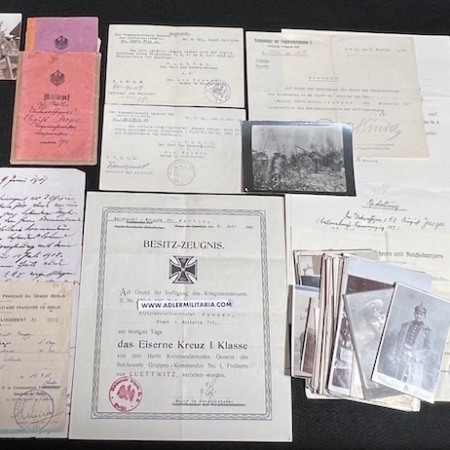
WW1 German Flak Grouping – Shot down x 2 Planes in 1918! – Ultra Rare! (On Hold)
We are pleased to be able to offer this incredible WW1 Grouping for the NCO August Jäger from Prussia. Jäger was born on the 6th of October 1881. Enlisting in WW1 in 1914 Jäger would serve until July of 1915 with various replacement units. Jäger obtained the rank of an NCO as early at 1914. Joining on the 7.7.1915 – Flak Zug 113, Flak Batterie 710 The unit is also mentioned in this book: https://www.amazon.com/Over-Front-Magazine-Winter-2002/dp/B07XKJRPXM Fighting in the following places in 1914/18 – 08.1914: Border Battles – Eastern Prussia Western Front: Arras, Artois, 6. Armee Battle of the Somme, Battles between the Maas and Mosel Rivers, including the Maas Heights. 1916 – Somme, 1917 – Somme, Siegfriedsfront, Cambrai, Seigfried Positions. 1918 – Somme, Aire On the 13th of July 1918, Jäger was accredited with the destruction of one allied aircraft. According to the documentation this was a Sopwith F1 Camel Aircraft. On the 5th of July 1918, Jäger was also accredited with bringing down a R.E.8 Aircraft. Interestingly, in the publication, Westarpscher Taschenkalender für die Luftwaffe, sowie für Luftschutz, Luftverkehr und Luftsport, Volume 7, 1943 Jägers unit is mentioned as shooting down three planes in the space of a week! Needless to say, such entries are extremely rare, and this is the first time from 1000s of WW1 Soldbuch/Military Passes where we have seen accredited aircraft kills. Item will be sent recorded from our US Storage. Pictures/Photo Album: Moved to: K-Flak Batterie 175, October 1918 – interestingly this unit was self propelled. Released from Service: 20.08.1919 Link: Mentioned in this book:
-

WW2 US M-209-B Hagelin Cipher Machine – Mega Rare! (Offer Accepted)
In 1934 the Swedish cryptographer Boris Hagelin (1892-1983) designed a cipher machine for the French Army. He developed the machine and it was adopted by the United States Army as the Converter M-209 Cipher Machine. By 1942, 400 Hagelin machines a day were being produced at Groton, New York. Eventually, more than 140,000 were manufactured during the Second World War. The M-209 was used by the United States Army as late as the Korean War (1950-1953) Encoding Machine, screwdriver, paper tape, technical manual, webbing bag and pencil. The Converter M-209-B was a small, compact, hand-operated, tape printing, cryptographic mechanical device. It used a series of rotors to encipher and decipher radio transmitted tactical messages rapidly. When properly set and operated it enciphered a plain text message of any length and automatically printed the enciphered text on a plain tape in five-letter groups. The M-209-B also deciphered transmitted messages that had been previously enciphered on another Converter. The Converter printed the plain text on a paper tape with proper spacing between the words. Important: This item is shipped from our US Storage Tracked Worldwide.


