Showing 667–675 of 1179 resultsSorted by latest
-
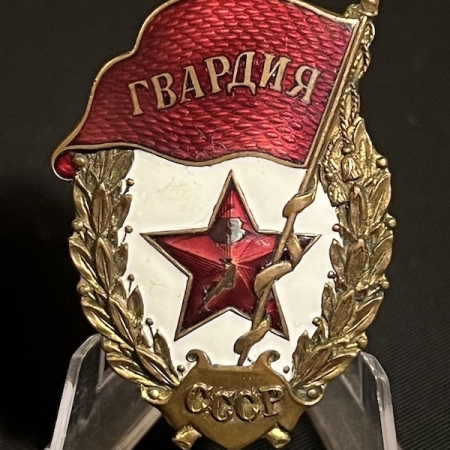
Estonian Made Red Army Guards Badge
An original made Estonian Red Army Guards Badge These are extremely hard to find. The former factory of Roman Tavast, a pupil of the well known Russian jeweler – Faberge. Therefore, all insignia made for RKKA in Estonia are famous for their quality. End of war or early postwar made badge. The screwback is marked: Roman Tavast – Tallinn . The badge is made of copper and covered with gilding. Story behind Roman Tavast Roman Tavast was born in Tallinn in 1895. He was born into a fisherman’s family. Tavast graduated from Niklasen’s 4-year private school and studied engraving as well as goldsmithing in E. Treder’s workshop. He had also worked for the goldsmith Julius Lossman, learned the art of gilding, and later completed courses at an art school. He graduated from evening high school to get a general education. Tavast then started his independent activities after the Estonian War of Independence. In 1920, Roman Tavast had provided himself with a one-seater goldsmith’s workbench, and in 1921, a wire rolling machine. In 1923, at the age of 28, he opened his own independent company for the production of badges, medals and other honors and awards – VMT Roman Tavast. Following the occupation of Estonia and the creation of the Estonian SSR in 1940, the factory and the residential building with the store were nationalized in 1940. Karl Johanson was appointed as the new director of the factory. Roman Tavast worked as a technical manager at the factory until June 1941, when he was deported to the Vorkuta camp system in the Russian North. Roman Tavast was sentenced to death and shot in 1942 in Sosva, Sverdlovsk Oblast, Soviet Union
-

Enlisted Mans Waffen SS – M40 Side Cap – Original (On Hold)
Original Waffen SS M40 Enlisted Mans Side Cap Textbook Example: Banana form, false piping and single line machine stitching on the interior. Small size stamp barely visible. Condition: Worn example, was found with a metal period Soviet Star (removed). No moth bites and perfect for display. Typical Sizing: 56cm This was recently found in Latvia, and was never in a collection before.
-

Waffen SS Belt Buckle – Steel RODO (SOLD)
Original RODO Waffen SS Steel Belt Buckle Buckle in steel and painted in period green on the right end of the belt, magnetic, maker marked “RODO” (Robert C. Dold, Offenburg) on the reverse, the buckle measuring 49 mm x 64.5 mm. Nice percentage of original finish, these are very hard to find in such lightly worn condition. This is a recent find in Latvia, was never in a collection.
-

WW1 German Soldbuch & Militärpass – MG Gunner Gefreiter Emil Krengel – Infanterie Regiment 141 – Iron Cross Second Class – Eastern & Western Front
Nice WW1 Set to a Machine Gunner Emil Krengel born in Mettmann in 1889 Won the Iron Cross Second class in Flanders Served with: 2nd Machine Gun Company, Inf Regiment 141 (35th Div) The 35th Division (35. Division) was a unit of the Prussian/German Army.[1] It was formed on April 1, 1890, and was headquartered initially in Graudenz (now Grudziądz, Poland) and from 1912 in Thorn (now Toruń, Poland).[2] The division was subordinated in peacetime to the XVII Army Corps (XVII. Armeekorps).[3] The division was disbanded in 1919 during the demobilization of the German Army after World War I. The division was recruited primarily in the southern part of West Prussia, and included a relatively high percentage of Poles. Combat chronicle The 35th Infantry Division began World War I on the Eastern Front. It fought in the battles of Gumbinnen and Tannenberg, and in the First Battle of the Masurian Lakes. In 1915, it participated in the Gorlice-Tarnów Offensive. In October 1915, it was transferred to the Western Front. In 1916, it fought in the Battle of the Somme. In 1917, it participated in the Battle of Arras and the Battle of Passchendaele. In 1918, the division fought against various Allied offensives and counteroffensives, including the Hundred Days Offensive. Allied intelligence rated the division as a mediocre division and considered it second class by 1918, mainly due to the losses it had suffered in the war’s earlier battles. Battle Calendar: 1915 01/31/1915 – 02/02/1915: Battle of Humin (Battle of Humin and Wola-Szydlowiecka) 03/05/1915 – 03/16/1915: Battle of Stolniki 07/13/1915 – 07/17/1915: breakthrough battle near Przasnysz 07/13/1915 – 07/14/1915: breakthrough at Przasnysz 07/15/1915 – 07/16/1915: Breakthrough of the Bogate Position July 18, 1915 – July 22, 1915: Pursuit battles to the lower Narew 07/23/1915 – 08/03/1915: Battle of the Narew 07/23/1915 – 07/24/1915: Narew crossing between Pultusk and Roshan 08/04/1915 – 08/07/1915: Battle of Orz-Bach (Goworowo) (Battle of Wonsewo) 08/08/1915 – 08/10/1915: Battle of Ostrow 08/11/1915 – 08/12/1915: Battle of Chizhev-Zambrov 08/13/1915 – 08/18/1915: Pursuit battles on the upper Narew and Nurzec (persecution to the Biala) 08/19/1915 – 08/25/1915: Battle of Bielsk 08/26/1915 – 09/05/1915: Pursuit battles at the Swisloc and at the Naumka-Werecia 09/06/1915 – 09/07/1915: Battle of Volkowyszk 09/08/1915 – 09/12/1915: Battle of the Zelwianka and the Njemen 09/12/1915 – 09/17/1915: Battle of the Szczara and Jeinia 09/17/1915 – 09/26/1915: Pursuit fights in the Lithuanian swamps September 27, 1915 – October 17, 1915: Departure and transport to the west western front October 19, 1915 – June 23, 1916: Position battles between the Somme and the Oise 1916 06/24/1916 – 11/26/1916: Battle of the Somme November 27, 1916 – March 15, 1917: Position battles on the Somme 1917 March 16, 1917 – April 10, 1917: Fighting in front of the Siegfried Front 04/02/1917 – 05/20/1917: Spring battle near Arras 1917 May 21, 1917 – May 28, 1917: Trench battles in Flanders and Artois 05/27/1917 – 06/13/1917: Battle of Flanders (Part 1: Battle for the Wyschaete bend and preparatory battles for the summer battle of 1917 in Flanders) June 7, 1917: Battle of Wyschaete and Messines 06/15/1917 – 06/20/1917: Fighting in front of the Siegfried Front 06/24/1917 – 10/08/1917: Fighting in the Siegfried Line 10/20/1917 – 12/03/1917: Autumn Battle 1917 in Flanders 12/04/1917 – 03/30/1918: trench warfare in Flanders in the winter of 1917/18 1918 03/31/1918 – 05/06/1918: Trench battles in Flanders and Artois April 9, 1918 – April 18, 1918: Battle of Armentières 07.05.1918 – 23.08.1918: trench warfare in Flanders 08/24/1918 – 09/02/1918: Battle of Monchy-Bapaume 09/03/1918 – 09/26/1918: Fighting in front of the Siegfried Front 1918 09/27/1918 – 10/08/1918: defensive battle between Cambrai and St. Quentin 10/09/1918 – 11/04/1918: Fighting before and in the Hermann Position 10/24/1918 – 11/04/1918: Battle of Valenciennes 11/05/1918 – 11/11/1918: Retreat fighting in front of the Antwerp-Maas position from November 12, 1918: evacuation of the occupied territory and march home
-
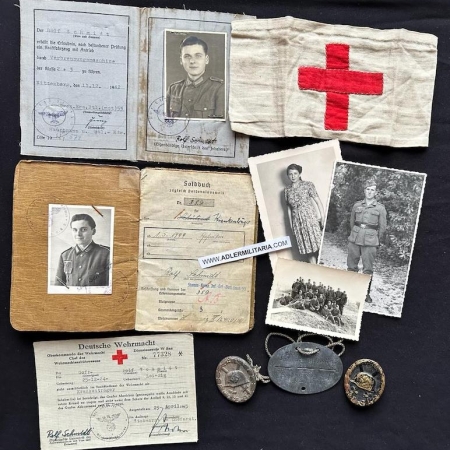
Wehrmacht Soldbuch – Krankenträger Schmidt – Grenadier Regiment 187 (87 Inf Div) – Medic Wounded in Russia (On Hold)
Soldbuch to Krankenträger / Gefreiter Rolf Schmidt From Leipzig, Germany, he was born into aa protestant family and in his civilian life he was a sales man. Soldbuch issues in October of 1942, after a period of training he was send to the Grenadier Regiment 187 of the 87th Infanterie Division. He was wounded with Shrapnel in Witebsk in Belarus, and was sent via hospital train to another Hospital in Prag. His injury must have been very bad, as it is entered in as 31b (shrapnel) and 26 – which is nerve and mental illness. Maybe Shell shock? He spent the rest of the war in a Wehrmacht Hospital in Vlašim (German: Wlaschim) is a town in Benešov District in the Central Bohemian Region of the Czech Republic – where he sat out till the end of the war and he was discharged on the 24.04.1945. Schmidt had a FN 6.35 (FN Baby Browning) and was given multiple times a Führerpaket (usually with some food/wine and small goodies to boost moral. Also included are: Armband is hand made. Both of his Wound Badges are included in the lot. His Dog Tag is complete with drawstring and is matching to the Soldbuch as per Page 1. Wehrmacht Driving license with nice photo Red Cross ID – issued on the 25th of April 1945 (one day after he was dismissed) Three Photographs Comments: This is a nice set to a German Medic, wounded in combat. This was not a put together lot and came as is. Not easy to find such little trinkets of history today with all the medals, tag, armband etc.
-
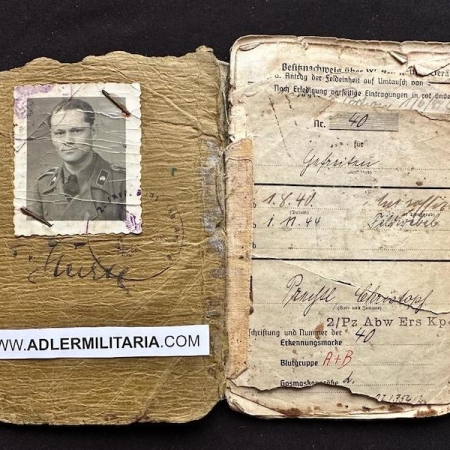
Wehrmacht Soldbuch – Feldwebel Prechtl – Panzerjäger Abt 61 – 11.Panzer Division – Lorraine France 1944 & Remagen 1945
Soldbuch issued to Christopf Prechtl in 1939. Nice Photo with Stug Wrap displaying the Eastern Front Ribbon. Sadly the Soldbuch is damaged/Burnt/Bloodstained? but it is possible to work out he was issued a MP40 and was with: Panzerjäger Abtl 61 . They were armed with Marder and Stug, and Prechtl was likely wounded when the Soldbuch was damaged. The fighting for Kirovograd dragged on until mid-January 1944 and then shifted to the area west of Cherkassy. In late February/early March 1944, the division fought at Shepetovka and Yamol, and then withdrew to the Bug by the end of March. At the end of May there were defensive battles in North Bessarabia and in the foothills of the Carpathians and in the area of Army Group South Ukraine. At the end of May 1944, the division was withdrawn from the front and transferred to southern France as an occupying force to be refreshed there. But even before the completion of this refresher and actual realignment, the division had to withdraw through the Rhône Valley after the Allied landings in northern France in August 1944. From October 1944 the division then fought in Lorraine. In December 1944 / January 1945 the division took part in the Ardennes offensive. After their failure, the division was on the Saar front and in February 1945 on the Roer and Rhine. In March 1945 the division fought at the Remagen bridgehead and in late March 1945 at the lower Sieg. By the end of the war, the division then withdrew through the Westerwald, Hesse, Thuringia, the Vogtland and the Sudetenland into the Bavarian Forest, where it surrendered to the American 3rd Army on May 8, 1945 Comments: This is a nice display Soldbuch for the Western Front, from a desirable unit worthy of further research. Because of the missing pages the price is very low.
-
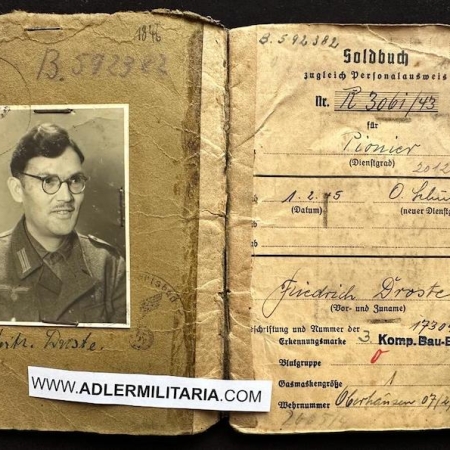
Wehrmacht Soldbuch – Oberschütze Droste – Landeschützen Batl 488 – Hüderich/Wuppertal 1945 – Fighting US Army (Sold)
Soldbuch issued to Oberschüzte Droste in 1943. He served with Pionier-Bataillon 6 (Minden), he was wounded on the Eastern Front with the 6th Infanterie Division by shrapnel. Awarded the Black Wounds Badge Sent to a new unit after recovery: Landesschützen Batl 488, fourth Company. – Originally intended to watch Prisoners of War. According to Lexicon der Wehrmacht the fourth company was given over to: Landeschützen Batl 491 Guarding POW’s first in Krefeld, then early 1945 in Hüderich, and last in the Wuppertal area fighting US Troops. Interestingly, he was issued a French Rifle, Camo Net.
-
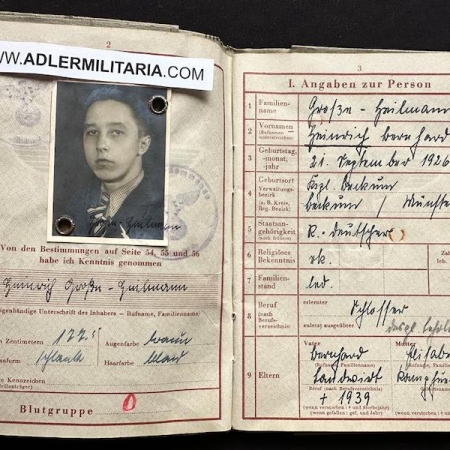
Heer Wehrpass – Grenaider Heilmann – Panzergrenadier Regiment 8 – 3.Pzgren Div – Battle of Köln 1945 (sold)
Wehrpass issued to Heinrich Grosse Heilmann, born in 1926. He was sent to his frontline unit after a period of training. He arrived in March of 1945 to the frontline, in the area of Cologne/Remagen in 1945 fighting the US Army. Interestingly, a report on his character is inside the pocket of the Wehrpass and states he is not recommended for promotion. He is not listed as killed in Action.
-
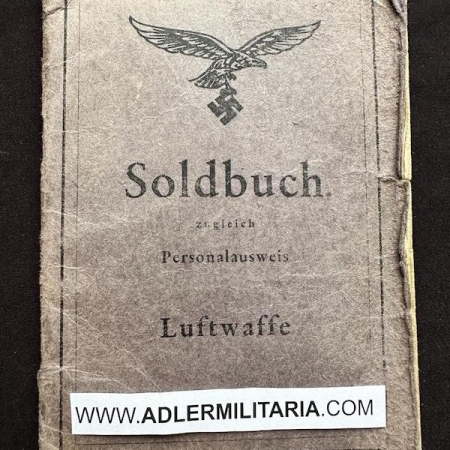
Luftwaffe Soldbuch – Kanonier Pois – Wiener Neustadt – Flak zbv 10609 – Vienna – Rare Soldbuch Edition (Reserved)
An interesting Soldbuch model, this one is in Latin letters and printed and issued in Vienna. Issued to Franz Pois, an older man born in 1898. He was enlisted in late 1944, and sent to various Flak units. He seems to have been a flak search light operator. Ending with S. zbv Batterie 10609 An interesting Soldbuch, could be researched further.


