Showing 631–639 of 1172 resultsSorted by latest
-
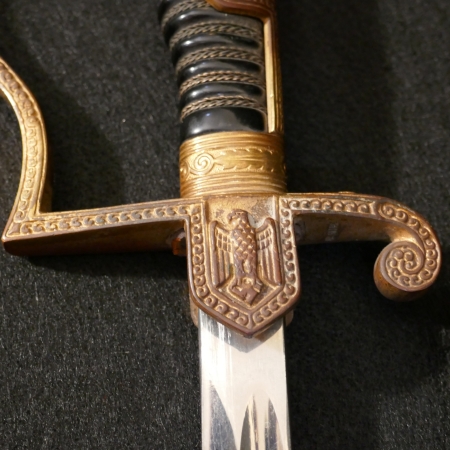
WWII German Army Wehrmacht Officer’s Sword & Scabbard – ‘Eickhorn Solingen’ & Squirrel Broadsword Logo to the Ricasso
WWII German Army Wehrmacht Officer’s Sword & Scabbard. Slightly Curved Single Edged Bright Blade with Fuller Measures 31 Inches to the Ricasso with the Overall Length being 36 ¾, Wire Wrapped Synthetic Handle, Army Eagle Insignia to the Cross Guard, ‘Original Eickhorn Solingen’ & Squirrel Broadsword Logo to the Ricasso (Carl Eickhorn Mfg.) The Gilt on the Brass Fitting exhibits wear with about 50% remaining. The Crossguard is marked ‘ges. gesch’, The Single Suspension Ring Scabbard retains about 70% of the painted black finish and shows some surface corrosion. Overall this Example Remains in Immaculate Issued Condition as Photographed with two cracks to the upper grip as seen. *International Shipping is Discretionary per Local Laws*
-

WW2 Soviet – Medal Group – Three Men – Incredible Story – KIA – Latvia 1944 – Destoryed Tank – Killed up to 200 Enemy Soldiers – Super Rare – Order of Glory – Medal for Courage
This grouping came from a private collector, found after the war in a bunker in Lubanna with a metal detector. There was a puzzle with this grouping, as two men are listed as buried in Latvia and have graves, until the research was completed. What is clear, these soldiers had their medals taken off and collected already during the war. Likely a field hospital or something similar. How do we know that? The last medal with research, the soldier was killed and buried one month before his unit arrived in Latvia in 1944. So these were clearly kept in order to either send back or to return them to family but never happened. All documentation from the archives including the divisional maps and wartime burial locations and unit daily reports will be supplied as a file to the new owner. PLEASE NOTE: See all images with annotations. Three Soldiers: Red Army Private – Vasily Zotov – Russian – 41st Anti-Tank Brigade Medal for Courage – 350689 – “During the fight from 11th till 20th of July 1943, he was a driver towing a 76mm Anti Tank cannon on a trailer. Under enemy machine-gun and mortar fire, he restored the car, oil sump, radiator, changed 5 cylinders, re-tightened the bearings, and repaired the water pump. Restored a captured Praga car. From a direct hit by a mine, a car loaded with ammunition and fuel, Comrade Zotov led the burning car out of the cluster of cars to the side for 200 meters, he then loaded part of the ammunition from the burning car.“ Comments: Zotov upgraded his medal holder to look like the early model of the Medal for Courage, commonly seen. Please see the photographs with annotations. Zotov was killed in battle in Latvia 1944 and buried see the photos and maps annotated. ——— 2. Red Army Guards NCO Balakin – Commander of Artillery Battery. Medal for Courage (Original First Pattern) – 134496 – In the battle near the village of Pshenachina, Smolensk region, on November 27, 1942, he destroyed 2 houses with firing points with direct fire. Destroyed 3 machine guns. Being surrounded near the village of Tsitsina 12/8/1942. blew up 1 enemy tank. In battle, he behaved boldly and bravely, worthy of a medal for courage. Order of Glory – Third Class – 16983 – During the period of hostilities for the villages of Antonova, Rozhnovo, Skryabino, Vorotkovo, Novo Sokolnichesky district of the Kalinin region from 01/27/44 to 02/02/44, the battery of Comrade Balakin destroyed a mortar battery, 6 machine-gun points, the fire of two artillery batteries and 4 machine-gun points of the enemy was suppressed, up to 200 enemy soldiers and officers were destroyed. In the battle for the village of Lamanovo in the Novo Sokolnichesky district of the Kalinin region on 02/07/44, the enemy launched a counterattack on the combat formations of the 3rd battalion of the 258th Guards Rifle Regiment, in 45 seconds a stationary barrage of the battery was called, despite the fact that the firing position was heavily shelled by enemy mortar fire, 2 people of the crew were disabled by mine fragments, communication was interrupted, Comrade Volakin, under enemy fire, fearlessly directed battery fire at the counterattacking enemy, the counterattack was repulsed, the enemy left 3 machine guns on the battlefield and up to 30 people were killed. Our infantry moved forward.” Interestingly, he was put forward for a second degree Order of Glory, but was given the Order of Glory third class. Balakin, fell in combat near Lubana, Latvia in August of 1944, he is buried in Mierini Latvia. ———- 3. Red Army NCO Neudachin – Blacksmith Killed in Estonia 1944 – Buried at Kolkhoz May 1st – Grave Number 2 – 31.07.1944 Medal for Military Merit – 1019025 – Blacksmith in Veterinary infirmary – Red Army Nevrozy – “During the battles from 20.6 to 3.07.1944, under artillery and mortar fire he evacuated successfully eight wounded horses. He has worked as a blacksmith forging since 1942, he forges horses perfectly. Born in 1915, Russian Nationality, Member of FKP, drafted by Ishimbayevsky RVC in 1940, 1942: Censored information.” —– Original Footage of the Riga Offensive 1944 https://www.youtube.com/watch?v=oOb-oMcjH1A
-
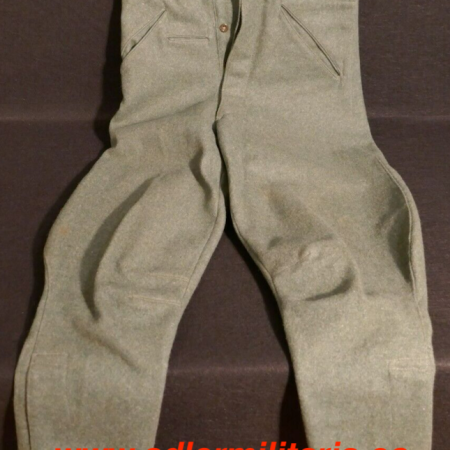
WW2 German Breeches / Pants – M1938 Polizei – Good Condition (Offer Accepted)
WWII German Police Polizei Green M1938 Service Breeches Wool, Uniform Pants Original WW2 German Police Polizei Green Pattern 1938 Service Breeches Wool, Uniform Pants, Small Size Approximately 30 x 26. Fine Issued Condition as Photographed with a few buttons missing and small area to the seat unstitched as seen
-
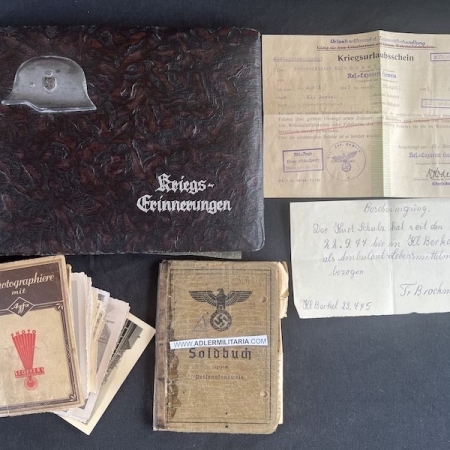
Wehrmacht Soldbuch and Photoalbum – NCO Kurt Schulz – Grenadier Regiment 505 (291 Inf Div) – G43 Rifle – Iron Cross (5 Awards) – Frontline Photos – Rare
An interesting grouping, and not often met with Soldbuch and Photo album with training and Frontline photos. Awards: August 1942 – Iron Cross Second Class August 1942 – Eastern Front Medal September 1942 – Infantry Assault Badge in Silver January 1943 – Wounds Badge in Black August 1944 – Wounds Badge in Silver Soldbuch was issued in Feb of 1941, by his training unit which is in the photo album. Interesting points in the Soldbuch: Wounded multiple times, with grenade splinters, he was also suffering from freezing wounds on his feet which meant he needed a three month hospital visit in Narva Estonia. Interesting Point Photo Album: Photos of the unit commander a German Cross in Gold Holder, Camo Helmets, Frontline in the Trenches, this is not often seen and adds a nice element knowing where the Soldbuch actually was. Equipment: Issued a Rifle 43 in June of 1944 a very nice entry. Frontline Unit: Grenadier Regiment 505 (291 Infantry Division) The German 291st Infantry Division, was an infantry division of the Wehrmacht and served in World War II. It was formed on February 10th 1940 as a division of the 8th Wave at the Troop training ground Arys im WK I (Prussia). 291. Infanterie Division was formed in Insterburg in the military training area of Arys (south-east of Königsberg, East Prussia) in February 1940 as part of the 8th Wave. Created by using cadres from previously existing units, it took part in the attack on France but played no noticeable role there. During the expansion of the Heer in the autumn the division lost 3 Btns. of Infantry (I /504th, I /505th and I /506th.) and one of Artillery (III /291st.) to the newly raised 306. Infanterie Division, but these units were replaced before the division was assigned to Heeresgruppe Nord in early 1941 as 18. Armee’s reserve as they prepared for the launching of Barbarossa. The “Elch” (Moose) division managed to advance 44 miles in the first 34 hours of the campaign in the Baltic States, but after being assigned the mission of clearing the Baltic coast, was temporarily stopped in their tracks at the naval base of Libau where Soviet Marines and 67th Rifle Division repelled their first attempt to rush the town on 25 June. Resorting to point blank artillery fire, Herzog’s men finally overran the town after four days of fierce street and house fighting and continued advancing up the Baltic Coast before reaching the Latvian capital of Riga which was already under attack from the East by Philipp Kleffel’s 1. Infanterie Division, the following day.[1] After helping secure Estonia during July and August, the division was deployed on the right wing of XXXVIII Korps’s ring around the Oranienbaum Bridgehead in early September and broke through the Soviet first line of defenses around Leningrad at Popsha before turning north and taking Peterhof, on the Gulf of Finland, sealing in the Coastal Army. After this success, the front settled down into static positions that changed very little for almost two years, but, following his receiving the Knights Cross in mid-October, there was little time for Herzog and his men to catch their breath as they were shifted to 18th Armee’s front along the Volkhov River to resist continued efforts by the Russians to break through to besieged Leningrad.[1] The division was finally withdrawn from the front in late December, but only had a few days’ rest before Andrei Vlassov’s 2nd Shock Army launched a massive offensive at the beginning of January aimed at the thinly held line at the junction of 61. Infanterie Division and 21. Infanterie Division. 505th Inf. Regt., under Oberst Lohmeyer to seal the breach , but it was only a question of time before they made another probe elsewhere. “A matter of time” was ten days, the breakthrough was slightly to the south, and it was the 291st that again stood in their way, but, despite atrocious weather, its men stood firm long enough for the Polizei and 58. Infanterie Division to cut off the Russian penetration, though fighting within the pocket went on until late June. After defeating the Soviet 2nd Shock Army’s penetration of the front over the Volkhov River, and, despite the renewal of the offensive by the Russians in the Mga sector, just to the north of their positions, they were kept on the relatively quiet sector north of Novgorod until January 1943, when they were shifted to LIX Korps sector on the junction of Heeresgruppe Nord and Heeresgruppe Mitte. During that Winter the divisions three Infantry Regiments lost one battalion each, except for one company from each which was, initially, formed into a Ski battalion, but this unit was later converted to bicycles. Remaining in defensive positions around Korotsen over the Winter the division was reinforced by the recreation of 506th Gren. Regt. in February but was nearly annihilated by the Soviet 3rd Guards Tank Army near Shepetovka in early March. By June they were back on 4th Panzerarmee’s front (XLII Korps) as they fell back through south-east Poland (also taking part in the fighting inside the Hube cauldron). The severely understrength Division rejoined XLII Korps in August and remained with them until over-run and destroyed by 1st Ukrainian Front near Czestochowa (Tschensotchau) after the Soviets resumed their offensive in mid-January 1945. Some remnants were incorporated into the 6. Infanterie Divisions 37th Gren. Regt. whilst the remainder were used to augment 17. Infanterie-Division in March. Comments: This is a really nice set, its not often to find a nice photo album with a Soldbuch. This particular album the soldier never finished, although had these photos with it. Including GR505 at the front in the bunkers and trenches.
-
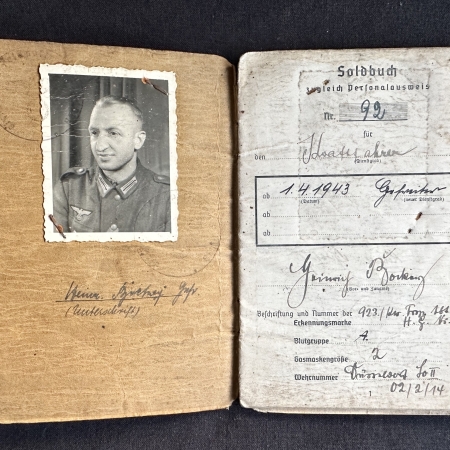
Wehrmacht Soldbuch – Gefrieter Bockey – Driver in Balkans – Eastern Front Medal – Drivers Badge – Worked for Allied Forces in 1945 – Reserved
$165.00A nice Soldbuch to a driver with two awards. He was active with: Kraftwagen-Transport-Abteilung 995 established on March 23, 1941 in Villingen in military district V as a departmental staff. On May 20, 1942, the Deutsche Reichsbahn columns 911, 926, 934, 935, 946 and 939 were incorporated as the 1st – 6th columns. On May 10, 1943, the columns were reorganized into three companies. In addition, there were the motor vehicle transport companies 927, 928 and 970. The department was an army force and reported to the Quartermaster General. It was used in the Balkans. 1945 – it seems he worked for the Allied forces again as a driver in the Labour Unit 1060 in Villach.
-
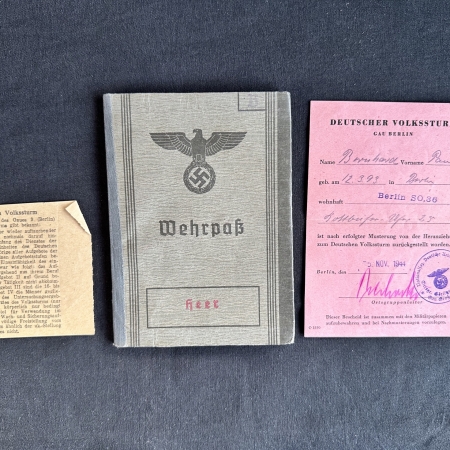
Wehrpass – Paul Bernhard – Berliner Volkssturm – Ortsgruppe Gorlitzer Bahnhof – Berlin 1945 (Sold)
A nice Wehrpass issued to Paul Bernhard, in November 1944 he was called up to the Berliner Volkssturm. He was a WW1 veteran serving with Infanterie Regiment 176 Interestingly, he lived in Kottbuser Ufer 25, and was enlisted in the Volkssturm into the Ortsgruppe Görlitzer Bahnhof. Both places today are busy tourist destinations. Also included is a newspaper extract detailing the Berlin Volksturm Process and enlistment, which adds to this little lot nicely. This item will feature in a Berlin Book with many other stories.
-
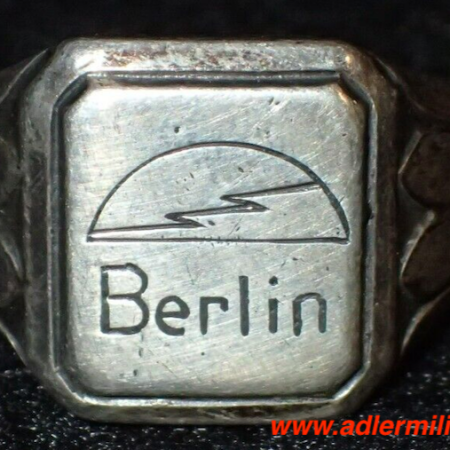
WW2 US Army – 78th Infantry Division – 900 Silver Signet Ring – Berlin 1945 Occupation
Wonderful Original WW2 US Army 78th Infantry Division – Berlin 1945 Occupation 900 German Silver Signet Ring Size 10 & Weight 19.3 Grams, The 78th ID Relieved the 82nd Airborne Division in November 1945 and Served Berlin Occupation Duty until May 1946. Good Condition as Photographed with personal wear as seen – (Photo 14 Reference: 78th Division Parade in Berlin 8 May 1946)
-

WWII USN 1946 Grouping – Atomic Bomb Operation Crossroads “Bikini Atoll & Highjump” – William H. Irwin USS Arkansas – Signed by Admiral Richard Byrd
WWII USN 1946 Operation Crossroads Bikini Atoll Highjump & Dog Tags BM1c RAREOperation Highjump Cards hand Signed by Admiral Richard Byrd Wonderful Original WWII USN to 1947/8 Collection of Cards and Tags to Included 1946 Operation Cross Roads Bikini Atoll then Boatswains Mate 1st Class ‘William H. Irwin’ USS Arkansas Joint Task Force One Atomic Bomb Test Participation Card. Operation Highjump Cards: Domain of the Penguin / Domain of Neptunus Rex Serving Aboard ‘USS Yancey’ AKA-93 both Signed to the Reverse by Admiral Richard E. Byrd. Accompanied by Irwin’s USN Navy Personnel Identification Discs “Dog Tags” all to William Harold Irwin, who was serving aboard USS Lexington CV-2 on December 7, 1941 (see Muster Roll), further serving during WWII aboard: USS Block Island CVE-21, USS Lexington CV-16, USS Portland CA-33, USS Oahu ARG-5, and LST-846 (Muster Rolls available for all ships at Ancestry showing WH Irwin ‘360 15 84’)
-

1860’s Japanese Shinshinto Tanto Dagger – Signed ‘Nobukuni Minamoto Shigenori’ (Sold)
Wonderful Original 1860’s Japanese Shinshinto Tanto Dagger Signed ‘Nobukuni Minamoto Shigenori’ Suguha Hamon Visible to the Tip Hirazukuri Style Blade with Two Narrow Grooves and One Wide to the Reverse Measures 10 7/8 Inches, 15 1/8 to top of the tang, 15 1/2 with the Tsuka, 16 1/4 in the Saya, & 1/4 at the spine. Finely Decorated and Gold Embellished Fuchi, Two Seppa, Tsuka, and Fantastic Ribbed Lacquered Saya Wonderful Antique Condition as Photographed with a rounded tip, exceptional candidate for conservation work as seen


