Showing 568–576 of 1179 resultsSorted by latest
-

WWII Soviet Medal for Courage – ЗА ОТВАГУ – With Archive Research – Killed 7 Germans and Took 1 POW in Budapest Hungary 1945 (Sold)
Goncharuk Efim Dmitrievich Date of birth: 1911 He was reported missing(lost) once but was found, at 04.06.1985 was awarded for the Order of the Patriotic War II degree. Place of call: Teplik RVC Ukrainian SSR, Vinnitsa region, Teplik district Date of entry into service: 03.1944 Military unit: 47 separate anti-tank battalion Feat dates: 02.13.1945 Feat: Working as a gun crew (horse drawn), he always keeps the horses entrusted to him in combat readiness. In the battle in the city of Budapest on February 13, 1945, participating in the battle, he destroyed seven soldiers with the fire of his personal gun and took one prisoner.
-
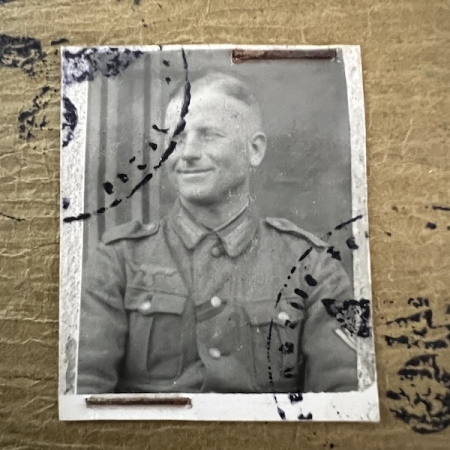
WWII German Wehrmacht Soldbuch – Stabsgefr Quiatkowski – Grenadier-Regiment 1053 (85 Inf Div) – Falaise Pocket – Normandy 1944 – Rare (On Hold)
Soldbuch Issued to Paul Quiatkowski in August 1939. He served with many units, including some early Reiter (Horse) Schwadron 26, then 320 and subsequently Aufklarungs Abt 371 (371 Inf Div) interestingly his unit was given over to the 353. Infanterie-Division Fighting in Russia and the Balkans. In Russia he had a code 34 injury pertaining to an “Accident or self mutilation” and in 1944, he arrived that the hospital in Abbeville (Normandy) in April of 1944 with a muscle complaint. Battle of Normandy, It seems that during the first days of the battle he was transferred at some period to the Grenadier Regiment 1053 (85 ID) The 85. Infanteriedivision arrived on the Normandy scene later in the campaign, not materializing until August, just in time to relieve the 12. SS-Panzerdivision (Hitlerjugend) on the Caen-Falaise highway on 11 August. The 12. SS had been battered by constant Allied air, artillery and tank attacks and was badly in need of a few days’ rest and refitting. However, the 85. ID was untested and under-strength. They were in no condition to hold a line of defence that was so contested. They got three days of relative peace. 14 August saw the 85. ID under heavy pressure from Allied bomber strikes, as well as the advance of the 1st Polish Armoured division. The fighting was intense and bitter. The tanks of the Poles won the day, literally rolling over the German lines. By 17 August, after their escape from Falaise, the 85. ID was reduced to one and a half infantry battalions, two field artillery pieces, and miscellaneous support troops, this reduced from a total strength of 6 infantry battalions and two field artillery battalions a month earlier. The 85. Infanterie division later saw action in Operation Market Garden and suffered heavy losses at Aachen. Comments: Mega rare unit to find, Normandy is also highly sought after. Sadly he pulled his awards page before being captured, this was likely due to him having fear of reprisal. Worth checking the archives/unit histories to see if he is mentioned for some awards as he had something to hide.
-
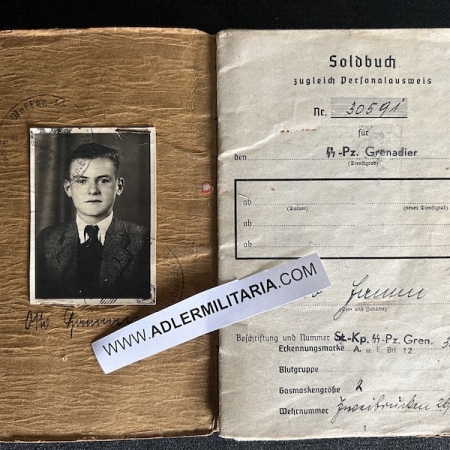
WWII German Waffen SS Soldbuch – SS-Pz-Gren Otto Hamm – LSSAH – Ardennes 1944/45 (Reserved)
An incredibly sought after unit. Otto Hamm was born in Webenheim, Homburg (Germany) into a protestant family on the 22nd of September 1926. He joined the Waffen SS in November 1943, enlisting iin the SS Panzergrenadier A.u.E Batl 12 (Germania) for basic training. He would join the following frontline units according to his Soldbuch: SS Panzergrenadier Regiment 37 (7th Company) – 17th SS Panzergrenadier Division “Götz von Berlichingen” Although it seems shortly after his deployment something (medically) happened to him and he was recovering till April 1944. After a short stint in another training unit he was once again deployed. The next unit he was assigned to was: SS Panzer Grenadier Regiment 2 ( 15 Komp, Combat Pioneers) – III Batl – 1. SS-Panzer-Division “Leibstandarte-SS Adolf Hitler” He would be deployed into the Ardennes, but would arrive on the 11th of January 1945 in a hospital with a code 33 (Freezing Wounds), the harsh winter of 1944/45 would leave Hamm in hospital till late 1945, suffering from various organ failure to to the freezing wounds. There are two security stamps signed by two different SS Officers. In the back pouch of the Soldbuch is a portrait of Hamm in uniform, interestingly this was taken in a Totenkopf Uniform. Which was likely issued to him during training. Comments: This Soldbuch is from a super hard unit to find anything for, the fact that he took part in the Ardennes Offensive with the LAH is astounding. Very hard to find item. https://www.youtube.com/watch?v=ZFbrZmMWz6k
-

WWII Soviet Red Star – Орден Красной Звезды – Officer – With Archive Photo – Latvia 1944 – Mint
Sr. Lieutenant of intendant corps GONCHARENKO proved himself as a determined, initiative officer during his service in the regiment. In the offensive operations, he efficiently and without delays provided the personnel with food supplies. He takes great care of food supplies for the troops and ensures every single soldier receives the rations fully according to the regulations. In the offensive operations near Dryssa, Krāslava, Dvinsk (June-July 1944), despite stretched out supply routes, Sr. Lt. GONCHARENKO timely delivered food to the field troops and kept his supply train moving among the regiment formation. As the result of this effort, there were no problems with food provisioning, which contributed to the achievement of the combat objectives. For exhibited care for providing food supplies to the regiment troops, Sr. Lt. GONCHARENKO deserves state award order “RED STAR”. Price includes tracked shipping World Wide.
-

WWII Soviet Medal for Courage – ЗА ОТВАГУ – With Archive Research – Killed a Sniper – 1st Guards Airborne Regiment, 5th Guards Airborne Division
Tokan Gavriil Tarasovich Date of Birth: 1912 Place of call: Peschansky RVC Ukrainian SSR, Vinnitsa region, Peschansky district Date of entry into service: 1944 Military rank: guards Private Military unit: 1st Guards Airborne Regiment, 5th Guards Airborne Division Guards Private Tokan Gavril Tarasovich – a (driver) of a 45 mm cannon, in battles from 03/16/45, after breaking through the enemy defenses under artillery fire, he quickly transported guns to the indicated firing positions. In battle, on March 17, 1945, he quickly transported to a firing position, which made it possible for the crew to destroy an enemy machine gun and 1 sniper firing cell, which interfered with the advance of our infantry.
-

WWII German FW 190 F-8 (931853) “White 7” Engine & Pilot Seat – Schlachtgeschwader 4 – Super Rare Relic of War
This unique and interesting find comes from Latvia in 2023. The pilot was serving with Schlachtgeschwader 4 operating out of Cesis, when the crash happened according to the German Archives (see attached) his body was recovered by the Wehrmacht and buried but his grave is not known exactly where. He was an expereinced pilot with over 60 missions, and both classes of the Iron Cross. As well as the Pilot Clasp with Bronze and Silver. He fought in France, Italy and Russia during the war. More details on the plane and pilot according to Unit archive: 1944-08-22, 1./SG 4, Fw 190 F-8, 931853, 7 weiße, south of Vejava, east of Ergli, Latvia. Pilot Uffz Daleiden, Heribert, + Likely hit by Flak – destroyed 100 %. Shipping: Please note, that these items are in excess of 450 KG but we can put this on a pallet shipped to the UK/EU via courier. For US inquires please send us an email. Price can be discussed, just send us an email.
-
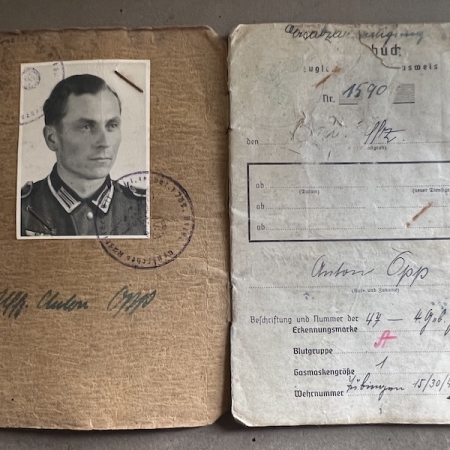
WWII German Soldbuch – Uffz Anton Opp – Gebirgsjäger Reg 100 – Kreta Armband – Anti-Partisan Actions – Kampfgruppe von Schultz – Operation Werwolf – RARE (Sold)
A very unique Soldbuch with a fascinating career. Soldbuch was issued as a replacement to Opp in August of 1943. He served initially with GJR100 fighting in Kreta he was awarded the Kreta Armband! Awards: 1.Bulgarian Cross IV Class 2. Armband Kreta 3. Anschluss Medal 4. Wounds Badge in Black – awarded for a bullet strike that went right through him. 5. Iron Cross Second Class 6. Eastern Front Medal Serving later in the following units: 1. Ausbildungs Batl 1 Kroatische Jäger Brigade 1. Ausbildungs Kompanie (Kroat) Geb Regt 1 Kampfgruppe / Sturmbrigade and later Brigade von Schultz – Oberst Hans-Joachim von Schultz (1 Sep 1944 – 8 May 1945) Some action history: Operation Werwolf ‘Werwolf’ (ii) was a German and Croat operation against the bridgehead of Marshal Josip Broz Tito’s Yugoslav forces at Virovitica in the Papuk mountain region of the puppet state of Croatia within German-occupied Yugoslavia (6/21 February 1945). The undertaking’s objective was to surround and destroy strong Yugoslav forces (49,000 men of the 12th, 16th, 36th and 51st Assault Divisions) and their supply bases in the Papuk mountain region, where they posed a direct threat to Zagreb, and also destroy the partisan divisions holding the ‘Virovitica bridgehead’ between Virovitica and Podravska Slatina. The Axis forces committed to ‘Werwolf’ (ii) totalled some 60,000 men. The German contribution comprised Generalleutnant Hellmuth von Pannwitz’s 1st Kosaken-Kavalleriedivision, Oberst Hans-Joachim von Schultz’s 2nd Kosaken-Kavalleriedivision, SS-Brigadeführer und Generalmajor der Waffen-SS August Schmidhuber’s 7th SS Gebirgsdivision ‘Prinz Eugen’, Generalleutnant Hartwig von Ludwiger’s 104th Jägerdivision, Generalleutnant Albrecht Baier’s 297th Division, the Kampfgruppe ‘Fischer’ based on elements of Generalleutnant Wilhelm Kohler’s 11th Felddivision (L), 10 to 12 police battalions controlled by the Divisionsstab zbV ‘Stephan’ and the 202nd Panzerabteilung. The Croat contribution took the form of Ustase General Ante Moskov’s 1st Assault Division, and elements of General Rafael Boban’s 5th Assault Division and General Stjepan vitez Peričić’s 7th Mountain Division. This major operation was based on two major Axis groupings, in the form of a western group under General Helge Auleb’s LXIX Corps zbV with the Cossacks and 1st Assault Division, and an eastern group under General Werner von Erdmannsdorrf’s XCI Corps zbV with the remaining forces. As they closed on the centre of the operational area from all sides, the Axis forces took Podravska Slatina on 8 February, and Virovitica and Slavonska Pozega on 9 February. The main assault was now over and the remainder of the operation took the form of a thorough mopping up of the partisan redoubt in the Papuk mountain region. The German after-action reports detail fighting that was at times very heavy as the partisans defended their positions to the last man. The operation was nonetheless considered a success inasmuch as the Yugoslav forces were dispersed and temporarily expelled from the surrounded area, most of their supply camps were captured and a great deal of booty was seized. The German record does not indicate German or Croat losses, but details the partisan losses as including 1,988 counted dead.
-

WWII German Wehrmacht Soldbuch – Obergefr Alois Brandl – Grenadier Regiment 1034 (59 Inf Div) – Operation Grenade
Soldbuch Issued to Alois Brandl, he served with various units: Infanterie Regiment 449 – in Russia Landesschützen Batl 880 Severe Wounds: He was hit by grenade fragments in Russia and took him sometime to recover. For which he was awarded the Wounds Badge. And in December of 1944 he arrived at his last unit. Which would be heavily involved in combat operations on the Western Front. Brandl was taken POW by US troops. Below find the combat diary for the period he was in the unit. Grenadier Regiment 1034 – 59 Inf Div The new section of the division was on the left at Tetz (south of Linnich) and reached on the right to the Wurm (1 km south of Randerath), then turned off to the east bank of the Rur and continued to follow the course of the river. On January 1st, 1945 the division’s sector on the left wing was extended to Jülich-Mersch and later J.-Welldorf. In return, the 183.VGD took over the section in the Randerath area on the right wing. When the GR 1036 was handed over to the neighboring XII.SS-AK during the British attack to gain the west bank of the Rur in mid-January, the Division section was shortened again on the left to Linnich-Tetz. Due to this enemy operation, the division had to withdraw its right wing to the east bank of the Rur near Rurich. At the end of January, the GR 1036 returned to the division with the fighting strength of only one battalion. The DivGefStd is located in Katzenm and later north of Opherten (southeast of Titz). By mid-February, the division was ready for action: 4 battalions (including 1 reserve at Hottorf) with only 3 companies each, plus a full FEB, the artillery with a total of 22 barrels and 2 heavy French booty howitzers with very little ammunition (nö Muentz ), the remaining anti-tank (motorized) consists of 3 guns. In addition, there is a larger number of about 30 fixed 8.8 guns deep in the main battlefield. The supply troops are at target strength. The division’s opponents are the 102nd US Inf. Div and then to the south the 28th US Inf Div. across from. The expected major Allied attack (Operation “Grenade”) to capture the Rur began with unusually heavy bombardment and subsequent artillery fire on the night of February 23, 1945. The attackers were able to cross the Rur in ten places. In the divisional section, too, it was possible to win a bridgehead over the Rur near Linnich and thus obtain a secure starting position for further actions. The villages of Glimbach, Geven and Grevenich are lost. A counterattack carried out by Muentz on Grevenich the following day with the support of a subordinate battery from the 341st Assault Gun Brigade failed. Trunks are also lost on this day and our own infantry is trapped at Tetz and cannot be relieved. Boslar and Hompesch are also lost and the enemy enters Muentz. On the night of February 25th 11.PzDiv took over the left divisional sector with all troops there (GR 1036) up to the Linnich-Titz-Ralshoven road included. In the division’s right sector, the line with the farmsteads between Katzen and Ralshoven was held despite high infantry losses, but the enemy managed to break through at the interface between 59 ID and 183 VGD in the direction of Erkelenz. There are heavy fights for the “Hauerhof”, which changes hands several times. An army order in support of the XII. Breaking through to Erkelenz by SS-AK turns out to be obsolete as the town is already in enemy hands. The enemy, advancing further to the north-west, conquered on 26.2. Holzweiler and reached on 27.2. Garzweiler. Here parts of the AR 159 are lost. There is no longer any connection to the neighboring units. From Elfgen, the remnants of the division, together with the remnants of a local police battalion, respond to army orders to recover Garzweiler on February 28th. at. The attack gets caught in the preparatory fire of an enemy tank formation and fails. The division commander, GL Poppe, was also wounded and left the division. The Rgt Kdr of the GR 1034 Obstlt i.G. Liebe takes over the command. On the same day, 11.PzDiv took command of the entire sector of the Division. In the days that followed, the remaining parts of the division fought their way back through the forest on both sides of Broich, and on March 4 they succeeded in crossing the Rhine near Dormagen and Worringen. On the right bank of the Rhine, the remainder of the division was deployed in a quiet sector for the next few days, and after the heavy losses the division was again refreshed by regional units and the Volkssturm. On March 20, GL Hoecker takes over command of the division at the Gef Std in Leichlingen. A replacement battalion will be assigned to the division for further replenishment on March 23rd. Nevertheless, the division was only half its target strength when, on March 27, parts of the division began to be moved on foot and partly by truck to the Sieg front west of Siegen. A first Div Gef Std is set up at Fischbach. All incoming parts (March 30/31) are immediately used on the southern front of the Ruhr pocket. The divisional sector extends from Betzdorf to Siegen (places excluded) and the main line of defense is the Sieg. After pulling out the right neighbor (12.VGD) from April 2nd. the division section extends to knowledge. In the course of the fighting until April 4, however, it shortened again to the Betzdorf-Freudenberg railway line border. Right neighbor is now the 62nd VGD. During these battles (March 31 – April 3) the enemy managed to win and fierce battles broke out around Freusburg, Mudersbach and Niederschelden. These places change hands several times. After the loss of the city of Siegen (April 4th/5th) and also the neighboring towns of Gosenbach, Aschenbach and Niederschelden – a counterattack together with the…
-
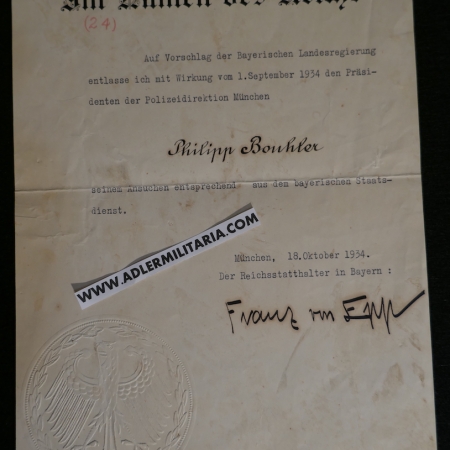
Pre WWII – Weimar Document – SS-Obergruppenführer Bouhler – Aktion T4 / Aktion 14f13 – Franz von Epp (Sold)
Very nice original document with Weimar Eagle embossed. This document states that he was dismissed from the Police in Munich, which coincides with the other offices he would later hold. There is a lot of information about Bouhler online, including pictures with all the Nazi top brass. Due to copyrights I could not add them here in the listing. Document is hand signed by Franz von Epp. Comments: An incredible document to tone of the most horrible men of the Third Reich, I was unable to find anything else related to him ever sold online. More on Bouhler: Philipp Bouhler (11 September 1899 – 19 May 1945) was a German senior Nazi Party functionary who was both a Reichsleiter (National Leader) and Chief of the Chancellery of the Führer of the NSDAP. He was also the SS official responsible for the Aktion T4 euthanasia program that killed more than 250,000 disabled adults and children in Nazi Germany, as well as co-initiator of Aktion 14f13, also called Sonderbehandlung (‘special treatment’), that killed 15,000–20,000 concentration camp prisoners. Bouhler was arrested on 10 May 1945 by American troops. He committed suicide on 19 May 1945 while in the U.S. internment camp at Zell am See in Austria. Bouhler was born in Munich, to a retired colonel, and spent five years in the Royal Bavarian Cadet Corps. He entered the 1st Royal Bavarian Foot Artillery Regiment in 1916 during the First World War, was commissioned as a Leutnant in July 1917, and was badly wounded the next month. He was awarded the Iron Cross, 2nd class, and was hospitalized through the end of the war.[2] From 1919 to 1920, he studied philosophy[3] and in 1921 became a contributor in the publishing house that put out the Nazi Party newspaper Völkischer Beobachter. Bouhler joined the Nazi Party (NSDAP) in July 1922 with membership number 12. By late 1922 he had become deputy business manager of the NSDAP under Max Amann.[4] He took part in the failed Beer Hall Putsch in Munich and when the Party was banned, became the Business Manager for the Nazi front organization, the Greater German People’s Community, based in Munich.[2] Upon the refounding of the party on 27 February 1925, he immediately rejoined and was made National Business Manager of the NSDAP, holding this post until November 1934. After the seizure of power in 1933, he was elected as a member of the Reichstag for electoral constituency 18, Southern Westphalia.[5] On 2 June 1933 Hitler appointed him a Reichsleiter, the second highest political rank in the Nazi Party.[6] He joined the SS in the rank of SS-Gruppenführer on 20 April 1933 with membership number: 54,932.[1] On 30 January 1936, Bouhler was promoted to the rank of SS-Obergruppenführer.[7] From the end of August to the end of October 1934, Bouhler was police president of Munich. In September he was made a member of the Academy for German Law. He was next appointed chief of Adolf Hitler’s Chancellery, a post specially created on 17 November 1934 that was first and foremost set aside for party business. He held that position until 23 April 1945.[8] In this job, for instance, secret decrees might be prepared, or internal business managed, before being brought before Adolf Hitler. Moreover, Bouhler was chairman of the “Official Party Inspection Commission for the Protection of National Socialist Literature” (Der Chef der Kanzlei des Führers und Vorsitzender der Parteiamtlichen Prüfungskommission zum Schutze des NS-Schrifttums), which determined what writings were and were not suitable for Nazi society.[3] Bouhler’s office was responsible for all correspondence for Hitler, which included private and internal communications as well as responding to public inquiries (for example, requests for material help, godfathership, jobs, clemency, NSDAP business, and birthday wishes). His personal adjutant was SS-Sturmbannführer Karl Freiherr Michel von Tüßling. By 1944, much of the functions of the Kanzlei des Führers were absorbed by the Party Chancellery (Parteikanzlei) under Martin Bormann.[9] During the war, Bouhler published Der großdeutsche Freiheitskampf (“the greater German freedom struggle”), a three volume book featuring the speeches given by Hitler from September 1, 1939, to March 15, 1942.[10][11][12] War crimes Rudolf Heß, Heinrich Himmler, Bouhler, Fritz Todt and Reinhard Heydrich (from left), listening to Konrad Meyer at a Generalplan Ost exhibition, 20 March 1941 Bouhler was responsible for the killing of disabled German citizens. By order of Hitler (backdated to 1 September 1939), Bouhler with Karl Brandt developed the Nazis’ early euthanasia program, Aktion T4 in which mentally ill and physically disabled people were killed.[13][14] The actual implementation was supervised by Bouhler. Various methods of killing were tried out. The first killing facility was Schloss Hartheim in Upper Austria. The knowledge gained from the euthanasia program was later applied to the industrialized annihilation of other groups of people, especially the Jews.[15] In 1941 Bouhler and Heinrich Himmler initiated Aktion 14f13. Bouhler instructed the head of the Hauptamt II (“main office ll”) of Hitler’s Chancellery, the Oberdienstleiter Viktor Brack to implement this order. Brack was already in charge of the various front operations of T4. The scheme operated under the Concentration Camps Inspector and the Reichsführer-SS under the name “Sonderbehandlung 14f13″. The combination of numbers and letters was derived from the SS record-keeping system and consists of the number “14” for the Concentration Camps Inspector, the letter “f” for the German word “deaths” (Todesfälle), and the number “13” for the means of killing, in this case, for gassing in the T4 killing centers.[note 1] “Sonderbehandlung” (“special treatment”) was the euphemistic term for execution or killing. In 1942, Bouhler published the book “Napoleon – Kometenbahn eines Genies” (Napoleon – A Genius’s Cometary Path), which became a favorite of Hitler’s. He had also published a Nazi publication Kampf um Deutschland (Fight for Germany) in 1938. Capture and suicide Bouhler and his wife, Helene, were arrested by American troops at Schloss Fischhorn in Bruck near Zell-am-See on 10 May 1945. Helene jumped to her death from a window at Schloss Fischhorn. On 19 May, Bouhler killed himself using a cyanide capsule while in the US internment camp at Zell-am-See. The couple had no children.[16] More on Franz von Epp Franz Ritter von Epp (born Franz Epp; from 1918 as Ritter von Epp; 16 October 1868 – 31 January 1947)[1][Notes 1] was a German general and politician who started his military career in the Bavarian Army. Successful wartime military service earned him a knighthood in 1916. After the end of World War I and the dissolution of the German Empire, von Epp was a commanding officer in the Freikorps and the Reichswehr. He was a member of Bavarian People’s Party, before joining the Nazi Party in 1928, when he was elected as a member of the German…


