Showing 559–567 of 1179 resultsSorted by latest
-
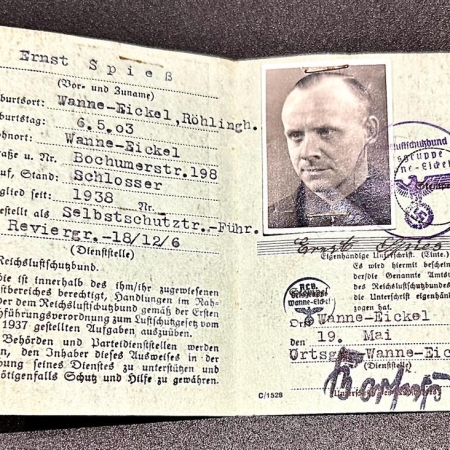
WWII German Reichsluftschutzbund – Selbstschutztruppen Führer Spiess – Wanne-Eickel – Rare ID
A very interesting, and not often found ID for Ernst Spiess, He was the leader of of a Luftschutz Troop in Wanne Eickel (Westfalen) Germany. A nice and rare ID, which would go well in any serious Luftschutz collection.
-
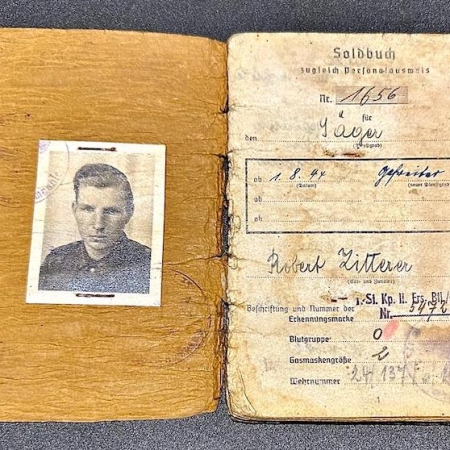
WWII German Army Soldbuch – Gefr Robert Zilterer – Jäger Regiment 228 (101st Jäger Division) – Cross of Iron Movie
Robert was born in 1924 in the area of Villach Austria, and was enlisted in the Army in 1943. He served with Gebirgsjäger Regiment 137 ( Training Company), then deployed with: Jäger Regiment 228 (101st Jäger Division) fighting in Ukraine till he was delivered to hospital in November 1943. After a short stint in hospital and with a training unit he was deployed to another unit, Grenadier Regiment 360 again in Ukraine. But in January of 1945 he was involved in an accident on the front and admitted to hospital. He was sent back to Austria to recover in March of 1945, with GJ Ersatz Batl 139 in Klagenfurt Austria. Awarded the Wounds Badge in Black. Comments: The Soldbuch seems to be bloodstained, when that happened we will never know. I did try and find him on the Volksbund website as a KIA, but it seems he made it out of the war. Comments: Interestingly the story about this unit was made famous by the Movie Cross of Iron, it was this unit depicted in the movie.
-
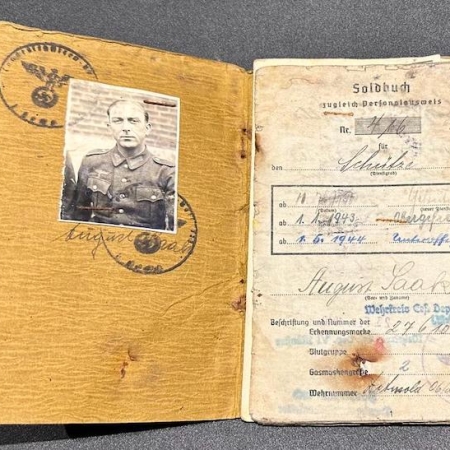
WWII German Army Soldbuch – Uffz Saak – Füsilier Battalion 275 – Killed Hürtgen Forest Battle – Battle Damaged – Rare (On Hold)
August Saak was born in 1906 and enlisted into the German Army in 1940. He served with: Infanterie Regiment 663, which was disolved into Landesschützen Batl 772, which was later renamed as Sicherungs-Bataillon 772. In 1944, the unit seen action in Lens France. It seems that during the battle in France in 1944, that he was again shifted to another unit, Landesschützen-Bataillon 773: The battalion was later placed under the military commander Belgium-Northern France in the West. In 1943/44 the battalion was used to protect the railways in the Antwerp area. At the beginning of 1944 the battalion was deployed near Charleroi. It seems that around the time of the invasion Saak was assigned to: Füsilier Battalion 275 (275 Infantry Division) Early in the Normandy landings, (June 6, 1944) two Infantry battalions, the Fusilier battalion, one artillery battalion and an engineer company were sent to the Normandy area. The rest of the division followed in mid July. The 275th suffered heavy losses in the Falaise pocket and was transferred to Aachen for refitting. Here it was re-enforced with the Luftwaffe fortress battalions XII and XX. The 275th was transferred to the Düren – Hürtgenwald area where it suffered severe losses and was disbanded. It seems he was killed on the last day of the Hürtgen Forest Battle according to the German Archive 16.12.1944 and is buried in Lommel. Comments: A super hard to find unit, the Soldbuch shows signs of a small splinter that entered the side of the book and stopped on the front cover. Likely a small fragment of a splinter.
-
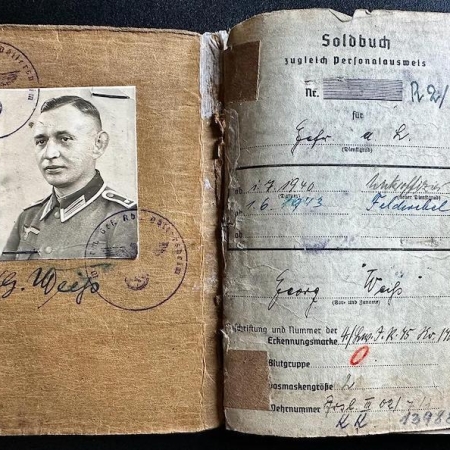
WWII German Army Soldbuch – Feldwebel Weiss – Wehrmachtsgefängnis Döllersheim – Feld Strafgefangenen Abteilung 16 – Western Front 1. FJ Armee – Battle of Poland 1939
An interesting and a unit not often seen, Weiss took part in the attack on Poland with Infanterie Regiment 360 as a Machine Gunner likely a MG34. But he had an issue with his knee and was sent to the WUG (or Wehrmacht Prison) these prisons were not a nice place, many executions took place in such prisons. And according to research Döllershem, and Larger Kirkenholz where he served was the scene of much terror. Please see below for the lists of those executed and the memorial to those that decided to flee as opposed to fighting for Nazi Germany. WUG Favoriten Wiess was sent to a rather rare unit, which is responsible for as Tessin puts it, harassed the prisoners under the harshest of circumstances. Feld Strafgefangenen Abteilung 16 (1. Fallschirmarmee) https://www.lexikon-der-wehrmacht.de/Gliederungen/FeldstrafgefangenenAbt/FSGA16.htm “In the field prisoner departments, convicts whose sentence was suspended until the end of the war were grouped together. The departments were set up by the Wehrmacht prisons. The origin of the prisoner detachments was an order from Adolf Hitler on April 2, 1942, which was implemented by the OKW on April 14, 1942. From May 1942, three prisoner detachments, each with 200 men, were set up in Glatz, Germersheim and Anklam. Field punishment units were formed from this. The soldiers had to be at least kv (fit for war), gvF (fit for garrison in the field) or gvH (fit for garrison at home). From 1943 onwards, members of all parts of the Wehrmacht served in the field prisoner departments. The following were not used in the field prisoner departments: – members of the Wehrmacht with sentences of less than 3 months – members of foreign national units – officers – soldiers unfit for service – people convicted for the first time, whose act was probably a one-time lapse – “asocial people who were difficult to train” – “homosexuals” There were until the end of the war 22 prisoner detachments with four to six companies each. On average, an estimated 20,000 men were deployed there. The unarmed service on the eastern front was required to do “the toughest work under dangerous circumstances”: building bunkers and positions, clearing mines and recovering corpses. The men had to do physical labor 7 days a week. Only in exceptional cases were reliable prisoners allowed to be armed and deployed to fight in intervention companies. It was important that the relatives not degenerate physically and mentally despite the heavy workload, since they were to be assigned to the front-line troops again after they had served their sentence. This was often contradicted by the behavior of the guards, who, hardly trained, harassed the prisoners. At the end of the war, individual departments were also deployed in the West.” Weiss was taken POW in 1945, and served with 805 Division under Allied Command. He survived the war. Comments: An interesting Soldbuch to an odd unit, they were obviously not nice guards doing horrible work. This is evidence of the many depictions of the forced work of Wehrmacht Prisoners.
-

WWII German Reichsarbeitsdienstpass – Female worked at Carl Zeiss Jena – Optic Factory (Sold)
A nice RAD ID with period picture of Erna Breuer from Cologne. She worked with Carl Zeiss in Jena, which produced many Optics for the German Army. Nice ID, remember price includes shipping.
-
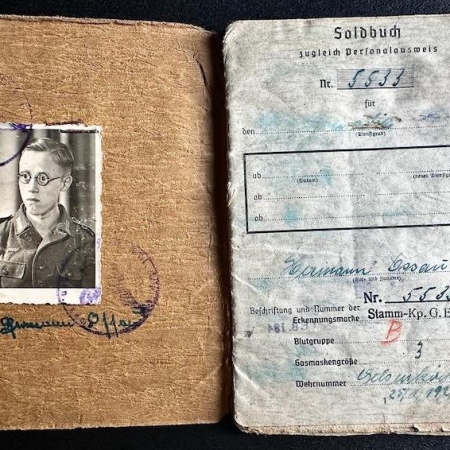
WWII German Soldbuch – Gefr Ossau – Killed in Action March 1945 – With EKM – Killed by US Troops (On Layaway)
A very sad Soldbuch, this young German Soldier went through a series of unit on the backline before being thrown into the front against the US Army advance in the Montabour sector. Born in 1925, he was killed at 20 in 1945. It seems he was enlisted into a ad hoc unit sent from the WK Kommando VI towards the front with: Marschbatl z.b.v Inf 105 According to the German Records he is buried in Montabour Germany and has his own grave. Extremely rare item nowadays to find, especially with the tag.
-
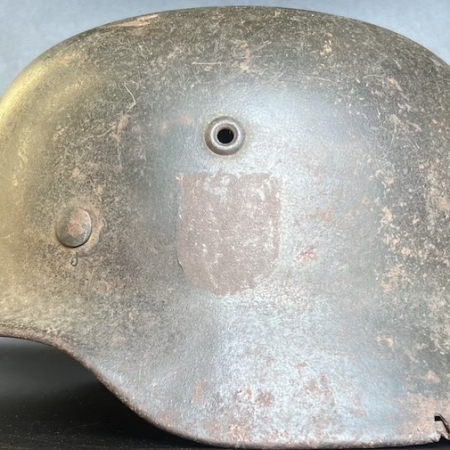
WWII German Helmet – ET 64 M40 Battle Damaged & Bloodstained – Found in Estonian Attic (On Layaway)
Here we have a really interesting German Helmet, a small splinter or what could have been a bullet fragment moved from the side of the helmet through the liner band and leather. We can only hope the soldier survived this terrible injury. But goes to show the smallest shrapnel damage can be lethal. His initials are in the liner also This helmet was found in an attic in Eastern Estonia. The buyer will be given the town name. M40 Helmet has had the decal period removed, as per the decal order for removal. Helmet was never in a collection. Maker is Eisenhüttenwerke, Thale. Size – Shellsize 64, headsize 56 cm Batch number on the shell – 938 Please remember this price included tracked shipping.
-

WWII American Air Force Medal Bar – Brigader General Martin F Scanlon – Incredibly Rare Medal Set – Mega Career – Attache to UK during the Battle of Britain
Martin Francis Scanlon (11 August 1889 – 26 January 1980) was a general officer in the United States Air Force during World War II. After joining the United States Army in 1912, Scanlon served on the Mexican border, and participated in the United States occupation of Veracruz. He joined the Aviation Section, U.S. Signal Corps, and during World War I served with the American Expeditionary Force on the Western Front as a pilot with the 91st Aero Squadron. Between the wars he was an assistant military attaché in Rome and London, and was the military attaché in London from 1939 to 1941, during the first part of World War II. He was an Assistant Chief of the Air Staff from July 1941 to March 1942 at Headquarters, United States Army Air Forces, and then went to Australia as commanding general, Air Command No. 2, based at Townsville, Queensland. As such he was in charge of the air forces in New Guinea during the Kokoda Track campaign. In September 1942, he returned to the United States where he commanded the 38th Flying Training Wing and the 36th Flying Training Wing. He retired from the United States Air Force in 1948, and was director of export and vice president of Republic Aviation until 1957. Early life Martin Francis Scanlon was born in Scranton, Pennsylvania, on 11 August 1889. He attended the University of Pennsylvania from 1908 to 1909, and Cornell University from 1910 to 1911, before being commissioned in the United States Army as a second lieutenant in the Infantry on 24 April 1912.[1] He initially served with the 7th Infantry Regiment, but transferred to the 19th Infantry Regiment. This regiment patrolled the border with Mexico from Fort Crockett, Texas. He participated in the United States occupation of Veracruz from May to October 1914, when the 19th Infantry returned to Galveston, Texas.[2] World War I Scanlon was at San Antonio, Texas, from September 1915 to March 1916, at which point he was assigned to the Aviation Section, U.S. Signal Corps.[2] He was promoted to first lieutenant in the infantry on 1 July 1916, and in the Aviation Section on 28 October 1916,[1] when he received his wings as a junior aviator in San Diego, California.[2] Scanlon assumed command of the 2d Aero Squadron, which was then flying seaplanes from Fort Mills on Corregidor Island in the Philippines. He was promoted to captain on 15 May 1917. He returned to the United States in November 1917, and was posted to Kelly Field and then Fort Worth, Texas for additional training.[2] He went to England, where he trained with the Royal Flying Corps from February to August 1918, with the rank of major from 7 June 1918. He joined the American Expeditionary Force on the Western Front in France, and was a pilot with the 91st Aero Squadron until September 1918, when he assumed command of Colombey-les-Belles aerodrome during the Meuse-Argonne Offensive. He was then air service commander of V Corps until March 1919. He was a student officer at the Army Artillery School at Trier, and was at the headquarters of the air service of the Third United States Army at Coblenz during the Occupation of the Rhineland.[2] Between the wars On returning to the United States in July 1919, he became commanding officer of Bolling Field, DC.[2] He reverted to the rank of captain on 27 August 1919, but was transferred to the United States Army Air Service with the rank on major on 1 July 1920.[1] In 1923, he attended the Air Corps Engineering School at McCook Field, Ohio. On graduation in August 1923, he was assigned to the National Guard Bureau in Washington, D.C., from 1 December 1923 to 1 May 1924.[2] Scanlon was the assistant military attaché for air at the United States Embassy in Rome from May 1924 until August 1927, when he returned to the United States to attend the Air Corps Tactical School at Langley Field, Virginia, from which he graduated in 1928, and then the United States Army Command and General Staff College, from which he graduated in 1929. He was then assistant military attaché for air at the United States Embassy in London.[1] After a four-year tour, he returned to the United States to become commander of the 15th Observation Squadron in 1933. He was the base commander of Bolling Field from January 1935 to January 1936, when he went back to England as the military attaché for air.[2] He was promoted to the temporary rank of lieutenant colonel on 20 April 1935. This became substantive on 1 August 1935. On 26 August 1936, he was promoted to the temporary rank of colonel.[1] He was special assistant to the United States Ambassador to the United Kingdom from April to September 1939, when he became the military attaché. He was promoted to brigadier general in the wartime Army of the United States on 1 October 1940.[2] World War II Scanlon was assigned to Headquarters, United States Army Air Forces as an Assistant Chief of the Air Staff from July 1941 to March 1942. He was then sent to Australia as commanding general, Air Command No. 2, based at Townsville, Queensland.[1] As such he was in charge of the air forces in New Guinea during the Kokoda Track campaign. When Major General George Kenney took over as commander, Allied Forces in the South West Pacific Area from Lieutenant General George Brett in August 1942, he formed an unfavourable impression. He later recalled: I had known Mike ever since 1918 and liked him immensely, but he was miscast in this job. He had been an air attaché in Rome and London for the best part of the last ten years, with a tour as intelligence officer in Washington, I don’t know why they sent him up to New Guinea; he was not an operator and everyone from the kids on up knew it.[3] Kenney replaced Scanlon with Brigadier General Ennis Whitehead.[4] Scanlon returned to the United…
-

WWII Soviet Medal for Courage – ЗА ОТВАГУ – With Archive Research – Ostrava Czech Republic Battle 1945
Polischuk Arsenty Kalenikovich Date of Birth: 1907 Place of call: Vinnitsa GVK Ukrainian SSR, Vinnitsa region, Vinnitsa Date of entry into service: __.03.1994 Military rank: guards red army soldier Military unit: 325th Guards Rifle Regiment of the 129th Guards Mountain Rifle Division Feat dates: 04.30.1945 Feat: Guard of the Red Army Polishchuk Arsenty Kalenikovich, for the fact that with his selfless work, courage and courage on 04/30/1945, under the enemy’s shock fire in the area of the city of Moravska Ostrava (Czech Republic), he delivered ammunition without interruption, which decided the outcome of the battle and contributed to the capture of the city.


