Showing 550–558 of 1179 resultsSorted by latest
-
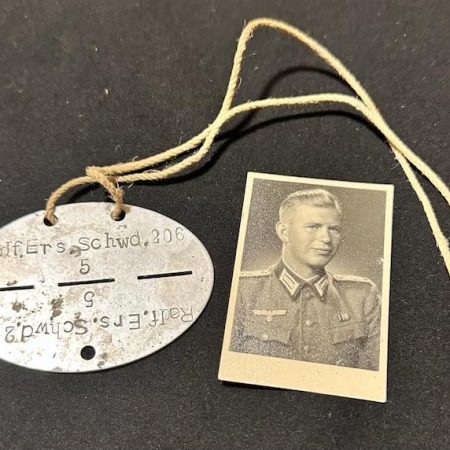
WW2 German Grouping – Dog Tag and Portrait – Panzer Regiment 24 – Oberlt Schlaefereit – DKiG – Survived Stalingrad (Sold)
Nice original items, directly form the veteran during a reunion event. Schlaefereit, Heinz 1939-1941: Zugführer, Radfahr-Abteilung 1 – Hildesheim Polish, French and Russian campaigns Winter 1941-1942: Radfahr-Abteilung 1 converted to Kradschützen-Abteilung 4 – 24. Panzer-Division promoted to Leutnant 28.07.1942: WIA Survived Stalingrad 1943-1944: Chef, 4./ Panzer-Aufklärungs-Abteilung 24 – 24. Panzer-Division Promoted to Oberleutnant Promoted to Rittmeister 1945: Chef, 3./ Panzer-Aufklärungs-Abteilung 24 – 24. Panzer-Division Survived the war and was still alive in 2001. Comments: More photos and accounts about him can be found online, this a rare opportunity to own an actual attributed tag, which made it out of Stalingrad. A silent witness of great feats of bravery. He won the German Cross in Gold and had the Honor Roll Clasp. And last posting was as Schwadron Commander of a Panzer unit.
-
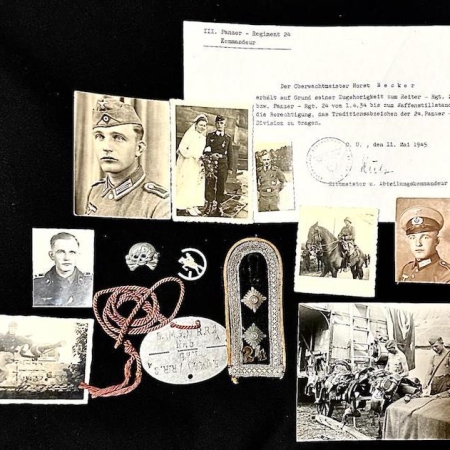
WW2 German Panzer Grouping – Oberwachtmeister Becker (PKA50) – Panzer Regiment 24 – 24 Panzer Division (On hold)
A super nice grouping to: Oberwachtmeister Horst Becker, who was a winner of the Panzer Badge 50. Seven Photos of Becker, often in Panzer Wrap, includes a Soldbuch Style Photo. One Photo he can be seen sitting on his Tank. Beckers Shoulder Board – Panzer Regiment 24 Beckers Dog Tag – First issue, MG Company Reiter Regiment 2. Panzer Skull belonging to Becker 24th Panzer Division Traditions Badge for headdress – Super Rare A copy of Beckers allowance to wear the traditional badge of the 24th Panzer Division, the Leaping Horseman. Unit History: The 1st Cavalry Division was formed shortly after the outbreak of World War II, in November 1939, when the 1st Cavalry Brigade was expanded to division-size. The division was part of the German invasion of the northern Netherlands where it encountered only weak defences as it was not a strategically important area. After the Dutch surrender, the division took part in the final actions of the battle of France before serving as an occupation force there and, from September 1940, in Poland. It participated in the German invasion of the Soviet Union, Operation Barbarossa, where it was part of the Army Group Center before being sent back to East Prussia for conversion to a tank division. After initially being stationed in northern France the division served under the Fourth Panzer Army in Army Group South of the Eastern Front from June 1942. The division participated in the capture of Voronezh and, in late December 1942, was encircled in the Battle of Stalingrad and destroyed. The 24th Panzer Division was reformed in March 1943 and served in Normandy, Italy,[2] and then went back to the Eastern Front where it suffered heavy casualties in around Kiev and the Dniepr Bend. During spring-1944 it took part in the battle of Târgu Frumos, part of the First Jassy-Kishinev Offensive. Near the end of the war, it saw action in Poland, Hungary, and Slovakia. Parts of the division were evacuated to Schleswig-Holstein and surrendered there to British forces at the end of the war while the remainder surrendered to Soviet forces in East Prussia in May 1945. In keeping with the Division’s mounted origins, the 24th Panzer’s tank crewmen wore the golden-yellow Waffenfarbe of the cavalry rather than Panzer pink. Comments: Sadly at some point Beckers Items were split after his death. His Soldbuch must be out there somewhere, and his medals were sold because of their appeal. Very sad, but still a nice little grouping to a real Panzer man.
-
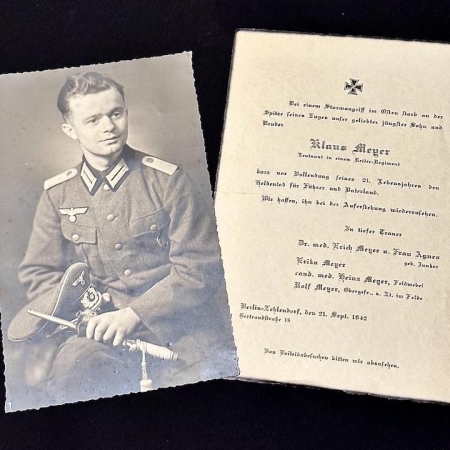
WW2 German Officers Death Notice and Portrait Photo – Aufklärungs Abteilung 176 (76 Inf Div) – Killed in Stalingrad – Kavallarie (Layaway)
An interesting little set, Leutnant Klaus Meyer, supposedly died during an attack according to his large death card printed by his family. Research conducted shows that Meyer in fact was killed by a small arms bullet to the head, 3KM outside Stalingrad. His unit listed as: Aufklärungs Abteilung 176 (76 Inf Div) The division was annihilated in the Battle of Stalingrad and reformed by the OB West on 17 February 1943. Meyer was not really found after the battle and is listed as maybe an unknown soldier in a German Cemetery.
-

WW2 German Army Soldbuch – Aufklärungs Abteilung 24 – Gerd Steinbach
Nice very clean Soldbuch for Gefr Gerd Steinbach Dog Tag – 212 – 1. Reit Schwd 24 A nice clean example, which I presume was lost very early war. There was never a photo in this Soldbuch. No sign of Steinbach was found in the lists of KIA. His Soldbuch was issued by Aufklärungs Abteilung 24, Übung (Training).
-
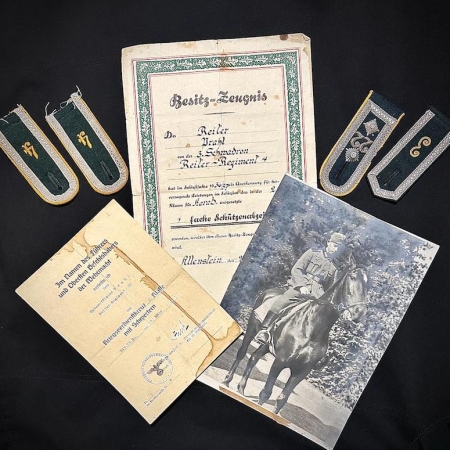
WW2 German Cavalry Set – Shoulder Boards and Documents – Battle of the Afsluitdijk Holland 1940 – Reiter Regiment 4 and Reiter Regiment 22 – Rare
This set belonging to Unteroffizier Prahl: Set of Reiter Regiment 4 shoulder boards One Uffz Reiter Regiment 22 shoulder board One Uffz Reiter Regiment 3 shoulder board KVK 2nd Class with Swords Document Reiter Regiment 22 – Signed by:Kurt Feldt (22 November 1897 – 11 March 1970) was a general in the Wehrmacht of Nazi Germany during World War II. He was a recipient of the Knight’s Cross of the Iron Cross. He was the German commander in the Battle of the Afsluitdijk on 12-14 May 1940. Shooting Award – Awarded by Reiter Regiment 22 Photo of Prahl on horseback Comments: A desirable little grouping to early Cavalry units and very desirable shoulder boards.
-
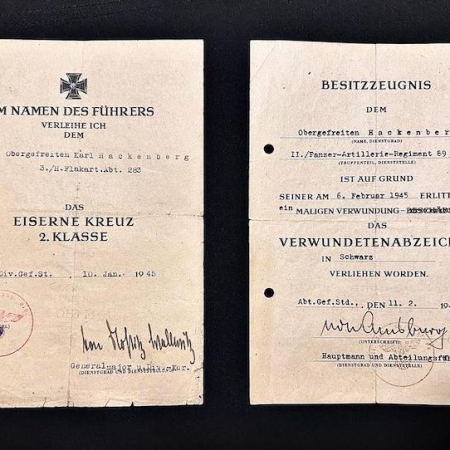
WW2 German Medal Certificates – Iron Cross and Wounds Badge – Heeres-Flak-Artillerie-Abteilung 283 – 24. Panzer-Division
Nice set for the 24th Panzer Division, Both belong to Obergefreiter Hackenberg who was serving with: Heeres-Flak-Artillerie-Abteilung 283 and Panzer Artillerie Regiment 89 (Both under the 24th Panzer Division). he 24. Panzer-Division was formed in November 1941 from 1. Kavallerie-Division in East Prussia. It was transferred to France in April 1942 and to the southern sector of the Eastern front in June 1942 where it remained until most of it was destroyed in Stalingrad. The remaining elements was sent to France and it was reformed there in March 1943. It was transferred to Italy in August following the Italian surrender. It was sent to the Eastern front in October and withdrew through the Ukraine suffering heavy losses. It fought in Hungary and Slovakia before being transferred to East Prussia and it surrendered to the Soviet Red Army at the end of the war. Iron Cross Second Class – signed by Generalmajor Gustav-Adolf von Nostitz-Wallwitz (Knights Cross Winner) see below for the information surrounding his death. 25.03.1945; severely WIA by shrapnel in the abdomen during the fightings in Belga peninsula in the Heiligenbeil pocket and transported to Eckenförde hospital 27.03.1945: DOW – died of his wounds and buried with full military honours by a British general His youngest son, born in January 1945 was christened on the lid of the coffin. Wounds Badge in Black – This is signed by a Hauptmann von Ausburg. Comments: 24 PD items are very sought after and have became very hard to find.
-
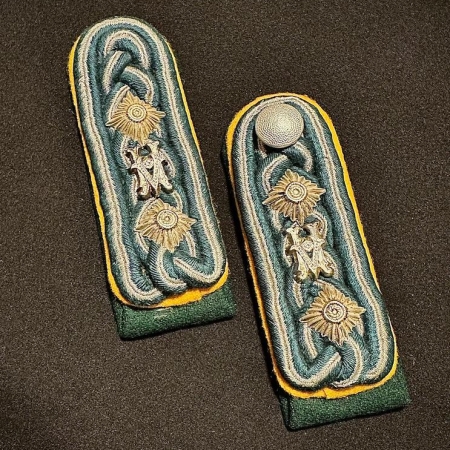
WW2 German Shoulder Boards – Heeresbeamter – Futtermeister – Super Rare Board – Kavallarie
Super set of matching boards for an extremely hard to find combination. These come from a top collection of Cavalry items. Price includes shipment tracked worldwide.
-
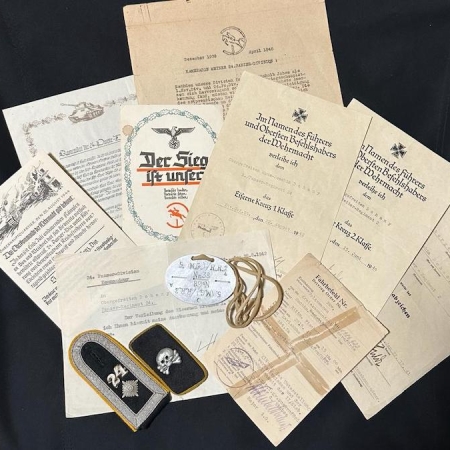
WW2 German Grouping – Wachtmeister Achim Dohany – 24. Panzer Division – Epic Historical Grouping – Super Rare (Sold)
This grouping consists of the following items: Leaflet to the 24th Panzer Division – from Von Edelsheim Postcard 24th Panzer – Victory is Ours Leaflet – OKW Meldung – Soldiers of the 24th Panzer Division April 1945 – Last words from von Nostiz Wallwitz – rare Congratulations for Iron Cross First Class 28.8.1942 – Panzer Regiment 24 – to Dohany. Signed: Bruno Ritter von Hauenschild (RK/OL) Iron Cross First Class Certificate for Dohany 22.08.1942 – signed: Bruno Ritter von Hauenschild (9 June 1896 – 10 March 1953), born Bruno Hauenschild, was a general in the Wehrmacht of Nazi Germany during World War II. Knights Cross with Oak leaves. Hauenschild served in World War I; at the beginning of World War II, he rejoined the army as an officer. From 15 April to 12 September 1942, Hauenschild commanded the 24th Panzer Division. On 26 January 1945 Hauenschild was given command of the III Military District headquartered in Berlin. Hauenschild commanded the III Military District until 15 March. He was relieved of command of the Berlin Defense Area on 6 March due to illness and was replaced by Lieutenant-General (Generalleutnant) Helmuth Reymann. Iron Cross Second Class Certificate for Dohany 22.08.1942 – signed: Kurt Feldt (RK) (22 November 1897 – 11 March 1970) was a general in the Wehrmacht of Nazi Germany during World War II. He was a recipient of the Knight’s Cross of the Iron Cross. He was the German commander in the Battle of the Afsluitdijk on 12-14 May 1940. Assault Badge Certificate for Dohany – 22.12.1941 – Signed by Kurt Feldt (RK) Driving Order – Interestingly after capture Dohany was given a Volkswagen with Registration WH1486629 along with Rittmeister Fischer and they drove home. Dohany – Dog Tag which he wore the whole war. Panzer Regiment 24 Shoulder Board belonging to Dohany Panzer Wrap Collar Tab belonging to Dohany Unit History: The 1st Cavalry Division was formed shortly after the outbreak of World War II, in November 1939, when the 1st Cavalry Brigade was expanded to division-size. The division was part of the German invasion of the northern Netherlands where it encountered only weak defences as it was not a strategically important area. After the Dutch surrender, the division took part in the final actions of the battle of France before serving as an occupation force there and, from September 1940, in Poland. It participated in the German invasion of the Soviet Union, Operation Barbarossa, where it was part of the Army Group Center before being sent back to East Prussia for conversion to a tank division. After initially being stationed in northern France the division served under the Fourth Panzer Army in Army Group South of the Eastern Front from June 1942. The division participated in the capture of Voronezh and, in late December 1942, was encircled in the Battle of Stalingrad and destroyed. The 24th Panzer Division was reformed in March 1943 and served in Normandy, Italy, and then went back to the Eastern Front where it suffered heavy casualties in around Kiev and the Dniepr Bend. During spring-1944 it took part in the battle of Târgu Frumos, part of the First Jassy-Kishinev Offensive. Near the end of the war, it saw action in Poland, Hungary, and Slovakia. Parts of the division were evacuated to Schleswig-Holstein and surrendered there to British forces at the end of the war while the remainder surrendered to Soviet forces in East Prussia in May 1945. In keeping with the Division’s mounted origins, the 24th Panzer’s tank crewmen wore the golden-yellow Waffenfarbe of the cavalry rather than Panzer pink. Comments: Super rare lot to an incredible character in the division, Achim Dohany, who was promated to Wachtmeister and R.O.B. on May 8 1945 by Major Kuls(who knew about him being Jewish), so he could attend to the “Offizierstreffen” after the war. Detail: Dohany wrote about his life:”Soldat – zweiter Klasse”(second rank Soldier) and mentions he played “Deutschland, Deutschland über alles” on a piano when the radio-broadcast told Germany had surrendered. He had been with them since the early days right to the end. Dohany made a publishing company after the war and many of the central books on the 24th Panzer Division are in fact from his publishing house.
-
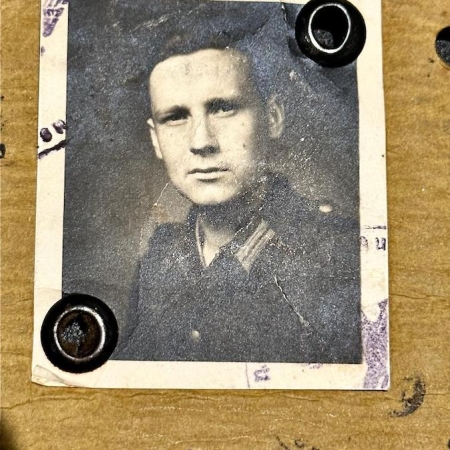
WWII German Soldbuch – Panzergrenadier Zoubek – Panzer Grenadier Regiment 304 – Kampfgruppe Cochenhausen – Fought Easy Company 506th 101 Airborne – Captured in Ardennes 1944 – Rare (Sold)
Zoubek was from Vienna, born in 1926 he was enlisted into the German Army in May of 1944. Point to note before looking at the action reports for the Bulge, is that the 506th Easy Company fought this unit which is super cool… Serving with the 2nd Panzer Divisions Stab (HQ), he was at some point during the battle assigned to: Stabs Kompanie, Panzer Grenadier Regiment 304 (2 Panzer Division) For the Ardennes Offensive 2. Panzerdivision was attached to the XLVII. Panzer Korps commanded by General der Panzertruppe Freiherr von Lüttwitz. In addition to 2. Panzerdivision, the Korps consisted of the Panzer Lehr Division and 26. Volksgrenadierdivision. As soon as the Volksgrenadiere of 26. Volksgrenadierdivision had secured crossings over the Our and Clerf Rivers, 2. Panzerdivision was tasked to breakthrough the American lines, bypass Bastogne to the north and race towards the Meuse and capture the bridges there. Only one day before the start of the offensive Oberst Meinrad von Lauchert took command of 2. Panzerdivision, so he was unable to meet all his commanders before the start of the offensive. In the pre-dawn hours of 16 December, Pioneers and a battalion of Panzergrenadiers crossed the Our river in rubber boats in order to capture the village of Marnach. This was meant to clear the road from Dasburg towards Clerf and further towards Bastogne, but the soldiers of the US 28th Infantry Division entrenched there held the village stubbornly. Only in the evening, when Pioneers finished a 60-ton bridge, were the division’s tanks able to cross the Our and join the fight. The defenders were then slowly pushed back. In the morning hours of 17 December an advance guard reached the town of Clerf, less than two miles west of Marnach and headquarters of the US 110th Infantry Regiment. The advance guard was stopped by Shermans of the 707th Tank Battalion. They lost four Panzer IV tanks in the fight, but destroyed three Shermans in return. The defenders of Clerf were furthermore reinforced by a tank company of the US 9th Armored Division, but in the evening all the American Sherman tanks were either destroyed or forced to retreat. Clerf was finally captured. On 18 December what was left of the 110th Infantry Regiment was forced to withdraw to the west. However, the stiff resistance of the 28th Infantry Division had played havoc with the German timetable. Meanwhile, CCR, US 9th Armored Division established two roadblocks east of Bastogne, the northern one near the village of Lullange, where the road from Clerf entered that leading to Bastogne. The second roadblock was further south near Allerborn. In the morning hours of 18 December the forward elements of Kampfgruppe Böhm reached the northern roadblock. With the tanks of Panzer Regiment 3 close behind, the roadblock was soon surrounded and annihilated. The southern roadblock was overrun shortly after dusk. Oberst von Lauchert now turned his Division to the northwest so as to swing past Bastogne in the north and maintain the momentum of the westward drive. All the delays allowed the American reinforcements to reach Bastogne before the Germans. One of these was Team Desobry from CCB of the US 10th Armored Division which deployed at Noville. The little village north of Bastogne was directly in the way of 2. Panzerdivision. Covered by the morning fog, the tanks of 2. Panzerdivision manoeuvred for an attack on the village. When the fog suddenly lifted, more than thirty tanks were revealed to the defenders of Noville. Accurate fire from the American tanks and tank destroyers caused the attack to fail. At midday the 1st Battalion of the 506th Parachute Infantry Regiment, under Lieutenant Colonel James L. LaPrade reached Noville and immediately counterattacked. However, the paratroopers were unable to reach the ridge lines due to the withering German fire. Elements of 304. Panzergrenadier Regiment infiltrated toward the south of Noville. Threatened by the prospect of being surrounded and short of ammunition, the defenders of Noville finally retreated towards Bastogne on the afternoon 20 December, but they held up the advance of 2. Panzerdivision for nearly two days and caused heavy casualties. The Highwater Mark Shortly after midnight Kampfgruppe Böhm, which had bypassed Noville to the north, captured a bridge over the Ourthe River at Ortheuville. This opened the road to Marche and Namur invitingly, but 2. Panzerdivision did not move, as their tanks had run dry and they had to wait for fuel. This allowed the advance elements of the US 84th Infantry Division to occupy Marche. When the advance finally resumed at nightfall 22 December, stiff resistance was encountered at Marche. Lüttwitz ordered Lauchert to turn the bulk of his division west towards Dinant and the Meuse, and to leave only a blocking force towards Marche. Kampfgruppe Böhm raced up the highway towards Dinant, followed by Kampfgruppe Cochenhausen, finally reaching the woods near Celles before daylight on 24 December. The advance elements of the division were only 9 km away from the Meuse crossings. The remainder of 2. Panzerdivision was stretched all the way back to south of Marche with the dual mission of continuing the westward advance and of protecting the northern flank. Meanwhile, the American 2nd Armored Division began to arrive northeast of Celles. Their CCA moved south into Buissonville, while the 24th Cavalry Reconnaissance Squadron occupied Humain, blocking 2. Panzerdivision route of advance. The leading Kampfgruppen were cut off. In the meantime Kampfgruppe Böhm had reached the village of Foy-Notre Dame were it encountered several tanks of the British 29th Armoured Brigade. Losing several vehicles to British fire and running out of fuel, the reconnaissance battalion went to ground. 2. Panzerdivision was stopped less than 5 km short of the Meuse crossings. On 25 December CCB of the 2nd Armored Division launched its attack on the cut off German Kampfgruppen. It was a clear day, and the attack received excellent air support. Kampfgruppe Böhm was soon destroyed. Lauchert ordered a relief attack to be conducted by Kampfgruppe Holtmeyer. The attack began on…


