
Showing 541–549 of 1179 resultsSorted by latest
-
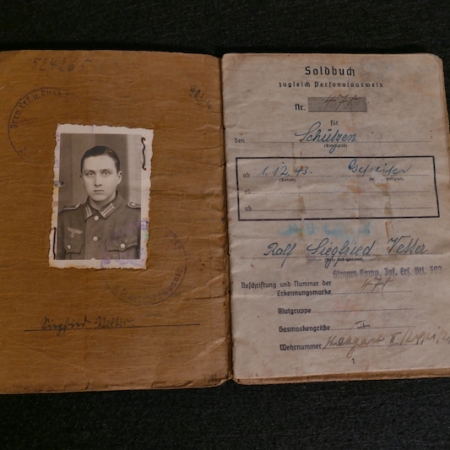
WWII German Army Soldbuch – Gefr Vetter – Finnish in German Army – Grenadier Regiment 1121 – 533 VGD – Fought against US Army in France –
Ralf Vetter was called up in October 1942, interestingly he was born in Helsinki, Finland. Grenadier Regiment 326 – 198 Infanterie Division Wounded in 1943 in Russia with the above unit and received the Black Wounds Badge. Grenadier Regiment 1121 – September 1944 – 553. Volks-Grenadier-Division After the start of the Battle of Lorraine on November 8, 1944, American units began shelling the positions of the 553rd Volksgrenadier Division on November 12, 1944. On November 12, the Americans continued their attack and broke into the positions of the division on both sides of Leintrey (about 40 km west of Sarrebourg), which had already suffered considerable losses again. Under the orders of Army Group G, the severely weakened division had to expand its sector into the Reclonville and Cirey areas. The division was subordinated to the 19th Army and was no longer operational. In mid-November 1944, the division had to face heavy attacks south of Blamont from the 79th US Infantry Division and the 2nd French. Repel Panzer Division. The strength of the grenadier companies had dropped to 4-8 men, the Grenadier Regiment 1121 no longer existed. On November 19, the attacking Allied formations were able to break through the front of the division in several places. Saint Georges was also taken by the enemy. A short-term marching battalion was added to the Grenadier Regiment 1119 and was completely wiped out in the fighting for Saint Georges. On November 20, the division was then included. The remnants of the division managed to break out of the encirclement via Niderviller (immediately on the Rhine-Marne Canal). According to AOK 19, the division was considered completely destroyed on November 20th. 1,300 men had escaped from the containment ring. On November 21, the division received 500 replacements from the Army NCO School in Bitsch. The following day, the divisional commander, General Bruhn, was taken prisoner. The division was taken over by General Höhne. The remnants of the division marched to Bitsch, where they were rallied. The Grenadier Regiments 1129 and 1121 were disbanded, the Grenadier Regiment 1119 still had the strength of a battalion. From Bitsch, the division was to be relocated to the Stuttgart area for refreshment. Due to a lack of personnel, however, it was immediately integrated into the defensive front on the Upper Rhine north of Karlsruhe. The division was now the XIII. Subordinated to the SS Army Corps and had a strength of one infantry regiment, two battalions from the Ettlingen NCO School, two replacement infantry battalions and various Volkssturm units. The artillery was a regiment with three departments (nine batteries) of different types of guns. Heavy weapons or anti-tank guns were completely absent. In early January 1945, the division received orders to cross the Rhine north of Strasbourg and form a bridgehead. Just one day later, it was under heavy Allied artillery fire. Then the division was taken back behind the Rhine and the LXIV. in the area north of Baden-Baden. Here the division became a corps reserve. On January 20, 1945, the division was assigned the Pioneer Battalion No. 405. On January 26, 1945, the division was transferred to the Pforzheim area for refresher training. In this refresher room, the division received teams born in 1927 and 1928 and the division was completely filled. At the beginning of March 1945, the division was transferred back to the Rhine and deployed there for defense. Here, too, they were again supported by Volkssturm units and fortress artillery. The planned training of the replacement did not take place because the soldiers had to be used to build the fortress. On March 24, the division received orders to move to the Höhenstrasse in the Weinheim-Heppenheim section of the Bergstrasse. On March 24, 1945, the division had a strength of 4,065 men. In the period from March 26 to 29, 1945, the right wing of the division was pushed back to Würzburg. On April 1, 1945, the division was ordered to retreat behind the Jagst. US troops focused on Crailsheim and took the town on April 6th. During the ensuing Battle of Crailsheim, the 553rd Volksgrenadier Division again suffered heavy casualties. On April 12, the US 10th Panzer Division broke through the division’s front near Öhringen. On April 16, Schwäbisch Hall was taken by US troops. The remnants of the division went back to Günsburg on April 22nd. The city fell to the Americans two days later. On April 23 the division still had a strength of 1,500 men, on April 26 there were still 600 men. On April 27, 1945, the division was finally crushed. A reorganization was planned as a division of the 33rd wave. Comments: Sadly he pulled his unit page, he likely had something to hide. But an interesting Soldbuch to a Soldier born in Finland who fought for the German Army.
-

WWII German Luftwaffe Soldbuch – Flieger Fritz Krause – Fallschirm-Jäger-Ersatz- und Ausbildungs-Regiment 3 – Late War FJ
This Soldbuch was issued to Fritz Krause born in 1924, he was drafted into a Luftwaffe replacement unit in late 1944. By 1945 he was in training with Fallschirm-Jäger-Ersatz- und Ausbildungs-Regiment 3 (20 FJD). During the period 4-8 May 1945, the remnants of the 9. Armee, attached to the 12. Armee, crossed to the west bank of the Elbe and surrendered to the U.S. Ninth Army. It would seem he was involved in the last battles although there are not many entries more to follow. A nice example of a late war FJ, who seen the end of the war out he is not listed as KIA.
-

WWII German Soldbuch – Grenadier Pregant – Hoch und Deutschmeister – “Operation Spring Awakening” – Hungary 1945 (Sold)
Soldbuch Issued to Oskar Pregant from Innsbruck, enlisted in September 1944 he was sent directly to his field unit after a few weeks. Serving with the 131st Infantry Division in Russia in late 1944, by early 1945 he was sent to the famous Hoch und Deutschmeiter (44. Infanterie-Division): The planned attack on a Soviet bridgehead at the confluence of the Drau and the Danube did not materialize. Instead, the individually arriving sub-units were pushed back to a line between Lake Balaton and the middle Drau. This section could then be held until February 1945. On February 17, it was transferred to a counterattack in the Komárom area. From March 7, the division took part in the “Spring Awakening” offensive. When the offensive bogged down, on March 18 the so-called Vienna Operation of the 3rd Ukrainian Front began. During the heavy defensive fighting, the division had to break out of a pocket with high losses and retreated along Lake Balaton. At the end of March they reached the Reich border and set up a defensive position there. On April 20, the train was transported to Lower Austria, where, however, no major battles took place.
-
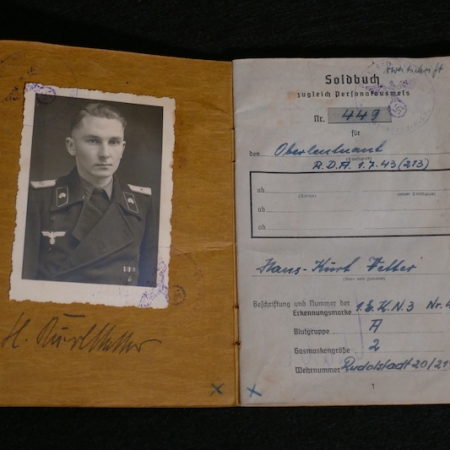
WWII German Panzer Soldbuch – Oberleutnant Hans Kurt Vetter (Swiss Born) – Panzer Regiment 2 & Panzer Lehr Regiment – Fought against US 101st Airborne Division at Bastogne – Ardennes & Holland – Ultra Rare (Sold)
A very rare Soldbuch to a Swiss Born German Officer fighting in a Panzer Regiment. His first edition Soldbuch was likely damaged due to his tank being hit and him sustaining injuries in December of 1943 with Panzer Regiment 2 His Second edition Soldbuch was issued in September 1944 with: Panzer Ersatz und Ausbildungs Abteilung 1 in Erfurt. Joining his frontline unit once again, he was sent to the Panzer Lehr Regiment: The Ardennes – Operation Wacht am Rhein In early November 1944, Panzer Lehr was transferred to Hasso von Manteuffel’s Fifth Panzer Army, part of Field Marshal Walter Model’s Army Group B in preparation for the planned winter offensive, Operation Wacht am Rhein, commonly known as the Battle of the Bulge. On 21 November, the partially refitted Panzer Lehr was ordered out of its assembly area to counterattack the American forces driving towards the Saverne Gap.At that time, it has a strength of 34 Panzer IV and 38 Panther tanks.The counterattack stalled, and Panzer Lehr was called back out of the line, much reduced in strength. The time spent refitting Panzer Lehr and several other units which had been committed prematurely meant that the operation had to be delayed. During the run up to the offensive, Panzer Lehr was kept in reserve, along with the Führer Begleit Brigade. On 15 December, the day before the offensive began, Panzer Lehr was still severely understrength, with only one of its two tank battalions ready for action, the other restored to its parent unit, the 3rd Panzer Division. Both of its Panzergrenadier regiments were at 80 percent of its authorized strength. It had only 57 tanks (30 Panthers and 27 Panzer IV) and 20 Jagdpanzer IV/70’s by the time the attack jumped off. In compensation, it was reinforced by two tank destroyer battalions and an assault gun brigade. The division’s armored reconnaissance battalion was its only organic unit up to strength. Wacht am Rhein opened on 16 December 1944, and Panzer Lehr moved out from the start positions in the center of the German line. The 26th Volksgrenadier Division was to clear the way for the division, but they soon became bogged down and the Panzer Lehr found itself moving forward at a crawl. The situation worsened over the next two days, with the 901st Panzergrenadier Regiment being halted by the Americans along the road to Wiltz, and the 902nd encountering heavy resistance in the town of Hosingen. Bastogne On 18 December, the assault got back underway. The 26th Volksgrenadier Division had secured the bridge over the Clerf River, opening the way to the road and rail-hub of Bastogne. Panzer Lehr’s armored reconnaissance battalion raced ahead, attacking towards Wiltz before rejoining the division on the route to Bastogne.The horse-drawn 26th Volksgrenadier had gotten itself mixed up in Panzer Lehr’s column, greatly slowing the advance. On the 19th, the division’s panzer regiment ran into a roadblock near Neffe, held by troops of Combat Team Cherry of the U.S. 10th Armored Division. After initial success, Panzer Lehr’s follow up attack resulted in heavy casualties. Combat Team Cherry pulled out, and the way to Bastogne was open again. However, the majority of the division’s armor had been sent north to Mageret to support 26th Volksgrenadier. After the taking of Mageret, a local informed Bayerlein, the division’s commander, that a column of about 50 American tanks and infantry was seen moving to Longvilly. Bayerlein ordered his troops to halt and set up a roadblock, giving him a chance to regroup and reorganize his troops. By the time that Panzer Lehr moved out again and reached the town of Bastogne, the US 101st Airborne Division (Screaming Eagles) had already secured it. Panzer Lehr was then divided, with half the division left to help 26th Volksgrenadier Division capture Bastogne, while the rest of the division, including most of its armor, were to continue on to the Meuse.[75] Over the next few days, the Kampfgruppe helping 26th Volksgrenadier, made up mostly of the 901st Panzergrenadier Regiment, wore itself out in successive attacks on the town of Bastogne. As the remainder of the division sped east, it enjoyed some minor successes, including the capture of a large American convoy, but it was brought to a halt by fierce resistance near St. Hubert, and was soon drawn into heavy fighting south of Bastogne. On the 21st, Manteuffel pulled Panzer Lehr out of the fight for Bastogne and grouped it with the 2nd Panzer Division and 116th Panzer Division Windhund for an assault on Dinant and the Meuse. Assault on Dinant After a day spent on reorganising the attack, Panzer Lehr finally got underway. It fought its way through St. Hubert and the road to Dinant and the Meuse again seemed open. The assaulting unit, the 902nd Panzergrenadier Regiment, was met by heavy resistance. Nor was the advance to become any easier thereafter. On 23 December, the division fought all day to reduce the town of Rochefort, suffering heavy casualties. The Americans finally withdrew – their casualties 25 men killed and 15 men wounded, after holding off an elite panzer division for an entire day. Bayerlein later compared the defence of Rochefort to that of Bastogne. Panzer Lehr made two rescue attempts to save 2nd Panzer and succeeded in retaking Humain, but Was unable to go any further. After another failed rescue effort by 9th Panzer, Panzer Lehr was ordered to fall back. Of the 2nd Panzer Kampfgruppe, only Major Cochenhausen and 600 or so of his men managed to escape on foot, abandoning almost all of the division’s armor to the advancing Allies.[86] The Meuse would not be reached; Wacht Am Rhein had failed. Relief of Bastogne The remnants of Manteuffel’s strike force were pulled back for one final attempt to take Bastogne. Panzer Lehr began to move into its new positions, after US 4th Armored Division, the spearhead of George Patton’s US Third Army, began its attack to relieve Bastogne and a corridor to the surrounded 101st Airborne was…
-
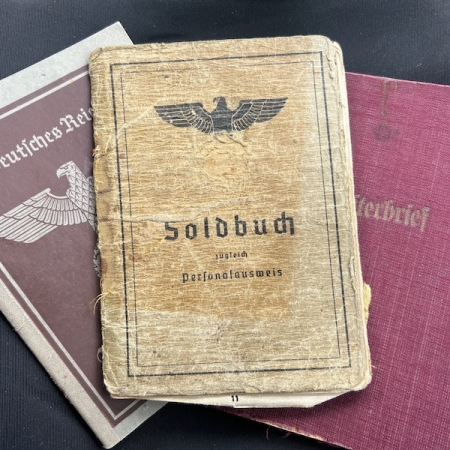
WWII German Soldbuch – Uffz Blunk – Verband 800/804 Sonderverband Brandenburg – Afrika Korps – Ultra Rare Grouping (Sold)
Here we have a Soldbuch issued to Johann Blunk born in 1922. Blunk was issued his Soldbuch in January of 1943, with “Brandenburg” (47681K). Awards: Italian German Africa Campaign – 5.9.42 Wounds Badge – 8.10.1942 Africa Korps Armband – 9.9.42 Infantry Assault Badge – 31.3.43 Entries: Arrived in Africa – 13.11.1941 (Brandenburg) 45432 – 13. Kompanie Lehr-Regiment Brandenburg z.b.V. 800 Arrived in Europe – 9.9.1942 – 16163 – 5. Feldlazarett 542 Arrived again in Africa 27.1.1943 Page 8 – Allowed to wear the Afrika Korps Armband. Blunk contracted Malaria in Africa in August 1942, and was flown back to Germany. Equipment Issued by following units 38951 – Verband 805 Sonderverband Brandenburg – (10.1942), 44414 – Abteilung von Koenen Lehr-Regiment Brandenburg z.b.V. 800, then Stab III u. 1.-4. Einheit (= A-D) Verband 804 Sonderverband Brandenburg (02.43) Signatures: Verband 804 Sonderverband Brandenburg – Oberleutnant Hans von Blödern (12.08.1913 – 02.07.1944) Born in Swakopmund Africa, Killed in action Lieno 1944 Unit History The Brandenburgers (German: Brandenburger) were members of Nazi Germany’s Wehrmacht special forces unit during World War II. Originally, the unit was formed by and operated as an extension of the military’s intelligence organ, the Abwehr. Members of this unit took part in seizing operationally important targets by way of sabotage and infiltration. Being foreign German nationals who were convinced Nazi volunteers, constituent members had lived abroad and were proficient in foreign languages as well as being familiar with the way of life in the area of operations where they were deployed. The Brandenburg Division was generally subordinated to the army groups in individual commands and operated throughout Eastern Europe, in northern Africa, Afghanistan, the Middle East and in the Caucasus. In the later course of the war, parts of the special unit were used in Bandenbekämpfung operations against partisans in Yugoslavia before the division was reclassified and merged into one of the Panzergrenadier divisions in the last months of the war. They committed various atrocities in the course of their operations. In Africa: When the Afrika Korps shipped out to Libya The Brandenburgers also went there. The men raised as 4 companies of Special Tropical Units, were made up of fluent speaking English or Arab members. They used captured British vehicles to operate behind enemy lines in raids and reconnaissance missions, mirroring the actions of the British LRDG. Generalfeldmarschall Erwin Rommel at first disapproved of the Brandenburgers but after he saw the damage inflicted by the LRDG and Stirlings SAS, he realised their value and accepted their unorthodox methods. The unit was charged with disrupting the British lines, but it was difficult to supply them and to provide transportation, so most men were either killed or captured. Oberleutnant von Koehnen of 13. (Tropen) Kompanie, Lehrregiment z.b.V. 800. 13. Kompanie In the context of Operation CRUSADER, the Brandenburger played a small role. by the use of ULTRA intercepts and with the help of posters on the Axis History Forum. They had been requested to support the planned attack on Tobruk, possibly by a seaborne landing. A relatively small force was sent under Oberleutnant von Koehnen. This was from 13./Lehrregiment 800 Brandenburg z.b.V.[4], and had been sent directly from Catania in Italy by plane on 14/15 November. The remainder of this company stayed in Italy, and was ready to be moved at the request of the Panzergruppe, although there are indications that this was not going to be possible before February 1942, maybe due to the transport situation following the destruction of the Beta/Duisburg convoy on 8/9 November 1941. The strength of this detachment was likely 1 Officer, 11 non-commissioned officers, and 70 men. It appears that this detachment was then rushed to Benghazi to shore up the defenses there, and maybe split up on the way, with part of it remaining in Agedabia under the command of an men called Doehring, maybe a senior non-commissioned officer. On 29 November, von Koehnen was in Benghazi with 1 officer, an unknown number of non-commissioned officers, and 31 men. The remainder of the company was at the time in Italy, with a strength of 3 officers, 31 non-commissioned officers, 159 men, and with 17 lorries, 8 cars, and 3 tractors. It is possible that another company (11./LR 800) arrived in Benghazi as part of Sonderverband 288 (see this older post). During the main battle these units seem not to have been engaged. They were basically immobile, and had little or no heavy weapons. It appears that they conducted an operation on 22 January 42 during the counter-offensive. My guess is this would have been a small operation, maybe using English-speaking soldiers wearing Commonwealth uniforms to confuse the Commonwealth forces by giving wrong traffic directions (always a favourite) or impersonating officers to give false orders. It would seem that Blunk was captured in Africa and was taken POW.
-
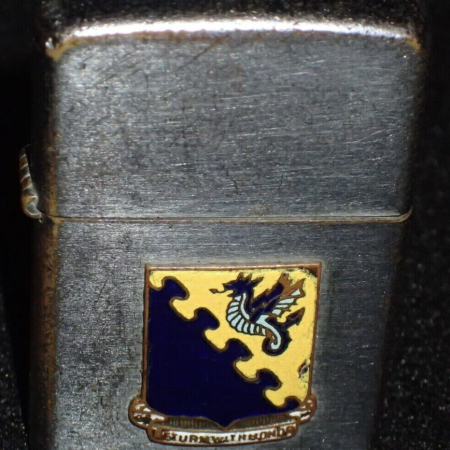
Vietnam War USAF 31st Fighter Wing Lighter ‘Major HM McFann’ – Incredible Story – WW2 Notable Pilot
Original Vietnam War USAF 31st Fighter Wing Headquarters Lighter ‘SUPER ACE Japan’ 31st SFW Crest ‘Return with Honor’; Personalized to ‘Major H.M. McFann’ who was Lt. Col. Harry Miles McFann of Tulsa, OK (b. Jun 24 1918 – d. Jan 29 1997), WW2 Notable Pilot who was awarded the Silver Star and Distinguished Flying Cross for action taken aboard B-17 Paper Doll 96th Bomb Group during a bombing raid of Schweinfurt, Germany and appearing on the front page of Stars & Stripes under the headline ‘Navigator Flies Bomber Home with Pilot Dead Co-Pilot Hurt’ Oct 23, 1943 – Sir Winston Churchill personally congratulated Lt. McFann the day after; Good Issued / Used Condition as Photographed lots of thumb wear and light enamel damage as seen – functionality untested, Recent Collection Acquisition; Presented as Acquired (print of the obituary, unavailable online – acquired from The Union County Genealogical Society included, Stars & Stripes for reference, not included), Rare – Excerpt from Air Force Magazine ‘Back to Schweinfurt’ by Barrett Tillman Aug 21 2018 – STRUGGLING HOME However, the Americans got little respite on the egress as some German fighter groups flew far from their bases in the Netherlands and northern Germany. 1st Gruppe of Jagdgeschwader 2 flew 180 miles to the 3rd Division’s outbound track. Generalleutnant Adolf Galland, commanding Germany’s day fighters, wrote, “We were able to break up several bomber formations and to destroy them almost completely. The approach and return routes were marked by the wreckage of shot-down aircraft.” Some of the fallen Flying Forts had strayed far afield. A 305th BG bomber, Lazy Baby, landed wheels up in Switzerland. Far in the opposite direction, another Chelveston aircraft was shot down near Hamburg, apparently trying to make it to Sweden. Even nearly home, losses continued. Almost out of fuel, the 303rd BG crew of the battle-damaged Cat-O-Nine Tails bailed out over England. All fliers landed within four miles of the crash, in a Risley resident’s backyard. Paper Doll of the 96th Group, three months old, returned with a dead pilot and badly wounded copilot. The navigator was Lt. Miles McFann, a prewar private pilot who got her down at an RAF field. He recalled, “We could have bailed out, instead of risking a crash-landing. I suppose a lot of fellows wouldn’t want to take a chance on having a navigator act as pilot, but they weren’t sticking because of their confidence in me. They all knew that [Lt. Robert] Bolick was dead inside that ship, and none of us was going to bail out and leave him in there. We just wouldn’t do it.” Some 2,900 airmen flew the mission, of whom 648 were listed killed, wounded, or missing in action; a staggering 18 percent casualty rate.The 1st Division took the heaviest losses by far: as noted, the 305th BG wrote off 13 bombers while the 306th lost 12. In contrast, the entire 3rd Division lost 15. Eighth Bomber Command listed 60 Flying Forts missing, plus five that crashed in England, with seven written off as “Category E,” or damaged beyond repair. All told, a horrific total loss of 72 bombers. Of the remainder, about three-quarters bore battle damage. Aircrew gunnery claims were typically extravagant; understandable with multiple B-17s often engaging the same fighters. The original figure was an unrealistic 288, reduced to 186 “confirmed” fighters downed. In fact, the Luftwaffe lost 53 aircraft with 29 aircrew killed or missing and 20 wounded. (Excerpt from Air Force Magazine ‘Back to Schweinfurt’ by Barrett Tillman Aug 21 2018)
-
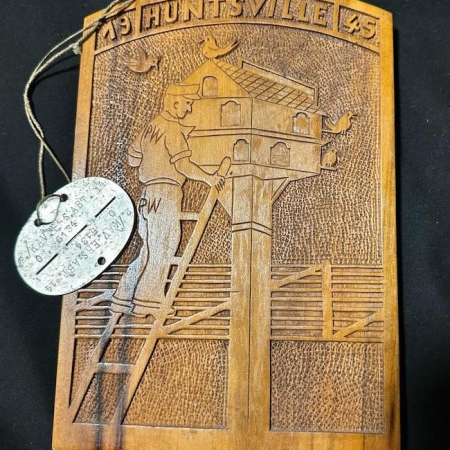
WW2 German P.O.W Art – Huntsville Texas U.S.A 1945 – Afrika Korps POW – With Kavallarie EKM – Dog Tag – Rare (sold)
An interesting little group of two items. Tag is marked Kavallarie Ersatz Abt 14 – Bloodgroup: O, Serial Number: 5134 Wooden handmade item showing a POW in Huntsville in 1945. A full report on the camp can be found here from Texas state university: https://www.shsu.edu/~jll004/publichistory/powcamp.pdf According to the amazing study and photos in the pdf history above, it was a camp specifically with Germans captured form the Africa Korps.
-
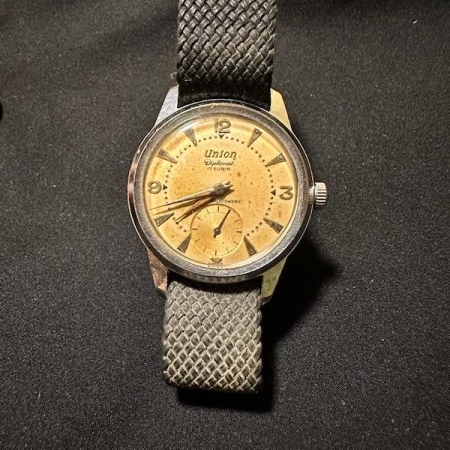
WW2 German Wrist Watch – Working Condition – Wehrmachtswerk – Union Diplomat 17 Rubis
Nice Period Swiss made Union Watch, still works.
-
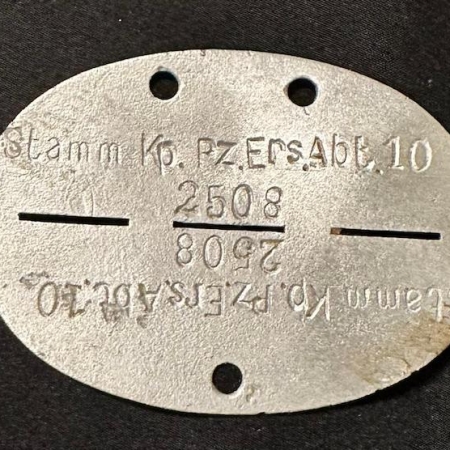
WW2 German Army Dog Tag – Erkennungsmarke – Panzer Ersatz Abt 10 (Layaway)
Nice tag was sadly cleaned as it was a ground find but none the less an original Panzer mans EKM.


