Showing 478–486 of 1179 resultsSorted by latest
-

WWII German Soldbuch Cover – Nice not seen one (Sold)
A nice Soldbuch cover, it seems they had a patent pending for this cover and made these under the company called Koriko.
-

WWII German Kriegsmarine Soldbuch – Matrosen Gef Otto Sadowski – Hafenkommandant Antwerpen – Antwerp 1944
$155.00Soldbuch issued to Matrosen Gefreiter Otto Sadowski born in 1894 in Königsberg, Prussia. Not many entries, although a nice original photo and equipment entered. Interestingly, after researching the unit, it seemed that there was an Operation called Unternehmen Bruno. https://de.wikipedia.org/wiki/Unternehmen_Bruno It would seem the last entry in the Soldbuch is August 1944, so we can assume he was taken POW shortly after. Comes with another ID, with photo stating that he crossed the Polish and DDR (East German) border to go to Baden. Nice not often seen unit/location.
-

WWII German Army Soldbuch – Schütze Alfred Weis – Festungs Pak Kp 2/XXXX – Surrendered to Swiss Army – Swiss Army Internment Stammlarger Chur – Mega Rare (Sold)
An interesting small grouping to the Sniper Alfred Weis, born in 1927, he was enlisted into the German Army in February of 1945. He served with : Festungs Pak Kp 2/XXXX (Festungs-Pak-Verband XXXX) – Oberrhein Front On December 16, 1944, the Germans attacked in the Ardennes. What became known as the “Battle of the Bulge” forced the movement of large numbers of U.S. troops north out of Alsace and Lorraine to counter the German attack. In January, additional U.S. troops were moved north in response to the German counter-offensive into northern Alsace, Operation North Wind (Unternehmen Nordwind). Taking advantage of the stretched Allied lines, Himmler ordered the recapture of Strasbourg. German troops assaulted across the Rhine near Gambsheim on January 5, 1945[4] and soon occupied a bridgehead including the towns of Herrlisheim, Drusenheim, and Offendorf north of Strasbourg. South of Strasbourg, German troops in the Colmar Pocket attacked north toward Strasbourg on January 7, inflicting painful losses on the French II Corps, but were ultimately unable to break the French defense. Reinforced by elements of the 10th SS Panzer Division, the German troops in the Gambsheim Bridgehead held their own against U.S. and French counterattacks during January 1945, manhandling the U.S. 12th Armored Division at Herrlisheim. The German successes of January, however, marked the high point for the Upper Rhine High Command. The Gambsheim Bridgehead, and further to the south, the Colmar Pocket, would not be reduced by Allied forces until well into February 1945, but the operations of the Upper Rhine High Command after mid-January were defensive in nature. Equipment: G43 with DOW Scope on the 5.4.1945 along with a pistol and cleaning kit for the Sniper Rifle, as well as a set of 6×30 BLC Binoculars . (PLEASE NOTE: These are very late entries, and we do not really think the Rifle entries are provable 100%). Swiss Issued IDs Interesting, and what seems to be incredibly rare is the Swiss ID attached. He is pictured in a Panzer Wrap, without Eagle issued in December of 1945. So he made it over the border to Switzerland to surrender on the 27th of April 1945. The photo was taken by Photo Brandt in Arosa, and the Swiss Countryside can be seen in the background. It seems he was then interned in a Camp in Chur, under the Military Internment Graubunden Chur. Another ID, was issued for when he was in Arosa Switzerland , and had to be presented when he visited any local businesses. Extra A nice uniform photo in RAD Uniform. Another document states that he was handed over in December to the French Army in Tuttlingen, interestingly it states he is a POW and a Deminer, so he was likely active in post war mine clearance. Also a 1947 issued Sport ID was in the grouping. Final What an incredible bit of history with the Swiss link, he was active with arms for about two weeks and made it to Switzerland.
-

WWII German Army Soldbuch – Oberfeldwebel Pangerl – Grenadier Regiment 978 (271 Inf Div) – Normandy Caen and Falaise 1944 – 1 Mark Occupation Money Souvenir 1944 (Sold)
Issued to Karl Pangerl, born in 1915. He raised the ranks to Oberfeldwebel He served with the following units: 1939 till 1942: Infanterie Regiment 97 / Inf Reg 72 – 46 Inf Divison From September 1, 1939, the division took part in the Polish campaign, crossed the border in the direction of Czestochowa and then marched south via Prtzysucha past Radom via Grabow and Warka to the Vistula. Eventually the division reached the area south of Warsaw, where it remained until the Polish surrender. The division was then used for a short time as an occupation force in Poland and moved to the Bad Driberg area as an OKH reserve in December 1939. There the division handed over Field Replacement Battalion 46 to the 183rd Infantry Division in January 1940. At the beginning of the western campaign, the division followed the fighting troops from the area west of Aachen via Maastricht, Namur, Cambrai to the west of Amiens. Here the division for the second phase of the campaign, the “Battle of France”, was prepared. At Flixécourt the division crossed the Somme and fought its way to the Seine at Donains. The division then advanced via Chateauneuf and Le Mans to the Loire in the Angers area. After the end of the western campaign, the division was used for coastal protection on the Atlantic coast. In March 1941, the division was then transferred to Romania as a training force in the Prilep area. In April 1941 the division took part in the Balkan campaign. However, she did not intervene in the fighting, but was towed to the Banat via Belgrade, where she remained for security purposes. At the start of the western campaign, the 46th Infantry Division was again assigned to the OKH reserve and moved to Romania. It was not until July 1941 that the division took part in the Russian campaign and was integrated into the Prut front with the 11th Army. In mid-July 1941, the Prut was crossed and the division marched to the Dniester, which was crossed in mid-July 1941. The division then advanced via Balza to the Dnieper near Bereslaw and turned here to the Crimean Peninsula. After the Perekop Isthmus was breached, the attack on the Parpach Isthmus began. After the Russian positions could be breached here, the city of Kerch itself was conquered. The 46th Infantry Division was then used for coastal protection on the Kerch Peninsula. After the surprising landing of large forces of the Red Army on the coast of the Kerch Peninsula in early 1942, the entire eastern part of the peninsula had to be abandoned. The division retreated to the Koy Assan – Vlandislavowka area. The Commander-in-Chief of Army Group South then sent her the following telex: “I deny the soldierly honor of the 46th Division for the flopping action during the landing of the Russians on the Kerch Peninsula and their hasty withdrawal from the peninsula. Awards and promotions are blocked until further notice. This telex is only up to the regiment commanders inclusive to announce.” signed by Reichenau Field Marshal Due to the protest of the division commander and the regiment commanders, the following telex was sent to the division by Field Marshal von Reichenau’s successor: “I express my special appreciation to the 46th Division for the outstanding performance in the defensive battles in the Isthmus since the beginning of January and look forward to corresponding proposals for promotions and awards.” Signed by Bock, Field Marshal In May 1942, the division then took part in the reconquest of the Kerch Peninsula and then took over the coast protection on the peninsula again. In September 1942, the division crossed over to the Halinsel Taman and then took part in the advance into the western Caucasus. Here the division was deployed in the Maikop area and fought at Kotlowina, Massnikova and Oplepen Berg, among others. When the retreat from the Caucasus began in January 1943, the division had to retreat to the Kuban bridgehead amid heavy fighting. The division was torn into individual combat groups and suffered heavy losses. At the beginning of April 1943, she was therefore transferred to the Zaporozhye area to be refreshed there. 1943 – 1944: Grenadier Ausbildungs Batl 72 – 46 Inf Div Training soldiers in Czech for the 46 Inf Div. 1944 – till capture: Grenadier Regiment 976 ( 271 Inf Division) On June 23, 1944, the division’s command post was moved to Chateaux de Cabrials (4 km east of Beziers). From June 30, 1944, the division was replaced by parts of the 198th and moved to Normandy. During the transfer, the rail transports were attacked by Allied fighter-bombers, resulting in casualties. The division was unloaded in Rouen and set out west across the Seine from there. On July 12, 1944, the foremost parts of the division reached Bernay (130 km east-southeast Lisieux). From July 17, 1944, the foremost units replaced the 10th SS Panzer Division on the Normandy front southwest of Caen. On July 21, most of the division was in the front line, with parts in the areas of Urville, Lisieux and Orbec. By July 25, 1944, the division had taken over the right section of the II SS Panzer Corps, replacing the 10th SS Panzer Division. Right border of the division section formed the division border, left border Fontaine – 1.8 km west of Vieux. The division was annihilated in August 1944 by the 5th Panzer Army in the Falaise pocket. Medals: 1. War merit Cross with Swords – 11.1941 2. Eastern Front Medal – 8.1942 3. Krim Shield – 10.1942 4. Romanian Medal Against Communism . 11.1942 Final Comments: He had a full line of equiptment issued, and the clues to him being in Normandy are clear, he has a promotion his last to Oberfeldwebel on the first of June 1944, and the next entry is for replacement uniform in July of 1944 with the 271 ID. The last entry in on August 1944. After which corresponds with the…
-

WWII German Wehrmacht Soldbuch – Kanonier Hans Maier – Grenadier Regiment 126 (48 ID) France 1944 – With EKM (Dog Tag) – Battle for Vienna 1945
Great ID Grouping to Kanonier Maier from the Nuremburg area. He was enlisted in April of 1944, and wen through a series of units, starting with Artillery through to a Grenadier. Here is a list of his active units he served with: Landesschützen Batl 820 – Guarding POWs in Lauf near his hometown. Festungs-Artillerie-Abteilung 3086 – in Lower Austria Artillerie Regiment 148 – 48 Infantrie Division – France 1944 Grenadier Regiment 126 – 48 ” ” – Slovakia / Austria 1945 From mid-September 1944 it was used to protect the mouth of the Saar in the Moselle near Wasserbillig. Here the division suffered heavy losses until the end of October 1944 and was therefore withdrawn from the front in November 1944. By order of October 9, 1944 (No. I/19817/44), the 48th Infantry Division (bo.) was reorganized and renamed the 48th Infantry Division. In mid-November 1944, the XIII. SS Army Corps the dissolution of the smashed division and the incorporation of the remnants into the 559th Volks-Grenadier-Division. After the remnants of the 48th Infantry Division had been incorporated, the 559th Volks-Grenadier-Division was temporarily renamed “Kampgruppe von Mühlen” (after their commander). The divisional staff of the 48th Infantry Division was used for tasks behind the front, and its supply troops were made available to the army. In December 1944, the divisional headquarters and the supply units were transferred to Slovakia. The division was then reorganized in the Trenčín area. However, this was not completed by the end of the war, a combat group was still used in the Battle for Vienna 1945. Final Comments: What is clear is that in May of 1945 he arrived in a hospital with a code 34, both of his lower legs where in some sort of accident and were crushed.
-

WWI Wright Martin Aircraft Corp – Tiffany Sterling – 5765G Presentation Plate – 1918 Historic Aviation Personality Richard F. Hoyt – 864g Silver
Wonderful Original WWI Wright-Martin Aircraft Corporation Tiffany Sterling 5765G Makers 483 Sterling Silver 925-1000 Presentation Plate 13 Inch Diameter Weighing 864 Grams. This Magnificent Piece is Date Engraved 1918 with ‘Aircraft Service Wings’ to the Top at 12 O’clock, Engraved – To Richard F. Hoyt In Appreciation of His Good Fellowship While Secretary of The Wright-Martin Aircraft Corporation During the War from His Coworkers with Eight Signatures Below. Richard F. Hoyt was a 20th Century Industrialist, Banker, Developer and Board Member of Numerous Large Corporations. He was Chairman of Madison Square Gardens and was Awarded The Presidents Cup by President Herbert Hoover in 1929 for among other issue his Significant Contribution to Military Aviation During WWI. Hoyt was a Financial Sponson of Both Charles Lindbergh and Adm. Richard E. Byrd’s Expeditions. He was an Early Speedboat Enthusiast (see 1934 New York Times Obituary & Photo of Pres. Hoover Presenting Cup for Reference) Fine Condition as Photographed with one small ding at about 11 O’clock, A Superb Addition to Any Advanced Aviation or Tiffany Sterling Collection, a Fine Display Piece with Volumes of History Hidden Within
-
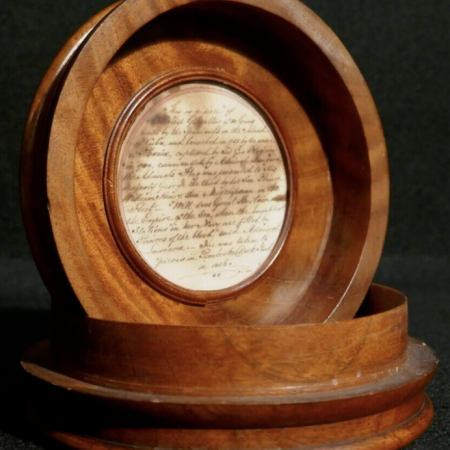
1836 Tobacco Jar Table Box – HMS Gibraltar – Spanish Navy Fénix 1749 – Mahogany Timber – Rare
Wonderful & Exceptional 1836 Tobacco Jar Table Box Mahogany Crafted from a Timber of Royal Navy H.M.S. Gibraltar Originally The Spanish Navy Fénix; A Turned Mahogany Table Tobacco Box, made from the Timber Of H.M.S. Gibraltar (1749), Circa 1836. The Interior has a Manuscript Label Purposefully and Intricately Inlaid to the Upper Lid Interior, Covered in Wood Banded Glass this History States ‘This is a piece of H.M. Ship Gibralter 80 guns built by the Spaniards on the Island of Cuba and launched in 1751 by the name of Phoenix, captured by Sir Geo Rodney in 1780 commanded by Admiral Langara. The Admirals Flag was presented to his Majesty George the Third by his son Prince William Henry then a Midshipman in the Fleet “Well does Great Britain Merit the Empire of the Sea when the humblest Stationes in the Navy are filled by Princes of the blood” said Admiral Langara. – She was taken to pieces in Pembroke Dockyard in 1836′ – G.T. – Originally built for the Spanish Navy in Cuba in 1749, the Fenix was the flagship of Admiral Juan de Langara. After it was captured by British Admiral Rodney at the Battle of Cape St. Vincent in 1780, it was commissioned as H.M.S. Gibraltar and taken into service. The ship subsequently saw action at The Battle of Fort Royal, Invasion of Tobago, Battle of Cudalore, Glorious First of June, Battle of Heyeres Islands, Battle of the Basque Roads, & was awarded the Naval General Service Medal with Clasp ‘Egypt’ before eventually being broken up in Pembroke Navy Dock 1836. This Historic & Unique Tobacco Box Measures 5 1/2 x 2 Inches – The piece remains in remarkable condition for its age as photographed but it has a split at the base of the upper half and provenance & glass can become loose with two pieces of the interior trim that holds it to the lid broken as seen (could easily be repaired); additionally, the lid is tight to the base and if pressed together as intended can be difficult to separate. A Nearly One of Kind Addition to Any Royal Navy Collection, Library Room, or Maritime Display – One of the More Unusual Tobacco Jars Available! – Recent Estate Auction Acquisition & Presented as Acquired, Exceptionally Rare – Prominent San Bernardino Estate (see history below) Fénix was an 80-gun ship of the line (navio) of the Spanish Navy, built by Pedro de Torres at Havana in accordance with the system laid down by Antonio Gaztaneta launched in 1749. In 1759, she was sent to bring the new king, Carlos III, from Naples to Barcelona. When Spain entered the American Revolutionary War in June 1779, Fénix set sail for the English Channel where she was to join a Franco-Spanish fleet of more than 60 ships of the line under Lieutenant General Luis de Córdova y Córdova. The Armada of 1779 was an invasion force of 40,000 troops with orders to capture the British naval base at Portsmouth. As the flagship of Admiral Juan de Lángara, the ship fought at the Battle of Cape St Vincent on 16 January 1780, where she was captured by the British Royal Navy and commissioned as the third rate HMS Gibraltar in March of that year. She spent a short while in the English Channel before joining Samuel Hood’s squadron in the West Indies and taking part in the Capture of St Eustatius in February 1781 and the Battle of Fort Royal the following month. Gibraltar and five other ships were sent to stop a French invasion fleet bound for Tobago in May 1781, but found the French too powerful and had to withdraw. In November, her 18-pound guns were replaced with 24-pounders, after which, in February 1782, she sailed to the East Indies and in the following year participated in the Battle of Cuddalore. At the start of the French Revolutionary War, Gibraltar served in the Channel Fleet, fighting at the Glorious First of June in 1794 before being sent to the Mediterranean in May 1795. In June, the ship was in an action off Hyères; then, in December 1796, she was badly damaged in a storm and had to return to England for major repairs. By June Gibraltar was back in the Mediterranean, serving in the navy’s Egyptian campaign, where she remained during and beyond the Peace of Amiens, except for a short period when she was sent home for a refit. Returning to the Channel in April 1807, Gibraltar joined the fleet under Admiral James Gambier, which fought the Battle of the Basque Roads in 1809. This was her last major action; the ship was taken out of service in 1813 and converted to a powder hulk. She became a lazarette in 1824, then was broken up in November 1836 at Pembroke Dock. Construction and armament Fénix was a Spanish, two deck, ship of the line built in Havana from mahogany.[2] Launched in 1749, her dimensions were 178 feet 10.75 inches (54.5 m) along the gun deck, 144 feet 6 inches (44.0 m) at the keel, with a beam of 52 feet 11.75 inches (16.1 m) and a depth in the hold of 22 feet 1.75 inches (6.8 m). This made her 2,184 35⁄94 tons burthen (bm). Classed as an 80-gun third rate, Fénix was armed with thirty 24 pounders (11 kg) on her lower gun deck, thirty-two 18 pounders (8.2 kg) on her upper gun deck, twelve 9 pounders (4.1 kg) on the quarterdeck, and six on the forecastle. Her sister ship, Rayo, was later converted to a 100-gun, three-decker. She was wrecked at Trafalgar in 1805. Fénix was captured by the British in 1780. She was copper sheathed and fitted out for British service at Plymouth Dockyard between April and August 1780 at a cost of £16,068.5.3d. The Admiralty changed her armament a number of times: in November 1781 the 18-pounders on her upper deck were upgraded to 24-pounders, and the same December two 68-pounder (31 kg) carronades were added. By 1810,…
-
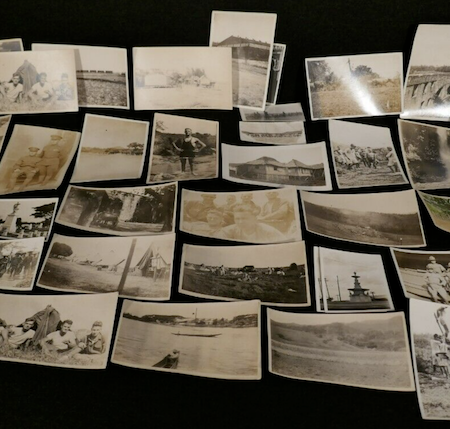
Philippine Insurrection 1899 – Moro Rebellion Photograph Collection 44 Photos – Exceptionally Rare
Wonderful Original Antique Philippine Insurrection Photograph Photo Postcard Collection 44 Pieces: Great Subjects as Seen – Camp, Machine Gun Practice, POWs, Landscape, Villages, Buildings, Recreation, Personal & Unit Photos, Training, Train, Early Truck, Old Stone Work, Boat, Base, Entrance Gate Camp Eldridge Los Banos, Laguna PI Philippine Islands (Colorized Illustration Enhanced), Bases, and More! This Collection Consists of 35 Photo Postcards, 5 3×2, 2 Small Photos, and Two Small Photos of a Roundabout Fountain / Statue
-

WWII German Army Wehrmacht – Cold Weather Sentry Boots – 1943 Dated
Original WWII German Army WehrmachtCold Weather Sentry Boots 1943 Dated & Marked, Constructed of Felt, Leather, and Wood Soles – Heavy Sturdy Construction Over-Boots – Overall Good Issued Condition as Photographed with minimal wear as seen


