
Showing 91–99 of 1271 resultsSorted by latest
-
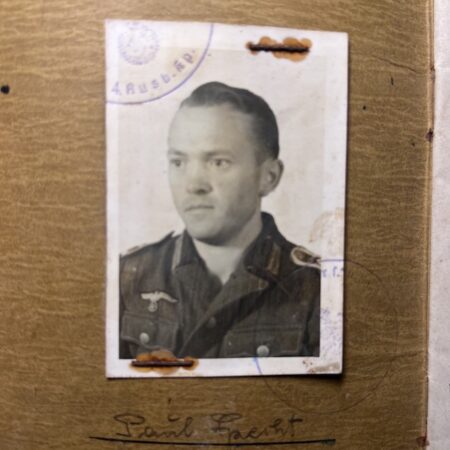
Original WWII German Soldbuch – Feldwebel Paul Specht – Panzer Grenadier Regiment 26 – 24 Panzer Division – Heiligenbeil 1945 – Rare
Soldbuch to Feldwebel Paul Specht It seems his Soldbuch was issued as a replacement with: Panzer Ersatz und Ausbildungs Abteilung 10 in September of 1944. Specht spent time in Litzmanstadt (Lodz) in 1944, with: Panzer Grenadier Ersatz Batl 413, and it seems they went into action there January 1945 and were almost wiped out. https://www.lexikon-der-wehrmacht.de/Gliederungen/InfErsBat/InfErsBat413-R.htm Specht was finally mobilised and sent via Marschbataillon Pz.Tr./307 to the 24. Panzer-Division, (Strength 300 Mann 4.1.1945 Wehrkreis X) Specht was assigned to his frontline unit of the 24 Pz Div – Panzer Grenadier Regiment 26 – 1 Schwadron Commanded by: Major Höhne (RK,DKIG) Killed in Action – February 19th, 1945 (Zinten, Heiligenbeil/Eastprussia, Germany) His Profile: https://www.tracesofwar.com/persons/6832/H%C3%B6hne-Georg.htm The division was then transported by rail, leaving behind its heavy weapons and armored vehicles, to Marienburg/Elbing (East Prussia). In the Elbing area, it was provisionally re-equipped with weapons and vehicles. The division was then deployed for defense and counterattacks in Southeast Prussia. From February 21 to March 27, 1945, defensive fighting followed in Ermland and the division withdrew to the bridgehead near Heiligenbeil. At the end of March 1945, the division was transported across the Baltic Sea to the Vistula Spit near Pillau. In mid-April, the remnants of the division (approximately 4,000 to 5,000 soldiers) were evacuated to Schleswig-Holstein, where it surrendered. Interesting Equipment: Peaked Visor Cap, Camo Kit Medals/Awards: Shooting Lanyard, 1st Class – 22.7.1941, Sports Badge in Bronze – 31.7.1941, War Merit Cross with Swords 20.4.1943. Fate: I have checked online resources and was not able to find what happened to Specht, although it could be that he made it back to Germany and surrendered, although there is no POW markings on the Soldbuch, a mystery that may later be solved…
-
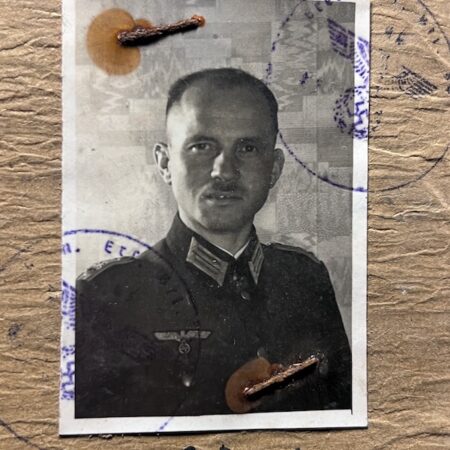
Original WWII German Soldbuch – Oberleutnant Ringel – Italy Milan 1943 – Grenadier Regiment 216 – 102 Inf Div – Iron Cross First Class – Escaped Pillau 1945 – POW Western Front! – Rare
Soldbuch issued in 1941 to Stone Mason Master from the area of Braunau (CZ), Arno Ringel. Frontline Units: Landesschützen Batl 554 The Landesschützen Battalion IV/VIII was established during mobilization on August 26, 1939, in Görlitz, in Wehrkreis VIII. The battalion was formed from the Infantry Replacement Battalion 406. The battalion was apparently deployed to Reichenbach during the winter of 1939/40. On April 1, 1940, the battalion was renamed Landesschützen Battalion 554. The battalion was subordinated to Division z.b.V. 408. From there, the battalion was deployed to the Commander of the VIII Prisoners of War. Feldkommandantur 1013 Field Command 1013 was established on August 22, 1943, in Military District VIII. Subsequently, the staff was subordinate to the General Staff of the 14th Army and then to the Plenipotentiary General of Italy and was located in Milan. Regiments Gruppe 348 – (102 Infanterie Division) Wounded in May 1944 – Bullet wound!! Interestingly the unit is mentioned here: https://www.lexikon-der-wehrmacht.de/Gliederungen/Divisionsgruppe/DivGruppe216.htm Field Post Numbers: The units (Staff, Regimental Groups, and 14th Company) were all registered in the field post overview as parts of Divisional Group 216 from January 10, 1944. The 13th Company followed on March 22, 1944. The 13th and 14th Companies were then assigned to Regimental Group 348 from May 22, 1944. The regimental groups and the staff were renamed parts of Grenadier Regiment 216 between November 23 and 29, 1944. Grenadier Regiment 216 ( 216 Infanterie Division) – Seems this was his last unit. From August onward, the division continued its retreat across the Lessna, the Bug, and the Narew Rivers to the East Prussian defensive position until January 1945. At the end of 1944, Division Group 216 was renamed Grenadier Regiment 216. After the costly battle for East Prussia, the remnants of the division withdrew via Sensburg and Heilsberg to the Königsberg area. The division was finally smashed in the Rosenberg-Balga-Heiligenbeil pocket. Remnants managed to escape across the Frisches Haff to Pillau. These remnants continued fighting in Western Pomerania as Division Group 102, surrendering to the Americans at Trave on May 5, 1945. Awards: War Merit Cross with Swords, Second Class, Jan, 1944, April 1944 – Iron Cross Second Class and Wounds Badge in Black, February 1945 – Iron Cross First Class – 102 Infanterie Division. He seemed to have defaced the Nazi Symbol on the entry with a smoke. Equipment: P38 Pistol, Compass, Lamp Diverse Paperwork Included: Drivers Licence, Permit to Drive in Milan Italy with his own car. Entry for bottle of Sparking wine, and Führer Present in Hospital June 1944. Border Crossing Permit to Denmark in 1943 on his way to Copenhagen in May of 1943! A POW Paper Issued by the Military Government of France. Condition: Missing Pages 5 – 7 – Addresses , not really critical on this one as not much information was lost, its possible he used it to prove his residence for Repatriation in June 1945 (See below) Final Comments It seems that Ringel was an experienced and battle-hardened Officer, he was awarded the Iron Cross First Class in February of 1945, and he managed to escape the hell in Eastern Prussia (likely only with some sort of boat!) Making it back to the Western Front he was by June of 1945 he was in a French POW Camp, mentioned in pencil is that he was repatriated by the American XXII Corps to return to the former occupied region of the Czech Republic, where he was from. Overall this is a desirable Soldbuch of a frontline Officer who survived the Western and Eastern Fronts.
-
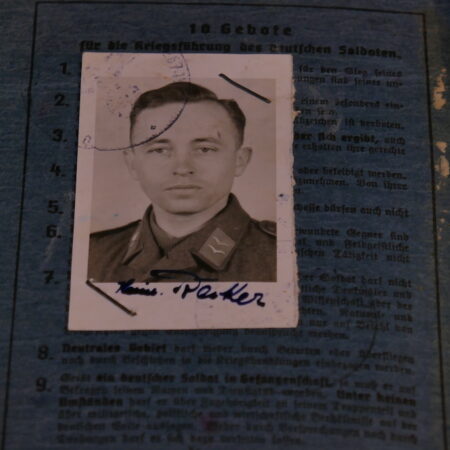
Original WWII German Luftwaffe Soldbuch – Obergefreiter Heinrich Becker – Luftgau-Nachrichten-Regiment Moskau
Issued to Becker in 1942. He served as a radioman for sometime in the following units: Luftgau-Nachrichten-Regiment Moskau The Moscow Air District Signal Regiment was established in Minsk in November 1941 with two detachments for the Moscow Field Air District: Regiment Staff from Staff / 15th Air District Signal Regiment Staff I. Detachment as a new formation 1st (Signal) Company as a new formation 2nd (Signal) Company as a new formation 3rd (Signal) Company as a new formation 4th (Signal) Company as a new formation Staff II. Detachment from Staff V. / 2nd Air District Signal Regiment 8th (Heavy Air Signal) Company from 13th / 2nd Air District Signal Regiment 9th (Heavy Air Signal) Company from 15th / 2nd Air District Signal Regiment 10th (Heavy Air Signal) Company from 15th / 2nd Air District Signal Regiment 11th (Heavy Air Signal) Company from 32nd / Air District Signal Regiment 2 12th (Heavy Air Signal) Company as a New Formation The regiment was deployed with its headquarters and 1st Battalion in Minsk and 2nd Battalion in Pinsk. In April 1942, the regiment transferred the 9th Heavy Air Signal Company to the 2nd Air District Signal Regiment as the new 15th Company. The company was subsequently reorganized. In October 1942, the 4th Company was transferred to the 82nd Air District Signal Regiment as the 1st Company and was reorganized from the 4th / Air District Signal Regiment Kharkov in April 1943. In June 1943, the regiment was renamed the 27th Air District Signal Regiment. The 4th Company of the regiment was reorganized as the 4th / Air District Signal Regiment 25 in April 1944 and reorganized in Kolodishchi a month later. The regiment was disbanded on September 2, 1944. The 1st Company became Air Intelligence Operations Company 104, while the 10th – 12th Heavy Air Signaling Companies remained as independent companies. They were deployed in the Radom/Warsaw area in 1945, where they suffered heavy losses. Luftgau-Nachrichten-Regiment 2 The 2nd Air District Communications Regiment was formed on 30 September 1939 for the newly formed Air District 2. The regiment initially consisted of: 1st (Telephone) Company 2nd (Staff Communications) Company 3rd (Telephone and Telex Operations) Company 5th (Air Reporting) Company 17th (Replacement) Company Over the next two years the regiment was reinforced to include: Regimental Staff I (Operations) Department II (Air Reporting) Department III (Replacement) Department V (Air Reporting) Department with a total of 23 companies. The II (Air Reporting) Department, set up at the beginning of May 1940 with 8th – 10th Companies, relocated to the Black Forest after it was fully formed and was deployed in the 7th Army sector on the Upper Rhine. From June 15, 1940, the division participated in the 7th Army’s advance into Alsace. After the armistice, the division moved via Trier and Luxembourg to Etampes in France. From there, the division marched to the Atlantic coast and took up positions from the Spanish border to the mouth of the Loire. It would seem he was drafted into a replacement driving unit and was captured, and returned to his sector in Germany. July 1942 – Issued a K98 Rifle and Bayonet. Rare Merkblatt for Plants fit for Consumption !! Awarded: Trades Badge for Drivers – July 1944. Interesting ID for – French Occupied Zone in Germany Post War with period photo.
-
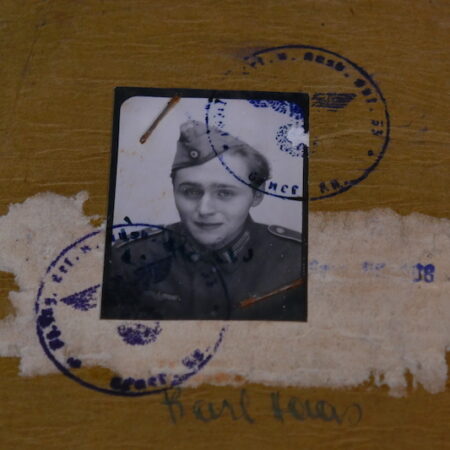
Original WWII German Army Soldbuch – Obergefreiter Karl Haas – 353 Infanterie Division – Siegfried Line – POW – EK2 – West Front
Soldbuch issued to Karl Haas in October of 1942. Non-Regulation Photo with Side Cap! Served in the following frontline units: Reserve-Grenadier-Bataillon 208 On October 20, 1942, the battalion was divided in Nancy into an Infantry Replacement Battalion 208 and a Reserve Infantry Battalion 208. From that day on, the replacement battalion was subordinate to Division 462. The reserve battalion was subordinate to the 182nd Reserve Division after its formation. The two battalions were renamed Grenadier Replacement Battalion 208 and Reserve Grenadier Battalion 208 on November 7, 1942, respectively. The replacement battalion was relocated to Metz on December 3, 1942. The Reserve Grenadier Battalion 208 was relocated to Versailles near Paris on September 14, 1943. Grenadier Regiment 226 – 79 Inf Div – Later 79 VGD On January 31, 1944, the 1st Battalion of the 731st Grenadier Regiment of the 711th Infantry Division (15th Wave of World War XII), which had already been relocated from west to east in October 1943, was incorporated as I./G.R.226. On July 7, 1944, I./G.R.226 was replaced by the 1st Battalion of the 993rd Grenadier Regiment of the 278th Infantry Division (22nd Wave of World War XII from Italy). The 2nd Battalion of the regiment was disbanded in the summer of 1944, leaving G.R.226 to consist of the 1st and 3rd Battalions. At the end of August 1944, the regiment was again defeated in the Jassy Pocket. A few smaller groups managed to break through to Hungary via the Capes. On October 27, 1944, the Grenadier Regiment was re-established with the 1st and 2nd Battalions as part of the formation of the 79th Volks-Grenadier Division. November 1944 – Festungs Pak Kompanie 1/XIII The headquarters of Fortress Anti-Tank Unit XIII was established in December 1944 in Straubing in Wehrkreis XIII. In February 1945, the headquarters in the west was destroyed and reorganized in March 1945 by renaming it the headquarters of Fortress Anti-Tank Unit XXII. Between December 1944 and January 1945, the 353rd Infantry Division operated as part of the LXXXI Army Corps at the Westfall defensive fortifications (Allied parlance: “Siegfried Line”), where it launched a major counterattack on 2 December, which was eventually beaten back by U.S. artillery. The 353rd Infantry Division was eventually trapped in the Ruhr Cauldron, where it went into American captivity around April 1945.[1] The division’s final commander was Colonel Kurt Hummel, who assumed command on 15 February 1945. Equipment – K98, P38 Pistol (Likely as MG Gunner) Injuries – Wounded in June 1943 – Grenade Splinter in the buttocks left side, found fit for service in May of 1944. Awards – Wounds Badge in Silver, Iron Cross Second Class, Iron Cross First Class (No stamp but looks good for the time 2.1945).
-
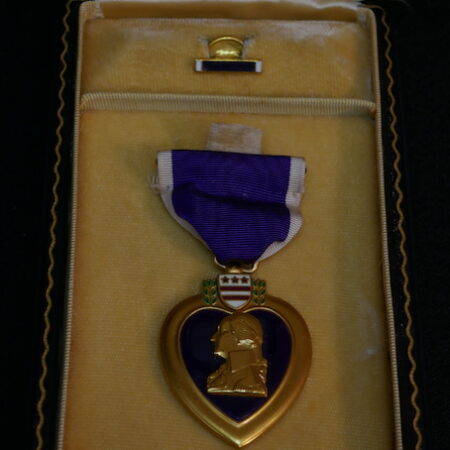
Original WWII US Army Cased Purple Heart – JAMES CONNERS PA – Anzio
An original complete WW2 cased Purple Heart medal. The medal comes in its original case of issue together with its ribbon bar and lapel pin. Found as is, this Purple Heart had a piece of paper in the front stating: JAMES CONNERS, PALOWALTO PA – Wounded during invasion of Anzio Died of Wounds Received Post War. 290
-
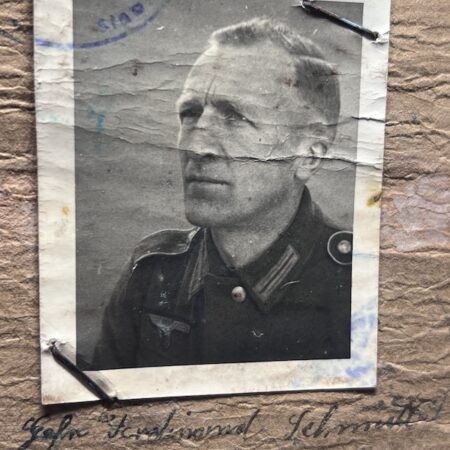
Original WWII German Wehrmacht Soldbuch – Obergefreiter Ferdinand Schmidt – Grenadier Regiment 861
Original WWII German Wehrmacht Soldbuch Obergefreiter Ferdinand Schmidt Grenadier Regiment 861 – 341 Infanterie Division The Soldbuch is incomplete! Seems he was assigned from January 1945 with the above unit: On December 2, 1944, the division’s command post was located in Püttlingen. On December 4, 1944, the division still had a combat strength of 2,600 men, including 800 infantry. A report from Army Group G dated December 6 stated: “Composed mainly of untrained Luftwaffe soldiers and stragglers; due to poor weaponry, low combat value, unsuitable for large-scale combat. During the night of December 8, 1944, the division withdrew to the Fenne-Klarenthal-Petite Rossel line on the Saar. It remained quiet there for the following days. From 11 p.m. on December 31, the division participated in Operation “Nordwind,” the German offensive in Alsace and Lorraine. By morning, the division had captured Schaffhausen, the forest east of Werbeln, and the settlement 1 km east of Ludweiler. On January 2, the heights southwest of Wehrden were taken. The division then remained in the positions it had reached as flank protection for the 1st Army. From February 1945, there was increased fighting and heavy casualties in the division’s area south of Saarbrücken on the Spichern Heights. Artillery bombardment. In the battle for the West Wall positions in this area, the division suffered heavy losses in the following weeks. On March 2, 1945, the division was relieved by the 559th Volksgrenadier Division and relocated behind the front line. During the night of March 13, 1945, the 347th Infantry Division relieved the 559th Volksgrenadier Division in its sector of the front. The division initially relocated its command post to Fischbach. Here, it was within the firing range of long-range American artillery. On the afternoon of March 13, the command post then relocated to Wahlscheid. The enemy remained quiet in the entire division sector for the next few days. During the night of March 18, 1945, the division withdrew to the Püttlingen-Völklingen line. The Americans only hesitantly followed the retreat of the division and the entire LXXXV. The division was then reunited near Homburg. the Saar and northeast of the city. During the night of March 20, 1945, the division received orders to withdraw to Homburg and secure the Vogelbach-Homburg line against any American forces attacking from the north. Following on the right, the 719th Infantry Division was to assume security on both sides of Landstuhl. The division’s command post was located in Bildstock. On March 20, 1945, the LXXXV Army Corps received orders to secure the northern flank of the XIII SS Army Corps, which was deployed in the west of the Palatinate Forest, with the weak remnants of the 347th Infantry Division, the 719th Infantry Division, and the 19th Volksgrenadier Division. The three divisions engaged in hard and heavy fighting against vastly superior American forces between March 20 and 22, 1945. The 347th Infantry Division defended a section southeast of Homburg. The division was gradually pushed back and finally received orders to fight its way through the Palatinate Forest. The bulk of the 861st Grenadier Regiment and parts of the 347th Artillery Regiment were unable to retreat to the Vogelbach-Homburg area and were taken prisoner. The 860th Grenadier Regiment and the remnants of the 36th Reserve Grenadier Regiment / 880th Grenadier Regiment under its command were able to break away from the enemy and establish a new security line in the Homburg area by March 20. The divisional command post had been relocated to Knopp, about 12 km east of Homburg. On the evening of March 20, the 347th Infantry Division received orders to withdraw to the western edge of the Palatinate Forest during the night of March 21 and to secure the entrance to this forest area on both sides of Steinalben. secure. The command post was to be relocated to Johanniskreuz. Upon arrival at the eastern edge of the Palatinate Forest the following day, the division came under the command of the XIII SS Army Corps. Because the retreat roads were blocked by units of the 17th SS Panzergrenadier Division, numerous elements of the division were taken prisoner by the Americans. The division’s command post was initially set up in Eschbach and relocated to Bornheim, east of Landau, on the afternoon of March 21. The division received new orders to assemble its remnants east of Landau. However, as early as March 22, 1945, the division received orders to secure the Westheim-Oberhochstadt line, about 11 km northeast of Landau, with its remaining remnants. There was no longer any connection to the left or right. The division’s command post was in Zeiskam that day and relocated to Mühle, about 3 km south of Nieder-Lustadt, that evening. On March 23, the command post was in Nieder-Lustadt. At nightfall on April 23, the division moved to the area west of Germersheim. Retreated and secured the Rhine crossing there. The command post relocated to the barracks in Germersheim. All of the division’s remaining vehicles were transferred to the east bank of the Rhine. To support the Germersheim bridgehead, the 4th Engineer Bridge Training and Replacement Battalion and the 308th Panzer Grenadier Replacement and Training Battalion were placed under the division’s command. On March 24, heavy fighting broke out around Germersheim, during which the division headquarters was almost completely eliminated by artillery fire. The division commander acted as commander of the Germersheim bridgehead that day. That evening, the division crossed the Rhine over the bridge near Germersheim. Rear troops remained in the bridgehead on the west bank until the following morning. However, the division was thus destroyed. The remaining Grenadier Regiment 860 was subordinated to the 2nd Mountain Division, and the divisional headquarters and Signals Detachment 347 were deployed to the 7th Army. The Grenadier Regiment 860, along with all remaining elements of the division, was finally incorporated into the 47th Volksgrenadier Division on March 27, 1945. By April 12, 1945, the headquarters of the 347th Infantry Division had been re-established. It assumed command of the southern sector of…
-
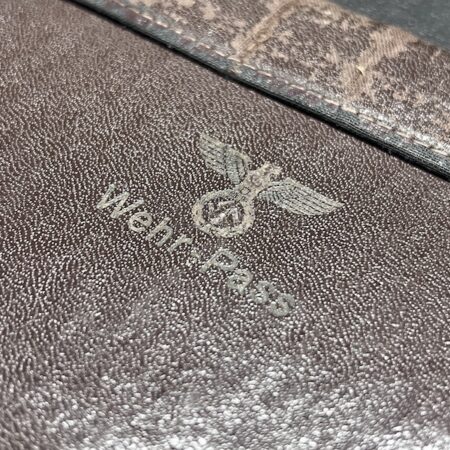
Original WWII German Wehrpass Leather Pouch
Here we have a Wehrpass Pouch Still closes although one side seems to be busted.
-
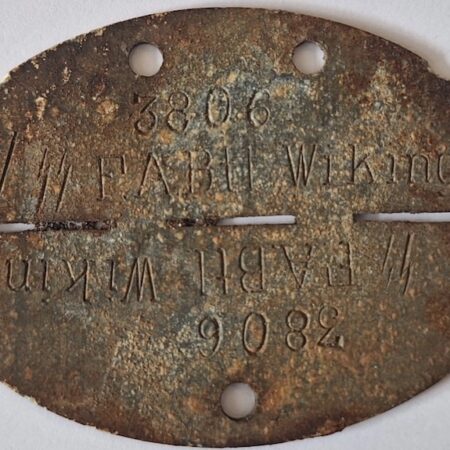
WWII German Waffen SS Dog Tag – Erkennungsmarke – SS Division Wiking – Found in Ground – Original
Really interesting, original Dog Tag for a member of the Feld Ausbildungs Batl of the the Wiking. Found in this year in the ground. Price includes Shipping World Wide
-
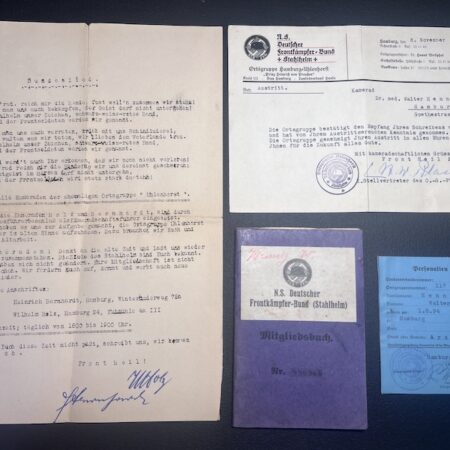
WWII German N.S Stahlhelm Bund Grouping – Dr Hennig -Hamburg – Rare Early ID Set!
Dr Walter Hennig born in 1894 in Hamburg. Served in WW1 as an Oberleutnant from 1914 till 1920! He was awarded the Following Awards: Iron Cross Second Class Iron Cross First Class Schaumburg-Lippe Cross The Hanseatic Cross KuK Military Cross Wounds Badge – Wounded Twice in WW1 He fought in France, Romania, Italy and Russia with the following unit: The Westfälisches Jäger-Bataillon Nr. 7 (7th Westphalian Jäger Battalion) of the Imperial German Army played a significant role in World War I, fighting on both the Eastern and Western Fronts. Initially part of the XX Army Corps, the battalion saw action at the Battle of Tannenberg on the Eastern Front before transferring to Italy and then the Western Front in 1918. The battalion was known for its elite status and experience in mountain warfare, having fought in various theaters including the Vogesen, Alps, and Karpathans. Here’s a more detailed look at the battalion’s involvement in WWI: Formation and Early Service: The battalion was formed in 1815 and saw action in the Franco-Prussian War and other conflicts before WWI. In 1914, it was garrisoned at Ortelsburg (modern Szczytno, Poland) and was part of the XX Army Corps. Eastern Front: The battalion initially served on the Eastern Front, including notable engagements like the Battle of Tannenberg. Shifting Fronts: In 1917, the battalion was transferred to Italy, and in the spring of 1918, it was moved to the Western Front. Elite Status and Training: Jäger battalions were considered elite units within the German Army, known for their training and experience in mountain warfare and raiding tactics. They were often used as assault troops and to revitalize sectors occupied by older troops. Distinctive Features: The 7th Jäger Battalion, like other Jäger units, was typically commanded by younger officers compared to their infantry counterparts. In 1932 he joined the NS Stahlhelm Bund, with Sturm 22 as the Doctor he left the NS Stahlhelm Bund in 1935. The documents are unique, as finding any higher ranks for the Stahlhelm Bund is nearly impossible, the books are usually nearly empty or have no photo. In this case, there is the NS Deutscher Frontkämpfer Bund ID with Uniformed picture.


