
Showing 613–621 of 1181 resultsSorted by latest
-

-

WWI German Silver Ring – Verdun 1916 – Original Period Ring
An original period WW1 Verdun Ring, hallmarked Silver.
-

WWII Soviet Red Star – Large Wartime Two Piece – Near Mint – Headgear
Original star, two piece wartime construction this model is getting harder and harder to find. This is the large version at over 3CM
-

WWII SS Soldbuch – Ludwigshafen SS Police – Meister der Schutzpolizei Ludwig Reimer – Police – Schupo – (Sold)
Nice not often seen issue of the SS Soldbuch for Police. Reimer was a WW1 Veteran and he can be seen in his uniform wearing a medal bar. He served in Ludwigshafen with the Schutzpolizei. The Schutzpolizei des Reiches or the Schupo was the state protection police of Nazi Germany and a branch of the Ordnungspolizei. Schutzpolizei is the German name for a uniformed police force. The Schutzpolizei des Reiches was the uniformed police of most cities and large towns. State police departments were in charge of protection police, Kripo criminal investigation divisions (Kriminalpolizei), and administrative police. The state protection police comprised a patrol branch, barracked police, traffic police, water police, mounted police, police communications units, and police aviation. Policemen were required to have previous military service, good physical and mental health, Aryan descent and membership in the Nazi Party.
-

WWII Soviet Medal for Courage – ЗА ОТВАГУ – With Archive Research -Belobrovets Kirill Maksimovich – Anti Tank Rifle Gunner – Ukrainian (Sold)
Belobrovets Kirill Maksimovich Ukrainian, born in 1909 Action for the Medal: – 1496816 The gunner of the anti-tank gun of the 2nd artillery battalion of the Red Army soldier Belobrov Kirill Maksimovich for the fact that in the battle in the Maurice Ludush area on September 14, 1944, he destroyed the enemy from his anti-tank weapons, which prevented the advancement of our infantry, thereby allowing the infantry to move forward.
-
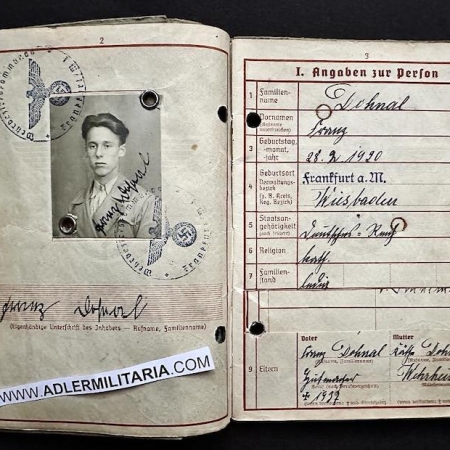
WWII German Wehrpass – Gefr Franz Dohnal – Wounded in Combat in Cholm – Infanterie Regiment 430 ( 129. Infanterie-Division) x 4 Medals
Gefreiter Franz Dohnal, Awards: Wounds Badge in Black – 12.1941 (Cholm) Grenade Splinters in left shoulder and back – interestingly he was wounded again, Wounds Badge in Silver – July 1943 – Grenade Splinter left arm and was suffering from Diphtheria. Westwall Medal – For RAD Service Eastern Front Medal Infantry Assault Badge and Iron Cross Second Class – June 1942 Service: Dec 1940 till November 1941 – Infanterie Regiment 430 and 03.43 – 08.43 – Grenadier Regiment 430
-

WWII German Soldbuch Medal Grouping – Obefr Helmut Hannig – Das Verdienstkreuz – Wehrmacht-Nachrichten-Kommandantur 301 – Sofia – DRK Set (Sold)
Soldbuch to Helmut Hannig in 1939, seems he served with Wehrmacht-Nachrichten-Kommandantur 301 in Sofia. Other IDs include for his family members a German Red Cross ID Wartime issued in 1944, along with her post war CDU Membership papers. Also includes a set of paperwork relating to a married in relation and his death certificate and his daughters Drivers licence. Cross of Merit with Band – originally issued to the Soldbuch Owner Helmut Hannig in 1993. With document these medals are hard to find. Strange set but very interesting with the postwar medal. The Cross with matching document is worth around 350/400 Euro. Priced to sell
-

WWII German Father & Son Set – Wehrpass KIA – Obgefr Heuser – Infanterie Regiment 278 (95 Infanterie Division) – Regiment History Online (Sold)
Wehrpass issued to W.Heuser, served with IR 278 (95 Inf Div) According to the archives, Heuser was killed by a direct hit on his position with artillery. Lot comes with his fathers train drivers ID for the German Railway : Reichsbahn Medals: Infantry Assault Badge – Jan 1942 Eastern Front Medal – Sept 1942 IR 278 Diary – https://www.lexikon-der-wehrmacht.de/Gliederungen/Infanterieregimenter/IR278-R.htm On July 4, the regiment began the advance east. July 6th Luck and July 8th Klewan. In the evening hours of July 10, the regiment reached the area west of Tuczyn on the Horyn. On July 14, the 95th Infantry Division replaced the SS Leibstandarte in the Sokolow section – where the Bialka flows into the Tenja. The detachment took place in the course of a counterattack by the division, since its own lines had been breached by a Russian counterattack. The regiment’s II Battalion reached the northern edge of the forest 2.5 km northeast of Sokolov at 17.30. In the evening hours, the 278th Infantry Regiment reported that its 5th Company was stuck in front of the forest north-east of Sokolow, facing west and was receiving fire from the forest. On July 16, the III. battalion of the regiment in the morning to Tynia / Cebrynka). On July 17, at 2:20 p.m., II Battalion pushed the crossroads north of Zubrynka. The place itself was taken around 3 p.m. The III. Battalion had advanced to the area around Alexandrowka. After taking Zubrynka, the 95th Infantry Division got possession of a bridge crossing over the Irszyca and advanced rapidly further north. The III. The battalion reached Alexandrovka and the regiment’s engineer platoon reconnoitred Pashinka at around 4 p.m. On the night of July 18, the 95th Infantry Division and the regiment were stopped at the positions they had reached. The regiment was withdrawn from the front and transferred to the Wilsk area. The regiment moved into quarters north of the Zhitomir – Wilsk line. On July 25, the regiment began moving to the Dedovshchina – Ozeriani area, which was reached on July 27. From here the deployment of the 95th Infantry Division against Greater Kiev began. Around noon on July 30, the regiment reached Grebjenki with forward parts. On July 31, the regiment continued its advance and at 10.30 reached the area 1 km from Deremisna. On July 31st the regiment crossed the Stugna. By nightfall, the 278th Infantry Regiment on the right, with one battalion, had crossed the Stugna north of Sloboda, the 279th and 280th Infantry Regiments with 3 and 2 battalions respectively, had crossed the river and positioned themselves just north of the crossing point for the night to defend themselves. During the night the bridgehead was extended to Velikiye Dmitrovichi, Velikaya Bugayevka Street. On August 1st the regiment attacked in the direction of the Weta. Heavy fighting broke out on the Weta on August 2nd. On August 4th the regiment was brought forward to the Weta to force the transition here. On August 5, the German attack across the Weta began. After heavy artillery preparation, the regiments of the 95th Infantry Division attempted to cross the Weta, which they managed to do by the evening. On August 6, the fighting in front of the regiment abated somewhat. The 1st Battalion of the 279th Infantry Regiment was in positions on the right wing of the Weta Front. II Battalion/IR 279 had pushed west past Lesniki and had gained some ground. The 1st / 280th Infantry Regiment followed, drawn far apart. At this time, the II. / 279th Infantry Regiment. The enemy used their air force all day long without being prevented from doing so by their own planes. The 278th Infantry Regiment was still stuck in front of a Russian bunker on the evening of August 6th. On August 5th and 6th the regiment lost 8 officers and 160 men. By the evening of August 8, it was possible to take the Russian bunker, thereby securing the regiment’s breakthrough. On August 10, the advance on Kiev was halted. The regiment received orders to clear the area east of Pirogovo and to secure the south-eastern part of Myschelovka. In the days that followed, combat activity abated noticeably. The regiment had suffered heavy casualties in previous offensive battles. On the night of August 20, the enemy succeeded in reconnaissance between the II and III. battalion of the regiment to break into the positions. The head of the 10th company, Oberleutnant Weinhold, fell in the subsequent counterattack. The following days were relatively quiet. On the night of September 16, the regiment moved into staging areas for the final attack on Kiev. The regiment advanced through Khodosovka into the forest on both sides of the road south of Pirogovo and kept the 1st Battalion close so that it could later be used to clean up Pirogovo. At first light on September 16, our own artillery opened fire and between 6:50 a.m. and 7:00 a.m. increased it to a barrage. The regiment stayed behind as the division’s reserve during the day. On September 17, the regiment was pushed into the front instead of the 280th Infantry Regiment. In the night of September 18, the regiment, together with the 279th Infantry Regiment, advanced to the southern edge of Myschelowka. At 11:50 a.m. the German fire began and lasted until 12:00 p.m. With the last barrage of fire, the regiment began to attack. At 12:19 p.m. Ju 87s rushed to the field positions that were still occupied. At 12.44 the regiment reached the Myschelovka – Kiev reached road. The regiment then advanced on Lisa Gora, which was part of the Kiev fortress belt. From the afternoon of September 18, the attack on the fortress of Lisa Gora began. The 280th Infantry Regiment, reinforced by the 1st Engineer Battalion 195, was to attack from the east, the 279th Infantry Regiment from the south and the 278th Infantry Regiment from the west. In addition, support from Stukas was promised again. Despite the use of…
-
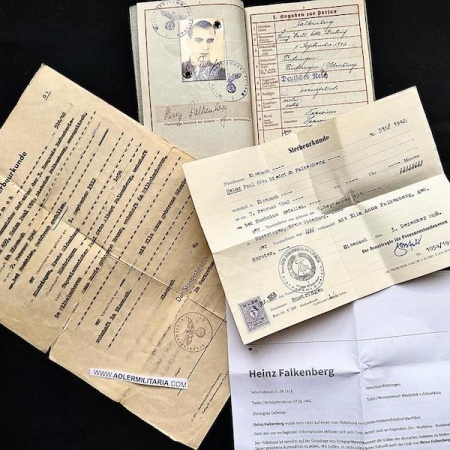
WWII German Wehrpass – Gefr Falkenberg – KIA – Infanterie Regiment 459 (251 Infanterie Division) – Battle for France 1940 -Killed in Action
Falkenberg was KIA in Russia with IR 459. Wehrpass with two death certificates and German Archive print out. 251 Infanterie Division At the start of the western campaign, the division advanced from the area south of Aachen to Liège, then fought its way through Lille to Bethune. The division then returned to Lille, where it was used as an occupation force. From July 1940 to April 1941 it was an occupation force in Brittany. Transferred to East Prussia in May 1941, the division advanced to Russia on June 22, 1941. She marched via Kovno to the Düna, which was crossed at Druja. Subsequently, the division continued the advance towards Polotsk, and then in August to Nevel. At the beginning of the advance on Moscow, the division reached the area around Dubno and Kalinin. Here the division was hit by the Russian winter offensive and had to withdraw. She withdrew to the Rzhev area, where she fought in February 1942 near Monchalowo and Warsowo. Bei Beginn des Westfeldzuges marschierte die Division aus dem Raum südlich von Aachen auf Lüttich vor, kämpfte sich dann weiter über Lille bis Bethune. Anschließend kehrte die Division nach Lille zurück, wo sie als Besatzungstruppe eingesetzt wurde. Von Juli 1940 bis April 1941 lag sie als Besatzungstruppe in der Bretagne. Im Mai 1941 nach Ostpreußen verlegt, stieß die Division ab dem 22. Juni 1941 nach Rußland vor. Sie marschierte über Kowno zur Düna, die bei Druja überschritten wurde. Anschließend setzte die Division den Vormarsch in Richtung Polozk und dann im August nach Newel fort. Bei Beginn des Vormarsches auf Moskau erreichte die Division das Gebiet um Dubno und Kalinin. Hier wurde die Division von der russischen Winteroffensive getroffen und mußte sich zurückziehen. Sie wich in den Raum Rshew zurück, wo sie im Februar 1942 bei Montschalowo und Warsowo kämpfte.


