
Showing 586–594 of 1164 resultsSorted by latest
-
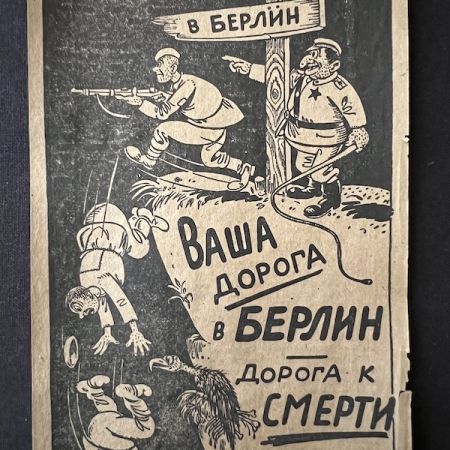
WWII German Propaganda – For Red Army Soldier – Berlin 1945 – Rare
This is a very odd one, but depicting a sign to Berlin, is a sign of death. A rarer German one.
-
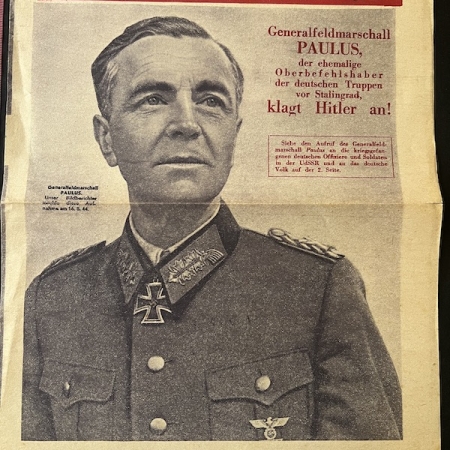
WWII Red Army Propaganda – For German Soldiers – Generalfeldmarschall Paulus – Stalingrad – Front IIlustrierte – August 1944 – Mega Rare (Hold)
WWII Red Army Propaganda – For German Soldiers – Generalfeldmarschall Paulus – Stalingrad – Front IIlustrierte – August 1944 – Mega Rare Comments: this is an incredible item for a frame. Depicting German Officers and Generals in Soviet captivity and tries to undermine the German Soldier. I have not seen another of this edition, and editions of this Front newspaper propaganda are highly sought after propaganda due to the artwork.
-
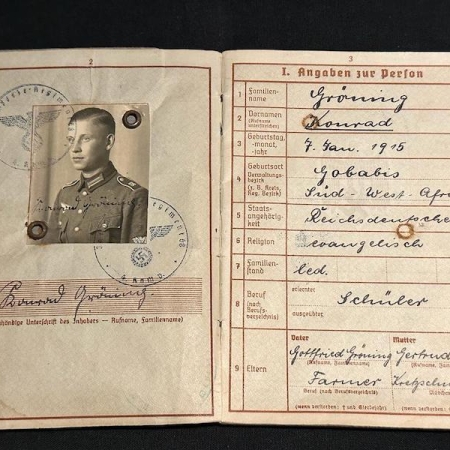
WWII German Wehrmacht Wehrpass – Oberfeldwebel Gröning – Grenadier Regiment 220 (58 Inf Div) – Born in Africa – Killed in Riga Offensive – Ergli 1944 – Super rare Volksdeutsche (Reserved)
A very interesting Wehrpass to Konrad Gröning born in Africa (Gobabis, South West Africa) in 1915. Joined as a volunteer in November of 1934 and resided in Berlin RAD Service – Berlin 1934 – Infanterie Regiment 8 (Machine Gun Company) It seems then he spent some time in various training and Luftwaffe units until June of 1943, 06.1943 – 02.1944 – Jäger Regiment 17 L – 02,1944 – 04.1944 – Grenadier Regiment 377 4.1944 – 08.1944 – Grenadier Regiment 220 – 58 Inf DivisionThe 58th Infantry Division was encircled and divided into battle groups and had to fight its way free. In the area of Wesenberg, the regiment was assembled and refreshed. The regiment was deployed again in February 1944. The regiment came to the Sirgalala Plains and was briefly attached to the 170th Infantry Division. The regiment came to Reval, where it served as a reserve unit for various divisions. On July 17, the regiment was transferred by rail to Dünaburg and from there marched towards Rokiskis. After a short, hard fight, the place can be conquered. From July 25, the regiment dug in here for defense. But on August 7th the town had to be evacuated again and retreat west towards Friedrichstadt. It then turned north into the wooded area north of Pukini. On August 10, the regiment was then pushed into the front at Memelbogen near Pecekalene. Medals: Wounds Badge in Black , War Merit Cross 2nd Class Trained on: MG08, K98, Luger P08, MG13, Handgrenade 24, MG0124, Mg 15, Promoted to Oberfeldwebel – 10.1942 He was killed in the Riga Offensive in August of 1944. Buried at the side of the road at Gut Samali on the main road Riga Madonas near Ergli. Although the German records say he is now buried as an unknown soldier in Riga Cemetery. Interestingly, we have for sale a set of Soviet Awards found in the same battlefield East of Riga. Comments: Super rare to find a Wehrmacht Soldiers Wehrpass born in Africa. Very nice example of a Wehrmacht Wehrpass, with uniform photo.
-
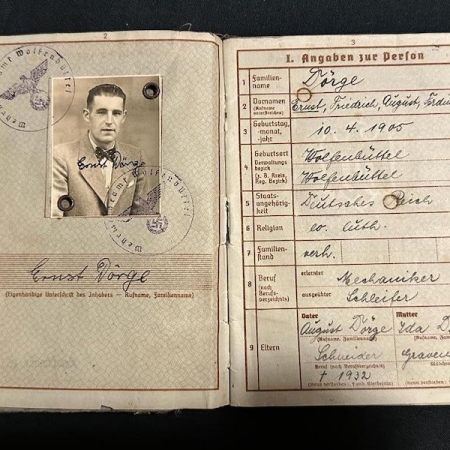
WWII German Luftwaffe Wehrpass – Gefr Dörge – 2cm Flak 30 – Flak Regiment 36 – Flak Regiment 7 – Poland 1939 (Sold)
$95.00Issued to Ernst Dorge, born in 1905 Nice battle for Poland 1939 Wehrpass for a Flak man. Noted is training on the 2cm Flak 30.
-
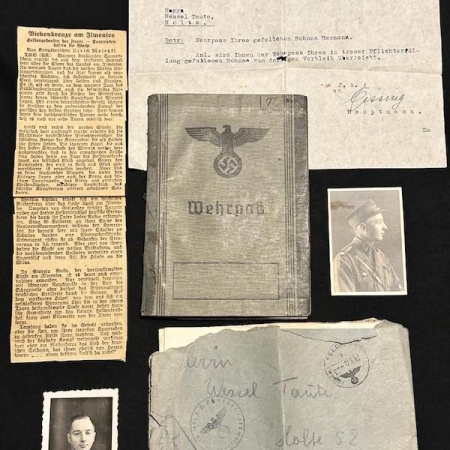
WWII German Wehrpass Grouping – Killed in Action – Oberschütze Taute – Infanterie Regiment 501 (290 Inf Div) – SA Portrait – (Offer Accepted)
KIA Grouping to Oberschütze Taute. Included is a letter dated 06.05.1942 – Death letter to father, states that the day before his son was hit in a fight in a forest. His comrades buried him A newspaper cut out describing the battles on the Ilmensee / Staraja Russa. Wehrpass from Taute Letter returning the Wehrpass to his father. SA Photo : small photo in SA uniform of Taute, and what looks to be a Soldbuch Picture of Taute. Inf Regiment 501 – 290 Inf Division In March 1941 the division then moved to East Prussia. She moved into a staging area in the Trappener Forest near Memel. After the start of the Russian campaign, the division broke through the Russian border positions on the Mituva River and took part in the fighting at the Kituriai bunker line. After advancing across the Dubysa and fighting with scattered Soviet tank and infantry units at Surviliškis-Kraakia, they took Dünaburg and then attacked via Sebezh, Rudnya, Ostrovo, Idriza, Pustoschka, Opochka, Velikoye Selo to the Staraya Russa area, where they reached positions on the Lowatj and the Pola. On January 9, 1942, the Soviet 11th Army made a breakthrough in the front area of the 290th Infantry Division south of Lake Illmen. The advancing Soviet 1st Guards Rifle Corps swung in a south-easterly direction at Staraya Russa in the rear of the X Corps and advanced in the direction of the Soviet 1st Shock Army, which had broken through south of Lake Seeliger, thereby closing the Demyansk pocket, in which the division was included. In March 1942, the division took part in “Operation Fallreep”, the opening of the pocket by the Seydlitz shock group. Im März 1941 verlegte die Division dann nach Ostpreußen. Sie bezog einen Bereitstellungsraum im Trappener Forst bei Memel. Nach dem Beginn des Rußlandfeldzuges durchstieß die Division die russischen Grenzstellungen an der Mituva und beteiligte sich an den Kämpfen an der Bunkerlinie von Kituriai. Nach Vormarsch über die Dubysa und Gefechten mit versprengten sowjetischen Panzer- und Infanterie-Einheiten bei Surviliškis-Kraakia nahm sie Dünaburg und griff anschließend über Sebesch, Rudnja, Ostrowo, Idriza, Pustoschka, Opotschka, Welikoje Selo bis in den Raum Staraja Russa an, wo sie Stellungen am Lowatj und der Pola erreichte. Am 9. Januar 1942 konnte die sowjetische 11. Armee im Frontbereich der 290. Infanterie-Division südlich des Illmensees einen Durchbruch erzielen. Das nachrückende sowjetische I. Garde-Schützenkorps schwenkte bei Staraja Russa in südöstliche Richtung in den Rücken des X. Korps ein und stieß in Richtung der sowjetischen 1. Stoßarmee vor, die südlich des Seeligersees durchgebrochen war, und schloss dadurch den Kessel von Demjansk, in dem die Division eingeschlossen wurde. Im März 1942 beteiligte sich die Division am “Unternehmen Fallreep”, der Öffnung des Kessels durch die Stoßgruppe Seydlitz.
-
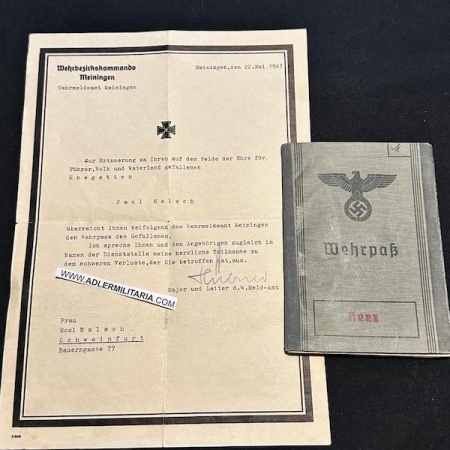
WWII German Wehrpass – KIA – Death Letter – Gefr Paul Malsch – Gebirgsjäger Regiment 85 (5 GJ Div) – Balkans – Wolchow – Schweinfurt
A sad set to Paul Malsch from Schweinfurt, Germany. Wehrpass, Letter returning the Wehrpass, not often found. Two newspaper cuttings about his death. It seems Malsch was hit several times by bullets in the neck, chest and body, he died in the aid station and he was buried in a field cemetery in Russia. See print out as he is on the KIA Lists. Service: Gebirgsjäger Regiment 85 In December 1941 the regiment left Crete to move to Salzburg and Tyrol. In mid-February 1942 it then rolled through Germany and the Baltic States to the area west of Leningrad. The regiment was housed in the Klopiny area. An attack on the Titansari, Lavansari and Seiskari skerries was planned in order to enclose Leningrad from the sea as well. But after the German failures in the winter of 1941/42, the mission was canceled and the regiment was used as a “fire brigade” on the front between the Neva and Volkhov. Im Dezember 1941 verließ das Regiment Kreta, um nach Salzburg und Tirol zu verlegen. Mitte Februar 1942 rollte es dann durch Deutschland und das Baltikum in den Raum westlich von Leningrad. Im Raum Klopiny wurde das Regiment untergebracht. Geplant war ein Angriff auf die Schären Titansari, Lavansari und Seiskari, um Leningrad auch von See her einzuschließen. Doch nach den deutschen Mißerfolgen im Winter 1941/42 wurde der Einsatz abgesagt und das Regiment als “Feuerwehr” an der Front zwischen Newa und Wolchow eingesetzt.
-
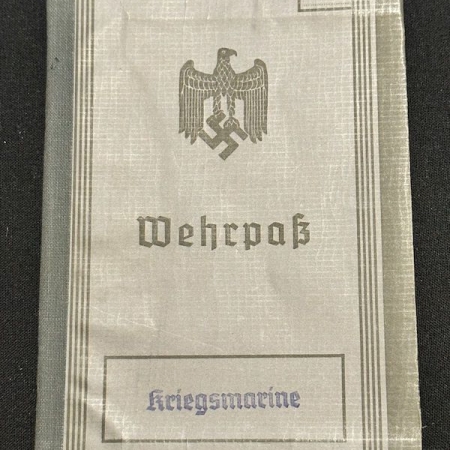
WWII German Kriegsmarine Wehrpass – Heinrich von Engel – Gorch Fock – KvK (sold)
Heinrich von Engel was onboard the Gorch Fock, a training vessel. Medals: KVK with Swords, and the Service medal
-
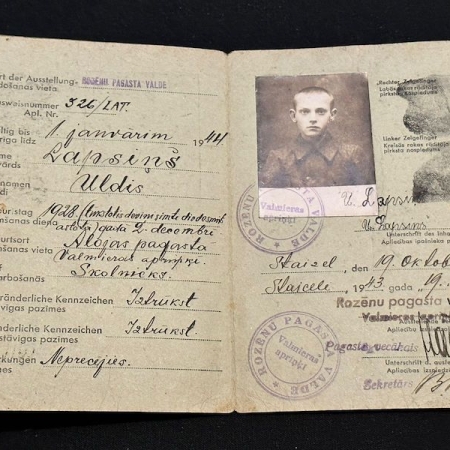
WWII German Issued Paperwork – Reichskommissariat Ostland – Personenausweis – Latvian National Uldis Lapsins – 1943 – Occupation Paperwork – Valmieras (sold)
A nice original issued Reichskommissariat Ostland identity papers for a young Latvian National from the area of Valmerias Not often found. The Reichskommissariat Ostland (RKO) was established by Nazi Germany in 1941 during World War II. It became the civilian occupation regime in Lithuania, Latvia, Estonia, and the western part of Byelorussian SSR. German planning documents initially referred to an equivalent Reichskommissariat Baltenland.[1] The political organization for this territory – after an initial period of military administration before its establishment – involved a German civilian administration, nominally under the authority of the Reich Ministry for the Occupied Eastern Territories led by Nazi ideologist Alfred Rosenberg, but actually controlled by the Nazi official Hinrich Lohse, its appointed Reichskommissar. Germany’s main political objectives for the Reichskommissariat, as laid out by the Ministry within the framework of Nazism’s policies for the east established by Adolf Hitler, included the genocide of the Jewish population, as well as the Lebensraum settlement of ethnic Germans along with the expulsion of some of the native population and the Germanization of the rest of the populace. These policies applied not only to the Reichskommissariat Ostland but also to other German-occupied Soviet territories. Through the use of the Order Police battalions and Einsatzgruppen A and B, with active participation of local auxiliary forces, over a million Jews were killed in the Reichskommissariat Ostland.[2] The Germanization policies, built on the foundations of the Generalplan Ost, would later be carried through by a series of special edicts and guiding principles for the general settlement plans for Ostland.[3] In the course of 1943 and 1944, the Soviet Red Army gradually recaptured most of the Ostland territory in their advance westwards, but Wehrmacht forces held out in the Courland Pocket until May 1945. With the end of World War II in Europe and the defeat of Germany in 1945, the Reichskommissariat ceased to exist.
-

WWII Waffen SS Soldbuch – SS Schützen Willi Kniess – Wounded in Action – Wounds Badge in Black (Sold)
SS Schütze Will Kniess from Bad Kissingen Germany. Member of the Waffen SS from August 1943 – Dog Tag: 7 Stamm Kompanie, SS Grenadier Ausbildungs und Ersatz Bataillon 4 – 2624 – The battalion was created in November 1943 by renaming the existing SS Grenadier Ausbildungs und Ersatz Bataillon 4, based in the city of Ede (Netherlands). At the end of November 1943, the battalion moved to the town of Wohlau (today Wołów, Poland), then in February 1945 it moved to Třeště. What is clear is that Kniess was wounded in action by a grenade fragment, 31b and would spend till February in various hospitals. For which he was awarded the wounds badge in black. Although we do not know what unit Kniess was with when he got wounded, could be found out with archive records. Nice insert to the Soldbuch stating that they are working on getting him a new picture. March 1945 – he is in Bad Tennstedt with the SS Kraftfahr Regiment , Gen.Komp. A nice SS for a display, super clean cover and would look good in a display.


