
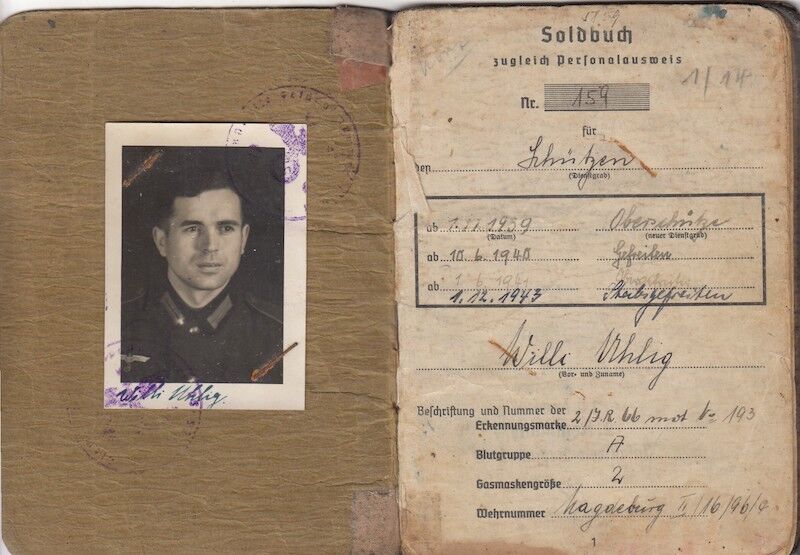
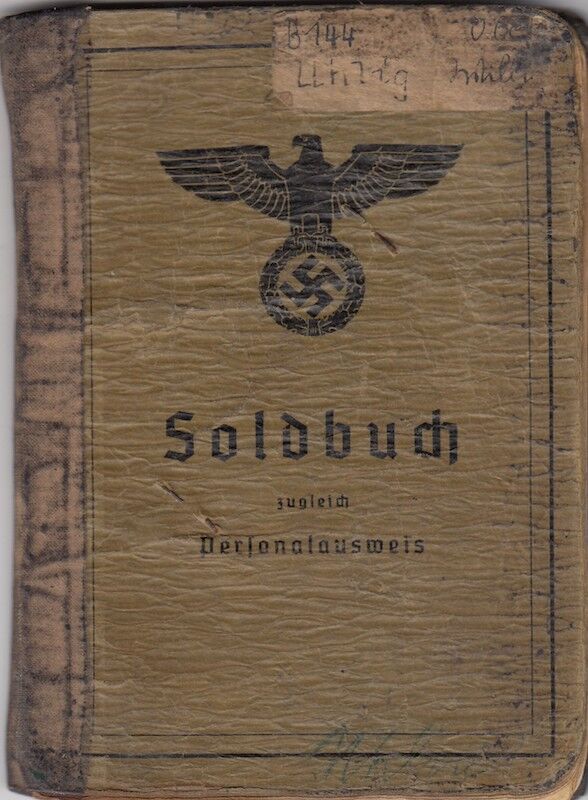
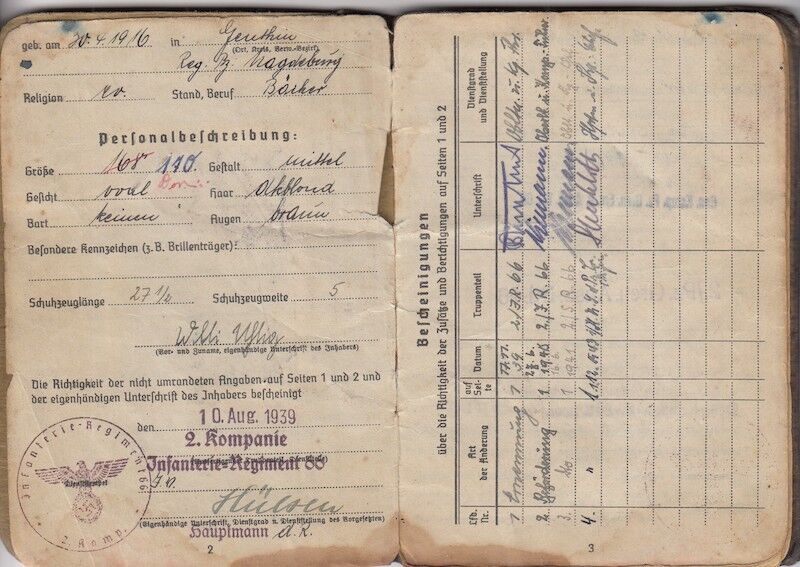
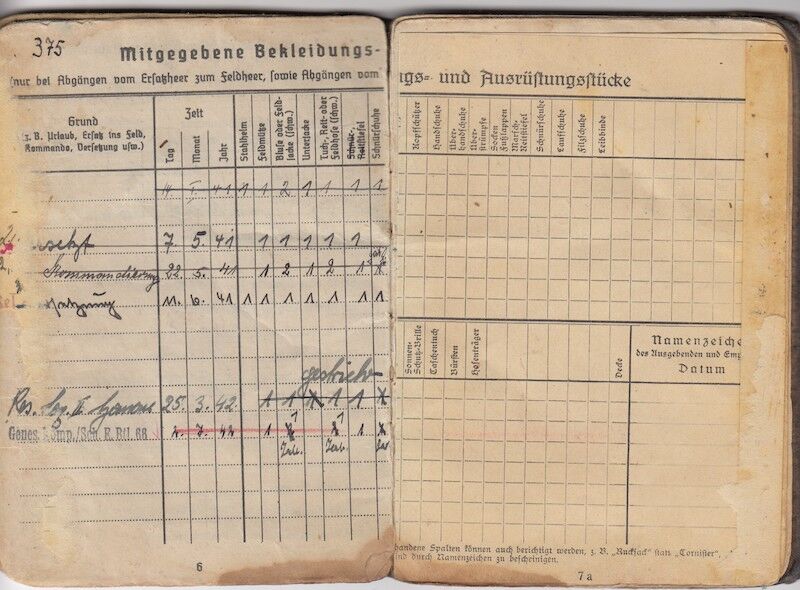
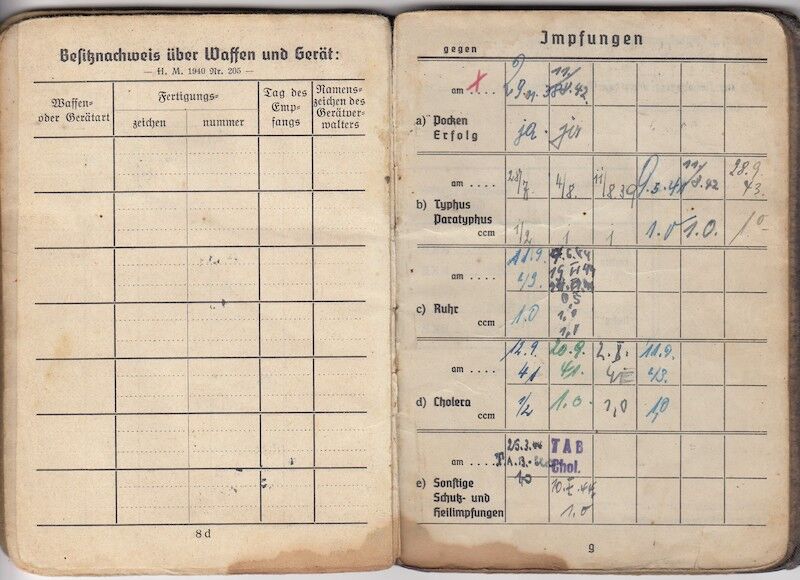
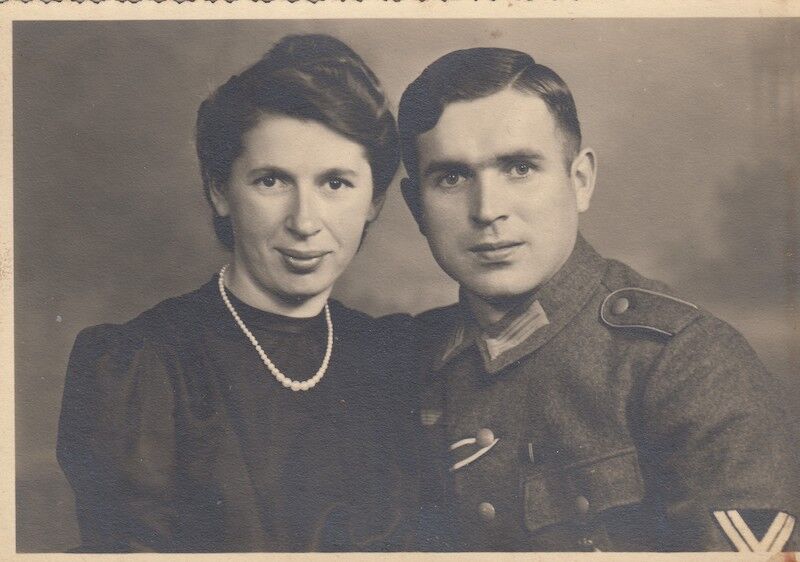
WWII German Wehrmacht Soldbuch – Stabsgefreiter Uhlig – Führerbegleit Brigade (FBB) – MP44 – Fought in battle of the Bulge at St Vith & Bastogne !!
Description
Willi Uhlig served in the German Army prior to the war starting.
He was in Infanterie Regiment 66 (13 Inf Division)
After the invasion of Poland on September 1, 1939, the regiment was still stationed in the Brieg area. It wasn’t until September 3, 1939, that the order was given to attack Poland. The regiment crossed the border and participated in the attacks on the Warta and Widawka river crossings, establishing bridgeheads across the river. After fighting around the Widawka position, the regiment advanced to the area south of Radom, where it engaged in skirmishes with Polish units. On September 13, 1939, the advance on Pulawy continued, which was reached the following day. Bridgeheads were established at Pulawy and Deblin, and from September 19, 1939, these bridgeheads were expanded, and reconnaissance operations were conducted east of the Vistula River. On October 2, 1939, there was further engagement with Polish units in the Kock area.
At the outbreak of war in the west, the 13th Infantry Division, as in Poland, remained in reserve and did not cross the border until May 13, 1940. On May 14, 1940, it reached Ettelbrück in Luxembourg. The regiment marched through Luxembourg, southern Belgium, and northern France to the Meuse River and participated in the defensive battles west of the Meuse near Sissonne. From May 20, 1940, it engaged in defensive battles in the Serre sector, and from May 22, 1940, it advanced to the Somme River and participated in defensive battles near Péronne and Corbie. The regiment was then deployed to the Doullens/Authie area and subsequently participated in the Battle of Dunkirk. Afterward, the regiment remained on the Channel coast as coastal defense until June 1, 1940. By June 6, 1940, the regiment had moved to its assembly area for the Battle of France in the Amiens bridgehead. Following the breakthrough battle on the Somme, the regiment was deployed north of Roye on June 11, 1940, and marched via Petit Morin to the Seine. This was followed by pursuit battles to the Langres Plateau and on both sides of the Côte d’Or. After attacks against the Western Alps, fighting took place on the upper Rhône and at Lac de Bourget. Following the armistice, the regiment assumed security duties near Coluz and began marching back to its garrisons on July 5, 1940. Upon reaching the garrisons on July 10, 1940, the regiment immediately began restoring operational readiness. As early as August 30, 1940, the regiment, along with the division, had to transfer to Vienna to serve as a training unit in Romania. On September 28, 1940, the III Battalion was disbanded, and the regiment was redesignated as Training Infantry Regiment 66. The regiment marched to its security and training area near Roman and Focsani. Following the severe earthquake in Romania on November 10, 1940, the regiment led the rescue and cleanup efforts.
Unit was renamed: Schützen Regiment 66 (13 Panzer Division)
Schützen Regiment 66 was formed on May 12, 1941. The regiment was created through the reorganization of Infantry Regiment 66. It remained subordinate to the 13th Panzer Division. Tactically, the regiment was subordinated to Rifle Brigade 13. The regiment was stationed in Upper Silesia and was transferred in June 1941 to its assembly area west of Hrubieszow. It was not until June 23, 1941, that it crossed the Bug River with the division. Rowno was captured by June 28, 1941, and the Stalin Line near Hulsk was reached on July 6, 1941. The line was breached by July 9, 1941, and the advance continued towards the Irpen River. Defensive fighting ensued there from July 11, 1941, and the advance to Fastow was not possible until July 20, 1941. A bridgehead was established there across the Unava River. Security battles ensued near Mironovka and Korsum. August 4th and 5th, 1941, were rest days before the regiment participated in security battles near Ivanovka and Dacha from August 6th, 1941. From August 19th, 1941, offensive battles took place in the Ssula sector, and on August 22nd, 1941, the regiment deployed to Dnipropetrovsk. Fighting around the city continued until the end of the month. After the heavy fighting, the regiment was withdrawn from the front and replenished south of Dnipropetrovsk. However, the replacements were far from sufficient to fill the gaps. From September 16th, 1941, the regiment moved to the assembly area and bridgehead of Kremenchug. From September 21, 1941, the regiment engaged in defensive battles along the Ssula River sector until September 24, 1941, when it launched another offensive towards Dnipropetrovsk as part of the Battle of Kiev. After the conclusion of the Battle of Kiev and a day of rest, the regiment marched to the Sea of
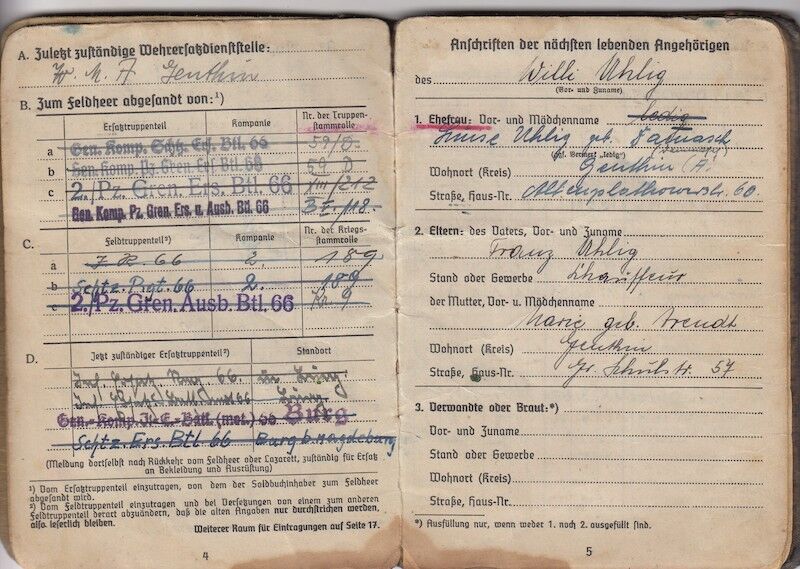
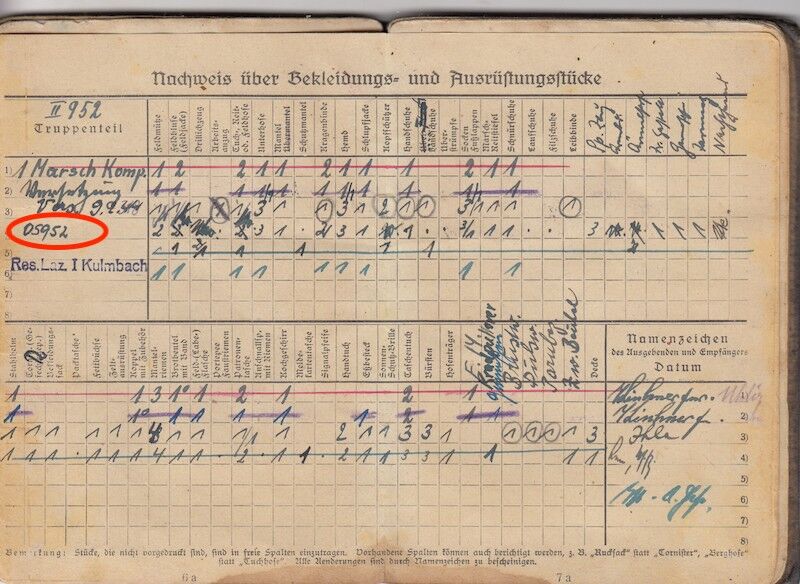
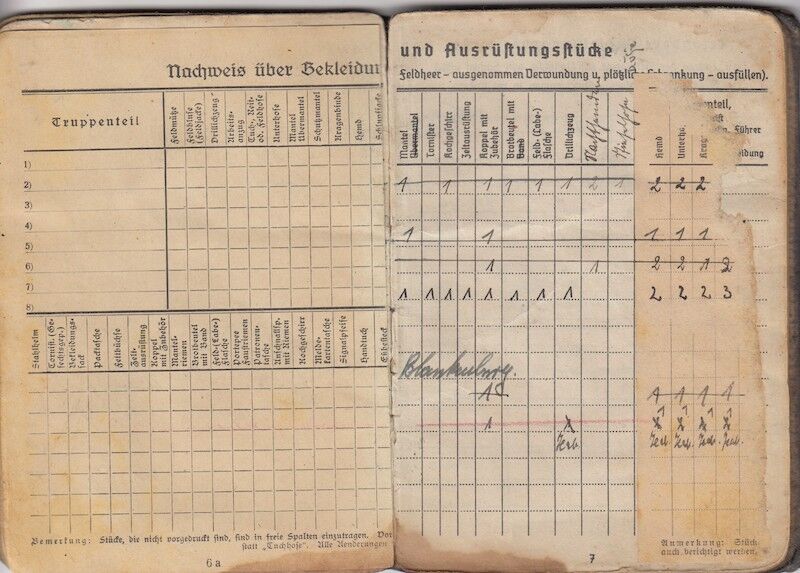
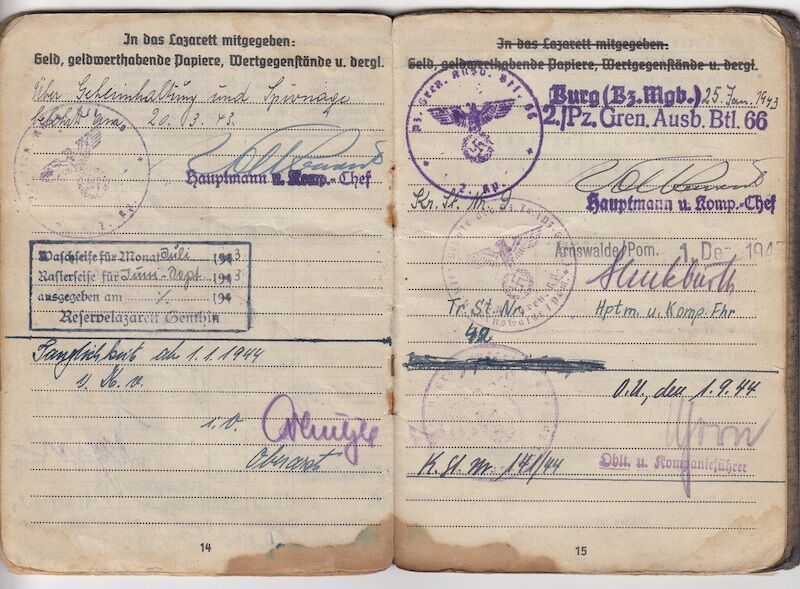
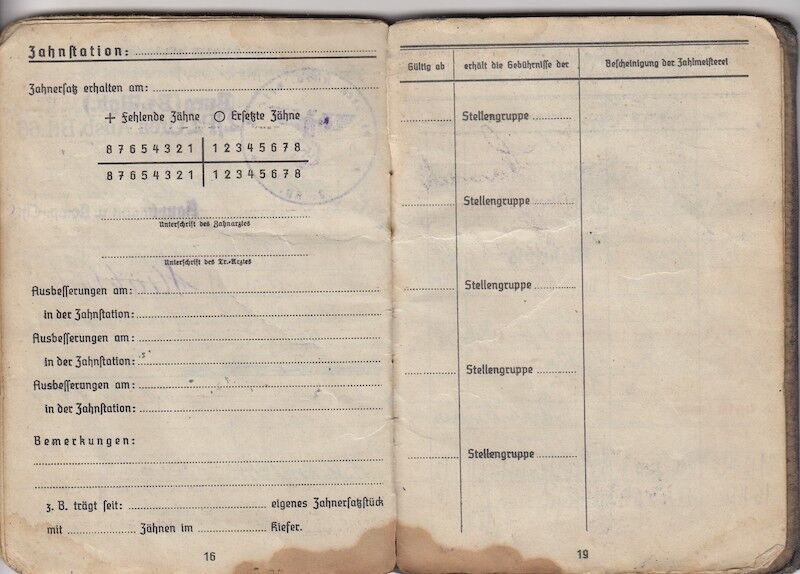
He was trying to hide his unit by removing page 17, although he did not hide his Feldpost Number: 05952
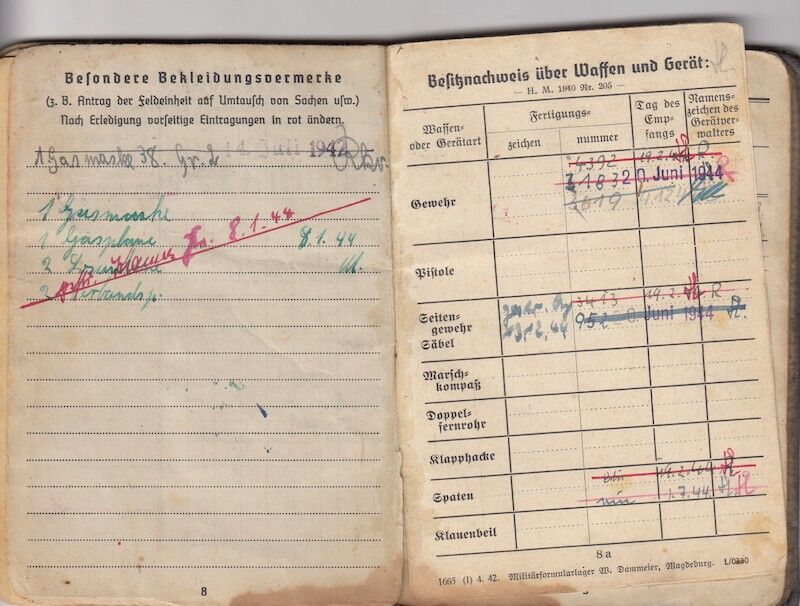
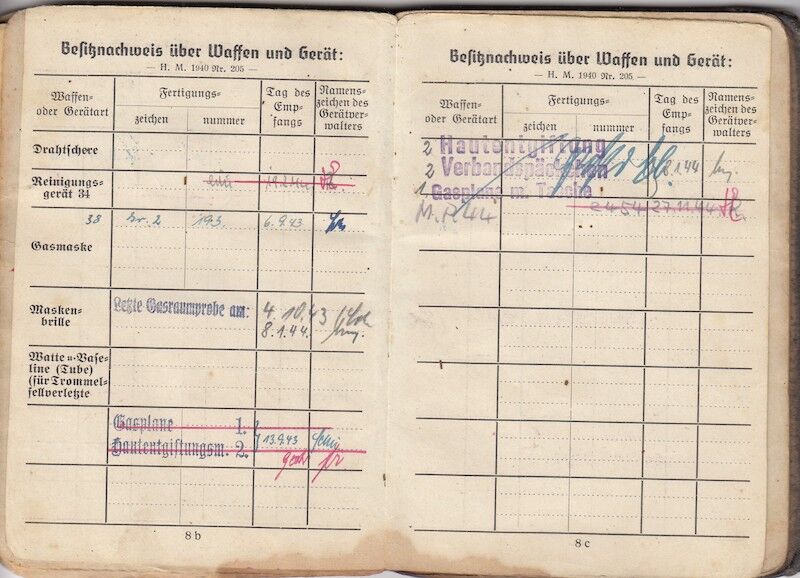
But on closer inspection he was assigned to the 6. Kompanie, Grenadier Führer-Grenadier-Brigade . He was issued many interesting items, including a MP44 in November 1944 as well as Iron Rations.
The Führerbegleit Brigade (FBB) was an elite German Army unit originally formed as a guard and escort force for Adolf Hitler. By late 1944, it had expanded into a combat formation and was committed to frontline operations during the Battle of the Bulge.
During the Ardennes Offensive in December 1944, the Führerbegleit Brigade was attached to the German Fifth Panzer Army under General Hasso von Manteuffel. Its role was to support the main German thrust through the Ardennes forest, helping exploit breakthroughs and reinforce advancing armored units. Despite being relatively well-equipped, including tanks and mechanized infantry, the brigade faced the same problems as other German units: poor weather, limited fuel supplies, and stiff American resistance.
The FBB participated in fighting around key locations such as Bastogne, where U.S. forces including the 101st Airborne Division held critical road junctions. Like many German formations, the brigade struggled to maintain momentum as Allied defenses hardened and supply lines faltered.
By early January 1945, as the offensive stalled and Allied counterattacks intensified, the Führerbegleit Brigade was forced to withdraw along with the rest of the German forces. The failure of the Ardennes Offensive marked one of Germany’s last major attempts to regain the initiative on the Western Front, and the FBB suffered significant losses in the process.
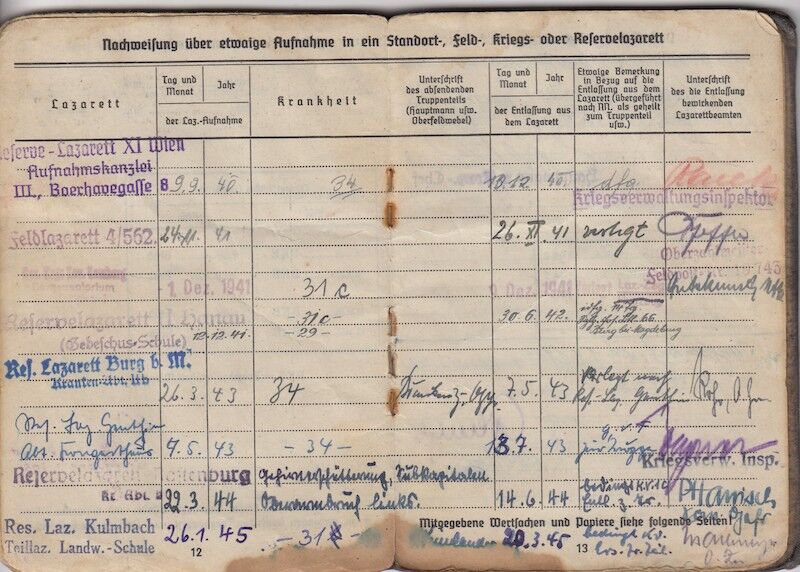
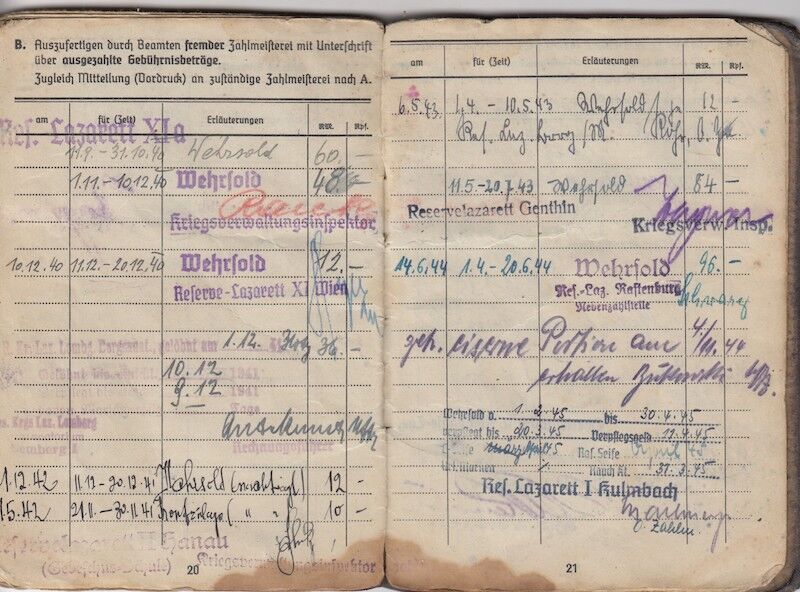
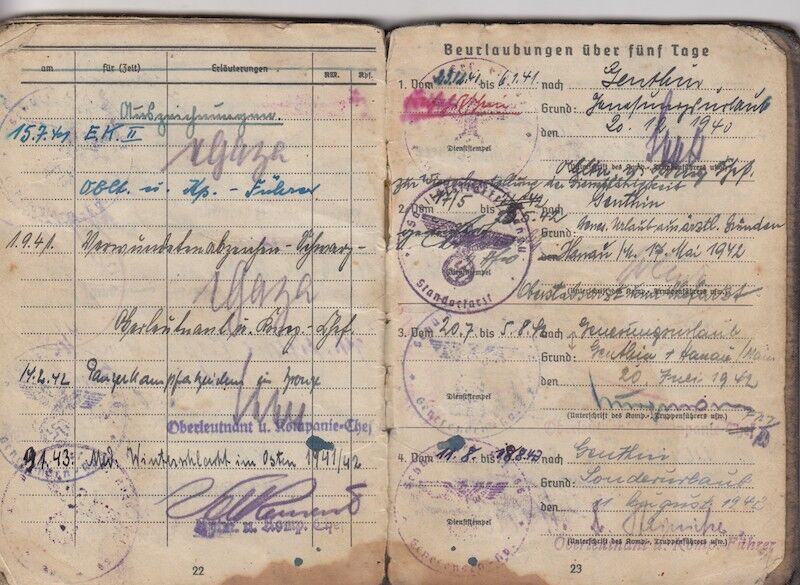
Hospital stays: he was suffering from an Accident (34) in 1940, in 1941 winter he arrived in hospital again with (31c) Burns.
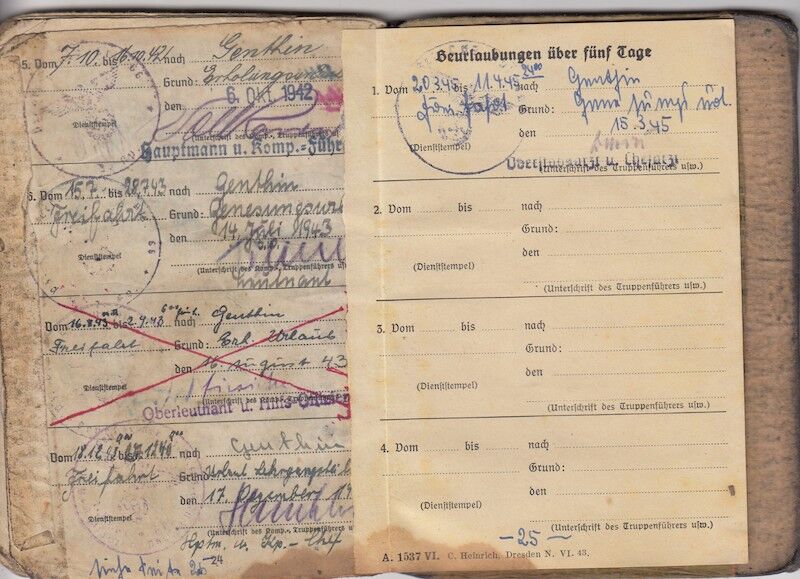
He was wounded with his last unit on the 26.1.1945 and stayed in hospital till late March of 1945. (31)
Awards: Iron Cross Second Class, Wounds Badge in Black, Panzer Assault Badge in Bronze, Eastern Front Medal.


